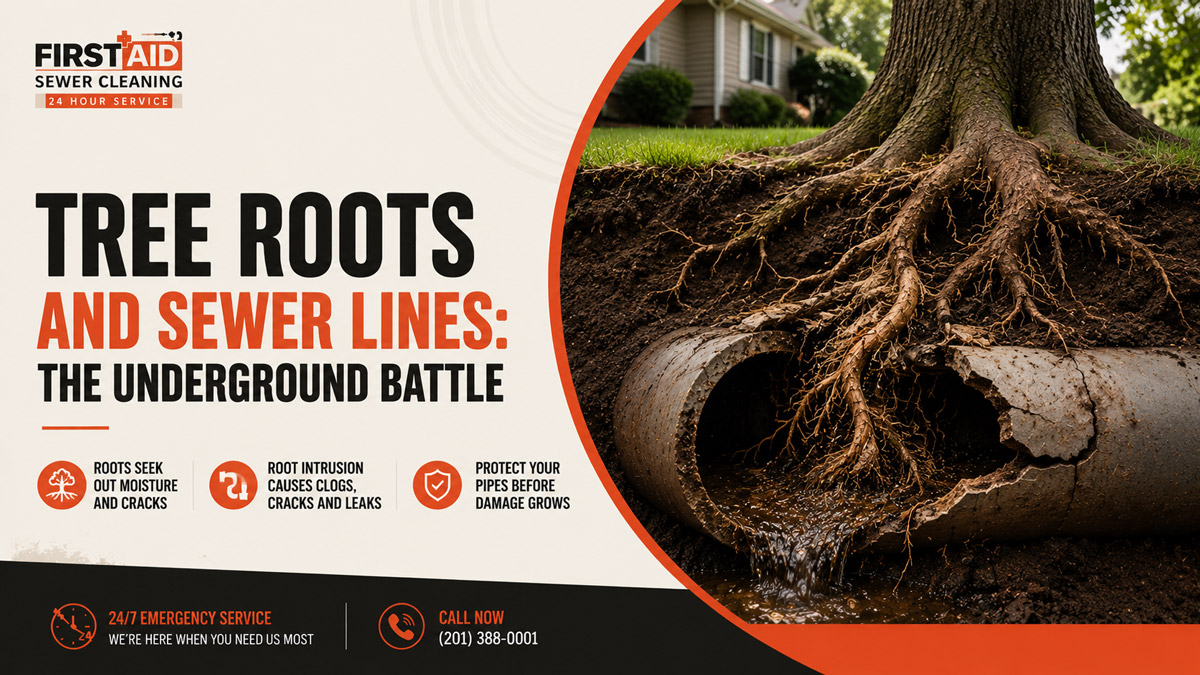
Tree roots and sewer lines are natural enemies with an unfair fight: the roots always win unless the line is protected. Understanding how roots get in is the first step to keeping them out.
How roots find the line
Roots grow toward moisture, and a sewer line is a pipe full of moisture. The roots do not push through solid pipe; they enter through small cracks, loose joints, or a damaged section, and once inside, the moisture and nutrients feed them. A hairline crack that a camera can barely see is a door for roots.
The slow takeover
Inside the line, roots grow into a mass that catches debris and narrows the pipe. The first sign is a slow drain, then a recurring clog, then a full backup. The timeline is years, which is why the problem is discovered during a camera inspection or an emergency, not at the start.
The cable problem
When roots clog a line, the instinct is a cable. The cable cuts the roots at the opening, and the drain flows again. But the roots are still in the soil, and the crack is still in the pipe. The roots regrow, the clog returns, and the cycle repeats. Cutting roots without addressing the entry point is temporary.
The jetting difference
Hydro jetting cuts and removes more of the root mass than a cable, scouring the line walls. It is the right method for root clogs that keep returning, and it buys the time to plan the real fix. But if the pipe is cracked, jetting cleans the line; it does not repair the entry point.
The repair decision
The camera is the decision-maker. If the camera shows a small crack and healthy pipe, a targeted repair may be possible. If the line is failing in a section, the section needs replacement. The footage shows the extent, and the repair plan is built from it.
The prevention question
The prevention is mostly about the site: know where the line runs, and do not plant deep-rooted trees or shrubs above it. The roots that enter a line are usually from trees planted decades ago, which is why the camera inspection is the reliable check for an existing line.
The home buyer version
For anyone buying a home with mature trees, the camera inspection is not optional; it is the check that shows whether the roots have found the line. The finding belongs in the negotiation, and a line that is clear today is a line worth documenting.
The practical summary
Slow drains, recurring clogs, and backups are the roots’ report card. The camera shows the damage, jetting clears the roots, and the repair fixes the entry point. Each step is evidence-based, and the team does all three.
The neighborhood pattern
New York’s older neighborhoods share the pattern: mature trees planted decades ago, aging clay or cast-iron lines, and roots that found the joints years ago. The camera is the only way to know which lines have the problem and how far it has gone. The inspection turns the neighborhood pattern into a specific plan for your line, and the plan is worth more than the pattern.
The maintenance habit
For a line that has had root trouble, the maintenance habit is the schedule: a preventive jetting, a camera check, and a watch on the problem area. The roots do not stop growing because the line was cleaned once; the schedule is what keeps them from winning. The team can set the schedule and the checkpoints, so the line is watched instead of surprised.
The same watch applies to new plantings: the tree planted today is the root problem of tomorrow if it goes in over the line. The site map and the camera are the tools, and the schedule is the discipline that keeps the roots from winning.
Related reading
Ask about your line with First Aid Sewer Cleaning.