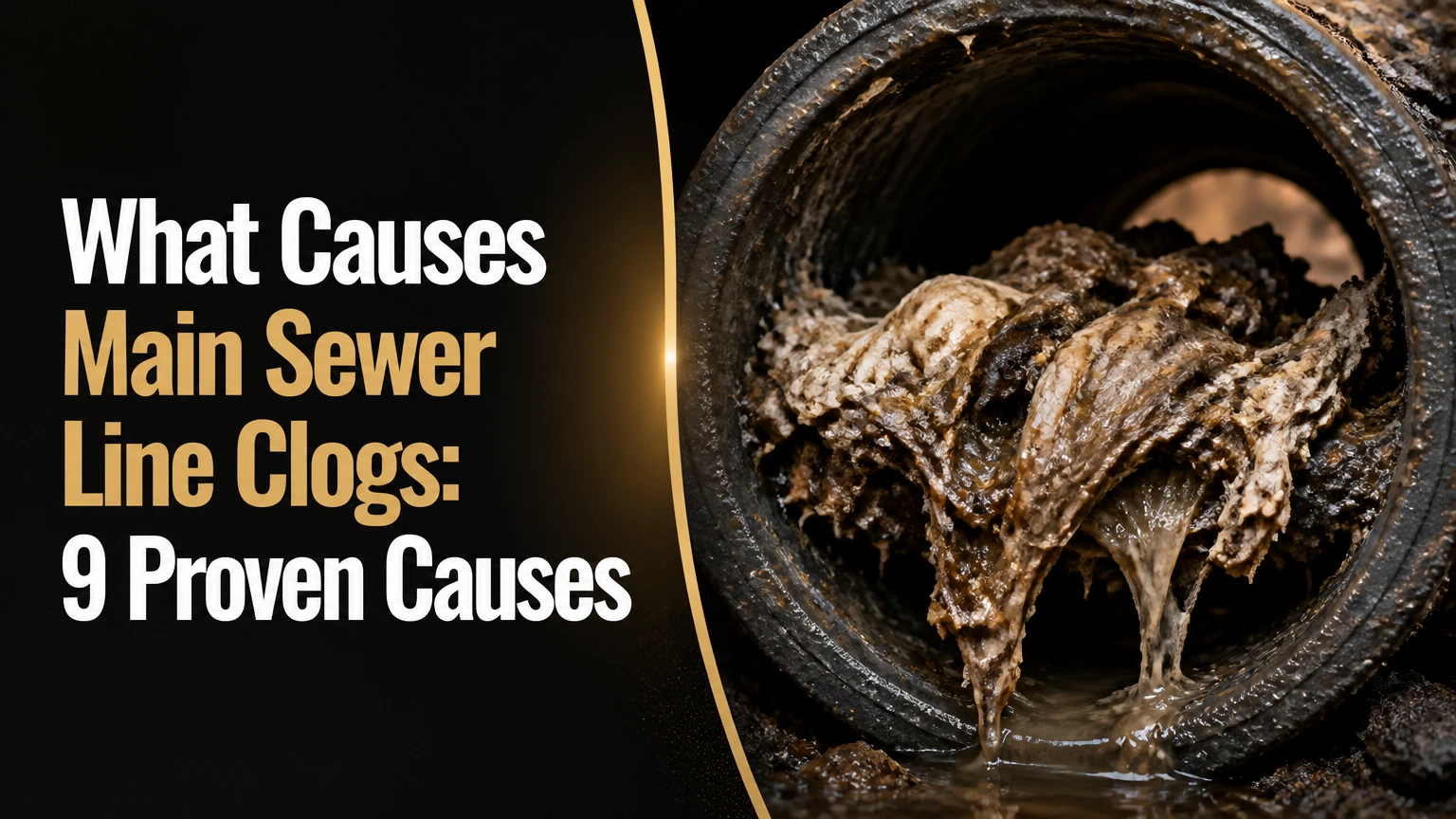
A main sewer line clog is usually caused by tree roots, grease and solids, flushed non-dispersible items, pipe damage, or internal scale that narrows the building’s primary waste pipe. A blocked main line affects multiple fixtures because wastewater cannot reach the municipal sewer connection or septic tank, so sewage backs up through the lowest drains.
Key Facts at a Glance
- A main sewer blockage typically affects two or more fixtures, while a branch-line clog usually affects one fixture.
- Tree roots enter through joints, cracks, and failed seals, then trap paper and solids as the root mass grows.
- A sewer camera identifies the blockage’s location and cause; clearing the obstruction alone does not prove the pipe is structurally sound.
- Pouring cooking grease, paper towels, wipes, dental floss, or hygiene products into drains increases blockage risk.
- Typical residential building sewer lines measure 3 or 4 inches in diameter, although local plumbing design varies.
- A recurring blockage often signals roots, a belly, offset joints, corrosion, or collapse rather than poor cleaning technique.
What Causes Main Sewer Line Clogs?
The most common main sewer line clog causes are root intrusion, grease deposits, unsuitable flushed items, pipe corrosion, sagging or misaligned pipe, collapse, construction defects, excessive solids, and septic-system restrictions. These causes often combine: a small crack admits roots, roots catch paper, and the resulting restriction becomes a complete backup.
A main sewer line carries combined discharge from toilets, sinks, tubs, laundry equipment, and appliances toward a public sewer or private septic tank. The line can therefore receive larger and more varied loads than an individual fixture branch. Once the pipe’s usable opening becomes too small, normal household discharge fills the line faster than wastewater can leave.
The blockage location also matters. A clog between the house and the municipal connection produces household symptoms, while a blockage in the public sewer can affect several properties. A licensed plumber or the local sewer authority may need to determine which segment is obstructed and who owns it.
1. How Do Tree Roots Block Sewer Pipes?
Tree roots block sewer pipes by entering small openings at joints, cracks, or deteriorated seals and forming a fibrous mass that catches wastewater solids. Roots do not normally break through an intact, watertight modern pipe; they exploit an existing defect and then enlarge the obstruction as they grow.
Clay tile and older jointed pipes are particularly vulnerable because they contain many connections. Cast iron can also admit roots when corrosion creates holes or when joints lose their seals. Willow, poplar, silver maple, birch, and elm have aggressive root systems, but any nearby vegetation can become relevant when moisture escapes from a damaged line.
Root problems often worsen during spring and autumn growth periods, although an established root mass can obstruct flow year-round. Mechanical cutting may restore flow temporarily, but it leaves the entry defect and some root material behind. Recurrent roots require camera-confirmed repair, pipe replacement, lining where appropriate, or a professionally selected maintenance treatment.
2. Can Grease Cause a Main Sewer Backup?
Grease can cause a main sewer backup when fats, oils, and grease cool against pipe walls, combine with solids, and progressively reduce the internal diameter. Kitchen grease is the main household contributor, while restaurants, food processors, and multifamily buildings can produce larger deposits that require scheduled cleaning.
Liquid cooking oil does not remain liquid throughout a cold underground sewer. Grease adheres to rough cast iron, offsets, roots, and existing sludge. Soap residue, mineral deposits, food particles, and paper can then build a layered restriction. Municipal fatbergs are extreme examples of the same adhesion process, although household clogs are usually smaller.
Do not pour grease into a sink, toilet, floor drain, or outdoor cleanout. Let small quantities cool, place them in a sealed container, and dispose of the container according to local waste rules. Scraping plates before washing reduces the solids that reach the building sewer.
3. Which Flushed Items Create Sewer Blockages?
The flushed items most likely to create sewer blockages are wipes, paper towels, sanitary products, diapers, cotton products, dental floss, disposable gloves, and cat litter. Toilet paper and human waste are designed for toilet disposal, but even toilet paper can accumulate when roots, scale, or a sagging pipe has already reduced flow.
“Flushable” labeling usually describes a product’s intended use, not proof that the item will disperse as rapidly as toilet paper in a specific sewer. Wipes can remain intact long enough to snag on roots or an offset joint. Paper towels contain stronger fibers and absorb water, which makes them poor candidates for flushing.
A single unsuitable item may pass through an intact line without immediate symptoms. Repeated disposal creates a mass, especially in a low-flow section or pipe belly. The practical rule is simple: flush human waste and toilet paper only, unless local utility instructions state otherwise.
4. How Do Damaged Pipes Create Clogs?
Damaged pipes create clogs by interrupting the smooth flow path, allowing soil, groundwater, roots, or standing wastewater to enter the line. Common defects include offset joints, cracks, holes, separated connections, bellies, flattened pipe, and full collapse.
A belly is a sagging section that holds water and sediment instead of maintaining the intended grade. A small belly may produce intermittent slow drainage, while a deeper belly can retain paper and solids after every discharge. An offset joint creates a ledge that catches debris and can admit roots.
Pipe collapse has a different symptom pattern. Drainage may fail suddenly after years of minor gurgling, and a cleaning cable may stop at the same distance repeatedly. A camera inspection should precede a major repair because a cleared line can conceal a structural defect that will immediately collect new debris.
5. Why Do Corrosion and Scale Narrow Older Sewer Lines?
Corrosion and scale narrow older sewer lines because oxidation, mineral deposits, and tuberculation roughen the pipe interior and reduce its effective opening. Cast iron can develop raised rust formations, while galvanized or other obsolete materials may deteriorate at joints and along the pipe wall.
The practical age risk depends on material, soil, installation quality, water chemistry, and maintenance. PVC and ABS generally resist internal corrosion, but plastic lines can still crack, separate, deform, or develop construction-related defects. Clay is structurally durable in some conditions but has many joints that can admit roots.
Typical service-life figures are planning estimates, not guarantees. PVC and ABS may remain usable for 75-100 years or longer; cast iron commonly requires assessment after roughly 50-75 years; clay can last decades but often develops joint defects; Orangeburg has a shorter and less predictable life because it can deform and flatten.
| Pipe condition | Typical effect on flow | Recurrence pattern | Camera finding |
|---|---|---|---|
| Root intrusion | Fibrous restriction, trapped paper | Weeks to months after cutting | Roots at joint or crack |
| Grease coating | Progressive diameter loss | Gradual, often kitchen-related | Oily wall deposits |
| Cast-iron scale | Rough wall, loose flakes | Repeated after snaking | Tuberculation or rust |
| Belly or sag | Standing water and sediment | Recurrent after cleaning | Low section with pooled water |
| Collapse | Little or no passage | Sudden or complete failure | Crushed or flattened pipe |
6. Can Poor Slope or Construction Errors Cause a Clog?
Poor slope or construction errors can cause a clog when a sewer line lacks enough grade to transport solids, contains an unintended high point, or has poorly joined sections. The correct slope depends on pipe diameter, local code, hydraulic design, and installation conditions, so a single universal slope should not be treated as a diagnosis.
Residential 3-inch and 4-inch drainage pipes are commonly installed near minimum code grades that may be approximately 1/8 to 1/4 inch per foot in some jurisdictions. The governing plumbing code and approved plans control. An excessively steep line is not automatically better because water can separate from solids under some conditions, but shallow grade, roughness, and low flow create the more common homeowner concern.
Construction debris can also obstruct a new line. Gravel, mortar, soil, plastic packaging, or an uncapped pipe may remain after installation. If a blockage appears soon after construction or renovation, request a camera inspection and review the contractor’s work before assuming tree roots or household misuse.
How Does a Main Sewer Line Blockage Behave?
A main sewer line blockage creates a hydraulic bottleneck: incoming water continues to enter the pipe, but the restricted section cannot pass it at the same rate. The wastewater level rises until it backs up through the lowest available fixture, often a basement floor drain, shower, bathtub, or low toilet.
The plumbing vent system does not remove a physical blockage. Roof vents equalize air pressure and support drainage, but a blocked vent generally causes trap or fixture symptoms rather than a sewage-filled main line. A vent issue and a main sewer obstruction can occur together, so diagnosis should follow the pattern of affected fixtures.
Water usage reveals the problem’s location. If a toilet flush causes shower water to rise, the restriction is likely downstream of both fixtures. If only one sink drains slowly, inspect that fixture’s trap and branch line first.
Which Symptoms Point to the Main Sewer?
Multiple affected fixtures, sewage backup at a low drain, gurgling after a washing machine discharge, and repeated stoppages are the strongest signs of a main sewer problem. A single slow sink or toilet more often indicates a local branch clog, although one fixture can be the first visible outlet of a larger obstruction.
Sewer gas odor near a floor drain may indicate an empty trap, damaged pipe, or backup. A wet or unusually green strip over the sewer route can indicate leakage, but irrigation, drainage, and natural soil differences can produce the same appearance. Outdoor evidence needs camera or utility confirmation.
| Symptom | More likely location | Immediate interpretation | Recommended check |
|---|---|---|---|
| One sink drains slowly | Sink trap or branch | Local restriction | Clean trap and branch |
| Toilet and shower back up | Building main | Downstream obstruction | Stop water use |
| Basement drain rises during laundry | Main or lateral | Lowest outlet receiving flow | Inspect cleanout |
| Gurgling in several fixtures | Main, vent, or partial obstruction | Air and water displacement | Plumber diagnosis |
| Yard stays wet above line | Leaking or broken sewer | Possible structural defect | Camera and utility review |
What Should You Do During an Active Backup?
During an active sewage backup, stop using toilets, sinks, showers, dishwashers, washing machines, and other water fixtures, then keep people and pets away from contaminated water. Call a qualified drain professional or the responsible sewer utility, because sewage exposure creates sanitation risks and an overflowing cleanout can release contaminated water.
Use this sequence:
- Stop household water use. Do not test the line with repeated flushes.
- Protect the area. Avoid contact, isolate children and pets, and use gloves and waterproof footwear only if access is unavoidable.
- Check whether neighbors have the same problem. Multiple affected properties may indicate a public main blockage.
- Locate the cleanout. Common locations include a basement, crawlspace, side yard, or near the property line.
- Do not force a sealed cap open. A cleanout under pressure can release wastewater suddenly.
- Request mechanical clearing and a camera inspection. The camera should identify the cause after flow is restored.
If sewage has contacted flooring, drywall, insulation, or porous furnishings, contact the insurer and a qualified remediation company. Cleaning a pipe does not decontaminate the building.
How Is a Sewer Clog Diagnosed Correctly?
A sewer clog is diagnosed correctly by combining symptom mapping, cleanout testing, mechanical access, and a video camera inspection. Clearing the line first may be necessary to restore flow, but the camera should determine whether the obstruction was grease, roots, scale, a belly, a break, or collapse.
A professional should document the camera distance from the access point, pipe material, defect type, water level, and property boundary. Ask for recorded video or still images, not only a verbal statement that “roots were found.” The footage helps distinguish a maintenance problem from a repairable structural failure.
A dye test can help trace connections in some properties, while smoke testing is used for certain leaks and illegal connections. Neither test replaces a camera for locating an internal blockage. For septic systems, the tank level, inlet baffle, outlet filter, distribution components, and drain field require separate assessment.
Which Clearing Method Fits Each Cause?
Mechanical augering is usually appropriate for an urgent soft blockage or limited root obstruction, while hydro-jetting is better for grease, sludge, and broad wall deposits when the pipe is structurally sound. Lining or excavation addresses defects that cleaning cannot permanently correct.
| Method | Best cause | Typical price | Main limitation |
|---|---|---|---|
| Main-line augering | Soft blockage or light roots | $150-$500 | May leave deposits and roots |
| Hydro-jetting | Grease, sludge, scale | $400-$1,200 | Risky in fragile or collapsed pipe |
| Camera inspection | Unknown or recurring clog | $150-$400 | Does not clear blockage alone |
| Trenchless lining | Cracks and leaking joints | $4,000-$15,000 | Poor fit for severe bellies or collapse |
| Excavation and replacement | Collapse, deformation, deep belly | $3,000-$30,000+ | Yard, driveway, and access disruption |
Prices are typical North American residential ranges, not quotes. Length, depth, access, permits, traffic control, cleanout installation, restoration, and regional labor rates can change the total substantially.
Hydro-jetting should not be treated as a universal upgrade. High-pressure water can worsen a brittle, fractured, or badly deteriorated line, and a contractor should assess pipe condition before using it. Chemical drain cleaners are poor choices for distant main-line blockages because the product may pool in stagnant wastewater and create a hazard for anyone opening the pipe.
Why Does the Clog Keep Coming Back?
A clog keeps coming back when cleaning removes the symptom but leaves the cause, such as roots, grease-coated walls, a belly, corrosion, an offset, or a partial collapse. Repeated snaking at the same interval is evidence that the pipe needs diagnosis rather than another blind cleaning.
Use the recurrence pattern as a clue:
- Returns within days: incomplete clearing, displaced debris, or a major obstruction remains.
- Returns every few months: roots, grease, scale, or a belly may be collecting material.
- Returns after heavy rain: infiltration, a broken line, combined sewer surcharge, or public sewer capacity issue may be involved.
- Returns only after laundry or kitchen use: a branch connection or grease-related restriction may be upstream.
- Returns in several homes: notify the sewer utility before paying for private excavation.
A practitioner rule of thumb is to request a camera after the second unexplained main-line stoppage, or immediately when the first stoppage involves an older line, sewage contamination, or a cable that meets a fixed obstruction.
What Causes Clogs in Septic and Shared Sewer Systems?
Septic-system clogs can result from a full tank, blocked inlet or outlet baffle, failed effluent filter, damaged building sewer, or saturated drain field. A septic backup is not automatically a main sewer pipe clog, and pumping the tank will not repair a crushed or root-filled line between the house and tank.
Shared laterals and condominium sewer systems add responsibility questions. The homeowner may own the building sewer to the property line, while the municipality owns the public main; private communities may assign maintenance differently through easements, bylaws, or service agreements.
Stormwater is another edge case. Heavy rain can surcharge a combined or undersized public sewer, overwhelm a backwater valve, or reveal defects that normally remain dry. A plumber can clear a private obstruction, but only the utility can correct a public-main capacity or surcharge problem.
How Can You Prevent Main Sewer Blockages?
Prevent main sewer blockages by keeping grease and non-dispersible products out of drains, controlling vegetation near the sewer route, correcting leaks, and inspecting older or repeatedly blocked lines. Prevention works best when it addresses both household inputs and the pipe’s structural condition.
Follow these practices:
- Flush only human waste and ordinary toilet paper.
- Collect cooking oil and grease in a container instead of pouring it into drains.
- Scrape food waste into the trash or compost before dishwashing.
- Keep wipes, floss, paper towels, cotton products, and hygiene items out of toilets.
- Use drain screens for hair, while recognizing that screens do not protect the main line from roots.
- Ask the local utility about tree-planting setbacks; a fixed 30-foot rule is not safe for every species, soil, or pipe route.
- Have an older or recurring-problem line camera-scoped before selecting root treatment or lining.
- Maintain a septic tank and effluent filter according to tank size, occupancy, and local guidance.
The strongest prevention insight is counterintuitive: a cleanout that flows today does not prove a healthy pipe. A camera can reveal a defect before the next household discharge turns it into an emergency.
How Much Does Main Sewer Repair Cost?
Main sewer repair commonly costs $150-$500 for augering, $400-$1,200 for hydro-jetting, $150-$400 for camera inspection, $4,000-$15,000 for trenchless lining, and $3,000-$30,000 or more for excavation and replacement. The obstruction’s cause and the line’s depth usually affect price more than the household symptom.
Homeowners should separate emergency restoration from permanent repair. A $300 cleaning may restore drainage, while a camera-confirmed collapsed pipe requires a separate repair estimate. Ask whether the price includes access, permits, traffic control, disposal, landscape restoration, and post-repair inspection.
Home buyers should request a sewer camera inspection rather than relying on a short plumbing test. A line can drain normally during a showing while roots, corrosion, or a belly remains one discharge cycle away from failure.
The Bottom Line
The answer to what causes main sewer line clogs is usually a combination of roots, grease, flushed debris, corrosion, poor grade, or structural pipe damage. Multiple slow fixtures and low-point sewage backups indicate a downstream main-line restriction, but only a camera inspection can distinguish a cleanable obstruction from a pipe that needs lining or replacement.
Stop water use during a backup, avoid chemical cleaners, and arrange professional clearing followed by visual inspection. The permanent solution must match the cause: remove deposits, control roots, repair defects, replace collapsed sections, or involve the utility when the public sewer is responsible.
Frequently Asked Questions
Can heavy rain cause a main sewer line backup?
Heavy rain can cause a backup when stormwater enters a defective private sewer, a combined sewer becomes surcharged, or a public system exceeds capacity. Rain does not usually create a household pipe clog by itself. Compare neighboring properties, inspect the cleanout, and contact the sewer utility if several buildings experience simultaneous backups.
How can I tell whether the city sewer or my pipe is blocked?
A private building sewer is more likely when only one property has symptoms and the obstruction lies between the house and property connection. A public-main problem becomes more likely when nearby properties back up at the same time. The cleanout condition, camera location, utility records, and local ownership rules determine responsibility.
Are chemical drain cleaners safe for a sewer main?
Chemical drain cleaners are generally unsuitable for a sewer main because the product may not reach a distant obstruction at an effective concentration and can remain in backed-up wastewater. Corrosive chemicals also endanger plumbers and can damage some older pipes. Mechanical clearing and camera inspection provide safer, more useful diagnosis.
Does a sewer camera inspection find every problem?
A sewer camera can identify visible roots, grease, scale, cracks, offsets, bellies, and collapse, but standing water, severe debris, inaccessible sections, or a blocked cleanout can limit visibility. A camera also cannot reliably determine every ownership or groundwater issue. The inspection report should state which sections were viewed and which were not.
Should I use root killer after roots are removed?
A root-control product may reduce regrowth after mechanical removal, but it cannot restore a cracked joint, eliminate a severe root mass, or repair a collapsed pipe. Product legality and sewer-utility rules vary. Repeated root intrusion is better addressed through camera-guided repair, such as joint rehabilitation, lining, or replacement where suitable.