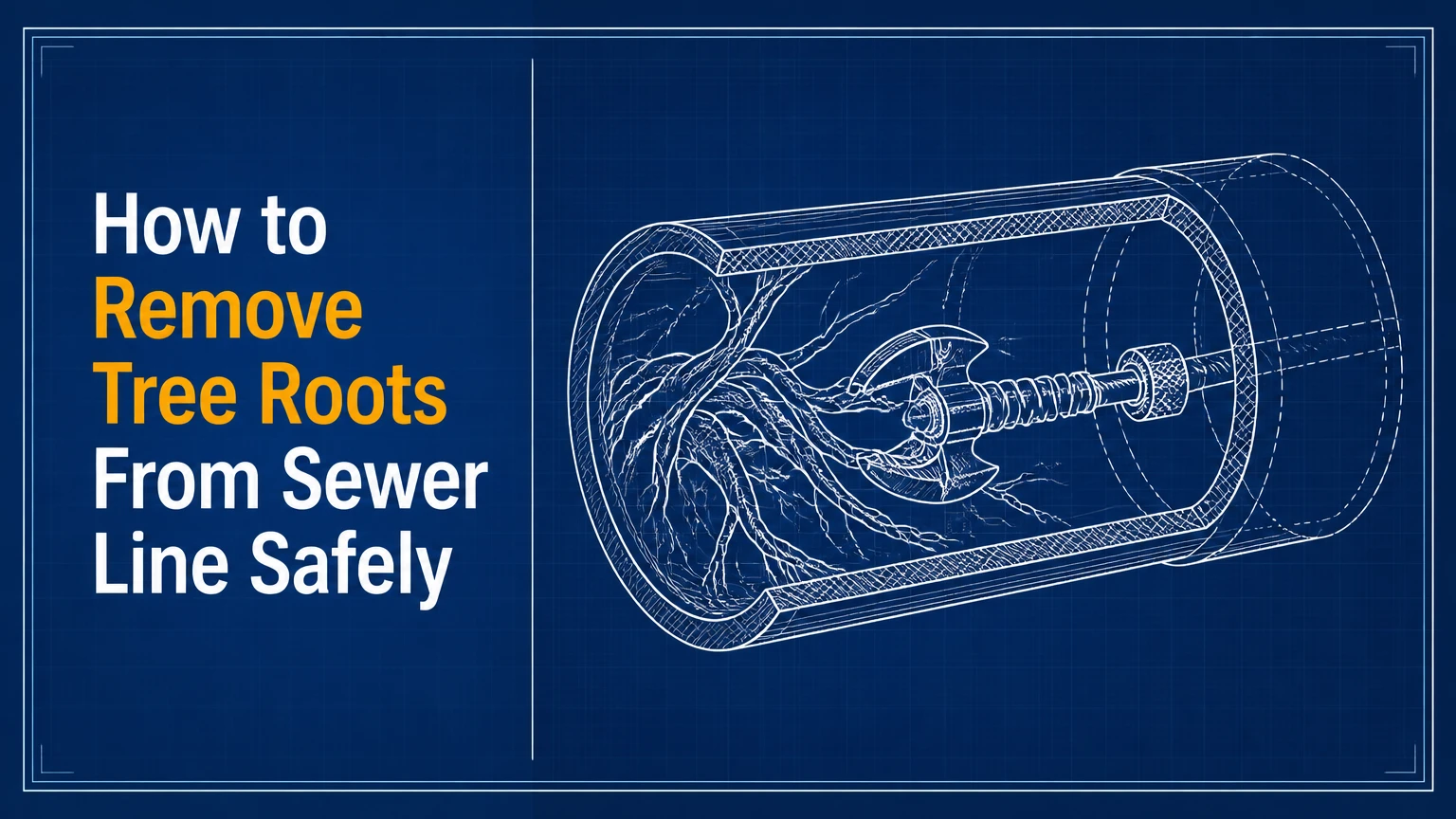
To remove tree roots from a sewer line, first confirm the blockage with a sewer camera, then cut the roots with a properly sized drain auger or hydro-jet nozzle. Root-killing treatment can slow regrowth, but recurring intrusion usually requires pipe repair, such as CIPP lining, pipe replacement, or excavation.
Key Facts
Tree roots usually enter through failed joints, cracks, separated fittings, or porous older pipe, rather than through an intact sewer wall.
Mechanical cutting restores flow quickly but does not seal the opening that allowed roots inside.
Hydro jetting cleans more of the pipe wall than an auger, but high pressure can damage brittle, cracked, or collapsed pipe.
Chemical root treatments suppress regrowth; they do not reliably remove a dense blockage or repair structural damage.
A camera inspection is the safest way to identify root location, pipe material, collapse, belly, offset joints, and remaining flow capacity.
Typical professional costs range from about $150-$400 for root snaking, $350-$900 for hydro jetting, and $4,000-$12,000 for trenchless lining.
Why Do Tree Roots Enter Sewer Lines?
Tree roots enter sewer lines through small openings that release moisture and sewer gases into surrounding soil. Common entry points include separated clay joints, cracked cast iron, failed mortar, loose connections, and aging concrete or fiber pipes.
Roots can travel considerable distances from a trunk when soil is dry, but the tree does not need to be directly above the sewer. Fast-growing species such as willow, poplar, silver maple, and some varieties of ficus create higher practical risk, although any tree can exploit an existing leak.
A root intrusion usually begins as fine root hairs. Those roots collect paper, grease, and sediment. The resulting mass becomes a partial obstruction that catches more solids until wastewater movement slows or stops.
What symptoms indicate root intrusion?
Root intrusion commonly causes repeated slow drainage, toilet gurgling, water rising in a bathtub during flushing, and backups that return after temporary drain cleaning. A single slow sink drain usually indicates a local fixture clog, while several affected fixtures point toward the building sewer or municipal lateral.
Watch for these patterns:
- A backup occurs in the lowest fixture first.
- Drains improve briefly after snaking, then slow again within weeks or months.
- Toilets bubble when a washing machine discharges.
- Sewer odors appear near a cleanout or floor drain.
- The problem worsens after heavy rain, when groundwater enters damaged pipe.
- A camera shows roots at one joint, several joints, or a continuously rough pipe wall.
A sewage backup is a sanitation emergency. Keep people and pets away from contaminated water, stop using plumbing fixtures, and call a licensed plumber if wastewater is rising, the cleanout is overflowing, or the line serves multiple units.
How to Remove Tree Roots From Sewer Line
The safest removal sequence has six stages: stop using water, locate an accessible cleanout, inspect the pipe, mechanically clear the obstruction, verify flow, and choose a regrowth or repair strategy. The camera inspection is the decision point that separates a temporary cleaning from a justified permanent repair.
Before you start
| Requirement | Typical specification | Why it matters |
|---|---|---|
| Inspection | 2-4 inch sewer camera | Identifies roots, collapse, offsets, and pipe material |
| Access | Exterior cleanout or basement cleanout | Provides a safer, straighter cable path than a toilet |
| DIY time | 2-4 hours | Includes setup, clearing, flushing, and cleanup |
| Equipment cost | $75-$125 per day for a rental auger | Local rental rates vary by machine size |
| Protective equipment | Leather gloves, eye protection, waterproof boots | Limits injury and sewage exposure |
| Pipe condition | No confirmed collapse or severe deformation | A cable can become trapped in failed pipe |
Do not open a pressurized or overflowing cleanout without gloves, eye protection, and a plan for contaminated water. Remove the cap slowly because backed-up wastewater may be behind it.
Step 1: Stop water use and locate the cleanout
Stop showers, laundry, dishwashing, and toilet flushing before opening the sewer access point. Find the main cleanout outside near the foundation, at the property line, or in a basement; some homes have two-way cleanouts, while older homes may have only an interior access fitting.
A cleanout often consists of a 3- or 4-inch threaded cap, but buried or painted fittings can be difficult to identify. Never dig near a suspected cleanout without checking for utility markings and avoiding underground electrical, gas, and water services.
Success checkpoint: The cleanout is identified, accessible, and located on the building side of the suspected blockage.
Common mistake: Removing a small sink or toilet trap cleanout and assuming it provides access to the main sewer.
Step 2: Inspect the sewer line before cutting roots
Run a camera through the cleanout before using a powered auger whenever possible. Record the distance from the access point to the root mass and note whether the pipe is clay, cast iron, PVC, Orangeburg, concrete, or another material.
The camera should answer four questions:
- Is the pipe open enough for a cable or jet nozzle?
- Are roots entering through one joint or many openings?
- Is the pipe cracked, collapsed, bellied, offset, or severely corroded?
- Is the obstruction on private property or in the municipal sewer?
Success checkpoint: The camera identifies a passable pipe and a root location that can be reached from the selected access point.
Common mistake: Blindly forcing a large cutter into an uninspected line. A cable can become trapped in a collapsed pipe, and a cutter can worsen a fragile joint.
Step 3: Choose a full-size mechanical root cutter
Use a commercial sewer machine with a cable and cutter sized for the line, not a small handheld sink auger. Residential building sewers are commonly 4 inches in diameter, while some laterals and larger properties use 6-inch pipe.
A C-cutter, root cutter, or properly sized expanding cutter can remove a root mass. The correct attachment depends on pipe diameter and the operator’s experience. A blade that is too small may punch a narrow channel through the blockage, leaving roots around the perimeter.
Feed the cable slowly through the cleanout. Engage the motor only when the cable is controlled, keep hands away from the rotating cable, and avoid forcing the cutter when it stalls. Withdraw the cable periodically to remove cut material and inspect the head.
Success checkpoint: The cutter passes the obstruction, the cable advances to the known root distance, and fixtures drain without immediate backup.
Common mistake: Running a large cutter aggressively in brittle clay or corroded cast iron. A professional should select lower-risk equipment when the camera shows structural weakness.
Step 4: Flush loose root debris
After cutting, flush the line with a controlled volume of clean water. A plumber may use a hose, a high-volume fixture, or a downstream cleanout, but flushing should stop if water backs up indoors or the line cannot carry the flow.
Cut roots do not vanish. Pieces may travel downstream and collect at another restriction, especially in a pipe with a belly, heavy grease, or a partially collapsed section.
Success checkpoint: The lowest fixtures drain continuously for several minutes, and the camera shows an open passage rather than a small hole through the root mass.
Common mistake: Testing only one toilet flush. Run multiple fixtures in sequence because a partial obstruction may tolerate one flush but fail under sustained discharge.
Step 5: Use hydro jetting when the pipe can tolerate it
Hydro jetting uses a pump, hose, and specialized nozzle to cut roots and wash debris from the pipe wall. Typical residential equipment may operate around 2,000-4,000 pounds per square inch, but pressure at the nozzle is only one part of the result; flow rate, nozzle design, hose size, and operator technique also determine cleaning performance.
A forward-facing jet opens the passage while rear-facing jets propel the hose and scour the pipe. Root cutting with water is often more complete than augering when the line contains grease, sludge, fine roots, or a thick coating of debris.
Hydro jetting is not appropriate for every sewer. A camera should rule out severe cracks, missing pipe sections, major offsets, Orangeburg deformation, or collapse before high-pressure cleaning.
Success checkpoint: A post-jetting camera shows a substantially clean pipe wall and no remaining obstruction at the original intrusion point.
Common mistake: Treating 4,000 PSI as universally safe. Brittle pipe can fail under pressure, and water can expose leaks that an auger temporarily leaves unnoticed.
Step 6: Apply only a permitted root-control product
Chemical treatment works best after physical clearing, when the product can contact the remaining root tips and entry points. Products may contain foaming dichlobenil or other labeled root-control ingredients; copper sulfate products have different environmental, plumbing, and regulatory limitations.
Follow the product label exactly. Do not assume a treatment approved in one state, province, or country is legal for sewer use elsewhere. Keep people and animals away from treated water, prevent unnecessary discharge, and never combine a root-control product with bleach, acids, caustic drain cleaners, or other chemicals.
Root treatment does not seal a crack. It also does not guarantee that the tree will remain healthy or that roots will not find another opening.
Success checkpoint: The line remains open after physical cleaning, and the product label confirms the application method, amount, waiting period, and repeat interval.
Common mistake: Pouring liquid drain opener into a root blockage. Sodium hydroxide and sulfuric-acid products target hair, grease, or organic clogs, not woody roots, and trapped chemicals create serious exposure hazards.
Which Root Removal Method Should You Choose?
Mechanical snaking is usually the fastest first treatment for a flowing but restricted line. Hydro jetting is the stronger cleaning option when the pipe is structurally sound and contains extensive roots or grease. Permanent repair becomes the better value when a camera shows repeated entry points, a failed joint, or a damaged pipe.
| Method | Typical cost | Typical time | Best use | Main limitation |
|---|---|---|---|---|
| Mechanical root cutting | $150-$400 professional; $75-$125 rental | 1-4 hours | Immediate partial or full blockage | Leaves entry points open |
| Hydro jetting | $350-$900 | 2-3 hours | Dense roots plus grease and sediment | Can damage weak pipe |
| Foaming root control | $20-$50 product application | 10 minutes application; days to weeks for effect | Regrowth suppression after clearing | Does not open dense masses |
| CIPP lining | $4,000-$12,000, often $125-$250 per foot | 1-2 days | Cracked or jointed pipe with suitable geometry | Requires preparation and access |
| Pipe bursting | $6,000-$20,000 typical project range | 1-3 days | Replacement where a new alignment is possible | Needs entry and exit pits |
| Excavation and replacement | $5,000-$20,000 or more | 3-5 days typical | Collapse, severe offset, or unsuitable trenchless pipe | Damages landscaping and hardscape |
Costs vary with geographic labor rates, depth, access, permits, traffic control, cleanout installation, and the distance of the repair. A quote that excludes camera inspection, restoration, or municipal fees is not directly comparable with an all-inclusive quote.
Is snaking better than hydro jetting?
Snaking is better for rapid flow restoration through a defined root plug, while hydro jetting is better for cleaning the pipe’s circumference and removing combined roots, grease, and sediment. Neither method permanently stops intrusion when a damaged joint remains open.
| Decision factor | Snaking | Hydro jetting |
|---|---|---|
| Immediate opening | Usually 1-2 hours | Usually 2-3 hours |
| Typical equipment | Cable and root cutter | Pump, hose, and root nozzle |
| Cleaning coverage | Channel through obstruction to near-full diameter | Pipe wall and obstruction when correctly operated |
| Weak-pipe risk | Cable can catch or damage joints | Pressure can expose or worsen defects |
| Best follow-up | Camera and root-control treatment | Camera and structural repair assessment |
Practitioner rule: if roots return after one or two cleanings in the same location, stop treating the recurring symptom as a simple clog. The pipe opening needs repair evaluation.
What Permanent Repair Stops Root Intrusion?
Permanent repair removes or seals the pathway roots use to enter. CIPP lining creates a cured liner inside a prepared host pipe, pipe bursting replaces the old line with a new pipe, and excavation replaces a selected section or the entire sewer directly.
CIPP is suitable only when the host pipe has enough shape and continuity for cleaning and liner installation. A collapsed, severely offset, or badly bellied line may require excavation or replacement rather than lining.
| Repair option | Structural requirement | Surface disruption | Typical service life claim | Common drawback |
|---|---|---|---|---|
| CIPP lining | Continuous host pipe with manageable bends | Low; access pits may be needed | 30-50 years, product-dependent | Reduces internal diameter slightly |
| Pipe bursting | Entry and exit access with suitable soil | Moderate pits; little continuous trench | 50+ years for suitable HDPE systems | Cannot follow every alignment |
| Spot repair | Localized crack or failed joint | One excavation area | Depends on replacement pipe | Other defects remain |
| Full excavation | Any accessible, repairable alignment | Highest | Depends on new pipe material | Driveways, trees, and utilities complicate work |
A liner is not automatically the best answer for every root problem. If the line has a severe belly, roots from multiple crushed sections, inadequate slope, or a disconnected segment, lining may preserve the wrong geometry.
How Can You Prevent Roots From Returning?
Root prevention requires both structural sealing and landscape management. Repairing the defective sewer section offers the strongest protection, while maintaining cleanouts and avoiding aggressive planting near the line reduces future risk.
Use these measures:
- Obtain the camera video and mark the intrusion distance on a site plan.
- Identify the tree and estimate its trunk-to-sewer distance.
- Avoid planting willow, poplar, silver maple, and similarly water-seeking species near sewer alignments.
- Install only a professionally designed root barrier where local conditions and utilities allow it.
- Keep the cleanout accessible for inspection and emergency cleaning.
- Use labeled root-control products only at the interval and dose stated on the product label.
- Do not remove a mature tree solely because roots entered a defective pipe; removing the tree may not remove the roots already inside the line, and nearby plants can exploit the same opening.
A counterintuitive point matters here: tree removal alone may not solve the sewer problem. The damaged joint continues to leak moisture, and remaining roots can persist or new vegetation can enter the same defect.
When Should You Stop DIY Sewer Root Removal?
Stop DIY work when the cable binds, the pipe cannot be located, sewage enters the home, the obstruction returns immediately, or the camera shows collapse or severe corrosion. A rental machine is unsuitable for diagnosing whether a line can structurally tolerate aggressive cutting.
Call a licensed plumber or drain specialist when:
- The cleanout is full and multiple fixtures are backing up.
- The auger cable becomes stuck or will not retract.
- A camera cannot pass the root mass.
- The line is made from Orangeburg, badly corroded cast iron, or fractured clay.
- A sewer backup affects finished flooring, electrical equipment, or living areas.
- The sewer crosses a public sidewalk, roadway, easement, or neighboring property.
- Roots return within weeks after cleaning.
- The pipe requires excavation, lining, bursting, or permit work.
If a cable becomes trapped, stop the motor and do not jerk the machine or switch repeatedly between forward and reverse. Controlled reverse tension may release a simple snag, but a cable trapped by collapsed pipe usually requires professional retrieval and possibly excavation.
How Long Does Root Removal Last?
Mechanical root cutting may restore flow for several months to several years, depending on the size of the defect, tree growth, pipe material, and wastewater loading. A structural repair can prevent entry at the repaired section, but a different downstream defect can still cause later intrusion.
Typical planning ranges are:
| Situation | Likely recurrence pattern | Recommended next action |
|---|---|---|
| One small joint, no structural damage | 6-24 months after cutting | Camera follow-up and labeled treatment |
| Multiple clay joints with fine roots | 3-12 months | Compare lining with spot repairs |
| Dense roots plus grease | Weeks to 12 months | Jetting, then structural inspection |
| Cracked cast iron | Unpredictable; often recurring | Repair assessment rather than repeated cutting |
| Collapsed or bellied pipe | Immediate or frequent backup | Excavation or replacement evaluation |
These are practical ranges, not guarantees. Soil moisture, irrigation, drought, tree species, and the number of entry points can change recurrence substantially.
What Common Root-Removal Mistakes Cost Homeowners?
The most expensive mistake is repeated cleaning without documenting the pipe defect. A $250 service call can become a much larger restoration project when a line collapses under a driveway or sewage remains inside the building.
Avoid these failures:
- Using a small blade for a large pipe: The cutter creates a narrow tunnel and leaves a root ring behind. Request a post-cleaning camera or use a correctly sized head.
- Jetting an uninspected pipe: High pressure can reveal structural failure after the operator has already worsened it. Inspect first.
- Applying chemicals to a blocked line: The product may sit in the house-side pipe and expose occupants or damage plumbing. Restore flow before treatment.
- Assuming all roots are on private property: The blockage may be in a shared lateral or municipal connection. The camera distance and local sewer responsibility rules matter.
- Accepting a trenchless quote without a video: Lining cannot correct every collapsed, offset, or bellied sewer. Ask for the inspection basis.
- Ignoring the cleanout: A buried or inaccessible cleanout increases emergency cost and can force a plumber to remove fixtures or excavate.
How Much Does Tree Root Removal Cost?
Typical US pricing is $150-$400 for professional root snaking, $350-$900 for hydro jetting, and $4,000-$12,000 for CIPP lining. Excavation often costs $5,000-$20,000 or more after accounting for depth, concrete removal, utility conflicts, permits, and surface restoration.
Ask every contractor to separate these line items:
- Camera inspection and recorded video
- Root cutting or hydro jetting
- Cleanout excavation or installation
- Root-control chemical application
- Spot repair, lining, bursting, or replacement
- Permit, inspection, and utility-location fees
- Soil, concrete, driveway, and landscape restoration
- Warranty duration and exclusions
A low cleaning quote may exclude the camera or follow-up inspection. A high repair quote may include restoration that another contractor has omitted, so compare scope rather than headline price.
FAQ
Can tree roots grow through PVC sewer pipe?
Tree roots rarely penetrate an intact PVC sewer pipe wall. Roots can enter PVC systems through failed rubber-ring joints, cracked fittings, damaged sections, or service connections, so newer plastic pipe lowers risk but does not make intrusion impossible.
Will bleach kill roots in a sewer line?
Household bleach is not a reliable sewer root treatment and can create hazardous reactions with other drain chemicals. Bleach also does not repair the crack or joint where roots entered. Use only a product specifically labeled for sewer root control, and follow local disposal and wastewater rules.
Does cutting sewer roots kill the tree?
Cutting roots inside a sewer line generally does not kill a mature tree because the cutter removes only roots in the pipe. However, excavation near a trunk can damage structural roots, destabilize the tree, or create a separate arboricultural hazard.
Can a homeowner use a sewer camera?
A homeowner can rent or purchase a small sewer camera, but image quality, locating accuracy, and push-cable performance vary widely. A professional inspection is more useful when the repair decision depends on pipe grade, distance, collapse, or responsibility at a property boundary.
Should I remove a tree near a sewer line?
Tree removal is not the first response to root intrusion unless an arborist identifies a significant tree hazard or the owner accepts the landscape consequences. Repairing the defective sewer usually addresses the entry pathway more reliably than removing a tree while leaving the damaged pipe open.
Does insurance cover sewer root damage?
Standard homeowners insurance often excludes gradual maintenance problems, root intrusion, and sewer-line deterioration, although coverage varies by policy and endorsements. Review service-line coverage, sewer-backup coverage, deductibles, and exclusions before assuming a cleaning or replacement claim will be paid.
The Bottom Line
The correct way to remove tree roots from sewer line blockage is to inspect first, clear the obstruction mechanically or with hydro jetting when the pipe is sound, verify drainage, and then address the defective joint or cracked section that permits regrowth. Use chemical root control only as labeled maintenance, not as a substitute for opening or repairing a damaged sewer.