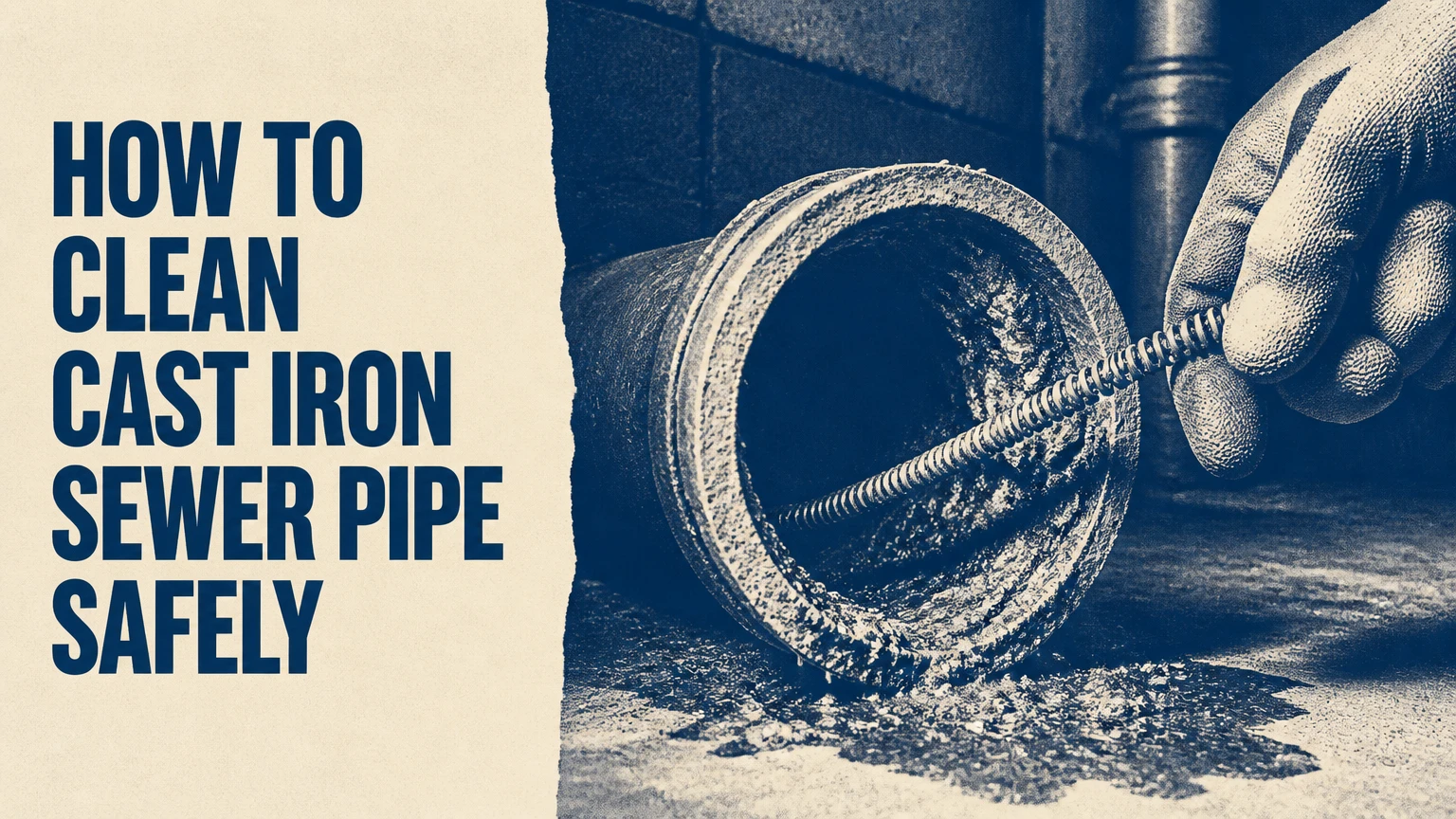
To clean a cast iron sewer pipe, first inspect it with a sewer camera, then clear the blockage and remove tuberculation with professional mechanical descaling or controlled hydro jetting. Flush all loosened debris and perform a second camera inspection. Do not use acid drain cleaners or high-pressure equipment on uninspected, severely corroded pipe.
Key Facts
Tuberculation is the rough iron oxide scale that narrows the inside of aging cast iron sewer pipe.
A drain snake usually opens a passage through a blockage but does not remove most wall scale.
Mechanical descaling is generally better for hard rust scale; hydro jetting is generally better for grease and soft deposits.
A camera inspection must precede aggressive cleaning when a cast iron line may be thin, cracked, bellied, or collapsed.
Typical professional cleaning costs range from about $150-$2,500, depending on access, method, pipe length, and condition.
Cleaning removes deposits, but it does not repair cracks, missing pipe bottoms, root-entry points, or separated joints.
What Makes Cast Iron Sewer Pipe Difficult to Clean?
Cast iron sewer pipe becomes difficult to clean because corrosion creates a rough internal surface that catches additional debris. Water, oxygen, detergents, grease, hair, paper, and organic waste contribute to deposits, while tuberculation creates irregular rust nodules that reduce the effective opening.
Cast iron was widely installed in residential drainage systems before plastic DWV materials became common. The pipe can remain serviceable for many decades, but age alone does not reveal its condition. A 75-year-old line may have adequate wall thickness, while a younger line may have severe corrosion from soil, moisture, poor drainage, or aggressive wastewater conditions.
Tuberculation versus a blockage
Tuberculation is attached to the pipe wall; a blockage is material obstructing the passage. The distinction determines the correct tool. A cable can punch through grease, paper, roots, or a localized obstruction, but the cable may leave the rough corroded circumference almost unchanged.
A cast iron sewer line with heavy scale can appear open on a camera while retaining only a narrow channel at the bottom. That channel may carry normal weekday flow but fail when a washing machine, bathtub, or multiple toilets discharge together.
Signs that cleaning may be necessary
Common indicators include:
- Repeated backups in more than one fixture
- Slow drainage in fixtures connected to the same branch
- Gurgling toilets after a shower or laundry discharge
- Rust-colored flakes in a cleanout or toilet trap
- Blockages that return days or weeks after snaking
- Root intrusion visible at a joint or crack
- A sewer camera showing heavy scale, a narrowed channel, or deposited debris
A single slow sink does not prove a cast iron sewer problem. The obstruction may be in the trap, branch arm, vent, or fixture tailpiece.
Can a Homeowner Clean Cast Iron Sewer Pipe?
A homeowner can safely perform limited maintenance, but full cast iron sewer cleaning usually requires a drain professional with a camera, descaling equipment, or a commercial jetter. A hand-operated auger may clear a short branch-line obstruction, but a main sewer line presents greater risks because the pipe may be fragile and the blockage may conceal structural failure.
Safe homeowner work
For a minor sink or shower blockage, a homeowner can usually:
- Remove and clean the fixture trap.
- Use a plunger with the overflow opening covered.
- Use a small manual auger designed for the fixture branch.
- Flush with warm water after removing grease or hair.
- Keep access points available for professional inspection.
Avoid forcing a rental sewer machine into an unknown main line. A rotating cable can snag a broken pipe edge, become trapped in a collapsed section, or remove a fragile section of already-thin iron.
Stop and call a professional when
Stop DIY work when wastewater rises from a floor drain, multiple fixtures back up, sewage returns after every discharge, or a sewer cleanout contains standing water. These signs place the problem in a branch drain, building drain, building sewer, or shared lateral rather than at one fixture.
A professional should also handle lines beneath slabs, buried lines, vertical stacks, lines connected to septic systems, and any pipe with visible leakage or structural deformation.
How Do Professionals Clean Cast Iron Sewer Pipe?
Professionals clean cast iron sewer pipe through a controlled sequence: camera inspection, initial opening, deposit removal, flushing, and verification. The technician selects a cable, flex-shaft descaler, or hydro jetter according to pipe diameter, scale thickness, blockage type, access point, and observed wall condition.
Before you start: requirements and typical costs
The following figures are typical United States contractor ranges, not fixed prices. Urban labor rates, emergency service, basement access, excavation, pipe length, and municipal requirements can move the final price substantially.
| Item | Typical value | What changes it |
|---|---|---|
| Camera inspection | $250-$500 | Cleanout access, line length, recording, locating |
| Minor augering | $150-$400 | Blockage depth, emergency timing, cable length |
| Hydro jetting | $400-$900 | Pipe diameter, water supply, debris volume |
| Mechanical descaling | $800-$2,500 | Scale thickness, access points, pipe length |
| Cleaning duration | 1-8 hours | Blockage severity and required verification |
| Sewer lining or replacement | Several thousand dollars or more | Length, access, excavation, permits, structural damage |
Tools and prerequisites include a cleanout or suitable access point, inspection camera, drain machine or descaler, controlled water supply, debris containment, protective equipment, and a disposal plan. A septic system requires additional caution because loosened iron scale and solids should not be forced into a small tank without considering its capacity and outlet condition.
Step 1: Inspect the pipe with a camera
Begin with a waterproof sewer camera from the cleanout, toilet opening, or another suitable access point. Identify pipe diameter, direction, distance to the municipal connection or septic tank, blockage location, tuberculation thickness, cracks, open joints, roots, bellies, and missing pipe sections.
The camera is not a cosmetic step. It determines whether aggressive cleaning is appropriate. A line with sound walls and deposits can often be descaled, while a line with a severely corroded bottom may require repair or lining instead.
Success checkpoint: The recording identifies the defect, its distance from the access point, and the pipe’s structural condition.
Common mistake: Approving a cleaning quote based only on the phrase “old cast iron.” Age does not quantify remaining wall thickness.
Step 2: Open the line cautiously
If standing sewage prevents camera passage, use the least aggressive suitable method to create a temporary flow path. A cable auger may clear paper, roots, or a soft obstruction, while a controlled jetting pass may move sludge when the pipe is structurally sound.
Do not interpret restored flow as a clean pipe. The cable may have made a narrow hole through a much larger deposit.
Success checkpoint: Wastewater drains sufficiently for a complete camera inspection, and the technician records what caused the initial obstruction.
Common mistake: Continuing to rotate a cable after it repeatedly catches. Repeated catching can indicate a broken joint, collapsed section, or severe scale lip.
Step 3: Select mechanical descaling or hydro jetting
Choose mechanical descaling for hard tuberculation and hydro jetting for grease, sludge, loose deposits, and flushing. A flex-shaft system uses a rotating chain or cutter to scrape deposits from the wall, whereas a jetter uses water propelled through a specialized nozzle.
Mechanical descaling equipment commonly operates around 1,000-3,000 revolutions per minute, although the actual setting depends on the tool and pipe. Hydro jetters may operate around 3,000-4,000 pounds per square inch and 2-8 gallons per minute in some sewer applications, but those figures are not universal safety settings for old cast iron.
Success checkpoint: The selected tool matches the deposit and the camera shows no condition that makes the tool unsafe.
Common mistake: Treating pressure as the main measure of cleaning quality. Nozzle design, flow, operator control, pipe condition, and debris removal matter as much as the pressure gauge.
Step 4: Descale the pipe in controlled passes
Run the descaler slowly through the affected section, usually from a downstream cleanout toward the building or from an appropriate upstream access point. The operator may make several passes with different chain sizes, gradually reducing attached scale instead of trying to remove all deposits in one aggressive pass.
A descaler can expose weak areas that deposits had temporarily sealed. That outcome does not necessarily mean the tool caused the failure; the inspection should establish whether the wall was already perforated or fractured.
Success checkpoint: The camera shows a substantially more open, consistently shaped passage without fresh cracks, displaced joints, or hanging pipe fragments.
Common mistake: Promising restoration to “100% of the original diameter.” Heavy corrosion may have permanently reduced the pipe wall, and cleaning cannot recreate metal that has already oxidized away.
Step 5: Hydro jet and flush the loosened material
Use a suitable sewer nozzle and enough water volume to carry loosened scale, grease, and organic debris toward the approved discharge point. Wide-angle or rotary nozzles may be preferable to a concentrated forward jet when the line is old, but the operator must match the nozzle to the pipe and condition.
Heavy cast iron flakes can settle in a low section or belly. If the debris is not removed, the cleaned line may back up shortly after service.
Success checkpoint: The downstream discharge is clear enough to show that solids have left the line, and a follow-up camera confirms that no scale pile remains.
Common mistake: Flushing blindly toward a septic tank or municipal connection without confirming where the debris will accumulate.
Step 6: Perform a final camera inspection
Inspect the line again after cleaning. Compare the before-and-after video, verify the cleaned section, document remaining corrosion, and note any crack, root entry, belly, offset joint, or hole that requires repair.
A final camera is also useful when a contractor recommends lining. Epoxy or cured-in-place lining requires a clean, sufficiently continuous host pipe; cleaning prepares the surface but does not automatically make lining possible.
Success checkpoint: The video identifies the complete cleaned length and separates deposits from structural defects.
Common mistake: Accepting “the water flows” as the final test. Flow confirms drainage, not pipe integrity.
Which Cleaning Method Should You Choose?
The best cleaning method depends on the material causing the restriction and the pipe’s structural condition. Mechanical descaling is the strongest option for attached rust scale, hydro jetting is effective for soft deposits and flushing, and snaking is the least expensive first response for a localized blockage.
| Method | Typical equipment | Best use | Main limitation | Typical service range |
|---|---|---|---|---|
| Snaking | 50-100-foot cable, 1/3-3/4 horsepower motor | Local blockage or roots | Leaves wall scale behind | $150-$400 |
| Hydro jetting | 3,000-4,000 PSI, 2-8 GPM jetter | Grease, sludge, loose debris | Can damage weak pipe | $400-$900 |
| Mechanical descaling | Flex shaft, chain head, carbide cutters | Hard tuberculation | Requires skilled control | $800-$2,500 |
| Enzyme maintenance | Biological treatment, 4-8-hour dwell | Light organic residue | Does not remove iron scale | $20-$50 |
| Replacement or lining | CIPP sleeve, spot repair, excavation | Structural failure | Higher cost and planning | Project-specific |
When is snaking enough?
Snaking is enough when a camera shows a localized, nonstructural obstruction in an otherwise open and sound line. Snaking is not enough when the pipe has heavy tuberculation, repeated backups, root intrusion, or a narrowed channel extending over several feet.
A cable may restore flow for six to twelve months in a recurring blockage, but that interval varies widely. A short-term result should trigger inspection rather than automatic repeat service.
Is hydro jetting safe for cast iron?
Hydro jetting is safe only when the cast iron line has enough remaining strength and the operator uses appropriate pressure, flow, hose, and nozzle control. A jetter can clean the full circumference more effectively than a cable, but water pressure can expose perforations or worsen a weak section.
There is no universal “safe PSI” for every cast iron sewer pipe. Pipe diameter, wall thickness, corrosion, nozzle distance, access direction, and existing defects determine the risk. A reputable contractor should explain why the chosen pressure and nozzle suit the camera findings.
When is mechanical descaling better?
Mechanical descaling is usually better when hard rust tuberculation occupies a substantial portion of the pipe opening. It physically scrapes the deposit rather than relying on water to break it apart, and it can prepare a reasonably continuous pipe for a lining assessment.
Mechanical descaling is not a repair. It cannot restore missing iron, seal a root-entry crack, reconnect separated joints, or correct a belly caused by settlement.
What Should You Avoid?
Avoid acid, caustic, and solvent-based drain cleaners in cast iron sewer systems, particularly when the line is old or its condition is unknown. These products can generate heat, damage seals, injure workers handling the cleanout, and leave hazardous liquid in a backed-up line.
Biological enzyme products are a different category. They may help reduce grease or organic residue when used according to the label, but enzymes do not dissolve tuberculation and should not be presented as a descaling treatment.
Practitioner rules that prevent damage
- Inspect before pressure. A camera cannot measure every aspect of wall thickness, but it can reveal holes, severe corrosion, roots, and deformation before cleaning begins.
- Clean from access points that control debris. Working from a downstream cleanout often makes it easier to move loosened material away from the building.
- Treat every recurring blockage as a diagnostic clue. Repeated service at the same distance often indicates a crack, root path, belly, or scale shelf.
- Never use the contractor’s pressure number alone. Ask for the nozzle type, flow rate, pipe diameter, and camera evidence supporting the selected setting.
- Separate deposits from structure. A clean pipe can still be a failing pipe if the camera shows an open joint or a missing bottom.
How Long Does Cleaning Last?
A cleaned cast iron sewer pipe may remain open for months or several years, but the duration depends on remaining wall condition, wastewater loading, roots, pipe slope, and whether the underlying defect was repaired. Typical estimates of six to twelve months for snaking, three to five years for hydro jetting, and five to ten years for descaling are planning ranges, not guarantees.
| Condition after service | Likely outcome | Recommended next action |
|---|---|---|
| Local grease blockage, sound pipe | Months to several years | Normal use and inspection if symptoms return |
| Heavy tuberculation, no structural defect | Several years, variable | Monitor flow and plan periodic inspection |
| Roots entering a crack | Recurring blockage | Spot repair, lining, or replacement |
| Belly retaining solids | Repeated backups | Correct slope or replace affected section |
| Missing bottom or perforated wall | Short-lived cleaning result | Structural repair, lining, or replacement |
| Shared or municipal lateral defect | Uncertain household result | Confirm ownership and arrange utility inspection |
A cleaned line should not receive a fixed maintenance promise without a post-cleaning camera and a description of the remaining defects.
How Much Does Cast Iron Sewer Cleaning Cost?
Cast iron sewer cleaning typically costs $150-$2,500 in the United States, with the method and access accounting for much of the difference. Emergency work, difficult cleanout access, long pipe runs, basement excavation, commercial equipment, and required disposal can increase the invoice.
| Service situation | Typical time | Typical cost | Price drivers |
|---|---|---|---|
| Fixture branch auger | 30-90 minutes | $100-$300 | Fixture access and emergency timing |
| Main-line cable clearing | 1-2 hours | $150-$400 | Distance, roots, cleanout access |
| Camera plus basic clearing | 1-3 hours | $250-$700 | Recording, locating, blockage severity |
| Hydro jetting and verification | 2-4 hours | $400-$900 | Water source, nozzle, pipe length |
| Mechanical descaling | 4-8 hours | $800-$2,500 | Scale thickness, multiple access points |
| Repair or lining after cleaning | 1 day to several days | Project-specific | Length, excavation, permits, structural damage |
Request an itemized quote with the camera fee, cleaning method, expected access points, equipment settings, flushing plan, final inspection, and any repair recommendation. A low quote that excludes verification may cost more if a hidden defect causes another emergency.
What Problems Can Happen After Cleaning?
Post-cleaning problems usually come from an uncorrected structural defect, incomplete debris removal, or a trap or vent issue rather than from ordinary “dirty pipe” returning immediately. The response depends on the timing, location, and camera evidence.
The pipe backs up immediately
Large scale fragments may have collected in a belly or downstream fitting. Have the contractor inspect the line, flush the debris, and confirm whether a low section, offset joint, or collapsed area is retaining solids.
Do not pour more chemical cleaner into the backup. Chemical residue makes subsequent cable or jetting work more dangerous.
Roots return within months
Roots return because cleaning removes the growth but leaves the entry path open. A root cutter can restore temporary flow, but recurring roots require a spot repair, cured-in-place lining, or replacement of the defective section.
Root growth at a joint does not prove that every foot of pipe needs replacement. The camera location and structural extent should guide the repair.
Sewer odor appears afterward
Sewer odor may result from a dried floor-drain trap, a disturbed cleanout seal, a loose toilet seal, or a newly exposed crack. Refill floor-drain traps with water, check cleanout caps, and inspect toilet bases before assuming the entire stack failed.
Persistent odor with no visible plumbing source warrants smoke testing or additional camera inspection. Sewer gas is a health and combustion concern, not merely a cleaning inconvenience.
When Should You Repair, Line, or Replace the Pipe?
Cleaning is appropriate for deposits in a structurally serviceable pipe; repair, lining, or replacement is appropriate when the pipe has defects that will recreate the blockage or leak. A pipe with a missing bottom, repeated root entry, major offset, collapse, or extensive perforation should not be treated as a cleaning-only project.
Cured-in-place pipe lining
Cured-in-place pipe lining, commonly called CIPP, inserts an epoxy-saturated sleeve inside a prepared host pipe and cures it in place. The method can reduce excavation when the line has suitable alignment, adequate diameter, and enough remaining continuity for the liner to pass through.
Cleaning is part of the preparation. The liner does not correct every belly, replace a missing section, or solve an access problem automatically.
Spot repair and replacement
Spot repair targets a limited crack, joint, or root-entry location. Excavation or pipe replacement becomes more appropriate when defects are widespread, the pipe has collapsed, the grade is incorrect, or the host material cannot support a liner.
Get the camera video before approving structural work. The video should show the defect, distance, proposed repair limits, and post-repair verification plan.
What Should Happen After Cleaning?
After cleaning, use fixtures normally, but monitor the previously affected branch for recurring gurgling, slow drainage, odor, or backup. Keep the before-and-after camera videos, invoice, equipment description, and any recommendation for lining or repair.
Avoid sending grease, cooking oils, wipes, paper towels, paint, or construction debris into the drainage system. Do not flush wipes simply because packaging describes them as flushable. In an older cast iron system, reducing solids and grease lowers the chance that rough scale will capture new material.
For a property purchase, request a recorded sewer scope rather than a verbal statement that the line was “cleaned.” The buyer needs to know whether cleaning exposed defects, whether roots remain, and who owns the lateral beyond the property boundary.
Frequently Asked Questions
Can vinegar clean a cast iron sewer pipe?
Vinegar may help with minor mineral residue at a fixture, but household vinegar does not remove substantial tuberculation from a buried cast iron sewer pipe. It cannot clear roots, repair cracks, or flush settled scale. Use mechanical or water-based professional cleaning after camera inspection for a main sewer line.
Is bleach safe for cast iron sewer pipes?
Small, label-directed household bleach use is not a descaling method and should not be mixed with drain cleaners, acids, ammonia, or other chemicals. Bleach does not remove iron scale or structural defects. Avoid adding concentrated chemicals to a backed-up line where workers may later open the cleanout.
Should cast iron sewer pipe be replaced with PVC?
Cast iron sewer pipe should be replaced with PVC when corrosion, collapse, grade failure, or repeated defects make cleaning and repair unreliable. PVC replacement can provide a new drainage path, but excavation, connection details, building codes, soil movement, and ownership of the lateral affect the decision.
Can a sewer camera see the entire problem?
A sewer camera can show blockage, roots, scale, cracks, offsets, and bellies, but it cannot perfectly measure remaining metal thickness or inspect every hidden exterior condition. A camera report is strongest when paired with distance measurements, flow testing, locating equipment, and a comparison video after cleaning.
How often should a cast iron sewer pipe be cleaned?
There is no universal cleaning interval for cast iron sewer pipe. A sound line may need service only when symptoms appear, while a heavily scaled line may require inspection or cleaning every few years. Schedule service based on camera findings, recurring blockages, root growth, and the pipe’s remaining condition.
Can cleaning prevent a cast iron pipe from leaking?
Cleaning cannot prevent leakage when corrosion has created a hole, crack, or failed joint. Removing scale may improve flow, but it can also reveal a defect that deposits had concealed. Leak prevention requires a structural repair, lining, or replacement selected from the inspected condition.
The Bottom Line
The safest answer to how to clean cast iron sewer pipe is to inspect first, open the blockage cautiously, match mechanical descaling or hydro jetting to the deposit, flush every loosened fragment, and verify the result with a camera. Snaking and enzymes have limited roles, while chemical drain cleaners create unnecessary risk. If the inspection shows roots, holes, a belly, or missing pipe material, cleaning alone is only a temporary measure.