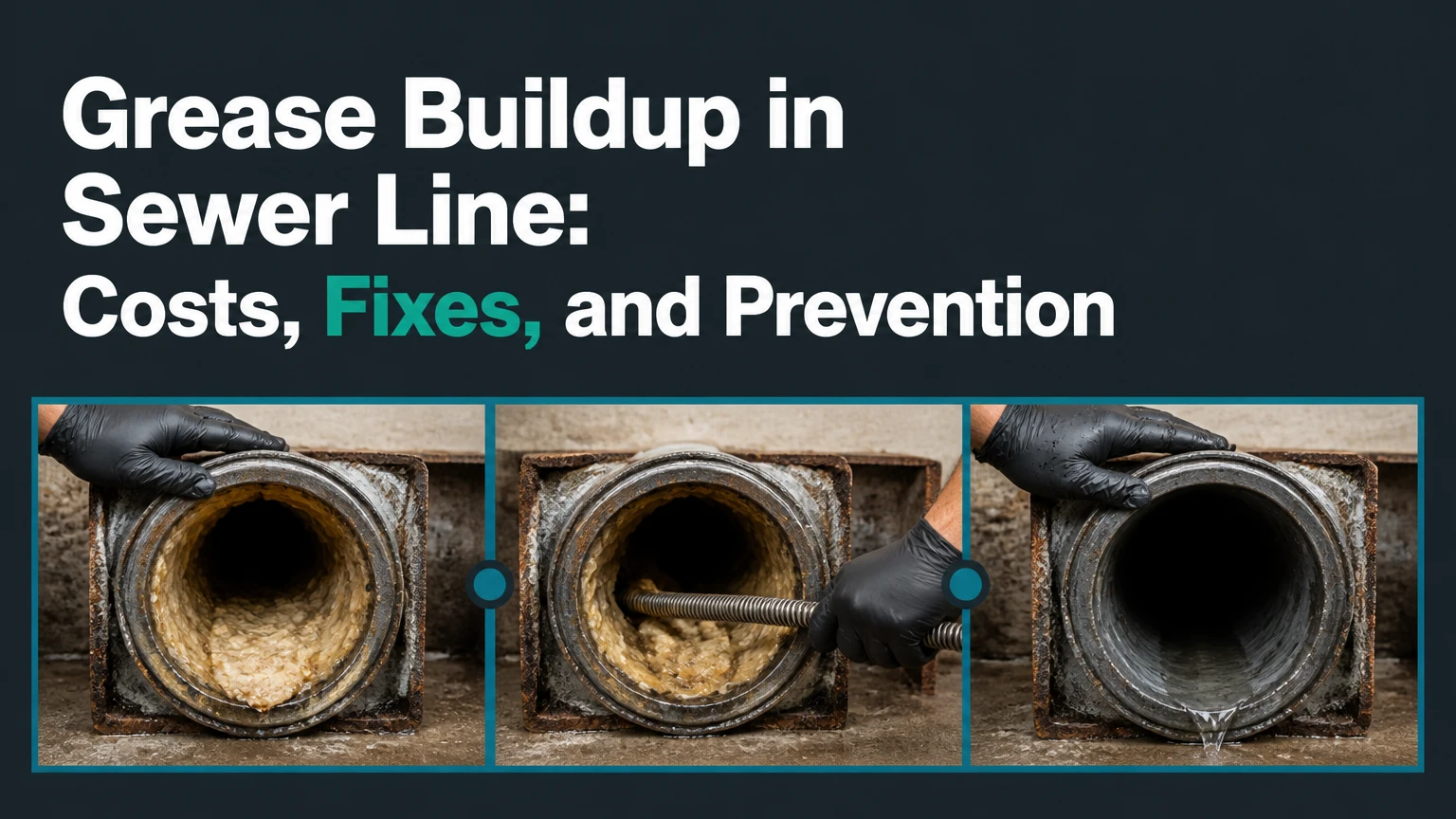
Grease buildup in sewer line systems is a restriction caused by fats, oils, and grease, commonly called FOG, that cool, adhere to pipe walls, and trap wastewater debris. A partial obstruction usually requires professional inspection and cleaning, while a total backup demands immediate water isolation and prompt sewer service because sewage can contaminate floors, walls, and fixtures.
Key facts at a glance
FOG enters sewer pipes from cooking oil, meat drippings, butter, sauces, dairy residue, and food particles.
A drain snake can restore flow by punching a passage through grease but often leaves the pipe wall coated.
Hydro jetting cleans more of the pipe circumference, but a camera inspection should precede high-pressure cleaning in older or damaged lines.
Enzyme and bacterial products are maintenance aids, not reliable solutions for a fully blocked sewer lateral.
Typical residential grease-line cleaning costs range from $150-$900, depending on access, blockage location, inspection, and cleaning method.
Repeated blockages every few months usually indicate residual grease, roots, pipe damage, poor slope, or an unresolved source problem.
What Is Grease Buildup in a Sewer Line?
Grease buildup in a sewer line is a layer of fats, oils, and grease that narrows the wastewater passage and eventually combines with solids, wipes, hair, sand, and other debris. FOG may remain liquid near a hot kitchen drain, but it becomes more viscous and adherent as wastewater travels through cooler branch drains and buried laterals.
A sewer restriction is different from a simple sink clog. A sink trap may hold a localized plug, whereas a sewer-line obstruction can affect toilets, showers, floor drains, laundry fixtures, and multiple apartments at once. In commercial kitchens, the same material can accumulate downstream of a grease interceptor when the interceptor is undersized, poorly maintained, bypassed, or hydraulically overloaded.
The US Environmental Protection Agency identifies FOG as a major contributor to sanitary sewer overflows because deposits narrow pipes and combine with other flushed materials. Local utilities often use their own FOG ordinances, so commercial pumping intervals and discharge limits vary by jurisdiction.
How Does Grease Become a Sewer Blockage?
Grease becomes a sewer blockage through cooling, adhesion, accumulation, and debris capture. Saponification can harden some grease deposits when fatty acids react with alkaline substances and calcium, but the process is not required for a serious obstruction and should not be treated as the universal explanation for every fatberg.
The typical sequence is:
- Discharge: Cooking oil, pan drippings, sauces, and food residue enter a fixture or floor drain.
- Cooling: Wastewater loses heat as it moves through traps, walls, crawl spaces, and buried pipe.
- Adhesion: Sticky fats coat rough or scaled surfaces, especially cast iron, clay joints, and partially obstructed sections.
- Layering: New grease adheres to the existing film, reducing the effective internal diameter.
- Debris capture: Solids, paper products, wipes, hair, grit, and food particles lodge in the sticky layer.
- Hydraulic restriction: Wastewater moves slowly, air pressure changes, and upstream fixtures begin to gurgle or back up.
Pipe temperature, grease type, flow velocity, pipe roughness, and slope determine how quickly deposits form. PVC and ABS have smoother surfaces than corroded cast iron, but smooth plastic does not make a line immune to FOG. A low-flow pipe with poor pitch can retain grease longer than a properly sloped older line.
A fatberg is a large hardened mass of FOG and trapped waste, but most residential obstructions are smaller wall deposits or sludge-like accumulations rather than literal underground rock formations.
Where Does Sewer-Line Grease Come From?
Household kitchens, restaurants, food processors, apartment buildings, and improperly connected commercial fixtures are the main FOG sources. The highest-risk materials include bacon fat, beef drippings, frying oil, gravy, mayonnaise, butter, cream, cheese residue, peanut butter, and oily food particles.
| Source | Typical FOG material | Common entry point | Typical consequence |
|---|---|---|---|
| Home kitchen | Bacon fat, butter, cooking oil | Kitchen sink or disposal | Branch-drain restriction |
| Restaurant fryer | Used fryer oil | Floor sink or indirect waste receptor | Interceptor overload |
| Commercial dishwashing | Plate grease and sauces | Three-compartment sink | Downstream lateral buildup |
| Apartment building | Combined cooking discharge | Shared stack or building drain | Multiple-unit slow drainage |
| Food processor | Animal fat and process solids | Industrial drain or lift station | High-strength wastewater restriction |
Garbage disposals increase the amount of suspended food material but do not remove oil. Finely chopped food can travel farther into the line, where it combines with grease and forms a denser deposit.
Dishwashers can worsen an existing restriction because they discharge hot, soapy water rapidly. The temporary heat may move soft grease downstream, where the deposit cools again.
What Are the Warning Signs of a Grease-Blocked Sewer Line?
The most useful warning signs are several slow fixtures, recurring backups after snaking, gurgling during discharge, and rancid odors from drains. One slow kitchen sink usually indicates a local branch problem, while simultaneous changes at toilets, tubs, showers, and laundry fixtures point toward a building drain or sewer lateral.
Symptoms that indicate a developing restriction
- Multiple slow fixtures: Two or more fixtures drain slowly during the same period.
- Gurgling: A toilet or sink bubbles when a washing machine, shower, or toilet discharges.
- Recurring blockage: The line fails again within weeks or months after cable cleaning.
- Water-level movement: Toilet water rises when another fixture releases water.
- Rancid odor: A persistent food-oil smell comes from a floor drain or cleanout.
- Backup at the lowest fixture: Wastewater appears first in a basement floor drain or low shower.
- Overflow at a cleanout: Sewage leaks from an exterior access point during fixture use.
A sewer backup with sewage exposure is an urgent sanitation issue. Stop using toilets, sinks, tubs, dishwashers, and washing machines, keep people and pets away from contaminated water, and contact a licensed plumber or the local sewer utility.
How Is Grease Buildup Diagnosed?
Grease buildup is diagnosed by separating a local fixture clog from a building drain or sewer-lateral restriction, then confirming the pipe condition with a camera when access and severity justify it. A professional typically tests affected fixtures, locates the cleanout, measures the obstruction distance, and uses a CCTV camera to identify grease, roots, breaks, or a sagging pipe.
A practical diagnostic sequence
- Map the affected fixtures. Record which fixtures back up and whether they share a wall, stack, or branch.
- Check accessible traps and cleanouts. A blocked trap can mimic a sewer-line failure.
- Determine ownership boundaries. The private lateral usually runs from the building to the municipal connection, but local rules differ.
- Run a camera inspection. The camera shows deposit thickness, cracks, offsets, root intrusion, standing water, and pipe material.
- Measure the restriction. Sonde locating or camera distance identifies excavation or cleaning access points.
- Verify the result. A second camera pass or controlled flow test confirms that the line is open and structurally intact.
A camera is especially valuable when the line has failed repeatedly, the property predates approximately 1970, or the pipe is clay, cast iron, Orangeburg, or visibly deformed. A camera does not remove grease, and hydro jetting does not repair a collapsed or badly bellied pipe.
Which Method Removes Grease Most Effectively?
Hydro jetting is usually the most complete cleaning method for a structurally sound sewer line because pressurized water scours deposits from the pipe wall instead of creating a narrow tunnel through them. Mechanical cabling is faster and less expensive for an urgent opening, while biological products fit prevention and chemical cleaners have the narrowest safety margin.
| Method | Typical residential cost | Typical service time | Best use | Main limitation |
|---|---|---|---|---|
| Mechanical cable | $150-$400 | 45-90 minutes | Immediate flow restoration | Leaves wall coating |
| Hydro jetting | $350-$900 | 1-3 hours | Broad grease removal | Requires sound pipe |
| Biological treatment | $40-$100 per gallon | 2-6 weeks | Preventive maintenance | Does not clear total blockage |
| Caustic cleaner | $20-$60 per application | 15-30 minutes | Limited local residue | Burn and pipe-damage risk |
| Pipe repair or replacement | $1,000-$15,000+ | 1 day to several weeks | Structural failure | Does not replace source control |
Mechanical snaking
A drain cable with a grease cutter opens a passage through the obstruction. The method is appropriate when wastewater must flow immediately, the line is fragile, or a camera indicates a localized soft blockage that does not require full-wall cleaning.
Snaking is not equivalent to descaling. A cable may leave a substantial grease ring, and the opening can close again when new FOG and solids pass through. Repeated snaking is often a symptom of incomplete cleaning rather than bad luck.
Hydro jetting
Hydro jetting uses a pump, hose, and nozzle with forward and rear-facing jets. Typical residential equipment operates around 1,500-4,000 psi and 2-18 gallons per minute, although technicians select pressure and flow according to pipe size, access, deposit type, and condition.
The nozzle direction matters. Rear jets propel the hose and carry loosened material toward the access point, while forward jets cut through the restriction. A technician should control wastewater discharge and prevent removed grease from entering another blocked section or a storm drain.
Hydro jetting can damage fragile, cracked, heavily corroded, or displaced pipes. High pressure also cannot correct a collapsed section, severe root intrusion with broken joints, or a low spot that repeatedly retains solids.
Biological and enzyme treatments
Bacterial and enzyme products can reduce fresh organic residue over time when used as labeled and allowed adequate contact time. These products do not reliably liquefy a hardened sewer obstruction, and claims that bacteria convert all grease directly into water and carbon dioxide oversimplify real wastewater conditions.
Avoid biological additives when a local authority prohibits them in grease traps or interceptors. A product that helps a household drain may disrupt commercial interceptor maintenance, mask a plumbing defect, or violate discharge requirements.
Chemical drain cleaners
Sodium hydroxide and acidic drain cleaners can generate heat and react with organic material, but chemical action does not make a damaged sewer pipe safe. Chemicals can injure occupants and technicians, corrode metal, attack joints, and create dangerous vapors when mixed with bleach, acids, or other cleaners.
Never use a chemical cleaner in a standing-water sewer backup before professional service. Tell the plumber exactly what product and quantity entered the line.
Winner by condition: Hydro jetting wins for complete cleaning of a sound line; cabling wins for a quick opening in a vulnerable line; biological treatment wins only for prevention; chemical cleaners are generally the least desirable sewer-line option.
How Much Does Grease-Line Cleaning Cost?
Typical residential grease-line cleaning costs $150-$900, while commercial mainline cleaning commonly costs $1,000-$3,000 or more. Camera inspection, difficult cleanout access, emergency timing, line length, pipe condition, disposal requirements, and excavation can change the final price substantially.
| Service situation | Typical price | Typical duration | Cost drivers |
|---|---|---|---|
| Single kitchen branch cable | $150-$300 | 30-90 minutes | Trap access and distance |
| Residential mainline cable | $200-$500 | 45-120 minutes | Cleanout and obstruction depth |
| Residential hydro jetting | $350-$900 | 1-3 hours | Pipe diameter and grease thickness |
| CCTV inspection | $150-$500 | 30-90 minutes | Camera length and locating |
| Restaurant lateral jetting | $750-$2,000 | 2-5 hours | Grease volume and disposal |
| Commercial mainline service | $1,000-$3,000+ | 3-8 hours | Diameter, access, traffic control |
| Excavation or replacement | $1,000-$15,000+ | 1 day to several weeks | Depth, surface, structural damage |
A low quote may cover only cable access and flow restoration. Ask whether the estimate includes camera inspection, jetting, locating, cleanup, disposal, after-hours fees, and a written condition report.
What Should You Do Before a Plumber Arrives?
Before a plumber arrives, stop wastewater use, protect occupants from sewage, and expose the cleanout without opening a pressurized cap. Do not pour boiling water, acid, lye, degreaser, or additional biological product into a backed-up line.
Use this emergency sequence:
- Stop all water use in the affected building.
- Close toilet lids and keep children and pets away.
- Shut off the water supply to a fixture that may refill.
- Photograph the backup and identify the lowest affected fixture.
- Find the exterior cleanout only if it is safely accessible.
- Do not stand over or force open a bulging cleanout cap.
- Call the municipal utility if neighbors also have backups.
- Disclose every chemical used in the line to the service technician.
If sewage has contacted drywall, insulation, carpet, electrical outlets, or porous wood, professional remediation may be necessary. Cleaning a visible floor without removing contaminated porous material can leave a persistent health hazard.
How Can You Prevent Grease Buildup?
The most effective prevention method is source control: keep FOG out of the drain, remove food solids before washing, and maintain any required interceptor. Monthly enzyme dosing cannot compensate for repeated oil discharge, an undersized grease trap, a damaged lateral, or a pipe with poor slope.
Residential prevention
- Let pan grease cool and place it in a sealed container or trash.
- Scrape plates into the garbage before washing.
- Wipe oily pans with paper towels.
- Collect used frying oil for a local recycling program.
- Do not rely on boiling water to transport grease safely.
- Use a sink strainer to catch solids.
- Schedule cleaning when a line repeatedly backs up.
A small amount of residue from a wiped pan is materially different from pouring a cup of liquid oil into the sink, but repeated small discharges still matter in a shared building drain.
Commercial kitchen prevention
Restaurants should dry-scrape plates, use drain screens, maintain grease traps or interceptors, train staff, and keep pumping records. The widely used “25% rule” means a grease interceptor should be serviced when combined grease and solids reach 25% of the liquid depth, but the enforceable requirement comes from the local sewer authority.
| Commercial control | Typical operating target | Verification record |
|---|---|---|
| Interior grease trap | Pump every 30 days or local interval | Manifest and service date |
| Exterior interceptor | Pump every 90 days or local interval | Waste volume and inspection |
| Drain screens | Clean each shift | Shift checklist |
| Plate scraping | 100% of food-service stations | Training audit |
| Mainline jetting | Every 3-12 months by history | CCTV or service report |
| FOG inspection | Monthly manager review | Corrective-action log |
The correct interval is based on measured accumulation, kitchen volume, interceptor size, and local code. A fixed 30-day schedule is a common starting point, not a universal legal rule.
Multi-family buildings and rentals
Property managers should identify shared stacks, prohibit chemical drain openers, document recurring fixtures, and provide tenants with FOG instructions. A building-wide backup deserves a coordinated response because one tenant’s kitchen discharge can affect a shared horizontal main.
Landlords and tenants should check the lease, local plumbing code, and utility boundary before assigning responsibility. A private lateral blockage is often the owner’s responsibility, while a municipal-main obstruction usually belongs to the utility, but exceptions are common.
What Problems Can Look Like Grease?
Roots, collapsed joints, pipe bellies, mineral scale, foreign objects, and excessive paper can mimic grease buildup. A sewer camera is the reliable way to distinguish a soft FOG restriction from a structural defect that cleaning alone cannot solve.
| Camera finding | Likely cause | Cleaning result | Required next action |
|---|---|---|---|
| Thick smooth wall coating | Grease deposit | Jetting usually improves flow | Source control and monitoring |
| Hair-like intrusions at joints | Tree roots | Temporary opening possible | Root treatment, repair, or replacement |
| Standing water over a long section | Belly or poor grade | Deposit may recur | Survey and structural correction |
| Offset or separated joint | Ground movement | Cleaning does not restore alignment | Spot repair or relining |
| Flaking interior wall | Cast-iron corrosion | Jetting may remove scale | Gentle cleaning and condition review |
| Flattened dark pipe | Orangeburg collapse | Cable may worsen damage | Replacement planning |
| Dense hard obstruction | Concrete, debris, or fatberg | Specialized cutting may help | Locate, remove, and inspect |
Expert rules of thumb
- A blockage that returns after 30-90 days is evidence of a remaining cause, not a successful permanent repair.
- Hydro jetting before a camera inspection is risky when the building has fragile clay, Orangeburg, severely corroded cast iron, or unknown pipe condition.
- A “flushable” wipe is not a grease treatment. Its fibers can reinforce a FOG mass and create a stronger obstruction.
- Hot water changes grease temporarily; it does not remove the total mass unless the material stays suspended and reaches an appropriate treatment system.
When Should You Call the Sewer Utility?
Call the sewer utility when several nearby properties have simultaneous backups, sewage emerges from a public manhole, or the problem appears beyond the private property connection. Call a plumber when only one property is affected, the blockage is inside the private lateral, or the utility confirms that its main is operating normally.
Ask the utility where its maintenance responsibility ends. Some jurisdictions own the main and part of the lateral, while others place the entire private connection on the property owner. Insurance policies may also distinguish sudden water damage from gradual maintenance failure.
FAQ
Can baking soda and vinegar remove sewer-line grease?
Baking soda and vinegar rarely remove a substantial sewer-line grease deposit. Their foaming reaction may loosen light residue near a fixture, but the reaction does not provide the sustained mechanical force needed to clean a long lateral. Use source control and professional cleaning for recurring or multi-fixture restrictions.
Does boiling water dissolve grease permanently?
Boiling water can liquefy some grease briefly, but it does not guarantee removal from the sewer line. The material may cool farther downstream and adhere again, especially in a long, shaded, poorly sloped, or partially blocked pipe. Hot tap water is not a substitute for cleaning.
Can grease clog a septic system?
Grease can overload a septic tank, restrict inlet or outlet components, and reduce treatment performance. Never pour cooking oil or fat into a septic drain. Septic maintenance depends on tank size, occupancy, solids accumulation, and local recommendations, so a pumping schedule should come from inspection history rather than a universal interval.
How often should a residential sewer line be hydro jetted?
A residential sewer line should be hydro jetted when inspection and service history show recurring deposits, not automatically every year. Properties with repeated FOG-related backups may need cleaning every 12-24 months, while a properly managed line may require no routine jetting for many years.
Can grease damage PVC sewer pipe?
Grease usually restricts PVC rather than chemically damaging the plastic, but aggressive chemical cleaners can harm connected components, seals, or surrounding materials. PVC lines can also contain poor joints, bellies, or construction debris that collect grease. A camera inspection identifies whether cleaning or repair is appropriate.
Who pays for a grease blockage in a sewer lateral?
Payment usually depends on the blockage location, ownership boundary, lease terms, and local utility rules. A homeowner commonly pays for a private building drain or lateral, while the sewer authority handles its public main. Obtain the utility’s determination and a plumber’s camera location before authorizing excavation.
The Bottom Line
Grease buildup in sewer line systems develops when FOG cools, adheres to pipe walls, and captures solids until wastewater flow narrows or stops. Stop water use during a backup, distinguish a local clog from a shared-line failure, and use CCTV inspection when recurrence or old pipe materials make the diagnosis uncertain.
For a sound pipe, hydro jetting generally provides the most complete grease removal. Snaking is a practical emergency opening but often leaves residue, biological products support prevention rather than emergency clearing, and caustic chemicals create avoidable hazards. The durable solution combines verified cleaning with disciplined FOG disposal, interceptor maintenance, and correction of roots, pipe damage, poor slope, or other conditions that cause deposits to return.