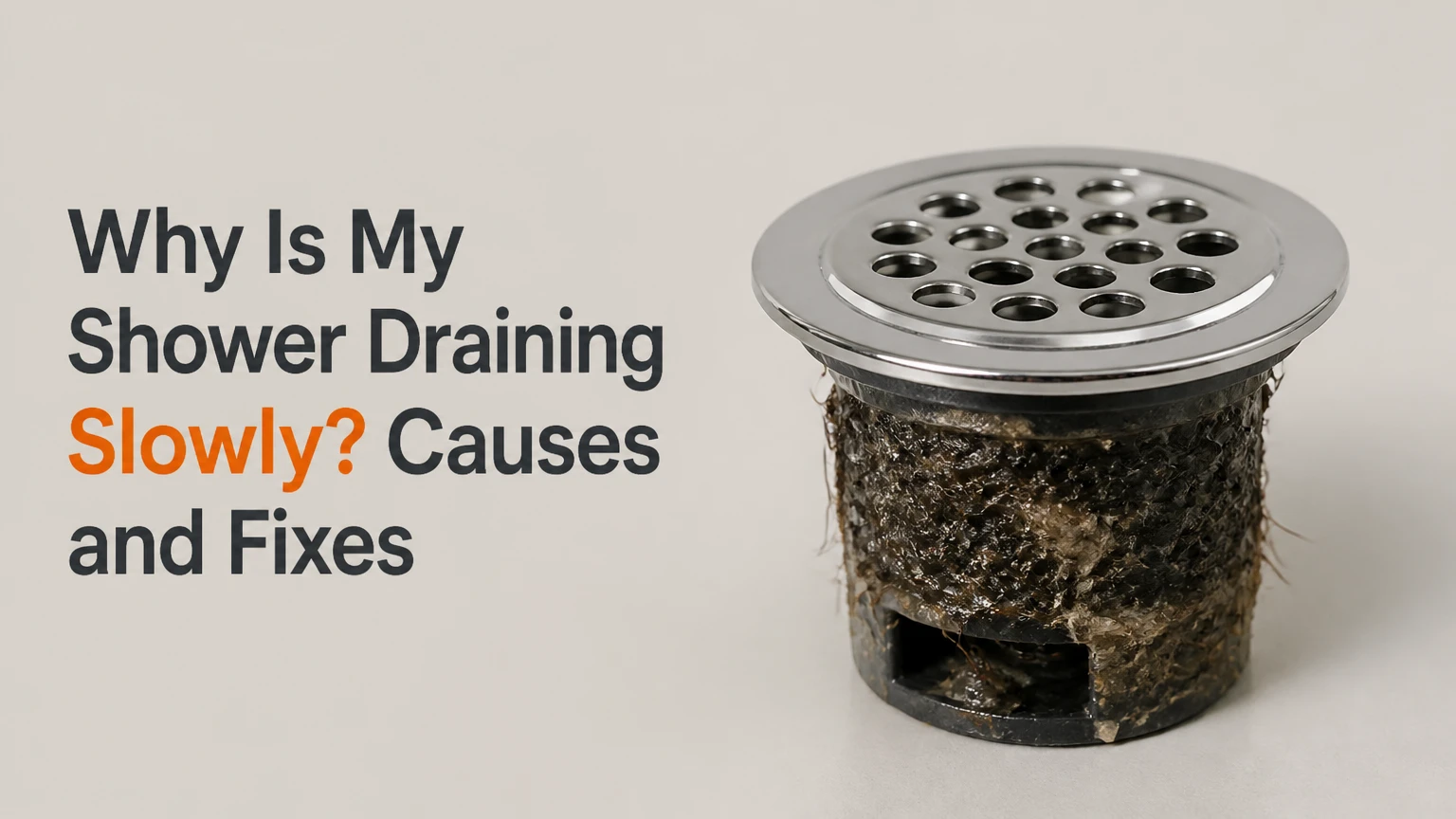
A shower drains slowly because hair, soap residue, mineral scale, or another restriction has reduced wastewater flow through the strainer, P-trap, drain line, or vented plumbing system. The most common blockage is a hair-and-soap plug near the drain opening or P-trap, but gurgling, sewage odor, or multiple slow fixtures can indicate a deeper main-line or vent problem.
Key Facts at a Glance
- A shower drain should remove water faster than the showerhead supplies it, or the shower pan will begin to fill.
- Hair usually collects in the strainer or P-trap, while mineral scale and construction debris can restrict deeper pipe sections.
- A flat cup plunger needs a watertight seal; a toilet flange plunger is usually the wrong tool for a shower floor.
- Use hot tap water for testing, not boiling water, because extreme heat can damage some acrylic pans, seals, and plastic components.
- Slow drainage in several fixtures usually indicates a downstream drain-line problem rather than a shower-only clog.
- A recurring blockage, sewage smell, toilet bubbling, or water backing up into another fixture warrants professional diagnosis.
What Is Causing the Slow Drain?
A partial blockage is the usual cause of a slow shower drain, and the restriction most often consists of hair bound together with soap, body oil, skin cells, and mineral deposits. The opening may look clear while the obstruction sits several inches below the grate, where it catches new debris and gradually narrows the passage.
A showerhead commonly supplies about 1.5-2.5 gallons per minute (GPM). Older or unrestricted showerheads may supply more. When the drain can discharge less water than the fixture supplies, water accumulates on the shower floor even though the pipe is not completely blocked.
The blockage can occur in four locations:
- At the strainer: Hair, lint, and visible soap residue sit directly below the cover.
- Inside the P-trap: A dense hair matrix or soap plug occupies the U-shaped trap.
- In the branch drain: Scale, sludge, grout, or a displaced pipe joint restricts the horizontal line.
- In a shared drain or vent system: A larger downstream obstruction or inadequate venting affects several fixtures.
A partially blocked drain is a flow problem, not necessarily a pipe-capacity problem. A clear 2-inch pipe can carry far more water than a residential shower supplies under ideal conditions, but real drainage depends on slope, fittings, air movement, pipe condition, and the size and texture of the obstruction.
How Does a Shower Drainage System Work?
A shower drain uses gravity to move wastewater through the strainer, trap, branch drain, and building drain while the plumbing vent admits air and helps prevent pressure fluctuations. The P-trap retains water after each shower, creating a seal that blocks sewer gases from entering the bathroom.
The normal route is:
Shower pan → strainer → P-trap → branch drain → larger building drain → sewer or septic system
The strainer catches larger material but cannot stop every hair from entering the pipe. The P-trap is the first low point and therefore a common place for heavy debris to settle. The vent does not pull water through the drain like a pump; it balances air pressure as water moves through the piping.
Residential shower drains commonly use a 2-inch waste connection in newer construction, while some older installations and tub-shower combinations use 1.5-inch piping. Local plumbing codes, fixture design, and building age determine what is permitted. A smaller or poorly configured drain can show symptoms sooner when hair and soap reduce the usable opening.
A horizontal drain generally needs a consistent slope, often 1/4 inch per foot under plumbing-code practice, although the applicable code depends on jurisdiction and pipe size. Too little slope can leave sediment in the line; excessive slope can allow water to outrun solids in some drainage configurations.
Which Materials Usually Block a Shower Drain?
Hair is the most common physical material, but hair rarely acts alone. Soap scum, body oils, mineral scale, skin debris, and grout particles combine into a sticky plug that is stronger than any one material by itself.
| Material | Where it collects | Typical symptom | Best first response |
|---|---|---|---|
| Hair and lint | Strainer or P-trap | Slow drain with no odor | Plastic hair-removal tool |
| Bar-soap residue | P-trap and branch line | Gradual slowing, white or gray film | Mechanical removal, then hot tap-water flush |
| Body oil and skin debris | Sludge around hair | Pooling after several minutes | Auger after surface cleaning |
| Calcium and magnesium scale | Older metal or hard-water pipes | Recurring restriction, gritty deposits | Plumber inspection or descaling |
| Grout, mortar, or drywall dust | New renovation drain line | Slow drain soon after construction | Professional cleaning |
| Tree roots or collapsed pipe material | Buried building drain | Several fixtures affected | Camera inspection and repair |
Bar soap usually leaves more insoluble residue than many liquid body washes, but liquid products can still combine with oils and hair. Hard water makes the problem worse because dissolved calcium and magnesium can form deposits on rough metal or mineral-coated pipe surfaces.
A new shower that drains slowly from its first use suggests an installation or construction problem rather than accumulated hair. Common causes include mortar entering the drain, an improperly aligned trap, insufficient slope, or a drain connection that was not fully opened.
What Does the Pooling Time Tell You?
Pooling immediately after the shower starts usually points to a restriction near the strainer or P-trap, while water that backs up only after several minutes more often indicates a partial blockage farther along the branch drain. Timing is useful evidence, but it cannot locate a clog precisely without a camera or inspection.
| Observed symptom | Likely location | Confidence | Next diagnostic action |
|---|---|---|---|
| Water pools within 10-30 seconds | Strainer or trap | High | Remove cover and inspect |
| Drain works briefly, then slows | Partial branch-line plug | Moderate | Use a plastic tool, then auger |
| Drain improves after removing hair | Surface or trap blockage | High | Flush and install a hair catcher |
| Gurgling accompanies slow flow | Vent or downstream restriction | Moderate | Check other fixtures |
| Toilet bubbles during shower use | Shared drain or vent | High | Stop using water and call plumber |
| Sewage returns through shower | Downstream building drain | High | Avoid chemical cleaners and seek service |
A bucket test can estimate fixture flow. Collect shower water for 10 seconds in a container, multiply the gallons by six, and compare the result with the showerhead rating. For example, 0.33 gallons in 10 seconds equals approximately 2.0 GPM. This test does not measure drain capacity, but it explains why a restriction may become visible under a high-flow shower and disappear under a low-flow trickle.
How Can You Clear a Slow Shower Drain?
Clear a slow shower drain from the least invasive method to the most forceful: remove visible debris, test with hot tap water, plunge with a proper seal, and use a hand auger only when the blockage remains. The best method depends on the obstruction’s depth, the drain design, and whether other fixtures are affected.
Before You Start
| Requirement | Typical value | Notes |
|---|---|---|
| DIY time | 15-45 minutes | Longer if the drain cover is corroded |
| Difficulty | Low to moderate | Augering requires controlled pressure |
| Basic cost | $5-$25 | Plastic tool, gloves, and cup plunger |
| Auger cost | $20-$60 | Typical 15-25-foot hand auger |
| Safety equipment | 2 pairs of gloves, eye protection | Keep chemical residue in mind |
| Materials | Bucket, flashlight, cloth, hot tap water | Do not mix cleaners |
Step 1: Remove the Strainer and Pull Out Debris
Remove the drain cover with the correct screwdriver, then shine a flashlight into the opening and pull out visible hair with needle-nose pliers or a plastic barbed drain tool. Do not push the material deeper, because a hair clump below the trap can become harder to retrieve.
Work slowly around the opening, especially when the grate is attached to a fragile plastic drain body. Put extracted debris in a sealed bag rather than washing it into a sink or toilet.
You will know it worked when: water begins moving faster immediately after the debris is removed.
Common mistake: forcing a screwdriver against a corroded screw and damaging the drain cover or surrounding finish.
Step 2: Flush With Hot Tap Water
Run the hottest tap water available for 3-5 minutes after removing surface debris. Hot water can soften soap residue and body oils, but it will not dissolve a dense hair plug or repair a damaged pipe.
Avoid pouring a kettle of boiling water into the drain. Boiling water can soften certain plastic components, stress acrylic shower pans, damage sealants, and create a burn hazard if water rebounds from a blocked opening. Hot tap water is the safer test.
You will know it worked when: the water level remains stable during a normal shower-flow test.
Common mistake: treating temporary improvement as proof that the entire blockage has gone.
Step 3: Plunge the Drain With a Flat Cup
Add enough water to cover the lip of a flat cup plunger, then press the plunger over the drain to create a seal. Pump 10-15 times with controlled strokes, lift the plunger, and test the flow; repeat for up to three cycles.
A tub-shower combination requires a second step. Remove the overflow cover and seal the overflow opening with a damp cloth before plunging, or pressure will escape through the overflow rather than moving the blockage.
You will know it worked when: the water level drops rapidly after the final lift.
Common mistake: using a toilet plunger with a projecting flange, which usually cannot seal properly over a flat shower drain.
Step 4: Use a Hand Auger Carefully
Feed a 1/4-inch hand auger through the drain opening, rotate the handle clockwise, and advance gradually when you feel resistance. A typical 15-25-foot auger is adequate for many shower branch-line clogs, but the tool may not negotiate every trap configuration.
When the cable catches, rotate it several times before withdrawing it slowly. Clean the cable between passes and run hot tap water for several minutes afterward. Never force the auger through a rigid obstruction, because aggressive pressure can damage brittle cast iron, old galvanized pipe, seals, or a plastic drain body.
You will know it worked when: the cable retrieves hair or sludge and the drain accepts a continuous flow without rising.
Common mistake: pushing a cable blindly when another fixture is backing up, because the blockage may be beyond the shower branch.
Which Drain-Clearing Method Should You Use?
A plastic hair tool is the safest first choice for a visible surface clog, while a plunger suits a soft blockage and a hand auger offers greater reach for a persistent physical obstruction. Enzyme products may help with maintenance, but chemical drain openers are a poor default for a shower containing standing water.
| Method | Reach or action | Typical time | Typical cost | Main limitation |
|---|---|---|---|---|
| Plastic barbed tool | 12-24 inches, captures hair | 5-10 minutes | $5-$12 | Cannot clear deep scale |
| Flat cup plunger | Pressure pulse at drain | 5-15 minutes | $8-$20 | Requires watertight seal |
| 15-25-foot hand auger | Mechanical extraction | 15-45 minutes | $20-$60 | Can damage pipes if forced |
| Enzyme treatment | Slow biological digestion | 8-24 hours | $10-$30 | Does not remove thick hair mats |
| Caustic or acid cleaner | Chemical reaction | 15-60 minutes | $8-$25 | Burn, fume, and pipe risks |
| Professional cable machine | Deeper mechanical cleaning | 30-90 minutes | $150-$500 typical | Service cost and access limits |
Enzyme cleaners are maintenance products, not reliable emergency clog removers. Product claims that an enzyme treatment is safe for all plumbing should be treated cautiously, because compatibility also depends on concentration, standing time, septic arrangements, and any cleaner already present.
Chemical drain openers can cause serious skin and eye injuries and can react dangerously with bleach, acids, or other products. A plumber working on a chemically treated drain may face a hidden splash hazard, so disclose the product and timing before requesting service.
Are Vent Problems Causing the Slow Drain?
A blocked or poorly configured vent can contribute to slow drainage, but a shower-only slowdown without gurgling is more likely to come from a physical drain restriction. Vent trouble becomes more plausible when several fixtures drain slowly, traps lose water, or the system makes bubbling and sucking sounds.
The vent allows air into the drainage system as wastewater moves away. If the vent is obstructed by debris, ice, an animal nest, or an installation defect, pressure changes can interfere with flow and produce gurgling. A vent problem is not normally fixed by inserting a small auger through the shower drain.
Do not climb onto a wet or steep roof to inspect a vent. A licensed plumber can test venting from accessible cleanouts, inspect roof penetrations safely, or use a camera and smoke or pressure testing where appropriate.
What If Other Fixtures Are Affected?
When a shower, bathtub, toilet, or bathroom sink becomes slow at the same time, suspect a shared branch drain, building drain, or sewer lateral rather than an isolated shower clog. Water backing up into the lowest fixture is a particularly strong sign that the restriction lies downstream of several connections.
Use this pattern to narrow the problem:
- Only the shower is slow: Start at the strainer, P-trap, and shower branch.
- Shower and tub are slow: Check their shared branch or nearby cleanout.
- Toilet bubbles during shower use: Stop running water and arrange professional service.
- Several bathrooms are slow: Treat the problem as a main drain or sewer issue.
- Water backs up after laundry discharge: The building drain may be restricted farther downstream.
Avoid repeatedly flushing toilets or running washing machines when wastewater is already rising. Additional flow can turn a manageable restriction into an overflow that damages flooring, cabinets, and subfloor materials.
How Do Tub-Shower Combinations Differ?
A tub-shower combination usually has an overflow opening and a longer waste path, so plunging requires sealing the overflow and the drain may be harder to access than a standalone shower drain. The tub stopper, trip lever, waste shoe, and overflow tube can also trap debris or interfere with an auger.
Remove the stopper or strainer according to its design before using a plastic hair tool. If plunging, cover the overflow plate firmly with a damp cloth. If the tub has a built-in stopper operated by a lever, do not force the mechanism with an auger unless you understand its position and removal method.
A tub that drains normally when the shower runs at low flow but backs up under a full-flow shower often has a partial restriction rather than a total obstruction. A tub that remains slow after surface cleaning may need access through the overflow opening or a nearby cleanout.
Why Does the Drain Keep Slowing Down?
A shower drain keeps slowing down when the underlying hair source, pipe scale, slope problem, or recurring soap-and-oil accumulation remains in place after a small opening is cleared. Repeatedly extracting the visible hair can restore flow temporarily while leaving a narrowing deposit deeper in the line.
Prevention works best when it matches the cause:
- Install a removable hair catcher that fits the drain without reducing the outlet opening.
- Empty the catcher after every several showers, or daily in a high-use bathroom.
- Rinse the drain with hot tap water for 1-2 minutes weekly.
- Remove and wash the catcher rather than pushing its contents into another drain.
- Record recurring symptoms, especially after renovation or plumbing work.
- Arrange inspection if the drain slows again within days of mechanical cleaning.
A hair catcher cannot solve mineral scale, a collapsed pipe, or an incorrect slope. It also cannot replace the drain cover if the opening is part of a certified waterproofing system, so select a compatible accessory rather than wedging an improvised screen into the drain.
When Should You Call a Plumber?
Call a plumber when mechanical cleaning fails, the drain repeatedly clogs, multiple fixtures are affected, wastewater smells strongly of sewage, or water backs up into another fixture. Professional service becomes more appropriate when the pipe is inaccessible, the plumbing is old and fragile, or chemical cleaner has already entered the system.
| Situation | DIY attempt appropriate? | Likely professional action | Typical service range |
|---|---|---|---|
| Visible hair at grate | Yes | None if cleared | $0-$20 |
| One slow shower after basic cleaning | Usually | Cable cleaning if needed | $100-$300 |
| Recurring clog every few weeks | Limited | Camera or deeper line cleaning | $200-$600 |
| Several fixtures backing up | No | Main-line clearing or inspection | $200-$800 |
| Suspected broken or collapsed pipe | No | Camera, excavation, or repair | $500-$5,000+ |
| Chemical cleaner already used | Avoid further DIY | Safe extraction and flushing | Varies by hazard |
Prices vary substantially by region, access, time of day, and whether the plumber must remove a fixture or use a camera. Ask whether the quoted price includes travel, cable cleaning, camera inspection, and any follow-up repair.
Tenants should photograph standing water, report the issue in writing, and use only non-invasive methods permitted by the lease. Homeowners can attempt surface removal, plunging, and cautious hand augering, but should stop when resistance suggests a fragile or inaccessible pipe.
What Mistakes Make a Slow Drain Worse?
The most damaging mistakes are forcing a cable, mixing chemicals, plunging without sealing the overflow, and assuming temporary flow improvement means the restriction is gone. Each mistake either increases safety risk or pushes the obstruction farther into a harder-to-access section.
Mixing Drain Chemicals
Never combine an acid cleaner with a caustic product, bleach, or another drain treatment. Chemical reactions can generate heat, fumes, or splashes, and a later plunger stroke can force corrosive liquid back onto skin.
Using a Wire Hanger
A wire hanger can scratch a finished drain, snag a seal, or push hair deeper without removing the plug. A flexible plastic tool is cheaper and better suited to shallow hair.
Applying Excessive Auger Force
A hand auger should advance through rotation and moderate pressure. If the cable stops abruptly, withdraw it slightly, rotate, and reassess rather than forcing it through a trap or joint.
Ignoring a Waterproofing Detail
Removing a drain assembly or cutting surrounding sealant can compromise the shower pan or waterproof membrane. Drain covers are removable; the bonded drain body is not a casual DIY component.
Repeating Enzyme Treatments Indefinitely
An enzyme product cannot correct a failed slope, a blocked vent, scale buildup, or a collapsed line. A recurring symptom needs diagnosis, not an endless maintenance cycle.
FAQ
Can low water pressure cause a shower drain to slow down?
Low water pressure usually makes a shower drain more slowly only because less water enters the pan, so it does not create a blockage. If the drain is visibly pooling despite weak spray, the drain has a restriction or the shower pan has a drainage-design problem. Test the shower flow with a bucket before diagnosing the drain.
Is baking soda and vinegar effective for shower clogs?
Baking soda and vinegar may loosen a small amount of surface residue, but the reaction does not reliably remove a compact hair plug or mineral scale. Mechanical extraction is more predictable and avoids leaving a chemical mixture behind a blockage. Do not use the combination after a commercial drain cleaner has entered the pipe.
How long should a shower take to drain?
A clear shower drain should normally prevent persistent standing water during ordinary flow, although a thin film may remain on a poorly pitched shower floor. A useful practical test is whether the water level rises continuously during a 2-minute full-flow test. If it does, the drain cannot keep up with the fixture.
Why does my shower drain slowly only in the morning?
Morning-only slowing can result from overnight cooling of soap and body-oil residue, heavier household water use, or a shared drain receiving flow from another fixture. If the problem occurs only during peak household use, test the shower when no other water is running. Continued symptoms suggest a partial downstream restriction.
Can a shower drain clog without hair?
A shower drain can clog without hair because soap scale, mineral deposits, grout, construction debris, pipe corrosion, and foreign objects can reduce the opening. A new installation with immediate poor drainage is especially suspicious for debris, slope, trap, or connection problems rather than hair accumulation.
What is the safest drain cleaner for an older home?
Mechanical cleaning is the safest first approach for an older home because it avoids exposing fragile metal, seals, and unknown pipe materials to corrosive chemicals. Use a plastic tool, flat cup plunger, or carefully controlled hand auger. Stop if the pipe leaks, the cable snags, or wastewater backs up elsewhere.
The Bottom Line
The answer to why is my shower draining slowly is usually a partial hair-and-soap blockage near the strainer or P-trap. Remove visible debris, use hot tap water, plunge with a proper seal, and then auger cautiously if necessary. If the drain keeps slowing, several fixtures are involved, or sewage backs up, the restriction may be in the vent, shared branch, building drain, or sewer lateral, and professional diagnosis is the safer fix.