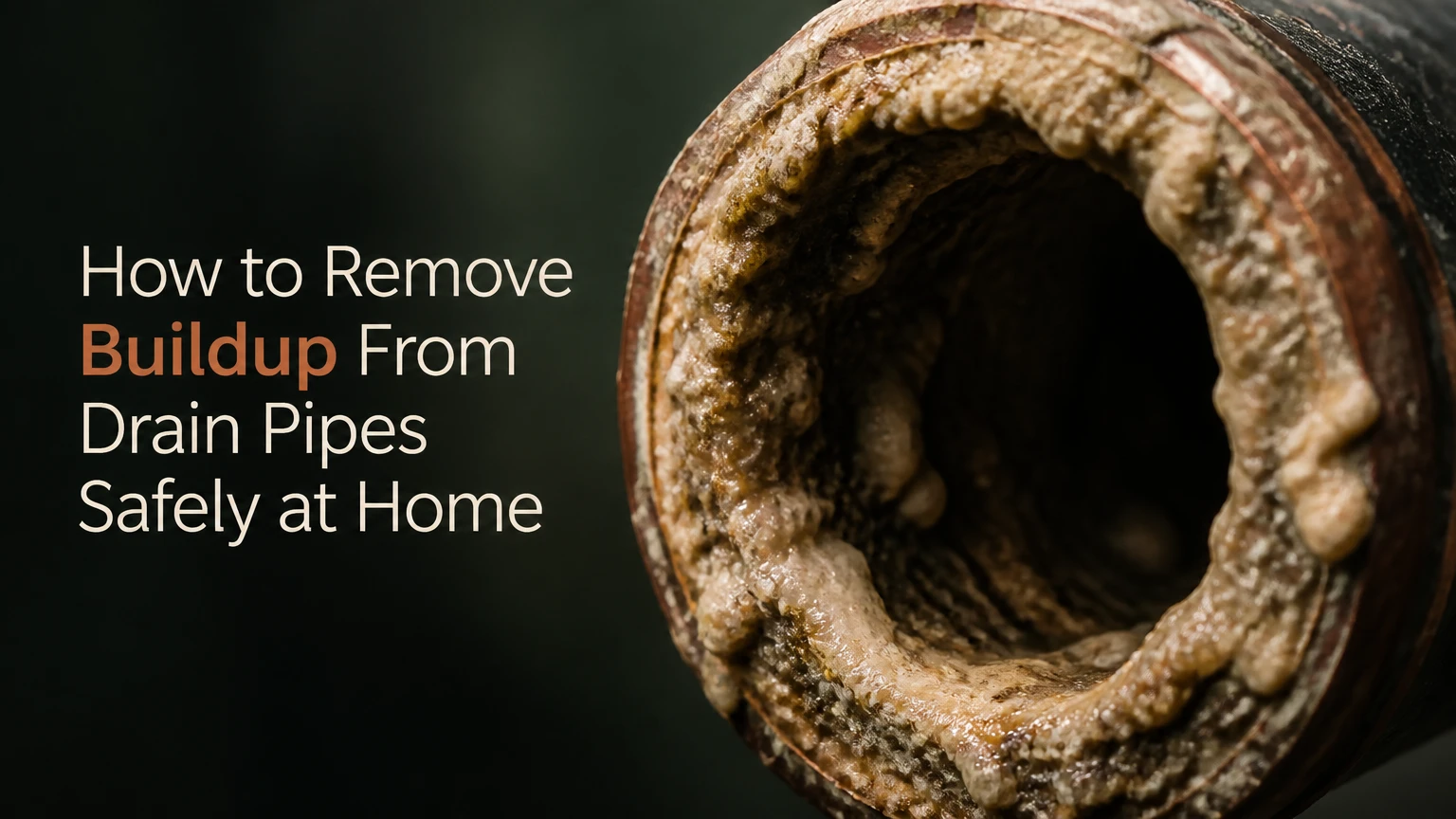
To remove buildup from drain pipes, identify whether the material is grease, hair, soap, food, biofilm, or mineral scale, then use a trap cleanout, hot tap-water flush, plunger, hand auger, or biological cleaner suited to that material. Severe scale, recurring blockages, old pipes, or multiple slow drains usually require professional mechanical cleaning or camera-guided hydro-jetting.
Key Facts
Drain buildup commonly combines grease or soap film with hair, food particles, sediment, and mineral scale.
A hand auger physically removes localized obstructions, while an enzyme cleaner slowly digests organic residue.
Baking soda and vinegar can deodorize and agitate light residue, but they rarely clean an entire pipe wall.
Household boiling water is not a universal solution; hot tap water is safer for unknown plumbing and glued plastic joints.
Multiple fixtures slowing at the same time indicate a downstream branch line or main sewer problem.
Never mix drain chemicals, and never use a plunger after adding a caustic or acidic drain opener unless the product label specifically permits it.
How Do You Identify Drain Buildup?
Drain buildup is material attached to the inside of a waste pipe, while a single obstruction is usually a discrete object or compact mass. Buildup tends to cause progressively slower drainage, recurring clogs, greasy residue, or odor that returns after a temporary opening.
A kitchen drain commonly accumulates fats, oils, grease, starch, coffee grounds, and food particles. Shower and bathtub drains more often contain hair combined with soap scum and skin oils. Bathroom sinks collect toothpaste, shaving residue, hair, and biofilm. Laundry lines can accumulate lint, detergent residue, and sediment.
Match the symptom to the likely material
| Symptom | Likely buildup | Best first action | Typical result time |
|---|---|---|---|
| Kitchen drain slows after cooking | Grease and food film | Trap cleaning plus hot tap-water flush | 20-40 minutes |
| Shower drain stops around the strainer | Hair and soap scum | Remove cover and pull hair mechanically | 10-20 minutes |
| Bathroom sink smells but still drains | Biofilm in stopper or overflow | Scrub stopper and overflow opening | 15-30 minutes |
| White, gritty flakes appear | Calcium carbonate scale | Mechanical cleaning or professional descaling | 30 minutes to several hours |
| Several fixtures slow together | Branch or main-line restriction | Stop fixture use and inspect cleanout | Same day assessment |
A useful diagnostic is timing. If the drain improves briefly and then slows again within hours or days, material may have shifted downstream, or a thick coating remains on the pipe wall. A single hair wad usually does not create that pattern.
Why Does Buildup Form Inside Drain Pipes?
Drain buildup forms when sticky residue catches solids and water chemistry hardens the deposit. Temperature changes make kitchen grease more viscous or solid, while calcium and magnesium in hard water can precipitate as scale on rough or corroded pipe surfaces.
Grease often enters a sink as a warm liquid. The drain line is cooler, so the grease coats the pipe and catches food particles. In wastewater treatment literature, the term “fatberg” describes hardened masses of fats combined with wipes and other solids, but a household branch drain normally contains a smaller grease-and-debris obstruction rather than a city-sewer fatberg.
Soap scum behaves differently. Hard-water ions react with fatty-acid soaps and form an insoluble residue that clings to shower and bathroom piping. Mineral scale then narrows the opening, creates a rough surface, and gives new organic material more places to attach.
The U.S. Environmental Protection Agency recommends keeping fats, oils, and grease out of household drains because they can accumulate in plumbing and sewer systems. That prevention rule addresses the binding layer rather than the later mechanical removal problem.
What Should You Do Before Cleaning?
Before cleaning a drain, determine the affected fixture, inspect the visible opening, identify the pipe material if possible, and avoid adding chemicals until you choose a method. Preparation takes 10-15 minutes and prevents chemical exposure, splash injuries, and damage to fragile fittings.
Before-you-start checklist
| Item | Typical quantity or specification | Purpose |
|---|---|---|
| Bucket | 10-20 liters | Captures P-trap water and sludge |
| Slip-joint pliers | 1 pair, adjustable | Loosens hand-tightened trap nuts |
| Hand auger | 3-6 meters for fixtures | Reaches branch-pipe obstructions |
| Rubber plunger | 1 correctly sized cup | Uses hydraulic pressure on soft clogs |
| Protective equipment | Gloves and eye protection | Prevents contact with contaminated water |
| Enzyme cleaner | Label-directed dose | Digests organic residue overnight |
Place towels around the cabinet or floor drain. Remove standing water with a cup if the water level is high. If a commercial drain opener was used recently, stop and read the safety data and label instructions before touching the trap or inserting a cable.
Do not work on a drain connected to a garbage disposal while the disposal is energized. Turn off the electrical switch, and disconnect power at the breaker when hands or tools could enter the disposal chamber.
Step 1: Clean the Strainer, Stopper, and P-Trap
Remove the visible drain hardware and clean the P-trap before treating the deeper pipe. Localized sludge commonly sits in the trap, so trap cleaning can restore flow without chemicals or a long auger.
For a sink, place a bucket under the P-trap. Loosen the slip nuts by hand or with pliers, keeping the washers in their original positions, then lower the trap and empty it into the bucket. Scrub the trap with a bottle brush and rinse it outdoors or into a separate container.
Check the trap for corrosion, cracks, flattened washers, and hardened deposits. Replace damaged washers before reassembly. Tighten plastic slip nuts by hand, then add only a small additional turn with pliers; excessive force can split the fitting.
Success checkpoint: Fill the sink with 2-3 liters of water and confirm that the trap does not leak.
Common mistake: Removing the trap without supporting it, which can stress the tailpiece or damage a brittle nut.
For a shower or bathtub, remove the strainer and pull accessible hair with a plastic drain tool or long-nose pliers. Do not force a rigid object through a trap that you cannot see.
Step 2: Flush Grease With Hot Tap Water
Flush grease and soap residue with hot tap water, not automatically with boiling water. Run the hottest safe tap water for 3-5 minutes while adding a small amount of dish detergent, because detergent helps disperse fresh grease before it cools again.
A full kettle of boiling water can damage some fittings, soften certain thermoplastic components temporarily, or loosen poorly made joints, although a short hot-water exposure does not automatically destroy PVC. The risk depends on temperature, duration, pipe condition, and whether the water contacts a vulnerable trap or glued connection.
Do not use hot water as the primary treatment for a completely blocked line. Water can back up and expose the user to scalding. Remove standing water first, and use a plunger or auger when flow is absent.
Success checkpoint: The water drains continuously without a rising level after the fixture receives 2-3 liters.
Common mistake: Pouring boiling water into a sealed or fully blocked drain, where pressure and scalding risk increase.
Step 3: Use a Plunger or Hand Auger
Use a plunger for a soft, nearby obstruction and a hand auger for hair, compact debris, or buildup beyond the trap. Mechanical tools provide more predictable results than chemical reactions because they retrieve or break apart the material rather than merely changing its chemistry.
For a sink with an overflow opening, cover the overflow with a wet cloth. Add enough water to cover the plunger cup, center the cup over the drain, and make 10-15 firm strokes while maintaining a seal. On a double-bowl sink, block the second opening.
To use a hand auger, feed the cable slowly until resistance appears. Rotate the handle clockwise while advancing 5-10 centimeters at a time, then withdraw the cable periodically to clean the tip. Avoid ramming the cable, particularly in thin-walled copper, heavily corroded cast iron, or galvanized pipe.
Success checkpoint: The drain accepts a continuous stream for 60 seconds, and the cable returns with less residue on repeated passes.
Common mistake: Pushing a clog farther into the branch line without retrieving the loosened material.
A 3-meter auger is often adequate for a sink or shower branch. A recurring obstruction beyond that reach may require a longer sectional machine, a cleanout, or a camera inspection.
Step 4: Apply an Enzyme Cleaner to Organic Film
Apply a labeled biological or enzyme drain treatment overnight after restoring partial flow. Enzyme products work on organic residue such as grease, hair proteins, and food film, but they do not dissolve calcium carbonate scale, metal fragments, roots, or plastic objects.
Follow the product label rather than estimating a stronger dose. Most treatments require 8-24 hours of contact time, and heavy organic residue may need applications over one or two weeks. Avoid flushing the product immediately with disinfectant, bleach, or a caustic drain opener because those chemicals can kill the microorganisms or create a hazardous reaction.
Enzyme cleaners are maintenance products, not emergency clog removers. Their main value is gradual reduction of biodegradable film after physical flow has been restored.
Success checkpoint: Odor and drainage improve over several applications without chemical fumes or repeated blockage.
Common mistake: Expecting an enzyme product to open a completely full drain within minutes.
Does Baking Soda and Vinegar Remove Drain Buildup?
Baking soda and vinegar can loosen light surface residue and reduce some odors, but the reaction does not reliably strip thick grease or mineral scale from an entire drain pipe. The acid-base reaction produces carbon dioxide, water, and sodium acetate, so much of the fizz is gas formation rather than a powerful cleaning compound.
For minor residue, place about 100 grams of baking soda in a mostly dry drain, add approximately 240 milliliters of white vinegar, cover the opening for 10-15 minutes, and flush with hot tap water. Do not seal a drain tightly with a rigid cap because gas pressure can stress weak connections.
Vinegar may soften small amounts of carbonate scale, but household contact time and concentration are usually insufficient for heavy deposits. Never combine vinegar with bleach or a commercial drain cleaner. The resulting chemical reaction can produce toxic gases or dangerous heat.
Which Drain-Cleaning Method Should You Choose?
The best method depends on the material, pipe condition, access point, and whether the restriction is local or deep. Mechanical cleaning is usually the safest first-line option for a household blockage, while hydro-jetting is more thorough for extensive grease or scale in a structurally sound line.
| Method | Best material or problem | Typical time | Typical cost in the USA |
|---|---|---|---|
| Trap cleaning | Sink sludge and food debris | 20-40 minutes | $0-$25 |
| Plunger or hand auger | Hair and soft local clogs | 10-60 minutes | $8-$80 |
| Enzyme treatment | Organic maintenance film | 8-24 hours | $10-$30 per bottle |
| Caustic drain opener | Label-approved organic clog | 15-60 minutes | $8-$25 |
| Professional cable machine | Deep branch obstruction | 30-120 minutes | $150-$500 |
| Hydro-jetting | Grease, sediment, extensive wall coating | 1-3 hours | $500-$1,500 |
Prices vary by country, access, emergency timing, and line length. The figures above are typical consumer ranges, not a universal service tariff.
When are chemical drain cleaners appropriate?
Chemical drain cleaners are a last-resort product for a compatible, accessible fixture line, not a routine buildup treatment. Sodium hydroxide products can break down some fats and proteins, while acidic formulations may attack organic matter, but both can burn skin and eyes and remain dangerous in standing water.
| Cleaner type | Primary action | Main limitation | Key safety condition |
|---|---|---|---|
| Sodium hydroxide | Converts fats and attacks proteins | Poor on objects, roots, and heavy scale | Follow label and avoid mixing |
| Sulfuric acid | Dehydrates and reacts with organic mass | High heat and severe burn risk | Professional use is safer |
| Enzyme or bacterial | Digests biodegradable residue | Slow and ineffective on minerals | Needs contact time |
| Vinegar solution | Mildly dissolves carbonate residue | Weak against grease and thick scale | Never mix with bleach |
| Dish detergent and hot water | Disperses fresh grease | Cannot remove established blockage alone | Use only with safe flow |
Chemical products do not normally “melt PVC” under every use condition, but heat, concentration, repeated exposure, and poor installation can damage plastic components, seals, or metal pipe. Chemical residue also makes later plunging, trap removal, and cable work more hazardous.
When Is Hydro-Jetting Better Than Snaking?
Hydro-jetting is better than snaking when a professional has confirmed a structurally sound line with broad grease, sludge, sand, or scale attached around much of the pipe circumference. A cable usually creates a passage through an obstruction, whereas a properly selected jet nozzle washes material from the pipe wall.
Professional equipment commonly operates around 1,500-4,000 PSI, but pressure at the nozzle is not a guarantee of safety or cleaning quality. The technician must choose pressure, nozzle angle, flow rate, and access point for the pipe diameter and condition.
A camera inspection is especially important before jetting old clay, galvanized, badly corroded cast-iron, or damaged lines. Hydro-jetting cannot repair separated joints, collapsed pipe, severe root intrusion, or structural defects. It can expose those defects by removing the material that was temporarily masking them.
Practitioner rule: A drain that repeatedly clears with a cable but returns within weeks often needs diagnosis and wall cleaning, not a stronger chemical dose.
How Do Pipe Materials Change the Method?
Pipe material determines how much mechanical force, heat, and chemical exposure the system can tolerate. PVC and ABS tolerate ordinary household drain use but still depend on sound glued joints, while old cast iron and galvanized steel may have fragile internal corrosion that a forceful tool can worsen.
| Pipe material | Common age or location | Preferred approach | Avoid |
|---|---|---|---|
| PVC | Modern residential branches | Trap cleaning, plunger, hand auger, labeled enzyme | Repeated high-heat or harsh chemical use |
| ABS | Drain and vent systems | Mechanical cleaning and hot tap water | Prolonged boiling-water exposure |
| Copper | Older interior waste lines | Gentle hand auger and inspection | Aggressive cable force |
| Cast iron | Older homes and stacks | Camera-guided cable or controlled jetting | Unsupervised acid and forceful ramming |
| Galvanized steel | Pre-1970 homes | Inspection before cleaning | Chemical openers and rigid force |
| Clay or Orangeburg | Older underground laterals | Camera inspection and specialist equipment | High pressure without pipe assessment |
Unknown pipe material is a reason to start conservatively, not a reason to use a stronger cleaner. Renters should report recurring or multi-fixture problems to the property manager before opening a trap or using chemicals.
What Changes for Kitchen, Shower, and Main Drains?
Kitchen buildup responds best to grease control, trap cleaning, and mechanical removal, while shower buildup usually responds to hair extraction at the strainer. Main-line restrictions require a different access point because fixture-level remedies cannot reach the entire sewer lateral.
Kitchen sink
Scrape plates into the trash, wipe greasy pans with paper, and collect cooking oil in a container. Clean the P-trap first, then use a plunger or auger. A garbage disposal does not make grease, rice, pasta, coffee grounds, or fibrous waste safe for the drain.
Shower or bathtub
Remove the cover and extract hair before using any liquid treatment. A monthly inspection of the strainer prevents a large hair-and-soap matrix from forming deeper in the trap.
Bathroom sink
Clean the stopper, pivot rod, and overflow channel. Toothpaste and soap residue often produce odor at the fixture opening even when the branch pipe remains open.
Laundry drain
Check for a loose lint filter, excessive detergent, or a partially blocked standpipe. Suds and discharge water can overflow quickly, so do not repeatedly run the washing machine to test a doubtful drain.
Main sewer line
Stop using toilets, showers, washing machines, and sinks when several fixtures back up together. A plumber may need the exterior cleanout, a camera, a motorized auger, or hydro-jetting.
What Common Mistakes Make Buildup Worse?
The most damaging mistakes are chemical mixing, using a tool after pouring caustic cleaner, ignoring the P-trap, and treating a main-line restriction as a fixture clog. Each mistake either increases injury risk or moves the material farther into the plumbing system.
- Mixing products: Never combine bleach, acid, caustic cleaner, ammonia, or vinegar. Toxic gas, violent heat, and pressure can result.
- Using a plunger over chemicals: Chemical splash can injure the face and eyes. Tell a plumber what product entered the line.
- Forcing an auger: Stop when resistance feels rigid or the cable kinks. The obstruction may be a broken pipe, root, or foreign object.
- Ignoring the cleanout: A downstream restriction can make trap work irrelevant and can push contaminated water into the home.
- Flushing grease with cold water: Cold water may harden grease farther along the line instead of removing it.
- Using repeated “maintenance” acid: Corrosion and damaged seals can create leaks that remain hidden behind cabinets or walls.
A short-term improvement is not proof that the pipe is clean. Verify sustained flow and watch the fixture through several normal uses.
When Should You Stop DIY Cleaning?
Stop DIY cleaning when sewage rises from a floor drain, multiple fixtures back up, a toilet gurgles when another fixture runs, or water appears near electrical equipment. Professional help is also appropriate when the blockage returns after one mechanical attempt, the pipe is old or unknown, or a chemical product has already entered the drain.
Call urgently for sewage exposure, a burst pipe, flooding, or suspected sewer collapse. Keep children and pets away from contaminated water, ventilate without creating aerosol spray, and follow local cleanup guidance.
A camera inspection is worthwhile when the same line fails repeatedly, when roots are suspected, or when a home has old cast iron or galvanized plumbing. The camera identifies offset joints, corrosion, scale, bellies, roots, and foreign objects that cleaning alone cannot correct.
How Can You Prevent Drain Buildup From Returning?
Prevent drain buildup by keeping grease, solids, wipes, and hair out of the plumbing, then flush appropriate fixtures with hot tap water and clean removable components regularly. Prevention works best when it targets the material that created the original restriction.
| Fixture | Prevention action | Suggested frequency | Material to keep out |
|---|---|---|---|
| Kitchen sink | Wipe pans and use a sink strainer | Every use | Oil, grease, rice, pasta |
| Shower | Install a removable hair catcher | Empty weekly | Hair and thick soap clumps |
| Bathroom sink | Remove and scrub stopper | Monthly | Hair, floss, cotton swabs |
| Garbage disposal | Run cold water during grinding | Every use | Grease and fibrous scraps |
| Laundry standpipe | Inspect hose and lint control | Every 3-6 months | Lint and excess detergent |
| Main line | Professional inspection if recurring | As symptoms require | Roots and structural debris |
Biological cleaners can support maintenance in organic buildup, but they do not replace proper waste disposal or repair defective pipe grades. Hard-water homes may need water-treatment advice, while scale inside a drain line generally requires mechanical or professional descaling.
Frequently Asked Questions
Can I use a drain snake after baking soda and vinegar?
Yes, a hand auger can follow a baking soda and vinegar treatment after the line is thoroughly flushed with water and no commercial chemical is present. The reaction may loosen surface residue, but the cable performs the actual physical removal. Wear gloves and eye protection because contaminated sludge can splash during retrieval.
Is drain buildup the same as a clog?
No. A clog is a restriction that stops or sharply reduces flow, while buildup is attached residue that progressively narrows the pipe. Buildup can create repeated clogs, but a single toy, wipe, root, or displaced pipe fragment can also block a clean pipe.
How long should an enzyme drain cleaner stay in the pipe?
Most enzyme drain cleaners require 8-24 hours, according to their product labels, and some heavy organic deposits need repeated applications for one or two weeks. Enzymes need contact time and should not be flushed immediately with bleach, disinfectant, or a caustic opener.
Can vinegar dissolve hard-water scale in a drain?
Vinegar can soften small carbonate deposits when it remains in contact with them, but it rarely removes thick or extensive drain scale. A professional descaling process, cable tool, or hydro-jetting service may be needed, particularly when the pipe opening has become visibly narrow.
Why does my drain clog again after cleaning?
A drain that clogs again may contain remaining wall buildup, a downstream obstruction, poor pipe slope, root intrusion, corrosion, or a damaged joint. If the same line fails within days or weeks, request a camera inspection instead of repeating stronger chemical treatments.
Can boiling water damage drain pipes?
Boiling water can stress vulnerable traps, seals, glued joints, or older plastic components, although a brief exposure does not guarantee damage. Hot tap water is the safer default when pipe material and condition are unknown. Never pour boiling water into a fully blocked drain where it can rebound and cause burns.
The Bottom Line
To remove buildup from drain pipes, start with the P-trap and visible hardware, use hot tap water for fresh grease, apply a plunger or hand auger for physical restrictions, and reserve enzyme treatment for slow organic maintenance. Avoid chemical cocktails and aggressive force. Recurring clogs, mineral scale, old plumbing, sewage backup, or multiple slow fixtures justify professional inspection, mechanical cleaning, or camera-guided hydro-jetting.