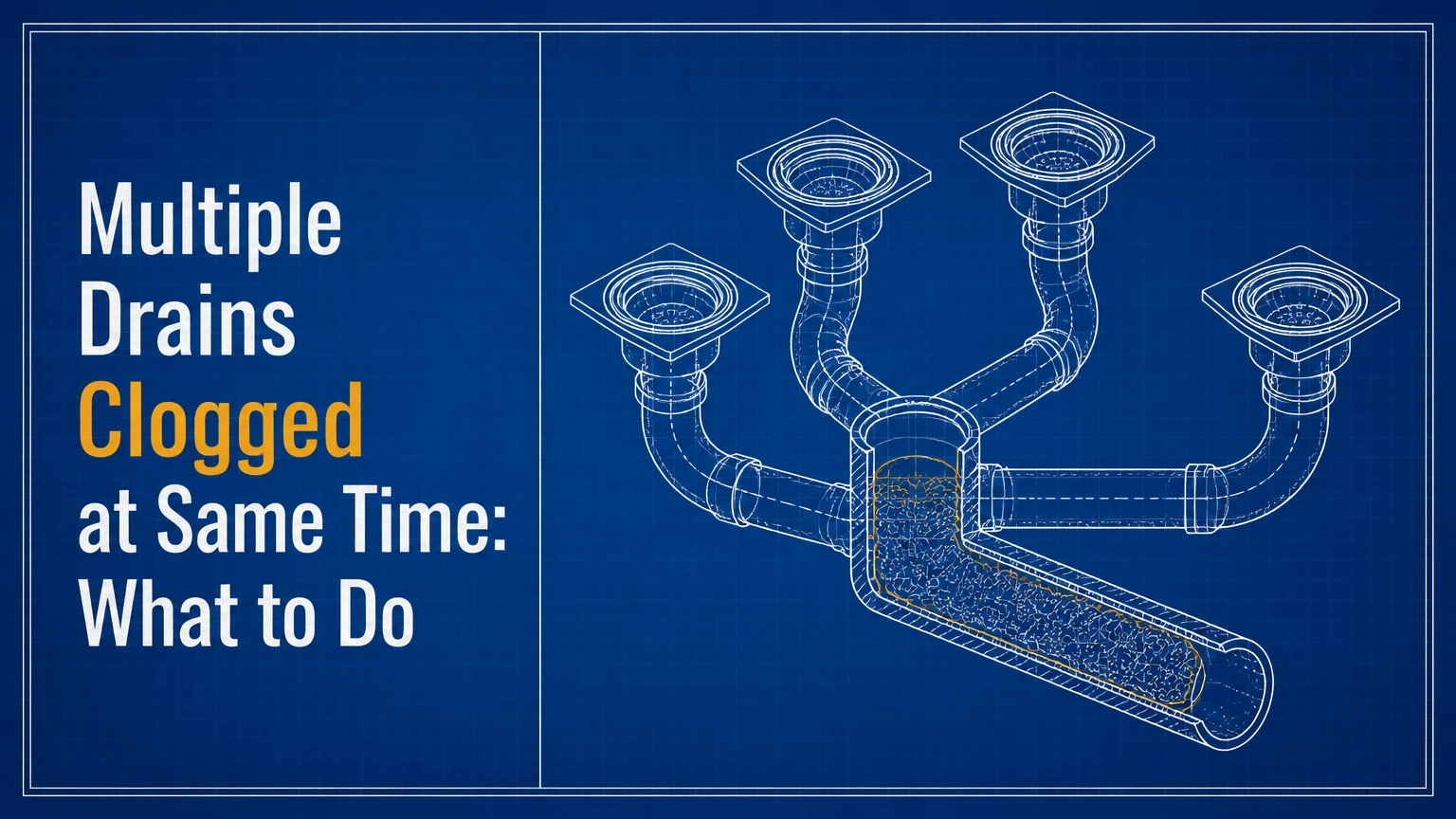
Multiple drains clogged at the same time usually indicate a blockage in a shared branch line, building drain, or main sewer lateral rather than several unrelated fixture clogs. Stop using water immediately, identify which fixtures are affected, and arrange professional diagnosis if wastewater backs up, the lowest fixtures rise, or a cleanout contains standing sewage.
Key Facts at a Glance
- A kitchen sink, bathroom sink, toilet, shower, and laundry drain failing together usually share a downstream obstruction.
- A basement floor drain or first-floor shower that rises first often marks the lowest open relief point, not necessarily the exact clog location.
- A vent obstruction can cause gurgling and slow drainage, but a full wastewater backup more often involves a blocked or damaged drainpipe.
- The household water shutoff does not stop wastewater already inside the drainage system from backing up.
- Water standing at an outdoor cleanout proves the obstruction is downstream of that access point, but it does not by itself prove the city caused the blockage.
- Chemical drain openers are unsafe and usually ineffective when a large pipe contains stagnant wastewater.
Why Are Multiple Drains Clogged at the Same Time?
A shared drainpipe blockage causes multiple drains to fail because several fixtures discharge into the same downstream section of the Drain-Waste-Vent system. When the obstruction sits beyond that junction, new water cannot pass normally, so the pipe fills and wastewater may rise through a toilet, shower, floor drain, or other low opening.
A single sink clog is usually local to the trap or nearby branch. Simultaneous failure changes the diagnosis because the fixtures have a common path. For example, a bathroom group may share a horizontal branch, while the whole house may converge into a larger building drain before the pipe leaves the foundation.
Gravity still drives most residential drainage. Air pressure also matters because vent pipes allow air to enter as water moves through the system. However, the often-repeated claim that every drain must maintain a self-scouring velocity of exactly 2 feet per second is too precise for a general household diagnosis. Actual flow depends on pipe slope, diameter, discharge volume, pipe roughness, and solids.
What Does the Backup Pattern Reveal?
The highest failing fixture often sits upstream of the restriction, while a lower fixture may become the overflow point. A second-floor toilet can appear normal when a basement drain is already filling because the blockage lies below the basement connection.
The pattern is more useful than the timing alone. “At the same time” may mean a sudden complete blockage, or several drains becoming progressively slower over days as grease, scale, roots, or a partially collapsed pipe reduces capacity.
| Affected fixtures | Most likely shared point | Typical interpretation |
|---|---|---|
| Bathroom sink, shower, and toilet | Bathroom branch line | Local bathroom branch obstruction |
| Kitchen sink and laundry standpipe | Kitchen-laundry branch | Grease, lint, or branch-pipe restriction |
| All first-floor fixtures, upper fixtures normal | Building drain below first floor | Main building drain or lower branch blockage |
| Basement floor drain, toilet, and shower | Main drain or sewer lateral | Downstream blockage near or beyond the foundation |
| Several units in one building | Shared building sewer | Common stack, building drain, or municipal connection |
How Can You Tell Which Pipe Is Blocked?
You can narrow the blockage location by comparing fixtures that share a room, floor, stack, or outlet. Affected fixtures confined to one bathroom suggest a branch line; failures across separate rooms and floors suggest the building drain or sewer lateral; gurgling without rising wastewater points more toward venting or a partial restriction.
Do not test the system by repeatedly flushing. A test flush adds more water to a pipe that may already be full. Instead, record the symptoms, shut down water-consuming appliances, and inspect visible standing water from a safe position.
Diagnostic Signs and Their Meaning
| Symptom | Likely location | Confidence and next action |
|---|---|---|
| Toilet bubbles when nearby sink drains | Toilet branch or shared bathroom branch | Moderate; stop use and check another fixture |
| Kitchen sink backs up when washer drains | Kitchen-laundry branch | High for a shared branch restriction |
| Toilets gurgle when any fixture drains | Main drain, sewer lateral, or vent | Moderate; professional assessment is appropriate |
| Basement floor drain rises after an upstairs flush | Downstream building drain or sewer lateral | High; stop all discharge immediately |
| Every fixture is slow but no water rises | Partial drain or vent restriction | Moderate; schedule diagnosis before total failure |
| Backup occurs only after rain | Sewer surcharge, infiltration, or yard drainage | Moderate; compare municipal and private-line conditions |
A toilet that bubbles when the sink drains does not prove the main sewer is blocked. The two fixtures may share a short branch. The symptom becomes more concerning when unrelated fixtures in another room also gurgle or back up.
What Should You Do in the First 10 Minutes?
Stop all water discharge, keep people and pets away from sewage, and prevent electrical contact with contaminated areas. Turn off washing machines, dishwashers, ice makers, and automatic water-treatment equipment, but do not confuse the house water shutoff with a solution to a blocked drain.
Use this sequence:
- Stop flushing and running faucets. Tell everyone in the property to suspend water use.
- Cancel automatic cycles. Stop the washing machine and dishwasher if doing so does not require entering contaminated water.
- Keep electricity away from wastewater. Do not enter a flooded area to operate a breaker; call an electrician or emergency responder if electrical equipment may be affected.
- Close doors to contaminated rooms. Prevent children and animals from contacting sewage.
- Photograph the condition safely. Record affected fixtures, water levels, and visible damage for the plumber, landlord, insurer, or municipality.
- Find the cleanout only if it is safely accessible. Do not open a pressurized or sewage-filled fitting indoors.
- Call the appropriate party. Contact a plumber, building manager, septic contractor, or municipal sewer department according to the situation.
The main water shutoff can prevent fresh tap water from entering the home, but it cannot drain a blocked sewer pipe. It is useful if a supply-side leak is also present, not as a primary response to a wastewater backup.
Which DIY Actions Are Safe?
A plunger may help when one toilet or sink is affected, but plunging is a poor strategy when several fixtures share a full line. A hand auger can address a nearby sink trap, although a typical 15-25-foot household auger may not reach a sewer-lateral obstruction located beyond the foundation.
Avoid chemical openers, caustic soda, acid products, and mixtures of cleaning chemicals. Stagnant wastewater can hold the chemical near the fixture, creating splash and burn hazards for anyone who later removes a trap or cable.
A wet-dry vacuum is not a substitute for drain clearing. It can spread contaminated water, damage household equipment, and leave sewage in porous flooring. Cleanup after a sanitary-sewer backup may require a professional remediation company because porous drywall, insulation, carpet pad, and wood trim can retain pathogens.
How Do You Check the Sewer Cleanout Safely?
A cleanout check can show whether water is trapped upstream or downstream of the access point, but opening a cleanout carries a splash and contamination risk. Use gloves, eye protection, waterproof footwear, and a flashlight; never place your face above the cap or force a cap that resists turning.
A cleanout is commonly a 3- or 4-inch fitting in a basement, crawlspace, garage, yard, or near the property line. Locations vary by construction age and local code. Some homes have multiple cleanouts, and a small capped fitting may serve only a branch.
If water spills when the cap is loosened, the pipe is full at that location and the obstruction is downstream of the cleanout. That downstream section may be on the homeowner’s private lateral, at the property connection, or in the public sewer. The observation does not, by itself, establish municipal responsibility.
If the cleanout is empty while indoor fixtures back up, the blockage may be between the fixtures and the cleanout, or the cleanout may not serve the affected fixtures. A plumber can verify direction and pipe condition with a camera.
What Causes a Main Sewer or Shared Branch Blockage?
Main sewer and branch blockages develop when deposited material, intruding roots, structural damage, or an unsuitable object reduces the pipe’s open area. The cause matters because a cable may restore flow temporarily without correcting roots, pipe collapse, severe scale, or a damaged joint.
Common Causes by Pipe Section
| Cause | Typical location | Warning signs | Durable remedy |
|---|---|---|---|
| Hair and soap residue | Bathroom branch | Shower and lavatory slow together | Local cable cleaning and debris removal |
| Cooking grease and food solids | Kitchen branch or building drain | Kitchen backup after dishwashing | Mechanical cleaning and disposal changes |
| Tree roots | Clay, concrete, or jointed lateral | Recurrent backups every months | Root cutting, jetting, repair, or lining |
| Scale and tuberculation | Older cast-iron pipe | Reduced flow and dark flakes | Camera inspection, cleaning, or replacement |
| Pipe belly or settlement | Buried private lateral | Repeated sediment and standing water | Excavation or engineered rehabilitation |
| Collapse or separated joint | Old or damaged lateral | Sudden total blockage, soil intrusion | Repair or replacement |
| Septic tank or outlet failure | Septic property | Whole-house backup, saturated drainfield | Septic inspection and pumping or repair |
Tree roots do not usually enter an intact modern solvent-welded PVC pipe through the pipe wall. Roots exploit joints, cracks, failed seals, and service connections. That distinction affects whether root cutting is a temporary measure or evidence that the lateral needs structural work.
Grease can remain liquid while warm and harden farther downstream. A kitchen drain may therefore appear functional at the sink while a cooler building drain accumulates a thick deposit. Flushable wipes, paper towels, diapers, and sanitary products can also obstruct lines because “flushable” labeling does not mean rapid breakdown under every sewer condition.
Can a Vent Stack Cause Multiple Drain Problems?
A blocked vent stack can make several fixtures drain slowly, gurgle, or produce trap odors, but a vent blockage is less likely than a drain obstruction to cause a sudden whole-house sewage backup. Vent problems restrict air movement; drain blockages physically restrict wastewater flow.
Common vent obstructions include leaves, bird nesting material, ice, and animal entry. Roof access creates fall and electrical hazards, so homeowners should not climb onto a roof to investigate a suspected vent blockage.
A vent diagnosis becomes more plausible when every fixture is slow, traps lose water, and no fixture produces a rising wastewater level. A drain-line diagnosis becomes more plausible when a toilet bubbles, a floor drain rises, or dirty water appears after another fixture discharges.
Professional plumbers may use a smoke test, camera inspection, or controlled fixture testing. Pouring water into the roof vent is not a reliable cure and can introduce water into an already compromised system.
Which Clearing Method Fits the Blockage?
Mechanical cabling is usually the first practical clearing method for a standard soft blockage, while hydro jetting is better for thick grease, scale, and recurring deposits after pipe condition has been assessed. A camera inspection should precede aggressive equipment when the pipe is old, fragile, repeatedly blocked, or structurally suspect.
| Method | Typical cost | Typical duration | Best application | Main limitation |
|---|---|---|---|---|
| Sink or toilet auger | $25-$150 equipment cost | 15-45 minutes | One nearby fixture | Limited reach and cutting power |
| Motorized sewer cable | $200-$600 service | 1-3 hours | Soft obstruction or root opening | May leave deposits on pipe walls |
| High-pressure hydro jetting | $600-$1,500 service | 2-5 hours | Grease, scale, heavy residue | Can damage compromised pipe |
| Sewer camera inspection | $150-$500 service | 30-90 minutes | Location and condition diagnosis | Does not remove the blockage |
| Excavation or spot repair | $1,500-$8,000 or more | 1-3 days | Collapse, belly, separated joint | Requires digging and site restoration |
Cable machines open a passage by cutting or pushing through material. That restored flow may last weeks, months, or years depending on the cause. A cable cannot repair a collapsed pipe, remove a structural belly, or permanently seal root-entry joints.
Hydro jetting uses pressurized water to scour deposits from pipe walls. It is not automatically the superior choice. A camera may reveal missing pipe sections, severe corrosion, or a clay lateral with unstable joints, where aggressive jetting could worsen the damage.
Practitioner rule: recurrent blockage plus an absent or incomplete camera diagnosis is an unfinished diagnosis, not proof that the line simply needs another cleaning.
What Does Professional Drain Clearing Cost?
Typical US residential pricing ranges from $200-$600 for straightforward sewer cabling and $600-$1,500 for hydro jetting, while camera inspection commonly adds $150-$500. Geographic labor rates, access, after-hours scheduling, pipe depth, cleanout availability, and the required repair can move the final bill substantially.
| Service or repair | Typical price range | Typical timeframe | Price drivers |
|---|---|---|---|
| Emergency diagnostic visit | $100-$300 | 30-90 minutes | Night, weekend, travel, urgency |
| Main-line cable cleaning | $200-$600 | 1-3 hours | Distance, roots, access, machine size |
| Camera inspection | $150-$500 | 30-90 minutes | Recording, locating, difficult access |
| Hydro jetting | $600-$1,500 | 2-5 hours | Pipe size, deposits, water supply |
| Cleanout installation | $1,500-$5,000 | 1-2 days | Excavation depth and surface restoration |
| Spot sewer repair | $1,500-$8,000 | 1-3 days | Depth, material, permits, access |
| Private lateral replacement | $5,000-$20,000 or more | 2-7 days | Length, excavation, paving, landscaping |
These are typical planning ranges, not guaranteed quotations. Ask whether the estimate includes locating the blockage, camera footage, disposal, permits, restoration, and a written explanation of pipe condition.
A low-cost cable clean may be reasonable for a first-time soft blockage with a readily accessible cleanout. A camera-first approach usually offers better value when the home has clay, Orangeburg, brittle cast iron, repeated root intrusion, or a previous unsuccessful cleaning.
What If the Backup Happens During Heavy Rain?
A backup that appears only during heavy rain can result from municipal sewer surcharge, stormwater entering a damaged private lateral, an overwhelmed combined sewer, or a septic system and drainfield unable to accept additional water. The timing does not prove that rain caused a household pipe blockage.
Record whether neighbors experience the same problem and whether the backup contains clear rainwater, sewage, mud, or sediment. Contact the municipal sewer department if multiple properties report simultaneous backups or if the public main appears surcharged.
On a septic property, rain can saturate the soil around the drainfield and reduce effluent absorption. A full septic tank, blocked outlet filter, broken distribution box, or failed lift pump can produce whole-house drainage failure. A septic professional should inspect the tank and system rather than treating the problem as a city sewer clog.
What Changes in Older or Multi-Unit Homes?
Older homes require camera inspection before aggressive cutting or hydro jetting because clay, Orangeburg, and deteriorated cast-iron pipes can fracture, deform, or lose joints. Multi-unit buildings require management notification because wastewater from another unit can travel through a shared stack or building sewer.
| Property situation | First contact | Main diagnostic issue | Avoid |
|---|---|---|---|
| Single-family home on city sewer | Licensed plumber | Private lateral versus public main | Assuming the city owns the entire lateral |
| Single-family home on septic | Septic contractor and plumber | Tank, outlet, drainfield, or house line | Repeatedly flushing to test flow |
| Condominium unit | Building manager or HOA | Shared stack and building drain responsibility | Opening common piping without approval |
| Rented apartment | Landlord or emergency maintenance | Shared riser, unit branch, or municipal sewer | Paying for structural common-area work before reporting |
| Historic home | Plumber with camera equipment | Fragile pipe material and unrecorded alterations | High-pressure cleaning without inspection |
Responsibility varies by lease, condominium documents, local ordinance, and the location of the defect. In many jurisdictions, the homeowner owns the private lateral up to a defined connection point, while the municipality maintains the public main. Verify the boundary with the utility rather than relying on a general rule.
Common Mistakes and How to Fix Them
Repeatedly Flushing an Upper-Floor Toilet
A toilet that still flushes may discharge into a partially open section above the blockage. The added volume can force sewage through a lower floor drain. Stop testing and wait for a plumber to establish the pipe’s capacity.
Pouring Chemical Drain Cleaner Into Standing Water
Chemical cleaner can remain concentrated in stagnant wastewater and injure the person who later opens the trap or uses a cable. Tell the plumber exactly what product was used, and do not mix it with bleach, acids, or other cleaners.
Assuming the Outdoor Cleanout Is the Property Boundary
A cleanout identifies an access point, not an ownership boundary. Water at the cap means the restriction is downstream of that fitting, but the downstream section may still belong to the private lateral.
Choosing Hydro Jetting Without a Camera
High pressure can expose weak joints, erode damaged pipe, or dislodge material that relocates downstream. Camera footage should establish that the pipe can safely tolerate the selected nozzle and pressure.
Cleaning Only the Fixture Trap
Removing a sink trap can clear a local obstruction, but it cannot solve a backup affecting a toilet, shower, and floor drain. Map the affected fixtures before spending time on isolated traps.
Entering Contaminated Water
Sewage can contain pathogens, sharp debris, and electrical hazards. Keep occupants away, isolate the area, and use a qualified remediation provider when porous materials or electrical systems are affected.
When Is a Multiple-Drain Clog an Emergency?
Call for emergency plumbing help when wastewater is actively rising, sewage has reached living space, toilets overflow without use, or the lowest drain is filling rapidly. Also escalate immediately when contaminated water approaches electrical panels, furnaces, water heaters, or other energized equipment.
A same-day appointment is appropriate for widespread slow drainage, repeated toilet gurgling, or a full cleanout. A routine appointment may be adequate for two mildly slow fixtures with no odor, overflow, or standing water, provided household water use remains minimal.
The practical threshold is risk, not inconvenience. A small backup can spread through flooring, drywall, insulation, and stored belongings within one appliance discharge cycle.
FAQ
Can several clogged drains clear by themselves?
A partial blockage can temporarily pass water when deposits shift, but spontaneous flow does not remove roots, scale, grease, or a damaged pipe. Treat temporary improvement as a warning, especially if toilets still gurgle or the lowest drain smells like sewage. Recurrence usually requires inspection rather than repeated plunging.
Should I call the city when my basement drain backs up?
Call the city sewer department when nearby properties have the same problem, the public main is visibly surcharged, or the utility’s policy requires a public-side inspection. Call a plumber first when only your property is affected. The ownership boundary varies by location and may not align with the nearest cleanout.
How long can I wait before getting a plumber?
Do not wait when wastewater is rising or several fixtures are completely blocked. For slow multi-fixture drainage without overflow, arrange service within 24-48 hours and reduce water use. A partial main-line restriction can become a complete blockage when a washing machine releases a large discharge.
Will a blocked vent make a toilet overflow?
A blocked vent can contribute to poor flushing, gurgling, slow drainage, and trap siphoning, but a toilet overflow usually involves a fixture trap or drain restriction. If dirty water rises in several fixtures, investigate the building drain or sewer lateral before blaming the roof vent.
Does homeowners insurance cover a sewer backup?
Coverage depends on the policy, endorsement, cause, and local terms. Standard policies may exclude sewer backup unless a specific endorsement applies, while damage from a sudden pipe break may receive different treatment. Photograph conditions, prevent further damage safely, and notify the insurer before discarding damaged materials.
How can I prevent another multi-drain blockage?
Keep grease, wipes, paper towels, and sanitary products out of the drainage system, maintain accessible cleanouts, and investigate recurring slowdowns promptly. Homes with documented root intrusion may need periodic inspection or cleaning, but a maintenance schedule should follow camera findings rather than an arbitrary interval.
The Bottom Line
Multiple drains clogged at the same time usually point to a shared branch, building drain, or main sewer lateral obstruction. Stop water use, protect people from wastewater, map the affected fixtures, and use the cleanout only when it can be opened safely. Choose cabling for many ordinary blockages, request camera inspection for recurring or older-pipe problems, and reserve hydro jetting for sound pipes with deposits that require full-wall cleaning. Treat multiple drains clogged at same time as a system diagnosis, not a collection of unrelated sink problems.