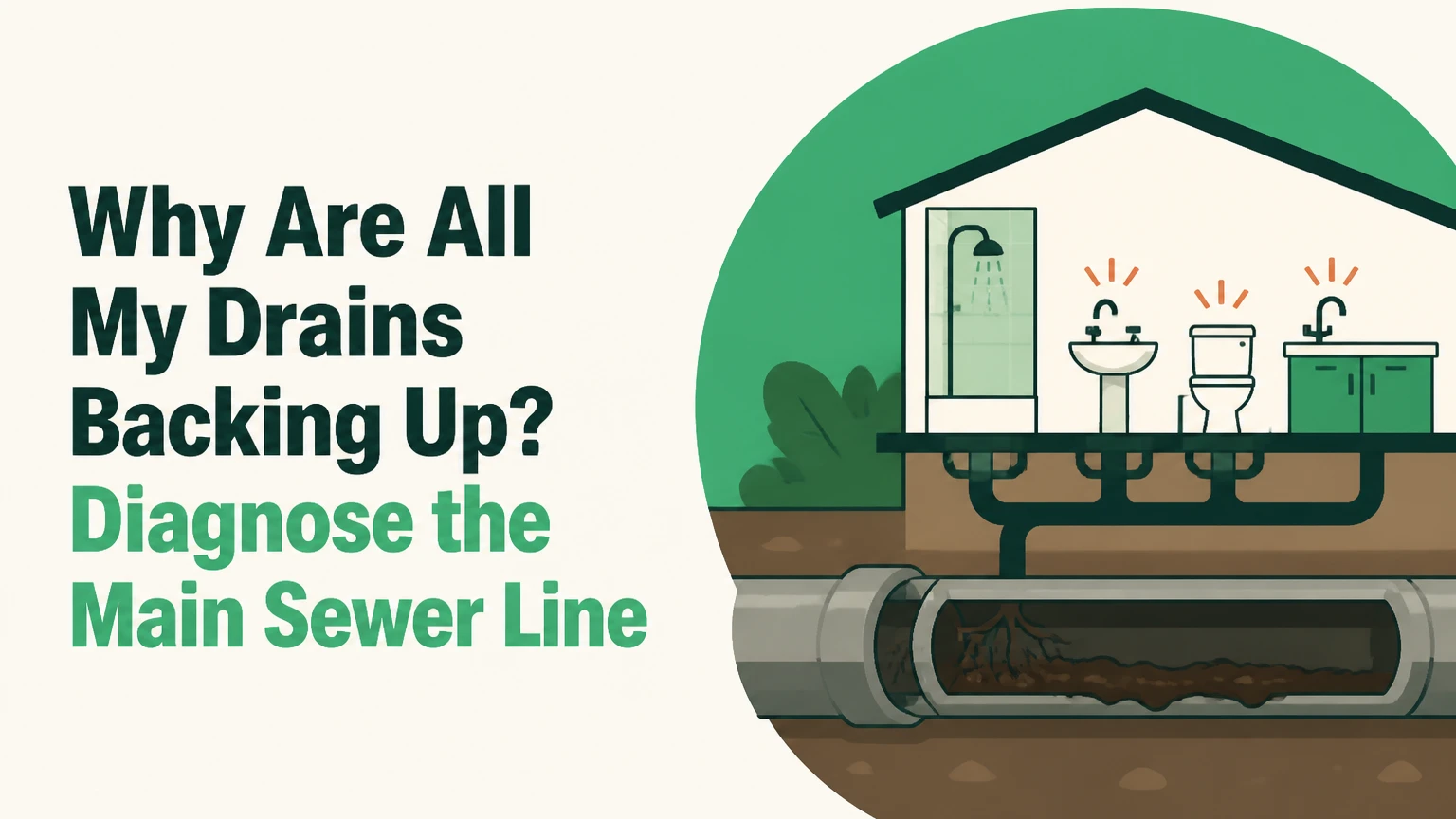
When all your drains are backing up at once, the most likely cause is a blocked or damaged main sewer line, not several independent fixture clogs. Wastewater from toilets, sinks, showers, and appliances cannot leave the house, so it reverses toward the lowest available drain. A municipal sewer failure or overloaded septic system can create the same symptom.
Key Facts at a Glance
Multiple backed-up fixtures usually indicate a restriction in the main building sewer or sewer lateral.
The lowest shower, bathtub, toilet, or basement floor drain usually overflows first because wastewater follows gravity.
A washing machine can expose a partial main-line blockage because its pump releases approximately 15-40 gallons quickly.
Chemical drain cleaners rarely solve a main-line obstruction and can injure occupants or plumbers.
A sewer camera identifies roots, grease, breaks, offsets, bellies, and collapses after flow is restored.
Typical professional clearing costs range from $200-$1,000, while structural replacement can cost $5,000-$25,000 or more.
Why Are All My Drains Backing Up?
A main sewer line backup happens when the large drain serving several fixtures becomes obstructed, damaged, or overloaded. Individual sinks and showers use smaller branch pipes, but those branches eventually converge into a building drain that carries wastewater through the main sewer lateral to a municipal sewer or septic tank.
One isolated slow sink usually has a local trap or branch-line problem. A kitchen sink, toilet, shower, and laundry drain failing together points farther downstream. The strongest confirmation is wastewater rising in a low fixture when another fixture discharges.
A plumbing vent can cause gurgling, slow drainage, or trap siphoning, but a blocked vent normally does not produce large amounts of sewage in several fixtures. A shared neighborhood sewer surcharge can also mimic a private blockage, especially after intense rainfall. Diagnosis must therefore identify where the obstruction sits, not merely clear the nearest drain.
Which fixtures usually show the backup first?
| Observed symptom | Likely location | Diagnostic meaning | Immediate response |
|---|---|---|---|
| Basement floor drain overflows | Main building drain or sewer lateral | Lowest opening receives displaced wastewater | Stop all water use |
| First-floor tub rises during laundry discharge | Partial main-line restriction | High-volume appliance flow meets bottleneck | Do not run washer again |
| One kitchen sink remains slow | Kitchen branch line | Localized obstruction is more likely | Avoid using drain chemicals |
| Several toilets gurgle together | Main line or shared sewer | Air and wastewater are moving around restriction | Arrange professional diagnosis |
| Fixtures back up only after rainfall | Municipal sewer, storm infiltration, or septic issue | Timing points beyond a simple fixture clog | Contact utility or septic provider |
How Does a Main Sewer Backup Travel Through a House?
Wastewater travels from fixtures through branch drains into a larger building drain, then through the main sewer lateral. When a blockage closes that downstream route, new water fills the pipe and rises through connected branches until it exits at a low fixture.
The sequence is predictable:
- A root, grease deposit, collapsed section, heavy scale layer, or foreign object narrows the main pipe.
- Toilet paper and solids catch on the narrowed section.
- Water from a toilet, shower, dishwasher, or washing machine enters the vertical stack.
- The obstruction prevents normal discharge to the street sewer or septic tank.
- The horizontal building drain fills and pushes air and wastewater back toward fixtures.
- Gravity directs the wastewater to the basement drain, lowest tub, shower, or toilet.
A partial restriction may allow several gallons to pass before the pipe fills. That explains why the household can seem normal for hours and then experience a sudden overflow after laundry or a long shower. The backup is often intermittent before it becomes complete.
Why does the washing machine make drains overflow?
A washing machine can reveal a partial sewer obstruction because its pump releases a large volume of water during a short drain cycle. A typical residential washer discharges about 15-40 gallons over several minutes, although the exact volume depends on the model and cycle.
If the main lateral passes only a small trickle, the washing-machine discharge exceeds the pipe’s remaining capacity. Water then rises in a nearby floor drain or shower. This pattern is more informative than a single slow sink because it tests the shared downstream pipe under a high-flow condition.
Do not repeat the test intentionally. One additional cycle can add contaminated water to flooring, drywall, insulation, and electrical areas.
What Causes a Main Sewer Line to Block?
The common causes are tree-root intrusion, grease, unsuitable flushable products, pipe deterioration, and a sagging or collapsed section. The correct repair depends on whether the obstruction is removable or whether the pipe itself has lost its shape, strength, or slope.
| Cause | Typical pipe or location | How the failure develops | Likely remedy |
|---|---|---|---|
| Tree roots | Clay, cast iron, Orangeburg, or jointed pipe | Roots enter cracked joints and expand around moisture | Root cutting, camera inspection, repair |
| Grease and food residue | Kitchen branch or shared lateral | Cooling fats coat walls and trap solids | Mechanical cleaning or hydro jetting |
| Wipes and hygiene products | Main drain and older rough pipe | Fibers snag on scale, joints, or roots | Mechanical removal and disposal change |
| Pipe belly | Settled soil beneath horizontal pipe | Low section retains water and sediment | Excavation or engineered replacement |
| Corrosion and scale | Older cast iron or steel | Interior diameter shrinks as deposits accumulate | Descaling, replacement, or lining |
| Collapse or offset joint | Clay, Orangeburg, PVC, or cast iron | Soil movement, crushing, or joint displacement blocks passage | Excavation or suitable trenchless repair |
| Septic overload | Tank, outlet baffle, or drainfield | Solids or saturated soil prevent effluent movement | Septic inspection, pumping, or field repair |
| Municipal surcharge | Public sewer or shared lateral | Stormwater or system blockage raises downstream level | Utility dispatch or private lateral inspection |
Tree roots do not usually create a blockage in an intact, well-sealed pipe. Root intrusion indicates an opening, failed joint, crack, or deteriorated pipe material. Cutting the roots restores flow, but it does not remove the entry path, so recurrence is common.
Grease creates a different failure. Hydro jetting may remove a broad coating, while a cable can bore a narrow hole through the deposit and leave the surrounding material in place. A recurring kitchen-related blockage therefore needs a cause-based cleaning plan.
Orangeburg pipe deserves special caution. The bituminous fiber pipe can deform under load and may flatten with age. Aggressive mechanical or high-pressure cleaning can worsen a weak section, so a camera inspection should guide the method.
What Should You Do Right Now?
Stop every activity that sends water into the plumbing system, protect people from sewage contact, and arrange emergency plumbing or utility assistance. The immediate objective is to prevent additional wastewater from entering the home, not to force the blockage through with chemicals or repeated flushing.
- Stop water use. Do not flush toilets, shower, run faucets, start laundry, use a dishwasher, or operate a sump-connected appliance that may discharge into the sanitary system.
- Keep people and pets away. Sewage can contain pathogens and sharp debris. Do not walk barefoot through contaminated water.
- Avoid electrical hazards. If sewage reaches outlets, appliances, extension cords, or a furnace area, leave the area and have power isolated by a qualified person.
- Close toilet lids and place absorbent barriers nearby. Do not push contaminated water into another room.
- Call the appropriate party. Contact a plumber for a private blockage, the municipal sewer department for a possible public surcharge, or a septic contractor for a private treatment system.
- Document the event. Photograph water levels, affected materials, fixture locations, weather conditions, and any cleanout discharge before cleanup.
- Notify the insurer and landlord promptly. Coverage, notice periods, and responsibility vary by policy and jurisdiction.
Do not pour liquid drain opener into a backed-up main line. The product can remain suspended in stagnant water, fail against roots or structural defects, damage some piping, and create a chemical-burn hazard for the person opening the line.
Can you safely open the main cleanout?
A cleanout can provide useful information, but opening a pressurized or full cleanout can release sewage unexpectedly. Only inspect an accessible outdoor cleanout if you can stand to the side, wear waterproof gloves and eye protection, keep ignition sources away, and stop immediately if the cap resists turning.
The result helps locate the problem:
- Water is standing at the outdoor cleanout: the obstruction may be downstream toward the street, in the public connection, or in the lateral between the cleanout and utility.
- The cleanout is empty while indoor fixtures back up: the restriction may be between the house and cleanout, beneath the foundation, or in an internal building drain.
- Water flows from the cleanout when the city sewer is known to be high: contact the municipality before authorizing private excavation.
- A septic cleanout is full: the septic tank outlet, baffle, effluent line, or drainfield may be restricted.
A cleanout result is directional evidence, not a final ownership determination. Property boundaries and utility rules differ.
How Do Plumbers Diagnose the Blockage?
Plumbers usually restore a controlled opening with a sectional cable or sewer machine, then use a camera to identify the pipe condition. A camera cannot reliably inspect a line that is completely full of opaque wastewater, so clearing and inspection are often separate stages.
A sound diagnostic visit should establish the access point, pipe diameter, distance to the defect, material, and whether the obstruction is recurring or structural. Ask for the camera recording or still images, not only a verbal statement that roots were found.
| Diagnostic method | Typical duration | Typical US price | Best information produced | Important limitation |
|---|---|---|---|---|
| Drain cable or auger | 1-3 hours | $200-$600 | Restores a channel through roots or solids | May leave deposits and damage unseen pipe |
| Sewer camera | 1-2 hours | $250-$500 | Locates roots, breaks, offsets, bellies, and collapse | Poor visibility in a full or heavily dirty line |
| Hydro jetting | 2-4 hours | $400-$1,000 | Removes grease, scale, and loose debris from walls | Unsafe for some brittle or collapsed pipes |
| Dye or smoke testing | 1-3 hours | $150-$500 | Helps trace connections or improper discharge | Does not replace camera inspection |
| Septic tank inspection | 1-2 hours | $250-$600 | Measures solids and checks baffles and outlets | Cannot evaluate the municipal lateral |
A practitioner rule of thumb is simple: repeated backups after recent cable clearing justify a camera inspection. Paying for repeated emergency openings without locating the defect often costs more than diagnosing the line once.
What does a sewer camera actually show?
A camera can show the obstruction’s position, pipe material, joint condition, root density, standing water, and structural deformation. The plumber should record the distance from the cleanout and identify whether the defect lies under the foundation, in the yard, near the property line, or in the public right-of-way.
A camera may show a “belly,” which is a sagging section that holds water and sediment. A belly is not fixed by repeated snaking because the slope remains wrong. A camera can also reveal an offset joint that allows soil entry, a cracked clay section, or an Orangeburg pipe that has flattened.
Which Clearing Method Is Appropriate?
Mechanical snaking is usually the first response for an urgent blockage because it creates a passage quickly and costs less. Hydro jetting is better for widespread grease or scale after the pipe has been confirmed sound, while neither method permanently repairs a collapsed, badly offset, or chronically sagging line.
| Method | Typical pressure or reach | Best use | Expected result | Main risk |
|---|---|---|---|---|
| Cable auger | 50-150 feet; 2-6 inch cutters | Roots, wipes, solids, urgent opening | Temporary to medium-term flow | Cable catches or damages weak pipe |
| Root cutter | 4-6 inch cutting head | Fine and moderate root growth | Flow restored through root mass | Root regrowth through failed joint |
| Hydro jetter | 2,500-4,000 PSI typical range | Grease, scale, soft deposits | More complete wall cleaning | High pressure harms fragile pipe |
| Enzymatic maintenance product | 1-4 week routine use | Limited organic residue control | Preventive support only | Cannot clear roots or collapse |
| Excavation or trenchless repair | 10-100+ feet of affected line | Structural failure | Permanent repair when correctly designed | Cost, access, permits, or unsuitable geometry |
Hydro jetting is not automatically a better version of snaking. High pressure can expose defects that a cable merely bypassed, and a responsible contractor should inspect older clay, cast iron, or Orangeburg piping before jetting.
Chemical drain cleaners are poor alternatives for main-line backups. They cannot correct roots, pipe collapse, a belly, municipal surcharge, or a septic drainfield failure.
When Is Sewer Pipe Relining Better Than Excavation?
Trenchless relining can be appropriate when the existing pipe has adequate shape, a continuous route, and limited localized damage. Traditional excavation is usually necessary for a complete collapse, severe belly, major offset, crushed pipe, inaccessible connection, or a line that requires altered slope.
| Repair option | Typical cost | Typical duration | Suitable condition | Usually unsuitable for |
|---|---|---|---|---|
| Local spot repair | $1,000-$4,000 | 1 day | One short crack or failed joint | Multiple defects across the line |
| Pipe relining | $100-$250 per foot; $4,000-$12,000 total | 1-2 days | Cracks and joints with usable pipe shape | Complete collapse or severe belly |
| Pipe bursting | $150-$350 per foot | 1-3 days | Replacement along a straight, accessible route | Dense utilities or fragile connections |
| Traditional excavation | $200-$300 per foot; $5,000-$25,000 | 3-5 days | Collapse, bad slope, deep structural failure | Locations where excavation is prohibited |
| Main-line replacement by sections | $5,000-$20,000 typical project range | 2-5 days | Several identified damaged segments | Unassessed or unknown line condition |
Prices are typical US residential ranges, not quotations. Depth, soil, pavement, landscaping, permits, access distance, pipe diameter, restoration, and local labor rates can change the total substantially.
Relining creates a pipe-within-a-pipe and can reduce excavation, but it slightly reduces the internal diameter and does not correct a fundamentally wrong grade. A contractor recommending lining should explain how the liner will pass bends, laterals, cleanouts, and the affected defect.
What Early Warning Signs Predict a Full Backup?
Gurgling toilets, recurring slow drains, sewage odors, and water appearing in a shower during laundry discharge are early warnings of a restricted main line. These signs often appear days or weeks before wastewater overflows, although a collapse or foreign-object blockage can produce an immediate failure.
| Warning sign | When it appears | Most informative interpretation | Recommended action |
|---|---|---|---|
| Toilet gurgles after shower use | During shared drainage | Air is moving around a downstream restriction | Schedule main-line evaluation |
| Tub rises during washer drain | High-flow discharge | Partial main line cannot accept peak flow | Stop laundry and call plumber |
| Several fixtures slow together | Same day or gradually | Shared building drain is restricted | Avoid chemical cleaners |
| Sewer odor near floor drain | Dry trap or sewage movement | May indicate backup, vent issue, or trap loss | Add water only if no backup exists |
| Backup returns within weeks | After cable clearing | Roots, deposits, belly, or structural defect remains | Request camera inspection |
| Problem follows heavy rain | Storm event | Public surcharge, infiltration, or septic saturation | Contact utility or septic provider |
A dry floor-drain trap can cause odor without a sewer backup. Adding approximately 2 cups of water to an unused trap may restore the water seal, but do not do this if another fixture causes wastewater to rise.
Is the City or Homeowner Responsible?
Responsibility depends on the blockage’s physical location and local utility rules. Homeowners commonly maintain the private building drain and lateral on their property, while a municipality may maintain the public sewer main, but shared laterals and property-line sections vary by jurisdiction.
Renters should notify the landlord or property manager in writing and by phone before hiring a contractor, unless an immediate emergency requires protective action under local law. Homeowners should ask the plumber to document the distance from the cleanout and check whether the defect lies in the public right-of-way.
| Situation | First contact | Likely decision point | Evidence to keep |
|---|---|---|---|
| Backup only inside one home | Licensed plumber | Private branch or lateral diagnosis | Camera video and invoice |
| Several neighboring homes affected | Municipal sewer department | Public main surcharge or blockage | Utility ticket number |
| Backup follows rainfall | Utility or septic contractor | Storm surcharge versus saturated drainfield | Weather date and photos |
| Rental property overflow | Landlord and emergency plumber | Lease and local housing rules | Written notice and timestamps |
| Shared lateral between homes | Utility and property owners | Easement or local maintenance rule | Survey, ordinance, camera distance |
| Septic-equipped home | Septic contractor | Tank, outlet, pump, or drainfield failure | Pumping and inspection report |
Standard homeowners insurance often excludes gradual wear, poor maintenance, roots, and sewer-line deterioration. Optional sewer-backup coverage may address certain interior losses, while service-line coverage may address some buried piping, subject to policy limits and exclusions.
What Changes If the Home Uses a Septic System?
A septic-system backup can result from a full tank, failed outlet baffle, blocked effluent line, pump failure, saturated drainfield, or a clogged house-to-tank line. A septic owner should not assume that a plumber clearing the indoor drain has solved the wastewater treatment problem.
Look for clues outside the house. Wet ground, sewage odors near the tank or drainfield, unusually lush strips of grass, an alarm on a pump tank, or backups after several days of heavy use point toward the private treatment system. Do not open a septic tank yourself because toxic gases and unstable covers create serious hazards.
A septic contractor can measure tank solids, inspect inlet and outlet baffles, test pumps, and evaluate the effluent route. Pumping may restore capacity when solids are the cause, but pumping cannot repair a failed drainfield or collapsed pipe.
How Much Does a Main Sewer Backup Cost?
Emergency clearing typically costs $200-$600 for mechanical snaking and $400-$1,000 for hydro jetting, while camera inspection commonly adds $250-$500. Structural repairs range from approximately $1,000 for a small spot repair to $25,000 or more for deep excavation, pavement restoration, and extensive replacement.
The lowest price is not always the lowest total cost. A $300 cable opening that recurs every month can exceed the cost of one camera inspection and targeted repair within a year.
Request an itemized estimate that separates:
- Emergency arrival and after-hours fees
- Access and cleanout work
- Cable, root cutting, or jetting
- Camera inspection and recording
- Excavation, liner, or replacement footage
- Permits, traffic control, and utility locating
- Soil, concrete, driveway, and landscaping restoration
- Cleanup, disinfection, and contaminated-material disposal
Typical service times are one to three hours for an accessible blockage and one to two days for relining. Excavation commonly takes three to five working days before restoration, although deep lines, frozen ground, permits, and buried utilities extend the schedule.
How Can You Prevent Another Backup?
Preventive work should target the failure mechanism, because grease control cannot correct a pipe belly and root cutting cannot seal a cracked joint. Reduce solids entering the system, maintain the sewer lateral according to its condition, and repair structural defects identified by a camera.
Use sink strainers and place cooled cooking grease in household waste instead of the drain. Flush only toilet paper and human waste. Product labels using “flushable” do not guarantee that wipes will move safely through an older or restricted sewer line.
For homes with mature trees near the sewer route, schedule condition-based inspections rather than automatic jetting every few years. Root treatment may slow regrowth in some systems, but it does not substitute for repairing an open joint.
A backwater valve can reduce basement flooding when correctly installed and maintained. The valve must remain accessible, and household fixtures may be unusable while the valve is closed during a municipal surcharge. A valve does not remove the blockage or protect fixtures located upstream of its placement.
What Common Mistakes Make the Damage Worse?
The most expensive mistakes are continuing water use, treating a main line like a sink clog, and accepting repeated clearing without a recorded diagnosis. Each mistake increases contamination, injury risk, or the chance of paying for temporary work several times.
- Running the washing machine: A short cycle can add 15-40 gallons to an already full drainage system. Stop use until flow is verified.
- Using chemical opener: Stagnant chemicals can burn skin and eyes, damage some pipe materials, and expose the plumber during cable work. Tell the plumber if chemicals were already used.
- Opening an indoor cleanout first: A full line can discharge sewage under pressure. Use an accessible outdoor cleanout only with protective equipment and an escape path.
- Jetting an uninspected old line: Pressure can worsen a brittle, cracked, or flattened pipe. Camera evidence should precede aggressive cleaning.
- Replacing landscaping before locating the defect: A contractor needs the failure distance and depth before deciding whether excavation is necessary.
- Ignoring a successful temporary opening: Normal flow after snaking does not prove that roots, a belly, or structural damage is gone.
An honest limitation matters here: no homeowner checklist can identify a buried pipe defect with certainty. The cleanout test narrows the location, but a camera inspection and local utility information are needed for a defensible repair decision.
FAQ
Can a blocked main sewer line affect only one bathroom?
Yes, if that bathroom connects to a branch line that is restricted before it joins the rest of the building drain. If the kitchen, laundry, and other toilets work normally, a local branch blockage is more likely than a whole-house main-line failure. A bathroom backup after other fixtures discharge still warrants downstream inspection.
Can rain cause all household drains to back up?
Rain can cause a backup when a municipal sewer becomes surcharged, stormwater enters a damaged private lateral, or a septic drainfield becomes saturated. Rain alone does not create a typical indoor fixture clog. Record whether nearby homes have the same problem and whether the event stops after the public system level falls.
How long can a house go without using water during a sewer backup?
A house should avoid water use until a plumber, utility, or septic contractor confirms a usable discharge path. Waiting several hours does not clear roots, a collapse, or a full septic tank. If wastewater is present indoors, arrange containment and professional cleaning as soon as possible.
Will plunging fix multiple backed-up drains?
Plunging may clear a single fixture trap or branch obstruction, but it rarely removes a blockage in the main sewer lateral. Plunging one fixture can also force wastewater toward another low opening. When several fixtures fail together, stop plunging and seek main-line diagnosis.
Should a new homeowner get a sewer camera inspection?
A camera inspection is sensible for a new homeowner when the property has mature trees, older clay or cast-iron piping, recurring backups, or no documented sewer evaluation. The inspection can identify inherited defects before renovation or landscaping hides access, although a clear camera does not guarantee future performance.
The Bottom Line
When asking why are all my drains backing up, start with the main sewer line, municipal sewer, or septic system rather than individual fixture traps. Stop all water use, keep people away from sewage, avoid chemical cleaners, and use the cleanout only with appropriate precautions. Mechanical clearing may restore flow, but recurring backups require camera evidence to distinguish roots and grease from a belly, collapse, or public-side failure.