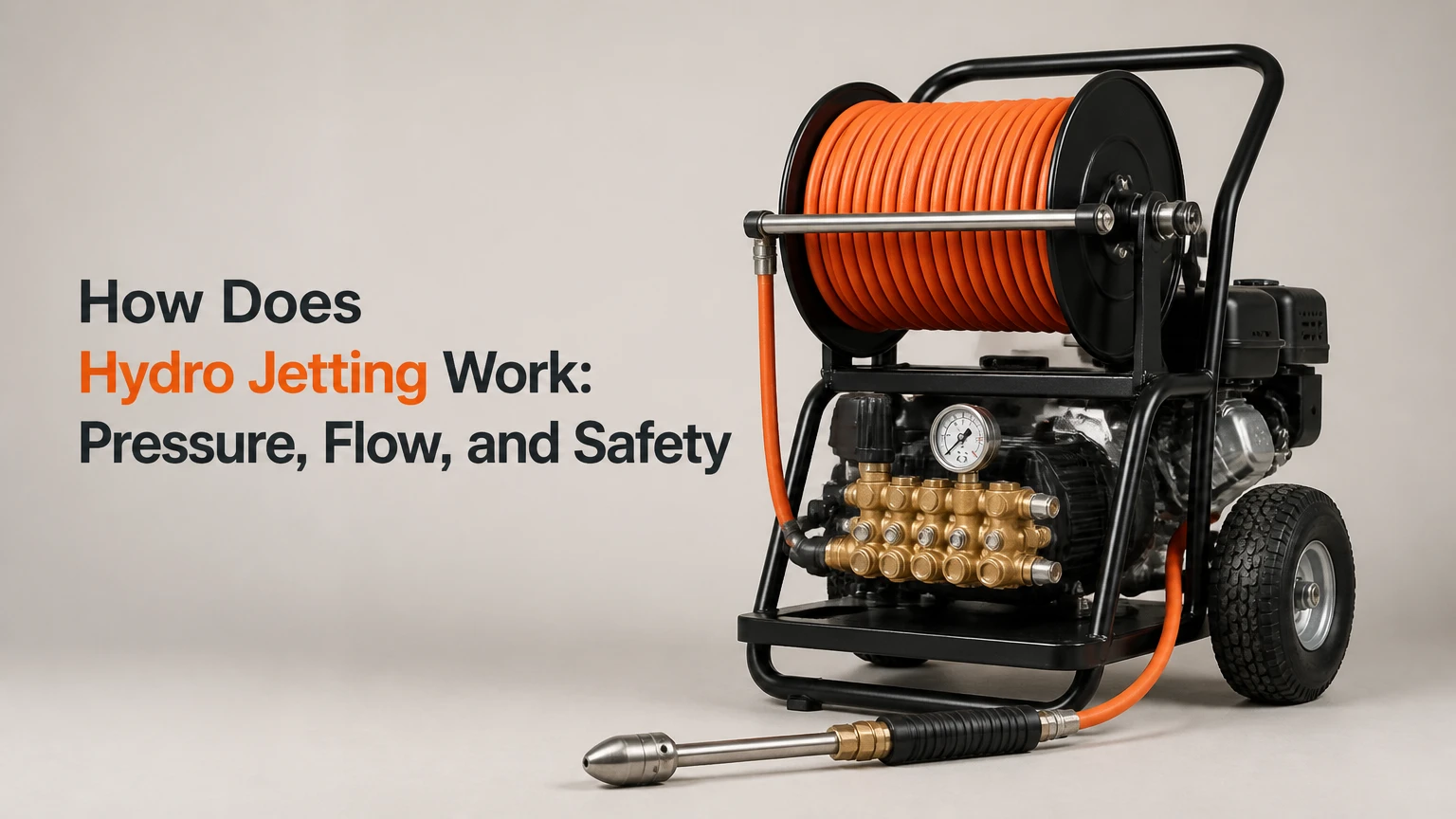
Hydro jetting cleans plumbing and sewer pipes by pumping water through a specialized nozzle at high pressure and volume. Forward jets break through obstructions, while angled rear jets propel the hose and scour pipe walls. The water then carries loosened grease, scale, roots, and sludge downstream, provided the pipe is structurally open and sound.
Key Facts at a Glance
- Hydro jetting uses water pressure to cut deposits and water volume to transport loosened debris.
- Typical professional equipment operates at approximately 1,500-4,000 PSI and 2-25 gallons per minute.
- A sewer camera should assess pipe condition before high-pressure cleaning, especially in older systems.
- Hydro jetting cleans a pipe wall but does not repair cracks, separated joints, bellies, or collapsed sections.
- A rotating nozzle cleans circumferentially, while a penetrator nozzle concentrates force on a hard obstruction.
- Typical US residential service costs about $350-$900 and takes roughly 1-3 hours.
What Is Hydro Jetting?
Hydro jetting is a professional drain and sewer-cleaning method that uses a pump, flexible hose, and engineered nozzle to direct high-pressure water through a pipe. Unlike a cable auger, which creates a passage through a blockage, a properly selected jetting nozzle can remove deposits around much of the pipe circumference.
The method applies two different kinds of hydraulic work. Pressure creates the cutting and shearing force at the nozzle opening, while flow, measured in gallons per minute, transports the detached material away. A high-PSI machine with inadequate flow may punch through grease without removing it from the system.
Hydro jetting is therefore a cleaning procedure, not a pipe-repair procedure. It can expose a crack or root entry point that was hidden beneath deposits, but it cannot restore a missing pipe section or seal a failed joint.
What Problems Can Hydro Jetting Remove?
Hydro jetting commonly removes grease, fats, oils, soap residue, mineral scale, paper sludge, sediment, and fine-to-medium root growth. The result depends on the deposit’s hardness, the pipe’s diameter, the selected nozzle, and whether downstream piping can carry the flushed material.
Tree roots deserve special caution. Jetting can cut existing root growth, but roots may return if they enter through a cracked joint or displaced section. Repeated root intrusion usually requires repair, lining, or replacement after cleaning.
How Does Hydro Jetting Work?
Hydro jetting works by converting engine or electric-motor power into a controlled water stream that exits through small nozzle orifices. The pump raises water pressure, the hose delivers it to the obstruction, and the nozzle converts pressure into fast-moving jets that cut deposits and create reaction force.
The rear-facing jets usually angle backward rather than directly toward the blockage. Their reaction force pulls the nozzle through the pipe, limits hose friction, and washes debris toward the access point. Forward-facing jets may open a path through grease or soft obstruction, but many cleaning passes rely mainly on rear jets.
At the pipe wall, water applies impact and shear. Grease separates from the surface, scale fractures or erodes, and loose sludge becomes suspended in the moving water. The sewer must still have an open downstream route, because hydro jetting cannot make removed material disappear.
Pressure and Flow Perform Different Jobs
Pressure describes force per unit area at the equipment and nozzle system. Flow describes how much water moves through the line over time. In practical terms, pressure cuts deposits, while flow flushes the cut material through the pipe.
The following ranges are typical field specifications, not universal operating settings. Actual nozzle pressure at the pipe may differ from the pump’s rated pressure because hose length, nozzle design, friction, and elevation reduce delivered performance.
| Equipment class | Typical pressure | Typical flow | Common application |
|---|---|---|---|
| Compact electric jetter | 1,500-2,000 PSI | 1.5-2.5 GPM | Kitchen branches and small drains |
| Portable gas jetter | 2,000-3,000 PSI | 2-4 GPM | Residential branch and building drains |
| Trailer sewer jetter | 3,500-4,000+ PSI | 8-25+ GPM | Main sewers and commercial lines |
| Municipal combination unit | 2,000-4,000 PSI | 20-80+ GPM | Large mains and vacuum recovery |
A useful practitioner rule is to increase flow when loosened debris repeatedly settles downstream, rather than automatically increasing PSI. More pressure can damage a weak pipe while leaving transport capacity unchanged.
What Happens During a Professional Hydro Jetting Service?
A professional hydro jetting service normally includes inspection, access, equipment selection, cleaning passes, and verification. A straightforward residential line often takes 1-3 hours, although long sewer runs, difficult cleanouts, heavy roots, water-supply limits, and multiple passes can extend the appointment.
Step 1: Inspect the Pipe With a Camera
The technician inserts a drain camera to locate the obstruction and assess pipe condition. The inspection can reveal roots, grease, scale, offsets, standing water, fractures, collapse, and the approximate distance to the problem.
Camera footage cannot always show every defect. Water, heavy sludge, tight bends, and a fully blocked section can obscure the lens, so the technician may first open a limited passage with an auger or low-risk cleaning method.
Step 2: Select a Safe Access Point
The hose enters through an exterior sewer cleanout, building cleanout, roof vent, floor drain, or another suitable access point. The best entry point provides a straight approach and allows wastewater to move toward an approved downstream outlet.
Opening a fixture trap without controlling discharge can release contaminated water into a room. Technicians should protect floors, identify cleanout direction, and confirm where loosened debris will travel before activating the pump.
Step 3: Match the Equipment and Nozzle
The technician chooses pressure, flow, hose diameter, and nozzle geometry based on pipe material, internal diameter, length, blockage type, and condition. A narrow line with a grease film needs a different setup from a large sewer carrying sand or root fragments.
A rotating nozzle may clean broad deposits, while a penetrator nozzle can open a dense obstruction. A wide-angle flushing nozzle is often used afterward to move residual sludge through the line.
Step 4: Feed and Operate the Hose
The technician feeds the hose into the line before applying full pressure or follows the equipment manufacturer’s operating procedure. Once activated, rear jets pull the nozzle forward, and the operator controls hose speed so water can work against the deposit.
Fast withdrawal is a common quality failure. Pulling the hose too quickly may leave grease attached to the wall, while slowly retracting the nozzle gives the jets time to scour the circumference.
Step 5: Flush the Loosened Material
The operator makes one or more passes, adjusting speed, nozzle choice, pressure, and flow as the obstruction changes. The goal is a clean, passable interior and reliable transport of removed material, not merely a temporary opening.
Wastewater may contain concentrated grease, roots, sediment, and sanitary debris. Commercial work may require containment, vacuum recovery, or disposal procedures governed by local environmental and sewer regulations.
Step 6: Verify the Result With a Camera
A post-cleaning camera inspection confirms whether the line is open and identifies defects exposed by cleaning. The footage should show the repaired flow path, remaining root intrusion, pipe joints, and any structural problem that prevents a durable result.
A clean camera image does not guarantee that a defective pipe will remain clear. If roots enter through a broken joint, hydro jetting removes the symptoms while the entry route remains.
Which Nozzle Is Best for Each Blockage?
Nozzle selection determines how water strikes, propels, and flushes through the pipe. Penetrator nozzles concentrate forward force, rotary nozzles distribute cleaning action around the wall, and flushing nozzles prioritize transport over aggressive cutting.
| Nozzle type | Jet pattern | Typical target | Main limitation |
|---|---|---|---|
| Penetrator | Narrow forward jet, angled rear jets | Soft blockages, dense grease, fine roots | Can bypass or snag in damaged pipe |
| Rotary | Spinning radial jets | Grease film, light-to-medium scale | May not open a dense root mass quickly |
| Flushing | Wide rear-angle jets | Sand, sludge, mud, loose debris | Weak cutting action on hard deposits |
| Root-cutting | Concentrated cutting jets | Fine-to-medium root intrusion | Does not repair the root entry defect |
A nozzle can clean the wrong area if its angle does not match the pipe diameter. For example, a nozzle designed for a large main may leave deposits in a smaller lateral because the jet pattern travels down the center rather than contacting the wall.
Is Hot-Water Jetting Better?
Hot-water jetting is often better for heavy grease because heat softens fats and oils before high-volume water carries them away. Cold-water jetting remains suitable for many residential blockages, mineral deposits, roots, and ordinary sludge.
Hot water does not make a structurally unsafe pipe safe. Temperature, detergent use, discharge rules, and pipe material must remain within the equipment manufacturer’s limits.
What Specifications Matter Most?
The most important specifications are pressure, flow, hose diameter, nozzle orifice, pipe diameter, and water supply. A machine’s maximum PSI alone cannot predict cleaning performance because a low-flow pump may lack the volume needed to transport debris.
Typical service ranges extend from 1.5-inch sink and branch drains to 12-inch or larger commercial and municipal lines. Large-diameter work requires more flow and carefully matched nozzles; simply using a higher-pressure small jetter is not an equivalent substitute.
| Variable | Typical range or value | Why it matters |
|---|---|---|
| Residential branch pipe | 1.5-4 inches | Requires compact hose and lower flow |
| Building sewer | 4-8 inches | Needs enough flow for sludge transport |
| Commercial main | 8-12+ inches | Benefits from trailer equipment and high GPM |
| Residential service duration | 1-3 hours | Includes setup, passes, and inspection |
| Water tank capacity | 200-500 gallons | Supports remote or high-flow work |
| Typical water use | 100-1,500 gallons | Depends on GPM and run time |
Actual water use can be estimated with a simple formula: gallons equal GPM multiplied by operating minutes. A 4-GPM machine running for 30 minutes uses about 120 gallons before pauses and setup losses.
Is Hydro Jetting Safe for Old Pipes?
Hydro jetting is generally suitable for sound, correctly installed pipe, but it can worsen fragile, collapsed, severely corroded, or disconnected plumbing. Pipe age alone does not determine safety; material, wall condition, joint integrity, and previous camera findings matter more.
Orangeburg pipe, severely deteriorated cast iron, brittle clay, thin-walled plastic, and lines with major offsets require particular caution. A camera inspection should precede aggressive cleaning, and the operator should select pressure and nozzle settings appropriate to the observed condition.
The Water Jetting Association emphasizes controlled operation and risk assessment in water-jetting work; its safety guidance treats pressure, hose movement, access control, and operator protection as interconnected hazards rather than isolated equipment settings. That principle applies directly to drain jetting.
Hydro jetting is not appropriate when the line has collapsed, has no downstream outlet, contains an unstable pipe section, or needs excavation to correct a belly. Cleaning a failed line can release debris into a void or expose occupants to sewage.
How Much Does Hydro Jetting Cost and Take?
Typical US residential hydro jetting costs about $350-$900, while commercial service commonly costs $500-$1,500 or more. A routine line usually takes 1-3 hours, but long runs, difficult access, repeated root passes, emergency scheduling, and water recovery can increase both figures.
| Service situation | Typical price | Typical duration | Main cost driver |
|---|---|---|---|
| Residential branch drain | $350-$600 | 1-2 hours | Indoor access and setup |
| Residential main sewer | $500-$900 | 1.5-3 hours | Line length and inspection |
| Restaurant kitchen line | $500-$1,500+ | 2-4 hours | Grease, access, and disposal |
| Multifamily or commercial main | $900-$2,500+ | 3-8 hours | Diameter, length, and equipment |
Local labor rates can move these ranges substantially. A trustworthy estimate identifies camera inspection, jetting passes, water, cleanup, after-hours labor, and repair recommendations separately.
Before approving work, ask whether the quote includes pre-service and post-service video, what happens if the hose encounters a defect, how wastewater is contained, and whether a second cleaning pass costs extra.
Hydro Jetting vs Snaking and Chemical Cleaners
Hydro jetting is usually the stronger choice for recurring grease, scale, and sludge in a structurally sound line. Snaking is often the better first response for a simple hair or paper blockage, while chemical cleaners are a poor substitute for mechanical diagnosis and can create handling hazards.
| Method | Cleaning action | Best target | Typical result |
|---|---|---|---|
| Hydro jetting | High-pressure, high-volume water | Grease, scale, roots, sludge | Broad wall cleaning |
| Cable auger | Mechanical cutting or piercing | Hair, paper, localized soft clog | Opens a passage |
| Enzyme treatment | Biological digestion over time | Light organic residue | Slow maintenance effect |
| Pipe repair or lining | Restores structure | Cracks, offsets, root-entry joints | Addresses the underlying defect |
Chemical drain cleaners generally cannot remove tree roots, collapsed pipe material, or heavy scale. They may also remain in standing water and expose technicians to caustic liquid during later snaking or jetting.
A cable machine can be valuable before jetting when a camera cannot pass the blockage. However, opening a passage is not the same as cleaning the pipe wall, so recurring grease problems often return after augering alone.
When Should You Use Hydro Jetting?
Hydro jetting is appropriate for recurring backups, commercial grease accumulation, heavy scale, root intrusion in a serviceable line, and persistent odors caused by organic buildup. It is especially useful when a cable has restored flow but the same blockage returns within weeks or months.
Residential warning signs include multiple slow fixtures, sewage backup at a low drain, gurgling after toilet flushing, and a camera-confirmed root or grease problem. A single sink hair clog rarely justifies whole-line jetting unless inspection reveals extensive buildup.
Restaurants commonly schedule kitchen-line jetting every 3-6 months, but the correct interval depends on grease production, trap maintenance, line length, and prior blockage history. Property managers may use cleaning before a building purchase or after repeated stack backups, but inspection should guide the scope.
When Is Hydro Jetting the Wrong Tool?
Hydro jetting is the wrong tool for a collapsed sewer, severe pipe separation, a belly that holds water, or a line with insufficient downstream capacity. Those conditions require repair planning, excavation, pipe lining, replacement, or another structural solution.
Hydro jetting also may be excessive for an isolated fixture clog caused by hair or a small paper obstruction. A hand auger or cable machine can resolve that problem with less water, lower cost, and less operational risk.
What Can Go Wrong During Jetting?
The most common hydro jetting failures are incorrect pressure, inadequate flow, rapid hose withdrawal, poor nozzle selection, and blind cleaning of damaged pipe. Each failure produces a recognizable symptom and requires a controlled response rather than more pressure.
- Water backs up at the access point: Pause the pump, check downstream capacity, and reduce flow or hose advancement. Continuing can overflow contaminated water.
- The hose stops moving: Shut off pressure before pulling. A camera should locate an offset, root mass, or collapse that may be trapping the nozzle.
- Debris returns immediately: Use a slower finishing pass or a higher-flow flushing nozzle. Loosened sludge may have settled farther downstream.
- The line clears but backs up again: Review post-camera footage for roots, a belly, scale, or structural damage. Recurrence usually indicates an unresolved cause.
- A fixture overflows indoors: Stop jetting, isolate the affected fixture, contain wastewater, and confirm the correct cleanout direction before restarting.
The most dangerous mistake is treating pressure as a universal solution. A higher PSI setting cannot compensate for a mismatched nozzle, insufficient flow, or a broken pipe.
What Should You Do After Hydro Jetting?
After hydro jetting, confirm that fixtures drain normally, inspect the post-service video, and record any defect or remaining root intrusion. Do not assume a temporary return of flow means the entire sewer problem is solved.
For a home, run several fixtures separately and then together while observing the lowest drain. For a restaurant, flush the kitchen line under operating conditions and verify that the grease trap and downstream connection accept the flow.
Avoid pouring grease, cooking oil, paint, solvents, wipes, or harsh chemical cleaners into the drainage system after service. Commercial operators should pair scheduled jetting with grease-trap maintenance, proper scraping, and documented backup history.
Frequently Asked Questions
Can hydro jetting remove tree roots completely?
Hydro jetting can cut and wash out fine-to-medium roots that have entered a sewer line, but it cannot permanently eliminate roots growing through a cracked joint or separated pipe. Root treatment, lining, excavation, or replacement may be needed after cleaning. A post-jetting camera identifies whether the entry defect remains.
How often should a home sewer line be hydro jetted?
A home should not follow a universal jetting calendar. A sound line with no recurring symptoms may need service only when inspection finds significant buildup, while a restaurant may need cleaning every 3-6 months. Repeated residential backups should trigger camera diagnosis rather than automatic annual jetting.
Can I rent a hydro jetter and do the work myself?
DIY hydro jetting is unsuitable for most homeowners because high-pressure water can penetrate skin, damage property, contaminate rooms, or become trapped in a defective pipe. Professional operators control hose reaction, pressure, water disposal, access protection, and camera inspection. A hand auger is safer for a simple fixture clog.
Does hydro jetting damage PVC pipes?
Hydro jetting does not normally damage sound PVC when the operator uses a correctly sized nozzle, pressure, and flow. Damage becomes more likely when a line has a failed joint, unsupported section, sharp offset, or nozzle obstruction. Camera inspection and manufacturer limits should determine the operating setup.
Will hydro jetting stop sewer odors?
Hydro jetting may reduce odors caused by grease, sludge, and organic residue coating the pipe wall. It will not correct a dry trap, blocked vent, broken sewer connection, leaking cleanout, or sewer-gas entry through a structural defect. Odors that persist after cleaning require a broader plumbing inspection.
Is hydro jetting a permanent solution?
Hydro jetting is a durable cleaning method, but it is not automatically permanent. Results can last years in a sound line with normal use, while grease-heavy restaurants, root-affected sewers, and defective pipes may re-clog quickly. Longevity depends on the material removed and the condition that caused it.
The Bottom Line
Hydro jetting works by combining high-pressure impact with sufficient water flow to cut deposits from pipe walls and flush the debris away. A camera-guided professional should match the PSI, GPM, hose, and nozzle to the pipe’s material, diameter, blockage, and structural condition.
Hydro jetting is a strong choice for recurring grease, scale, sludge, and roots in an intact line. It is not a repair for collapse, separation, cracking, or poor drainage grade. For the query “how does hydro jetting work,” the decisive answer is that nozzle geometry and water volume matter as much as pressure, while inspection determines whether the method is safe.