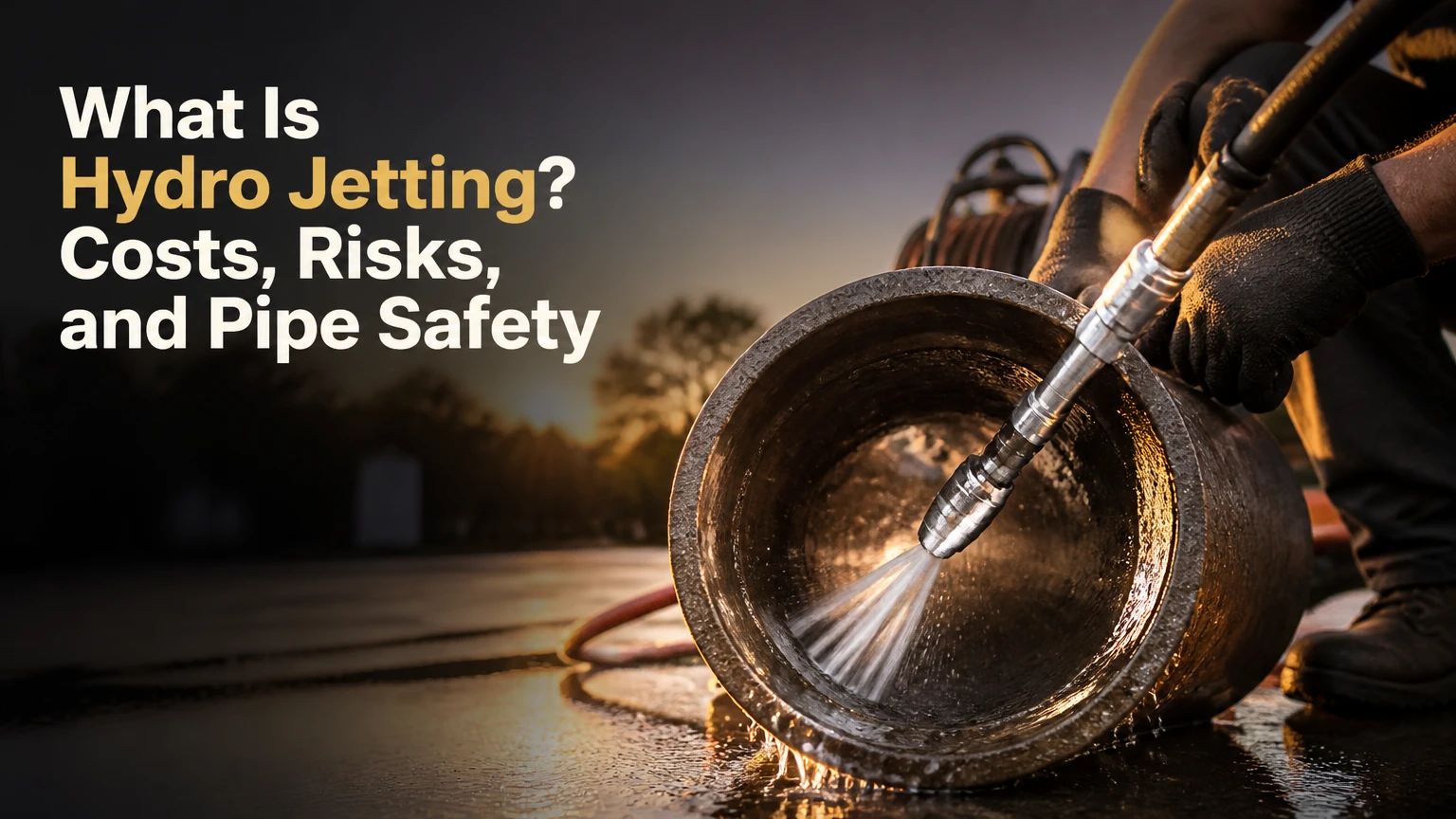
Hydro jetting is a professional drain and sewer cleaning method that sends pressurized water through a specialized nozzle to remove grease, sludge, mineral scale, sediment, and some root intrusion from pipe walls. Unlike an auger, which creates a passage through a clog, hydro jetting can wash material from much of the pipe circumference, provided the pipe is structurally sound.
Key Facts at a Glance
- Hydro jetting uses a pump, high-pressure hose, water, and a directional nozzle to clean plumbing lines.
- A sewer camera inspection should usually precede jetting when the blockage involves a main line, roots, old pipes, or repeated backups.
- Cleaning pressure is not a universal safety value; pipe material, condition, nozzle design, flow rate, and operator control all affect risk.
- Hydro jetting removes buildup, but it does not repair a collapsed pipe, severe offset joint, broken connection, or defective sewer slope.
- Typical residential service costs about $350-$800, with access, inspection, blockage severity, and region affecting the final price.
- Snaking is often the safer first intervention when a line is inaccessible, structurally uncertain, or blocked by a small localized obstruction.
What Is Hydro Jetting?
Hydro jetting is mechanical pipe cleaning with pressurized water rather than an acid, caustic solution, or rotating cable. A motor-driven pump pushes water through a flexible hose and nozzle, where small openings convert pressure into high-velocity streams that cut, scour, and transport deposits through the line.
The method is common in residential main sewers, commercial kitchen drains, grease interceptors, storm drains, and larger municipal pipes. Small electric jetters may clean interior branch drains, while gas-powered or trailer-mounted units provide the flow needed for long or wide sewer lines.
Hydro jetting is best understood as a cleaning process, not a sewer-line repair. If a camera shows a crushed section, major root displacement, a disconnected joint, or a pronounced belly that holds water, jetting may improve flow temporarily while leaving the underlying defect unchanged.
What does hydro jetting remove?
Hydro jetting can remove soft deposits and many hard deposits, including cooking grease, soap residue, sludge, sand, mineral scale, paper accumulation, and some tree roots. Results depend on deposit thickness, pipe diameter, nozzle selection, access, and the condition of the pipe surface.
A penetrator nozzle may open a path through compacted sediment. A flushing nozzle then carries loosened material downstream. For heavy roots or scale, a contractor may use a rotary nozzle or a water-assisted root-cutting tool, but root removal does not stop future root growth.
How Does Hydro Jetting Work?
Hydro jetting works through two related forces: water velocity at the nozzle and reaction thrust from rear-facing jets. The forward jet breaks or loosens material, while angled rear jets pull the hose through the line and push debris toward the downstream outlet or cleanout.
Pressure is measured in pounds per square inch, or PSI. Flow is measured in gallons per minute, or GPM. PSI helps the stream penetrate deposits, while GPM supplies the volume needed to scour surfaces and carry loosened material away. A high-PSI, low-flow machine is not automatically effective on a long sewer line.
The nozzle shape controls the cleaning pattern. Forward jets provide cutting action, rear jets provide propulsion and wall coverage, and specialized rotating heads distribute water around the pipe circumference. The operator must advance and retract the hose slowly because a fast pass can leave deposits behind.
What happens inside the pipe?
A typical cleaning pass follows this sequence:
- The operator inserts the nozzle through a cleanout or other approved access point.
- Rear jets pull the hose toward the obstruction while the forward jet opens or penetrates the material.
- The operator pauses, advances, and retracts the hose to expose different sections of the pipe wall.
- Water loosens grease, scale, roots, and sediment.
- The flow carries debris to a downstream sewer, collection point, vacuum truck, or interceptor.
- The operator checks drainage and, when appropriate, repeats the pass with a different nozzle.
The nozzle does not create a perfect “razor-sharp water wall,” and hydro jetting does not guarantee a like-new internal diameter. Deposits can remain in joints, heavily pitted cast iron, rough clay, or sections that the nozzle cannot reach because of a severe offset or obstruction.
What Does a Professional Hydro Jetting Visit Include?
A professional hydro jetting service commonly takes 1-2 hours for a straightforward residential line. Difficult access, long runs, repeated passes, indoor protection, heavy roots, or commercial grease can extend the work to several hours.
Six standard service steps
Step 1: Inspect the line.
The technician identifies the affected fixtures, locates a cleanout, and uses a sewer camera when structural condition or blockage location is uncertain. A camera cannot always travel through a fully blocked line, so an auger may be needed to create initial access.
Step 2: Confirm pipe condition.
The operator checks visible pipe material, approximate age, cleanout condition, access diameter, and any prior repair history. Older Orangeburg, badly corroded cast iron, fractured clay, and compromised PVC require a more conservative plan.
Step 3: Select pressure, flow, and nozzle.
The contractor matches equipment to pipe diameter and deposit type. Nozzle orifices, hose size, pump capacity, and distance from the pump all affect water delivery at the blockage.
Step 4: Protect the property.
Indoor work requires control of splash, drain openings, wastewater, and hose routing. Exterior work requires attention to cleanout seals, landscaping, vehicle access, and the path taken by discharged debris.
Step 5: Clean in controlled passes.
The technician feeds the hose gradually, allows water to work on the obstruction, then retracts it at a controlled speed. Rapid movement can miss wall buildup, while excessive pressure can damage a weak line.
Step 6: Verify the result.
The technician checks fixture drainage and may perform a second camera inspection. Before-and-after video is especially valuable for recurring clogs, property purchases, root intrusion, and disputed service outcomes.
Which Equipment and Nozzles Are Used?
Hydro jetting equipment ranges from compact electric machines for short branch lines to trailer-mounted systems for large commercial or municipal pipes. The correct choice depends on required flow, pipe diameter, hose length, access, water supply, and debris disposal.
| Equipment type | Typical pressure | Typical flow | Common application |
|---|---|---|---|
| Compact electric jetter | 1,500-2,500 PSI | 1.5-2.5 GPM | Interior sinks, showers, and short branch drains |
| Cart-mounted gas jetter | 3,000-4,000 PSI | 4-9 GPM | Residential main sewers and commercial drains |
| Van-mounted jetter | 3,000-5,000 PSI | 8-18 GPM | Long building laterals and grease-heavy lines |
| Trailer-mounted jetter | 4,000-8,000+ PSI | 10-30+ GPM | Storm drains, industrial lines, and large mains |
These figures are typical operating ranges, not universal specifications. Pump output can differ from pressure at the nozzle, and a contractor may lower pressure while preserving flow to reduce risk.
| Nozzle type | Water pattern | Best target | Important limitation |
|---|---|---|---|
| Penetrator | Narrow forward jet with limited rear spread | Packed sludge, ice, and compact sediment | Opens hard material without broad wall cleaning |
| Flushing | Wide rear-facing spray pattern | Grease, soft sludge, and loose sediment | Ineffective against dense roots or thick scale alone |
| Rotary | Rotating water pattern | Mineral scale and broad wall deposits | Requires appropriate pipe condition and access |
| Root-cutting tool | Water jets plus mechanical cutting action | Heavy root intrusion | Removes roots but does not prevent regrowth |
| Descaling nozzle | Concentrated abrasive water pattern | Mineral or rust scale | Can worsen damage in severely pitted pipe |
Why do PSI and GPM both matter?
PSI indicates force per unit area, while GPM indicates the volume moving through the line. A 4,000-PSI pump delivering 4 GPM may clean differently from a 3,000-PSI pump delivering 12 GPM, especially in a long pipe where transport capacity matters.
A contractor should explain nozzle pressure, pump flow, pipe diameter, and cleaning objective rather than quoting PSI alone. “Residential pressure” is not a dependable safety category because modern PVC, old cast iron, vitrified clay, and Orangeburg do not have the same structural condition.
When Is Hydro Jetting the Right Choice?
Hydro jetting is usually appropriate when a structurally sound line has recurring grease, sludge, scale, sediment, or broad wall buildup. It is particularly useful when an auger repeatedly restores flow for only a short period because the auger leaves a thick coating behind.
| Situation | Likely first choice | Reason |
|---|---|---|
| Kitchen grease buildup | Hydro jetting | Removes wall film across a broad section |
| Single hair clog in a sink | Small auger | Lower cost and lower equipment requirement |
| Repeated main sewer backup | Camera, then jetting if sound | Identifies roots, deposits, or structural failure |
| Severe root intrusion | Camera, root cutting, repair plan | Cleaning alone cannot stop root recurrence |
| Collapsed or offset pipe | Repair or replacement | Jetting cannot restore missing pipe structure |
| Mineral scale in sound cast iron | Controlled descaling jet | Removes deposits with condition-based pressure |
| Storm-drain sediment | High-flow jetter or vacuum truck | Flow transports large sediment loads |
| Commercial FOG accumulation | Scheduled jetting | Prevents progressive narrowing of the line |
Hydro jetting can also help before a sewer-lining project by removing deposits that would prevent inspection or surface preparation. The contractor still needs to verify that the pipe can accept the cleaning process.
Should recurring clogs be hydro-jetted?
Recurring clogs justify a diagnostic inspection, and hydro jetting is often the appropriate cleaning method when the camera shows grease, scale, or stable root intrusion. A recurring backup caused by a collapsed pipe, belly, or broken connection needs repair rather than repeated cleaning.
Commercial kitchens often schedule cleaning at intervals based on grease production, line size, and backup history. A fixed three-month or six-month interval may fit one restaurant and waste money at another; maintenance logs provide a better basis than a generic calendar.
Is Hydro Jetting Safe for Old Pipes?
Hydro jetting is safe only when the operator matches the equipment and technique to the pipe’s material and condition. High-pressure water can expose existing defects, dislodge weak material, open a failed joint, or force water through a cracked line into soil or a building cavity.
| Pipe condition | Jetting outlook | Required precaution |
|---|---|---|
| Modern PVC with intact joints | Generally favorable | Use a nozzle and pressure suited to diameter |
| Sound cast iron with light scale | Often suitable | Control descaling intensity and inspect afterward |
| Vitrified clay with stable joints | Conditional | Camera-check cracks, offsets, and root entry points |
| Heavily corroded cast iron | High risk | Use conservative cleaning or plan replacement |
| Orangeburg pipe | Poor candidate | Confirm condition before applying pressure |
| Collapsed or separated pipe | Not a cleaning candidate | Repair, excavation, or trenchless replacement |
| Pipe with a severe belly | Limited benefit | Correct the slope or replace the affected section |
A camera inspection does not make every old pipe safe. It improves the decision by showing wall condition, but some defects remain hidden behind deposits or outside the camera’s field of view.
What is hydro jetting not good for?
Hydro jetting is not a reliable solution for a collapsed sewer, a missing pipe section, a failed structural connection, severe pipe displacement, or a persistent low spot that retains wastewater. It also cannot guarantee permanent root control because roots can re-enter through the same defect after cleaning.
Hydro jetting is a poor DIY project. A pressurized hose can whip if a fitting fails, water can injure skin, wastewater can contaminate occupied areas, and an incorrect nozzle can damage a line or flood a building. Professional operators should use appropriate protective equipment, secure hose connections, and control the work area.
How Much Does Hydro Jetting Cost and How Long Does It Take?
Typical residential hydro jetting costs $350-$800 and takes about 1-2 hours for inspection, setup, cleaning, and basic verification. Commercial and industrial work commonly costs $1,000-$3,500 or more and may require 3-8 hours, disposal equipment, after-hours access, or multiple cleaning passes.
| Service scenario | Typical cost | Typical duration | Main price driver |
|---|---|---|---|
| Short residential branch line | $250-$500 | 45-90 minutes | Interior access and setup |
| Residential main sewer | $350-$800 | 1-2 hours | Cleanout access and camera inspection |
| Root-heavy residential line | $600-$1,500 | 2-4 hours | Cutting passes and repeat verification |
| Restaurant drain or grease line | $1,000-$3,500+ | 3-8 hours | FOG volume, access, and disposal |
| Large commercial or storm line | $2,000-$10,000+ | 4-12+ hours | Diameter, water volume, and vacuum support |
Typical figures vary by region and do not establish a guaranteed price. Ask whether the quote includes camera inspection, water, travel, cleanup, wastewater handling, and a return visit if the line blocks again.
A written “warranty” may cover a recurring clog for a stated period, but it normally does not cover a structural failure, new root growth, misuse, or a different branch line. Read the exclusions.
Hydro Jetting vs. Snaking vs. Chemical Cleaners
Hydro jetting is the strongest general cleaning option for broad deposits in a sound sewer line, while snaking is often the lower-risk first response for a localized obstruction. Chemical cleaners are limited because they may open a small passage without removing the underlying buildup and can create chemical exposure for later workers.
| Criterion | Hydro jetting | Drain snaking | Chemical cleaner |
|---|---|---|---|
| Main mechanism | Pressurized water | Rotating cable or auger | Acidic or alkaline reaction |
| Typical residential cost | $350-$800 | $150-$500 | $10-$40 |
| Wall coverage | Broad, often near 360 degrees | Narrow cable path | Unpredictable contact |
| Grease removal | Strong when flow carries waste away | Usually partial | Temporary or limited |
| Root response | Cuts or washes roots with proper tool | Breaks or tears a path | Does not remove roots reliably |
| Structural risk | High if condition is poor | Lower, but cable can snag | Corrosion, heat, or exposure risk |
| Repair capability | None | None | None |
Chemical drain openers can also leave caustic liquid in a blocked trap or line. Tell the plumber about any chemical product used before service. Never combine drain chemicals, bleach, or other household cleaners.
What Problems Can Occur During Jetting?
Most hydro jetting failures result from diagnosis, nozzle choice, access, or debris management rather than from the basic water principle. A contractor should stop work when the camera or operating behavior indicates structural failure.
Common failure modes and corrections
- The hose stops advancing: A collapsed section, sharp offset, tight bend, or lodged debris may be blocking travel. Stop the pump, bleed pressure, and locate the obstruction rather than forcing the hose.
- Water backs up indoors: Flow may exceed the line’s ability to discharge, or a downstream blockage may remain. Pause jetting, protect fixtures, and confirm the downstream route.
- Pressure drops suddenly: A clogged nozzle, damaged hose, restricted inlet filter, or inadequate water supply can reduce performance. Shut down before inspecting fittings.
- The clog returns quickly: Jetting may have opened the line without resolving roots, a belly, broken joints, or an undersized section. Compare the post-service camera with the original inspection.
- The line leaks after cleaning: Water may have revealed a pre-existing crack or displaced weak material. Excavation or trenchless repair may be necessary.
- Debris reaches another fixture: Poorly controlled flow can move grease or sludge into a branch connection. Stop, isolate fixtures, and clear the affected branch.
A counterintuitive practitioner rule is that more pressure is not always better. Higher flow with a correctly selected nozzle can transport loosened grease more effectively than maximum PSI, while excessive pressure can turn a marginal joint into a leak.
How Can You Prepare for a Jetting Appointment?
Prepare by identifying every affected fixture, locating cleanouts, removing fragile items near drains, and telling the contractor about prior chemical use, repairs, backups, and pipe age. Clear access to exterior cleanouts and provide enough water and electrical or vehicle access for the selected equipment.
Use this hiring checklist:
- Ask whether a camera inspection is included before and after cleaning.
- Request the proposed PSI, GPM, nozzle type, and reason for that selection.
- Confirm the pipe material and whether the contractor has identified collapse, roots, offsets, or a belly.
- Ask what happens to wastewater and loosened debris.
- Confirm the total price, minimum charge, access fees, and warranty exclusions.
- Request video or written findings if the line is part of a property purchase.
- Ask whether the service cleans one branch, the building sewer, or the public connection.
A professional should describe the line being cleaned precisely. “The sewer” can refer to a sink branch, a building drain, a private lateral, or a municipal main, each requiring different equipment and responsibility.
What Should Different Property Owners Do?
Homeowners with one isolated sink clog can usually begin with a plunger or appropriately sized auger. Owners with repeated main-line backups, sewage odors, multiple slow fixtures, or mature trees near the lateral should prioritize a camera inspection before authorizing hydro jetting.
Property buyers should request a sewer scope during the inspection contingency period. If the camera shows stable pipe walls with moderate roots or deposits, jetting may be a reasonable maintenance expense; if it shows Orangeburg deformation, an offset, or collapse, negotiate around repair or replacement instead.
Restaurant managers should track backup dates, grease-trap service, menu changes, and line-cleaning results. That record can establish a maintenance interval based on actual FOG loading, which is more defensible than automatically booking every three or six months.
Septic-system owners need additional caution. Hydro jetting a private building drain may be appropriate, but forcing large debris or excessive water toward a septic tank can disturb baffles or overload the system. The contractor should identify the tank, distribution components, and approved discharge path first.
Frequently Asked Questions
Can hydro jetting clear a completely blocked sewer?
Hydro jetting can clear a complete blockage when the pipe remains open enough for the nozzle to reach the obstruction and the line is structurally intact. A technician may first use an auger to establish a passage. If the camera shows collapse, severe displacement, or a lodged object, repair or excavation is more appropriate.
Does hydro jetting prevent tree roots from coming back?
Hydro jetting removes or cuts existing root intrusion but does not permanently prevent regrowth. Roots usually enter through cracks, failed joints, or service connections, so lasting control requires repairing the entry defect. A maintenance treatment may slow recurrence, but it cannot substitute for structural repair.
Can a homeowner rent a hydro jetter?
A homeowner can sometimes rent a compact drain jetter, but rental use carries equipment, injury, contamination, and pipe-damage risks. DIY jetting is especially inappropriate when the line is old, buried, connected to multiple fixtures, or blocked downstream. A professional camera inspection is usually less expensive than repairing a damaged sewer.
How often should a sewer line be hydro-jetted?
There is no universal interval. A sound residential line may need jetting only after recurring buildup, while a restaurant line may require service several times a year based on grease loading and backup history. Maintenance frequency should follow camera findings, cleaning results, and documented recurrence rather than a generic promise.
Will hydro jetting fix a sewer-line belly?
Hydro jetting will not fix a sewer-line belly, which is a low section caused by settlement, poor grade, or deformation. Jetting can remove sediment collected in the low spot and temporarily improve flow, but wastewater and solids will continue to accumulate until the slope or affected pipe section is corrected.
Is hydro jetting environmentally friendly?
Hydro jetting avoids the acid and caustic chemicals used in some drain cleaners, but “zero environmental impact” is too broad. The process consumes water and may produce contaminated wastewater containing grease, sewage, or removed scale. Responsible contractors control discharge and follow local wastewater and storm-drain requirements.
The Bottom Line
Hydro jetting is a powerful water-based method for cleaning grease, sludge, scale, sediment, and some root intrusion from structurally sound plumbing lines. It is not a repair for collapse, severe offset, defective slope, or broken pipe. Before approving what is hydro jetting as a solution for a recurring backup, require a condition assessment, a pressure-and-flow explanation, a defined price, and before-and-after verification.