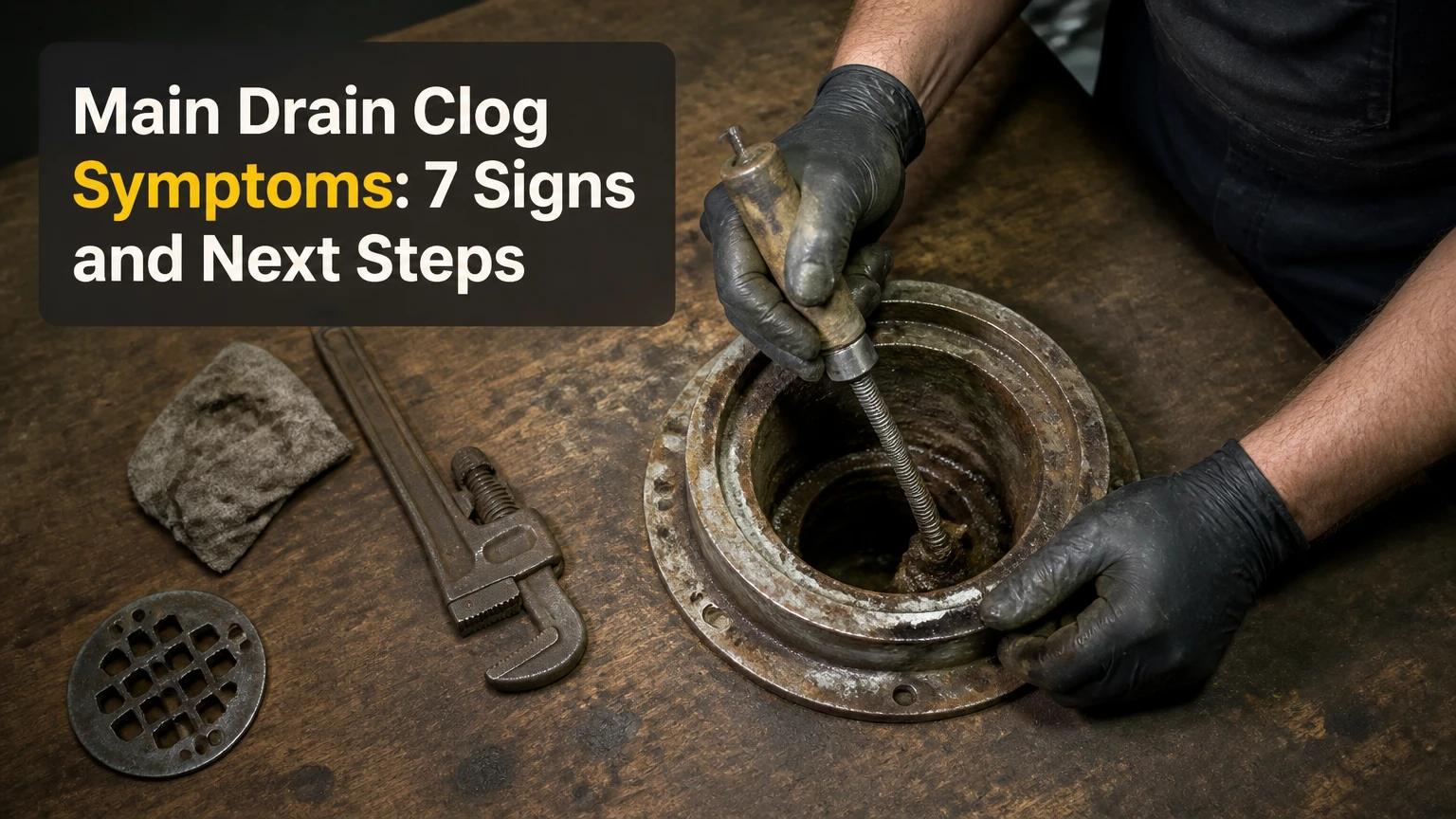
Main drain clog symptoms usually affect multiple fixtures, cause wastewater to rise at the lowest drains, and produce gurgling or persistent sewer odors. A toilet that bubbles when a washing machine drains is a stronger main-line warning than one slow sink. Stop using water and arrange professional diagnosis when two or more fixtures react together.
Key Facts at a Glance
A main drain blockage can make a toilet, shower, floor drain, and sink respond to one another.
Wastewater usually appears first at the lowest fixtures because gravity directs the backup there.
A full outdoor cleanout indicates standing wastewater, but the cleanout alone cannot identify the exact defect.
Liquid chemical drain cleaners rarely solve a distant, fully blocked sewer lateral and can create handling hazards.
A sewer camera identifies roots, grease, offsets, bellies, collapsed sections, and pipe scale before repair.
Typical U.S. service costs range from $150-$400 for a camera inspection and $200-$900 for mechanical clearing or hydro-jetting.
What Are the Main Drain Clog Symptoms?
The strongest main drain clog symptoms are simultaneous drainage problems in separate rooms, sewage emerging from a basement or ground-floor drain, and fixture interaction when water is used elsewhere. Gurgling, recurring backups, and sewer odors support the diagnosis, while one isolated slow drain usually indicates a local trap or branch clog.
A main drain, often called a building sewer or sewer lateral, receives wastewater from toilets, sinks, tubs, showers, dishwashers, and washing machines. In a typical house, the pipe leaves the building and carries flow toward a municipal sewer connection or septic tank.
Symptom severity and meaning
| Observed symptom | Likely significance | Immediate response |
|---|---|---|
| Toilet bubbles when a washer drains | Shared downstream restriction | Stop washing and flushing |
| Basement floor drain overflows | Main drain backup at the lowest outlet | Keep people and pets away |
| One bathroom sink drains slowly | Local fixture or branch restriction | Try a plunger, not chemicals |
| Sewage appears at an exterior cleanout | Downstream line may be full | Call a drain professional |
| Yard becomes wet along the lateral route | Leak, root damage, or saturated soil | Arrange inspection before digging |
| Sewer odor without slow drainage | Dry trap, vent issue, or partial leak | Refill traps and investigate |
The pattern matters more than any single symptom. A gurgling toilet alone can result from a vent obstruction, but gurgling plus a rising shower drain indicates shared drainage resistance.
How Does a Main Sewer Backup Move Through a House?
A blocked sewer lateral prevents wastewater from leaving the property, so new water increases pressure behind the obstruction and pushes sewage toward lower open fixtures. Basement drains, basement showers, floor drains, and ground-level tubs commonly overflow first because they sit below upper-floor plumbing connections.
Consider a washing machine draining 20-40 gallons during a cycle. If the lateral is nearly blocked, that discharge can force water through a nearby toilet or floor drain within seconds. The overflow may look like a fixture clog, but the timing reveals that the obstruction is farther downstream.
A partial blockage often produces intermittent symptoms. Small discharges pass through, while a bathtub drain, laundry load, or repeated toilet flush overwhelms the remaining opening. A complete blockage produces rapid backup and creates a higher risk of contaminated water entering flooring, walls, and electrical areas.
What does fixture interaction reveal?
Fixture interaction shows that two plumbing fixtures share a restricted downstream path. For example, a toilet that rises when a nearby tub drains points toward a blockage in the shared branch or building drain, while a basement drain that reacts to an upstairs washer more strongly suggests a main-line restriction.
The exact location still requires testing. A blockage between two bathrooms can mimic a main sewer problem, and a clogged vertical stack can affect several fixtures on one floor.
Which Signs Separate a Main Line Clog From a Local Clog?
Multiple affected fixtures are the clearest practical distinction between a main line clog and a local clog. A local clog normally affects one fixture, whereas a main-line restriction affects fixtures that may be distant from one another and often worsens when high-volume appliances discharge.
| Pattern | Main-line restriction | Branch or fixture clog | Vent-stack problem |
|---|---|---|---|
| Number of fixtures | 2 or more rooms | 1 fixture or bathroom group | Several fixtures may drain slowly |
| Toilet response | Bubbles or rises during other discharges | Usually normal | Gurgling, often without sewage |
| Lowest drain | Often overflows | Usually unaffected | Usually remains dry |
| Washer discharge | Can trigger widespread backup | May affect one nearby drain | May cause slow drainage |
| Plunging result | Temporary or no improvement | Often improves flow | Does not remove the cause |
| Typical remedy | Main auger, jetting, or repair | Trap or branch cleaning | Vent inspection or clearing |
A useful rule of thumb is to count affected drainage zones rather than fixtures. If a kitchen sink, upstairs toilet, and basement shower all show symptoms, a shared downstream restriction becomes much more likely.
Can sewer odors prove a main drain clog?
Sewer odors do not prove a main drain clog because dry P-traps, cracked vent pipes, loose toilet seals, and plumbing leaks can release sewer gas without a blockage. Odor combined with slow drainage, bubbling, or wastewater makes a lateral problem more credible.
Pouring water into an unused floor drain can restore a dry trap, but recurring odor requires inspection. Sewer gas can contain hydrogen sulfide and methane, and strong odor near an enclosed pit or drain warrants ventilation and professional assessment.
What Causes a Main Drain Clog?
The common causes include tree-root intrusion, grease and sludge accumulation, wipes or other foreign objects, mineral scale, construction debris, and structural defects such as bellies, offsets, or collapsed pipe sections. Pipe age and material influence which cause is most likely.
| Cause | Typical location or pipe condition | Why flow stops | Permanent response |
|---|---|---|---|
| Tree roots | Clay, Orangeburg, or cracked joints | Roots trap paper and debris | Root cutting plus repair or lining |
| Grease and sludge | Kitchen-connected lateral | Deposits narrow the internal diameter | Mechanical cleaning or hydro-jetting |
| Wipes and paper products | Toilets and shared branches | Fibers catch on rough surfaces | Augering and disposal changes |
| Mineral scale | Older cast-iron pipe | Flaking scale reduces capacity | Descaling, replacement, or lining |
| Pipe belly | Settled soil beneath the line | Low spot retains solids | Excavation and slope correction |
| Offset joint | Shifting or damaged pipe | Misaligned edges catch waste | Spot repair or replacement |
| Collapse | Crushed, brittle, or severely corroded pipe | Passage is physically closed | Excavation or suitable trenchless repair |
Tree roots do not normally enter an intact, sealed pipe. They exploit joints, cracks, and deteriorated sections where moisture is available. Root cutting restores flow temporarily, but repeated intrusion is evidence that the pipe itself may need rehabilitation.
“Flushable” labeling does not mean immediate sewer-line compatibility under every system condition. The U.S. Environmental Protection Agency’s consumer guidance consistently limits toilet flushing to human waste and toilet paper, because wipes and similar products can accumulate in household and municipal systems.
Why do repeated clogs matter?
A main drain that clogs every few months may have a persistent structural cause rather than a series of unrelated household mistakes. Recurrence after snaking commonly points to roots, heavy scale, a belly, an offset joint, or a damaged section that continues catching debris.
A cable can create a narrow opening through a root mass without cleaning the pipe wall. Flow may return, but the remaining roots and debris can recreate the obstruction quickly.
What Should You Do First During a Suspected Backup?
Stop all water use immediately, protect people from contaminated water, and call a licensed plumber or drain specialist for a main-line assessment. Do not run the washer, dishwasher, shower, or sinks, and do not flush toilets unless a professional confirms the line is open.
- Stop incoming water. Turn off the home’s main water valve if household members or automatic appliances might continue using water. The shutoff does not remove water already inside the drainage system.
- Keep away from sewage. Prevent contact with wastewater, especially for children, pets, older adults, and anyone with a weakened immune system.
- Protect electrical areas. Do not enter standing water near outlets, appliances, furnaces, or electrical panels. Contact an electrician or emergency service if electrical equipment may be wet.
- Document the event. Photograph the affected areas, record the time, and preserve invoices and cleanup records for the property owner or insurer.
- Call the responsible party. Homeowners should contact a plumber; renters should notify the landlord or property manager immediately. Municipal responsibility may begin at the public sewer connection, depending on local rules.
Is it safe to open the outdoor cleanout?
Opening an outdoor cleanout can reveal whether the lateral contains standing wastewater, but a pressurized or full cleanout can release sewage suddenly. Only inspect it if the cap is accessible, the area is safe, and you can loosen the cap slowly while wearing eye and skin protection.
A cleanout full of water generally means the blockage is downstream of that opening. An empty cleanout can mean the blockage is inside the building, upstream of the cleanout, or lower in the line where the pipe configuration prevents visible water. The result is useful, not definitive.
Never stand directly over the cap. Never use a torch, open flame, or unprotected hands around sewer gas.
How Is a Main Drain Blockage Diagnosed?
A professional diagnosis normally combines fixture testing, cleanout access, mechanical probing, and a sewer camera inspection. The camera shows the obstruction and pipe condition, while a locator can mark the defect’s position and approximate depth for targeted repair.
A typical sequence is:
- Map the symptoms. The technician notes which fixtures react, how quickly they back up, and whether the problem follows appliance discharge.
- Inspect accessible cleanouts. The water level helps establish whether the restriction is upstream or downstream of that point.
- Clear enough access for the camera. A small opening may be needed before the camera can pass.
- Run and locate the camera. The operator records roots, grease, scale, cracks, bellies, offsets, and collapse, then measures distance from a known access point.
- Verify flow afterward. A second camera pass or controlled discharge confirms that the line is open and reveals defects that cleaning exposed.
A camera inspection cannot always pass a completely collapsed pipe, a sharp offset, or a dense obstruction. In that situation, the failed access attempt is itself evidence that excavation or a different access point may be necessary.
Should You Snake, Hydro-Jet, Line, or Replace the Pipe?
Mechanical snaking is usually the first clearing option for a passable line with roots or a compact blockage, while hydro-jetting is better for grease and wall deposits. Pipe lining or excavation becomes necessary when inspection finds structural damage that cleaning cannot correct.
| Method | Typical cost | Typical duration | Best application | Main limitation |
|---|---|---|---|---|
| Main-line auger | $200-$450 | 1-2 hours | Roots, paper plugs, solid obstructions | May leave deposits behind |
| Hydro-jetting | $400-$900 | 1.5-3 hours | Grease, sludge, soft roots, scale | Risks fragile pipe |
| Camera inspection | $150-$400 | 30-60 minutes | Location and condition diagnosis | Cannot clear a collapse |
| Cured-in-place lining | $4,000-$12,000 | 1-2 days | Cracked but structurally stable pipe | Does not correct a severe belly |
| Excavation and replacement | $3,000-$15,000 or more | 2-5 days | Collapse, severe offset, belly | Disrupts landscaping and paving |
These are typical U.S. consumer ranges, not guaranteed quotes. Access, pipe depth, permitting, regional labor rates, pavement removal, disposal, and whether the contractor provides a camera report can change the total substantially.
Hydro-jetting should not be treated as a universal upgrade. High pressure can worsen brittle clay, severely corroded cast iron, or a pipe with an unstable collapse. A camera inspection should guide pressure and nozzle selection.
When does trenchless lining make sense?
Trenchless lining can suit a cracked or root-damaged pipe that still has a continuous, reasonably aligned passage. The liner creates a new pipe inside the old one, but it cannot restore correct grade to a belly or replace missing soil around a collapsed section.
Traditional excavation remains the more reliable choice for a crushed pipe, major offset, severe sag, or a defect that prevents proper liner installation. A contractor recommending lining should explain how service connections will be reinstated and how the liner’s diameter affects capacity.
What Other Problems Mimic a Main Drain Clog?
A full septic tank, clogged effluent filter, blocked building drain, obstructed vent, frozen lateral, or municipal sewer surcharge can resemble a main-line blockage. The correct response depends on the property’s drainage system and on where wastewater remains trapped.
| Look-alike problem | Clues that support it | Useful next check |
|---|---|---|
| Full septic tank | Slow drains across the house, recent pumping overdue | Check tank and effluent filter |
| Clogged septic outlet | Tank recently serviced, persistent backup | Septic professional inspection |
| Blocked plumbing vent | Gurgling and odor without wastewater rise | Roof or vent inspection |
| Frozen sewer lateral | Symptoms begin during severe freezing weather | Temperature and line-depth assessment |
| Municipal surcharge | Neighbors report backups or street sewer work | Call the utility department |
| Building drain blockage | Cleanout inside is full, exterior cleanout is clear | Camera from interior access |
A septic tank should not be opened casually. Gases, unstable covers, and biological hazards make tank inspection a professional task. A full tank can produce house-wide symptoms even when the private sewer lateral is clear.
Municipal sewer responsibility varies by city. Some utilities maintain the public main and part of the connection, while the property owner maintains the private lateral. Ask the utility where its responsibility ends before authorizing excavation.
How Can You Prevent Another Main Drain Backup?
Prevent recurrence by keeping grease, wipes, paper towels, dental floss, and hygiene products out of the drainage system, maintaining accessible cleanouts, and inspecting older laterals when symptoms recur. Properties with mature trees or aging clay and cast-iron pipes benefit from condition-based camera inspections.
Practical prevention measures include:
- Collect cooking oil and grease in a container for household-waste disposal.
- Flush only human waste and toilet paper.
- Do not rely on “flushable” wipes for sewer safety.
- Keep roots, shrubs, and large trees from being planted directly over the lateral.
- Have a camera inspection after repeated stoppages, not after an arbitrary number of plunging attempts.
- Test basement backwater valves according to the manufacturer’s schedule.
- Keep the cleanout cap visible and accessible; buried access increases emergency response time.
- Ask an insurer about sewer-backup and service-line endorsements because standard homeowners policies may exclude or limit these losses.
For a home purchase, a 15-minute fixture test cannot evaluate an underground lateral. A sewer scope during the inspection or due-diligence period can identify roots, bellies, offsets, and pipe material before they become an ownership expense.
What Are the Most Common Diagnostic Mistakes?
The most expensive mistakes are continuing to discharge water, using caustic chemicals in a full line, and accepting a temporary cable opening as proof that the pipe is sound. Each mistake either increases contamination or hides the structural cause.
Mistake 1: Treating every slow drain as local
A slow sink may be local, but a slow sink plus a bubbling toilet changes the diagnosis. Record timing across fixtures before attempting any repair.
Mistake 2: Pouring liquid drain cleaner into a main line
Chemical cleaner rarely travels effectively through a distant, water-filled lateral. It can remain in the standing wastewater, creating a chemical exposure risk for the technician and damaging some plumbing components.
Mistake 3: Hydro-jetting an unverified old pipe
Jetting cleans aggressively, but a fragile or collapsed pipe may not tolerate high pressure. Camera evidence should precede equipment selection.
Mistake 4: Replacing pipe without locating the defect
Excavating based on a guess can destroy landscaping while leaving the actual obstruction untouched. Require a marked location, measured distance, and recorded findings before approving targeted excavation.
Mistake 5: Ignoring a temporary success
If the drain works for two weeks after snaking, the service restored passage but may not have corrected roots, scale, or a belly. Recurrence is a diagnostic signal, not bad luck.
FAQ
Can a main drain clog clear itself?
A partial main drain restriction can appear to clear when water forces a temporary opening through grease, paper, or soft debris. The underlying material remains in the pipe, so symptoms often return after a large laundry load or several toilet flushes. A complete blockage will not reliably resolve without clearing or repair.
How long can I wait before calling a plumber?
Call promptly when multiple fixtures back up, sewage reaches a floor drain, or a toilet bubbles during appliance discharge. Waiting hours or days allows additional wastewater into the system and can increase flooring, drywall, odor, and cleanup costs. One isolated slow sink without backup is less urgent.
Will plunging a toilet fix a main sewer blockage?
Plunging can improve a toilet’s bowl-level obstruction, but it cannot reliably clear a distant main sewer blockage. If plunging one toilet causes another fixture to rise or does not restore several drains, stop using water and request a main-line evaluation rather than repeating the same attempt.
Are main drain clogs covered by homeowners insurance?
Coverage depends on the policy, the cause, and whether a sewer-backup or service-line endorsement exists. Many standard policies limit sewer backup coverage or exclude maintenance-related damage. Contact the insurer before discarding damaged materials, but do not delay emergency containment while waiting for an adjuster.
How often should a sewer lateral receive a camera inspection?
There is no universal annual interval for every home. A camera inspection is especially sensible after repeated stoppages, before buying an older property, after root removal, or when the lateral uses aging clay, Orangeburg, or cast iron. Mature trees and prior repairs increase the value of condition-based inspection.
What is the difference between a drain clog and a sewer backup?
A drain clog usually restricts one fixture or branch, while a sewer backup affects the shared building drain or lateral and can push wastewater into multiple low fixtures. The distinction comes from the symptom pattern and testing, not from the color or smell of the water alone.
The Bottom Line
The most reliable main drain clog symptoms are multiple slow or backed-up fixtures, toilet bubbling during another fixture’s discharge, wastewater at the lowest drain, and recurring problems after temporary clearing. Stop water use, avoid chemical cleaners, inspect the cleanout only with appropriate caution, and obtain a camera-based diagnosis when symptoms are widespread or recurrent. A blockage can be cleaned, but a damaged lateral requires repair.