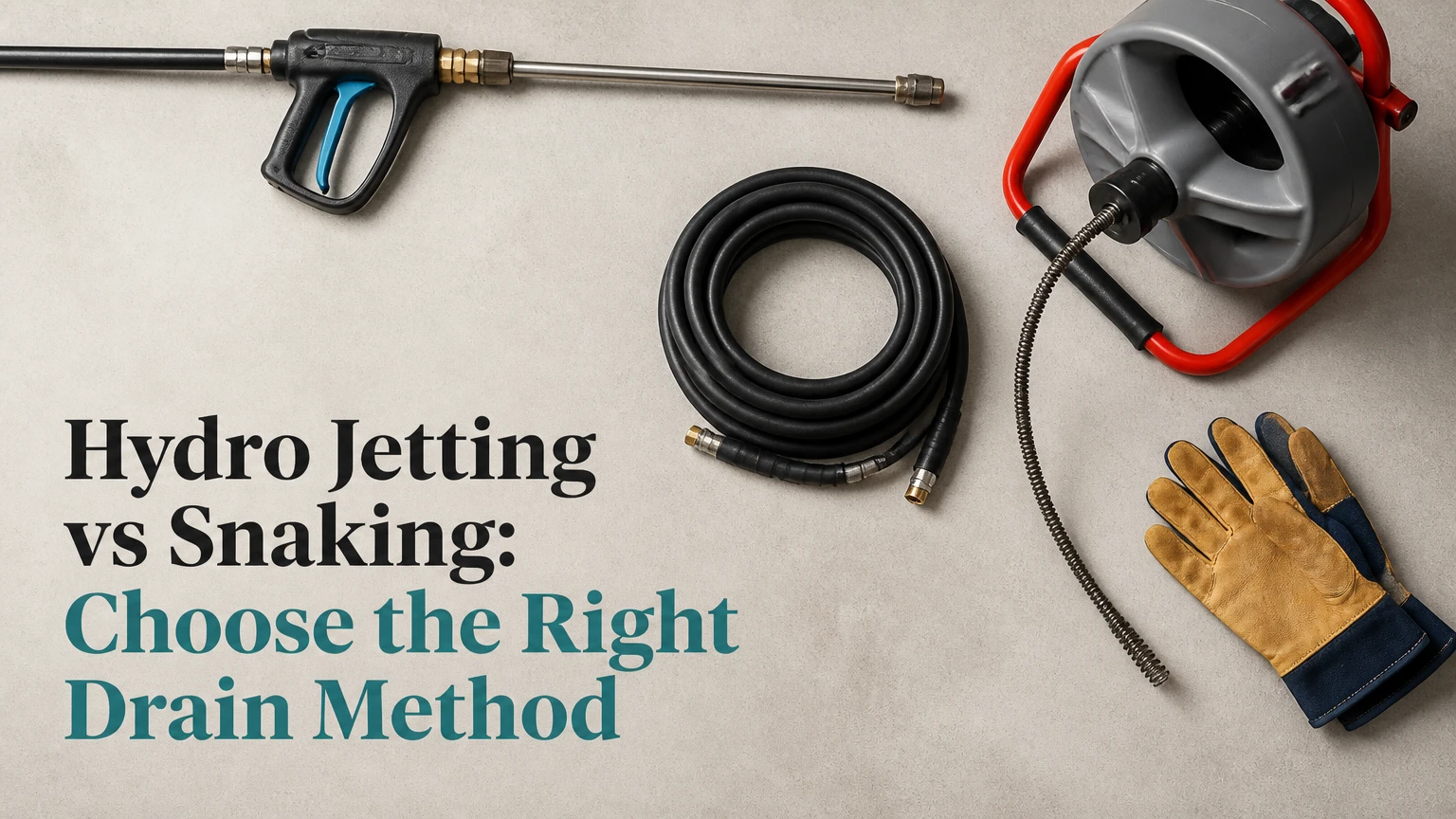
Hydro jetting vs snaking is a choice between opening a blocked passage and cleaning the pipe’s interior. Snaking uses a rotating cable to pierce, break, or retrieve an obstruction, while hydro jetting uses pressurized water to scour deposits and carry loosened material away. Snaking usually wins for isolated clogs; hydro jetting usually wins for recurring, grease-filled, scaled, or root-intruded lines.
Key Facts at a Glance
- Snaking is typically faster and less expensive, with common residential service prices of about $150-$350 and service times of 30-90 minutes.
- Hydro jetting cleans more of the pipe wall, but typical residential pricing is higher at roughly $350-$1,200.
- A drain snake can restore flow without removing grease, scale, or sludge attached to the pipe wall.
- Hydro jetting should be matched to pipe condition, diameter, access, nozzle type, pressure, and water flow, not PSI alone.
- A camera inspection is strongly advisable before jetting a questionable sewer line, but it is not universally required for every small, accessible drain.
- Neither method repairs a collapsed, severely cracked, misaligned, or badly separated pipe.
What Are Snaking and Hydro Jetting?
Snaking, also called drain augering, uses a flexible metal cable with a cutting or retrieval head. The cable rotates inside the drain and creates a channel through hair, paper, food residue, or other localized obstructions. A professional may also use the head to hook and withdraw material.
Hydro jetting uses a hose and specialized nozzle to direct high-velocity water through the line. Rear-facing jets propel the hose and wash loosened debris backward, while forward-facing or rotating jets can attack selected deposits. The method cleans a larger portion of the pipe circumference than a basic cable typically reaches.
The distinction matters because “clear” and “clean” describe different outcomes. A snake can restore drainage while leaving a thick layer of grease on the lower pipe wall. A jetter can remove that deposit, but high-pressure water cannot make a structurally failing pipe safe or restore missing pipe sections.
Which Method Is Better for a Clogged Drain?
Snaking is the better first response for a new, isolated clog with a predictable cause, especially in a sink, bathtub, shower, or toilet branch. Hydro jetting is the better cleaning method for recurring backups caused by grease, mineral scale, sludge, or substantial root intrusion in a structurally sound line.
The right decision depends on five variables: obstruction type, pipe condition, pipe diameter, access point, and recurrence history. A kitchen sink that slowed yesterday does not justify the same process as a commercial grease line that backs up every month.
Comparison Table: Snaking vs Hydro Jetting
| Decision factor | Snaking | Hydro jetting |
|---|---|---|
| Typical residential price | $150-$350 | $350-$1,200 |
| Typical service time | 30-90 minutes | 1.5-4 hours |
| Main mechanism | Rotating steel cable | Pressurized water and nozzle |
| Typical working pressure | Mechanical torque, not PSI | About 1,500-4,000 PSI, application-dependent |
| Typical water demand | None during cable operation | About 2-8 gallons per minute |
| Best target | Localized blockage | Deposits along a pipe section |
| Root performance | Cuts or punctures roots; regrowth remains | Removes more root mass, but regrowth remains possible |
| Pipe-condition risk | Lower when correctly sized | Higher if the pipe is brittle, cracked, or poorly supported |
| DIY suitability | Hand auger for limited fixtures | Generally unsuitable for homeowners |
Prices are typical United States service ranges, not fixed national rates. Local labor, emergency access, cleanout excavation, camera charges, pipe diameter, and travel can change the invoice substantially.
How Does Each Drain-Cleaning Method Work?
Snaking and hydro jetting both begin by identifying an access point and locating resistance, but the tools interact with the obstruction differently. Snaking applies torque through a cable; hydro jetting applies water velocity, impact, and flushing force through a nozzle.
The Snaking Process
- Choose access. A plumber may use a fixture opening, trap, cleanout, or sewer access point.
- Select the cable. Cable diameter and head style should match the drain size and obstruction.
- Feed the cable. The operator advances it until resistance indicates the blockage or a bend.
- Rotate and engage. A cutter breaks material, or a retrieval head hooks it.
- Withdraw and inspect. The operator removes captured debris and checks cable condition.
- Test flow. Several minutes of running water can reveal whether the opening is adequate.
A snake succeeds when water passes, the cable returns without unexplained damage, and the fixture drains at its normal rate. A successful flow test does not prove that the pipe wall is clean or that a root problem is permanently solved.
The Hydro Jetting Process
- Assess the line. Confirm pipe size, access, discharge route, and likely obstruction.
- Inspect when risk warrants it. A camera is especially important for older sewer lines, repeated failures, roots, suspected breaks, and unknown materials.
- Choose pressure and flow. The operator matches the pump, hose, nozzle, and pressure to the line.
- Position the nozzle. The hose usually enters through a cleanout, with direction selected for safe debris movement.
- Jet and retract gradually. Rear jets pull the hose while water scours the interior during controlled withdrawal.
- Flush and verify. The operator confirms flow and may perform a post-cleaning camera inspection.
Hydro jetting is not simply “more pressure.” A 2,000-PSI machine with the correct flow and nozzle can outperform a higher-PSI setup with insufficient water volume. Nozzle angle, hose diameter, operator control, and the drain’s internal condition determine the result.
Which Equipment Does Each Method Use?
Drain augers range from small manual tools to long commercial machines. Hydro jetters range from compact electric units for branch drains to truck-mounted or trailer-mounted systems for larger sewer lines.
| Equipment type | Typical capacity | Suitable application | Main limitation |
|---|---|---|---|
| Hand auger | 3-25 feet, 1/4-inch cable | Sink, tub, toilet branch | Limited reach and cutting force |
| Handheld power auger | 25-50 feet, small cable | Shower, laundry, small branch | Poor choice for large roots |
| Drum machine | 50-100+ feet, up to 3/4-inch cable | Residential main and sewer line | Heavy cable can damage weak pipe |
| Sectional machine | 10-15-foot cable sections | Long commercial or sewer runs | Requires skilled handling and open access |
| Compact electric jetter | About 1,500-2,100 PSI, 1.5-2 GPM | Indoor branch lines | Limited flow for large sewer deposits |
| Gas-powered jetter | About 3,000-4,000 PSI, 4-8 GPM | Main lines and commercial drains | Large equipment and higher operating cost |
What Do Hydro Jet Nozzles Do?
Nozzle selection changes the cleaning pattern and the direction of debris movement.
| Nozzle type | Jet pattern | Typical use | Important limitation |
|---|---|---|---|
| Penetrator | Forward jet plus rear jets | Initial passage through soft blockage | Can push debris deeper if misused |
| Flushing nozzle | Mostly rear-facing jets | Grease, sludge, and routine flushing | Less aggressive against hard scale |
| Rotary nozzle | Rotating water pattern | Broad wall cleaning and deposits | Requires suitable pressure and access |
| Root-cutting nozzle | Concentrated cutting pattern | Moderate root intrusion | Cannot repair root entry or pipe damage |
A nozzle does not remove every deposit equally. Hardened mineral scale may require mechanical descaling before or after jetting, and a large root mass may require repeated passes or excavation if roots enter through a major defect.
Does Snaking or Hydro Jetting Last Longer?
Hydro jetting generally lasts longer when the cause is wall buildup, because it removes more of the material that narrows the pipe. Snaking can last equally well for a one-time obstruction, such as a toy, hair bundle, or isolated paper blockage that has no continuing source.
Recurrence is the useful test. If a line backs up again within days or weeks after cable cleaning, the remaining deposit, root intrusion, inadequate slope, or structural defect deserves investigation. Repeating the same cable pass without identifying the cause often produces repeated service charges rather than a durable solution.
Hydro jetting also has limits. Roots can regrow, grease can re-enter a restaurant line, and a damaged pipe can collect debris again. Preventive cleaning extends the interval between blockages only when the source of the material and the pipe’s structural condition are addressed.
Which Method Handles Roots, Grease, and Scale?
Hydro jetting is usually more effective against grease, sludge, and broad deposits; a properly selected root-cutting setup can remove more root material than a standard cable. Snaking remains useful for puncturing a root mass, opening an urgent passage, or retrieving a solid object that water pressure could move deeper into the system.
| Obstruction | Better first method | Why | What can remain afterward |
|---|---|---|---|
| Shower hair | Snaking | Cable hooks and removes compact hair | Soap film on pipe wall |
| Toilet paper blockage | Snaking | Quickly opens a short branch line | No significant residue in many cases |
| Kitchen grease layer | Hydro jetting | Water scours the pipe circumference | Grease source remains |
| Mineral scale | Hydro jetting or descaling | Broad deposit needs wall contact | Damaged pipe or hard scale core |
| Tree roots | Camera plus jetting or cutting | Root mass needs diagnosis and removal | Root entry point and future regrowth |
| Wipes or foreign object | Snaking or retrieval | Cable can capture solid material | Object may remain if head cannot grip it |
A snake is not “ineffective” against every root problem. Cable cutters can clear substantial intrusion, but they often create a tunnel through roots rather than remove the entire root mat. Jetting can clean more of the circumference, yet neither method closes the opening where roots entered.
Is Hydro Jetting Safe for Old Pipes?
Hydro jetting is conditionally safe for old pipes, not automatically safe or automatically destructive. The central risk is structural weakness, including cracks, missing joints, corrosion, thin-wall cast iron, fragile clay, Orangeburg fiber pipe, or a partially collapsed sewer.
A camera inspection is not mandatory before every small hydro-jetting job. It is prudent before high-pressure cleaning when the pipe is old, the material is unknown, backups recur, roots are present, or the operator cannot explain where the water and debris will go. The plumber should document pipe condition and adjust pressure rather than rely on a generic machine setting.
Pipe Materials and Risk
| Pipe material | Common concern | Jetting approach | Inspection priority |
|---|---|---|---|
| PVC or ABS | Joint separation or poor support | Correct nozzle and moderate settings | Medium for recurring issues |
| Cast iron | Corrosion and thin walls | Conservative pressure and careful access | High after decades of service |
| Vitrified clay | Cracks and displaced joints | Inspect before aggressive cleaning | High |
| Orangeburg | Deformation and collapse | Avoid assumptions; diagnose first | Very high |
| Copper branch drain | Small diameter and fittings | Usually use a smaller method | Medium |
| Concrete sewer | Surface erosion and joints | Match nozzle and flow to condition | High for root problems |
The commonly repeated claim that jetting causes every weak pipe to burst is too broad. The more accurate concern is that jetting can expose or worsen a defect that already exists, while an uninspected line can fail under pressure or lose support when deposits are removed.
How Much Do Snaking and Hydro Jetting Cost?
Typical residential snaking costs about $150-$350 for a standard service call, while hydro jetting commonly costs $350-$1,200 depending on line size, access, inspection, and equipment. Emergency work, long sewer runs, commercial grease lines, and difficult cleanout access can exceed those ranges.
| Cost component | Snaking, typical range | Hydro jetting, typical range |
|---|---|---|
| Basic labor and equipment | $150-$350 | $350-$900 |
| Camera inspection | $100-$350 | $100-$350 |
| Emergency or after-hours premium | $50-$300 | $100-$500 |
| Main-line or long-run surcharge | $50-$300 | $150-$800 |
| Commercial grease-line service | $250-$700 | $500-$2,000+ |
| Pipe repair after structural failure | Not included | $500-$15,000+ |
Ask whether the quoted price includes travel, cleanout access, camera footage, water supply, debris cleanup, and a return visit if flow does not improve. A low advertised jetting price may exclude the inspection and setup needed to perform the work responsibly.
Which Should You Choose for Your Situation?
The best method changes with the fixture, symptoms, history, and pipe condition. The following recommendations separate an urgent flow-restoration problem from a pipe-cleaning and maintenance problem.
A Single Sink, Tub, Shower, or Toilet Clog
Choose snaking first when one fixture is affected and the blockage appeared recently. A hand auger or professional branch-line auger can remove hair, paper, or a compact obstruction without the cost and water requirements of jetting.
Do not keep escalating force when a snake encounters a hard stop. The resistance may indicate a trap, fitting, foreign object, or damaged pipe rather than a normal clog.
Multiple Fixtures Backing Up Together
Use the symptoms to suspect a branch or main sewer restriction, then arrange professional diagnosis. Snaking may restore emergency flow, but a camera inspection can identify roots, a belly, a collapsed section, or a displaced joint that cleaning alone will not correct.
A Recurring Main Sewer Backup
Consider hydro jetting after inspection when the line repeatedly accumulates grease, sludge, scale, or roots and remains structurally sound. If the same section fails every 6-12 months, paying for repeated cable openings may cost more than addressing the deposit pattern.
A Commercial Kitchen
Hydro jetting is generally better for grease-heavy restaurant lines because FOG deposits coat the pipe rather than forming one compact plug. A maintenance schedule may range from every 3-6 months, but the correct interval depends on meal volume, interceptor maintenance, pipe diameter, and prior accumulation.
Snaking is still useful for an urgent opening or a solid item. It is a poor substitute for removing a broad grease bed.
An Older or Historic Home
Start with diagnosis and conservative cable work when pipe material, age, or condition is uncertain. Jetting should follow a camera inspection if the line contains aging cast iron, clay, Orangeburg, or suspected corrosion.
A pre-1970 construction date alone does not prove that jetting is unsafe. Renovations may have replaced sections with PVC, while a newer-looking line may still have a severe defect.
What Mistakes Make Drain Cleaning Fail?
The most expensive drain-cleaning mistake is treating restored flow as proof of a healthy pipe. A narrow channel through grease or roots can drain during testing while leaving most of the obstruction attached to the wall.
- Skipping diagnosis on a recurring line: Repeated cleaning hides structural defects and increases total cost.
- Using the wrong cable head: A retrieval hook cannot clean a wide root mat, while an aggressive cutter may damage a fragile branch.
- Jetting without an exit plan: Loose grease, scale, or roots can move downstream and block a narrower section.
- Using PSI as the only specification: Flow rate, nozzle design, hose size, and operator control determine cleaning performance.
- Forcing a cable around resistance: A kinked cable or broken cutter can create a second obstruction.
- Jetting a collapsed pipe: Water cannot restore a passage that has lost its usable cross-section.
- Ignoring the source: A leaking grease trap, flushable-wipe use, or tree root entry will recreate the problem.
An experienced operator records the access point, approximate distance to resistance, pipe material, nozzle or cutter used, and the final flow result. Those details make the next service decision more accurate.
What Are the Alternatives to Both Methods?
Chemical drain cleaners are not a dependable substitute for snaking or hydro jetting in a blocked main line. Caustic products may sit in standing water, damage certain materials, injure occupants, and complicate safe cable work.
Other alternatives include:
- Trap cleaning: Appropriate when the blockage is inside a removable sink trap.
- Toilet augering: Designed for toilet bowls and nearby passages, with less risk of scratching porcelain than a general cable.
- Mechanical descaling: Uses chain knockers or specialized cutters for hardened mineral deposits.
- Pipe repair or replacement: Required for collapse, severe separation, major corrosion, or repeated root entry.
- Root treatment: May slow regrowth in some systems, but it does not replace structural repair.
No cleaning method should be sold as a repair. Cleaning removes material; repair restores the pipe’s shape, alignment, watertightness, or support.
How Can You Verify the Job Worked?
Verify restored flow with a sustained test, not a single bucket of water. For a fixture, run the faucet or flush repeatedly while checking nearby drains; for a main line, observe discharge at the cleanout or use several fixtures under normal household demand.
A post-service camera inspection is especially valuable after root removal, heavy scale cleaning, a difficult main-line blockage, or a service where the precondition was uncertain. The camera should show the cleaned section, remaining defects, standing water, displaced joints, and any material that could cause recurrence.
Keep the invoice and video when available. A future plumber can distinguish a new blockage from a known defect and avoid repeating an unsuitable procedure.
The Bottom Line
Hydro jetting vs snaking is not a contest with one universal winner. Choose snaking for a new, localized blockage or solid object when the immediate goal is to reopen the drain. Choose hydro jetting for recurring grease, sludge, scale, or root-related restrictions in a pipe that inspection shows can tolerate the selected equipment.
Hydro jetting vs snaking should therefore be decided by cause and pipe condition, not by the cheapest quote or the highest advertised pressure. If cleaning fails repeatedly, stop ordering another opening service and investigate the line’s structure, slope, joints, and source of debris.
Frequently Asked Questions
Can hydro jetting remove tree roots permanently?
No. Hydro jetting can remove substantial root growth from the pipe interior, but it does not permanently seal the crack, failed joint, or damaged connection where roots entered. Roots may return, sometimes within a year, if the entry point remains open. A camera inspection determines whether cleaning, root control, excavation, or pipe rehabilitation is appropriate.
Is snaking safe for cast-iron pipes?
Snaking can be safe for cast-iron pipes when the cable, cutter, and force match the pipe’s condition. Corroded cast iron may have thin walls that a large cutter can damage or expose. Recurring backups, rust flakes, and an older installation justify camera inspection before aggressive cable work.
Can I hydro jet a kitchen sink myself?
Homeowners should generally avoid hydro jetting a kitchen sink without professional training and correctly rated equipment. Compact consumer jetters may lack the flow, hose control, and recovery planning needed for a blocked branch. Incorrect pressure or nozzle selection can damage fittings, force debris deeper, or expose the operator to contaminated water.
How long does hydro jetting take?
A typical residential hydro-jetting visit takes about 1.5-4 hours, including access, setup, cleaning, flushing, and testing. A short branch line may take less time, while a long sewer run, severe scale, root intrusion, or camera inspection adds time. The cleaning pass itself is only one part of the service.
Does hydro jetting use more water than snaking?
Yes. Snaking uses mechanical cable action and normally adds little or no process water, while hydro jetting commonly uses about 2-8 gallons per minute. Total consumption depends on pressure, flow rate, hose travel, number of passes, and flushing time. Water use should be considered where discharge capacity is limited.
Should I snake or jet a drain before selling a house?
Use the least invasive method that resolves a documented problem, but investigate recurring or multi-fixture symptoms before listing the property. A camera inspection can reveal defects that cosmetic drain cleaning hides. Provide service records and footage when available, because a temporary opening may not address a buyer’s future sewer liability.