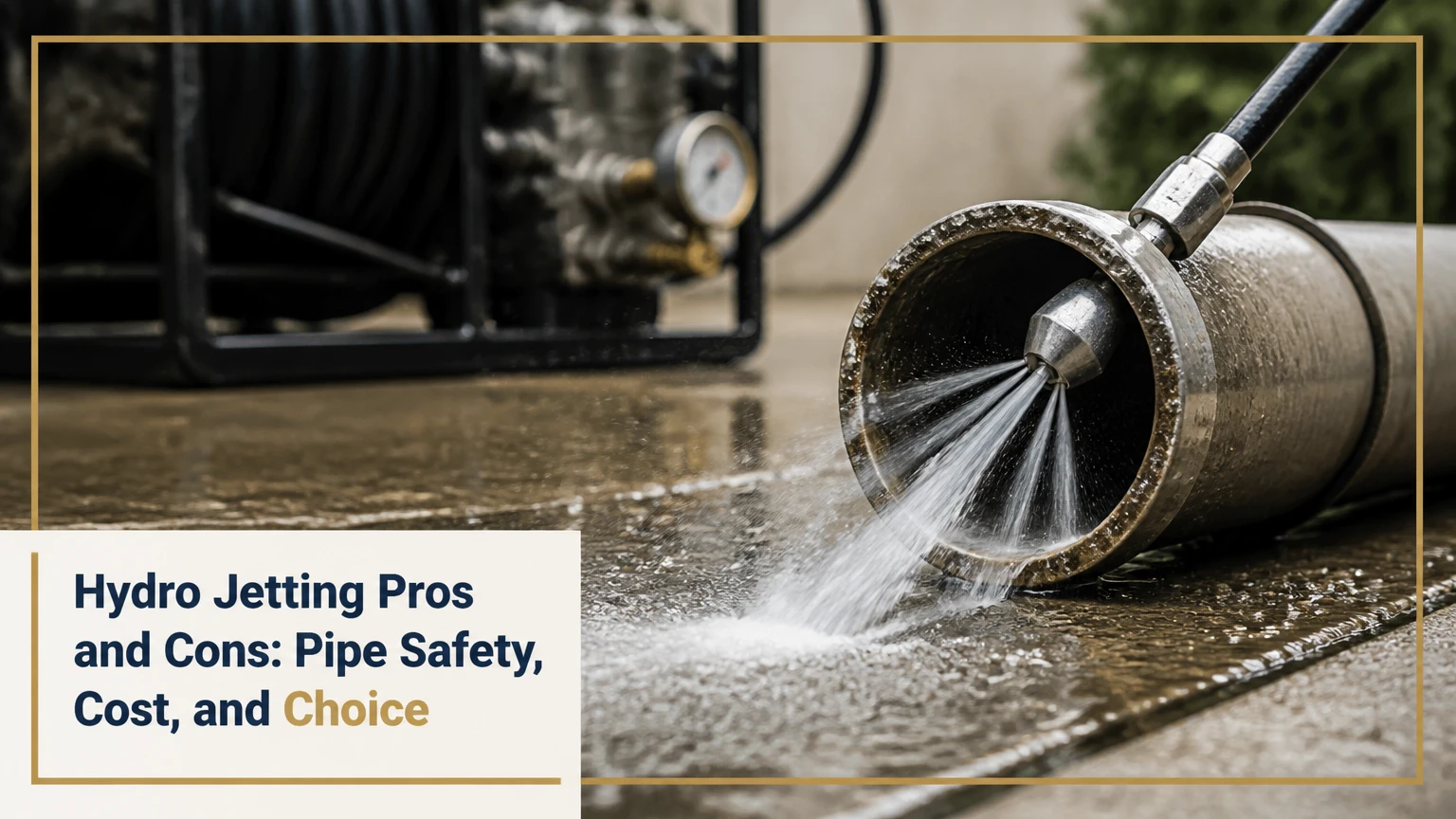
Hydro jetting is a professional drain-cleaning method that uses pressurized water to remove grease, scale, sludge, and some root intrusion from pipe walls. Its main advantages are deeper cleaning and longer intervals between blockages; its main disadvantages are higher cost, water use, and the possibility of worsening damaged pipes when inspection or pressure selection is inadequate.
Key Facts at a Glance
- A typical residential sewer jetter operates around 1,500-4,000 PSI and 2-20 GPM, although the correct setting depends on pipe condition, diameter, nozzle, and blockage.
- Hydro jetting cleans a larger area of the pipe wall than a drain auger, which usually creates a narrow passage through the obstruction.
- A camera inspection should precede jetting when a line may be collapsed, heavily corroded, offset, or made from fragile material.
- Typical residential pricing is approximately $350-$700 for a main-line service, with camera inspection, access, and difficult excavation sometimes billed separately.
- Hydro jetting removes buildup, but it cannot repair a collapsed, bellied, disconnected, or severely fractured sewer pipe.
- Professional jetting commonly takes 2-3.5 hours from setup through post-cleaning verification.
What Is Hydro Jetting?
Hydro jetting is pipe cleaning with a high-pressure pump, flexible hose, and specialized nozzle. The nozzle sends water forward into the obstruction and backward against the pipe wall, so the water both breaks apart debris and pulls the hose through the line.
The method differs from chemical drain cleaners because water provides the cleaning force. It also differs from an auger: a cable often drills through a clog, while a properly selected jetting nozzle washes residue from a larger portion of the circumference. “Complete cleaning” does not mean the pipe becomes structurally new; hydro jetting restores usable internal space only when the pipe remains sound.
The result depends on flow as much as pressure. PSI supplies force at the nozzle, while gallons per minute, or GPM, carries loosened material downstream. A high-PSI, low-flow machine may penetrate a blockage but leave transport problems, whereas a suitable flow rate can move grease and sediment out of the line.
What Can Hydro Jetting Remove?
Hydro jetting can remove soft grease, soap residue, sludge, mineral scale, paper accumulation, sand, and some tree-root intrusion. Specialized nozzles and multiple passes may be required for hardened deposits or extensive roots.
Hydro jetting is less suitable for a completely collapsed pipe, a major offset joint, a severe belly that holds water, or a line with missing sections. Jetting may expose those faults, but structural repair requires spot repair, lining, or replacement.
How Does Hydro Jetting Work?
Hydro jetting works through nozzle velocity, water flow, directional jets, and controlled hose movement. Forward jets penetrate the obstruction, while rear-facing jets scour the pipe wall and produce thrust that advances the nozzle.
A technician normally starts at a cleanout and works toward the blockage or upstream branch. The operator controls the hose speed because moving too quickly can leave deposits behind, while forcing the nozzle into a damaged section can enlarge a defect. The operator also manages downstream flow so loosened debris does not create a second backup.
Nozzle choice changes the cleaning pattern. A penetrating nozzle suits a dense obstruction, a flushing nozzle carries sludge, and a root-cutting or descaling configuration targets harder material. Professional systems can range from small electric units for branch drains to trailer-mounted machines for large commercial lines.
What Happens During a Professional Service?
A professional hydro jetting service usually follows six stages:
- Inspect the line with a camera. The technician identifies the blockage, pipe material, joint condition, intrusion, and collapse risk.
- Locate a suitable access point. The cleanout must provide a usable route and enough working room for the hose.
- Select pressure, flow, and nozzle. The decision accounts for pipe diameter, material, condition, obstruction type, and downstream drainage.
- Feed the hose before engaging full pressure. Controlled insertion reduces the risk of striking an obstruction at maximum force.
- Make one or more cleaning passes. The technician advances and retracts the hose at a controlled speed, monitoring water movement.
- Verify the result. A second camera pass can document remaining defects, open diameter, roots, scale, and the condition of joints.
The first camera is the safety decision; the second camera is the quality check. A service that provides neither may still clear water, but it gives the owner less evidence about why the line failed and whether the cleaning worked.
Hydro Jetting Pros and Cons
Hydro jetting is strongest when a structurally sound pipe has recurring grease, scale, sludge, or root-related restrictions. The trade-off is that the same force that removes buildup can damage a weak pipe, and the service costs more initially than basic cable clearing.
What Are the Main Advantages?
- Broader cleaning: Water can wash residue from much of the pipe circumference instead of making one opening through the clog.
- Strong grease performance: Jetting can break up and transport fats, oils, and grease that commonly re-form after a narrow cable passage.
- Useful root control: A suitable nozzle can cut or scour roots from the line, although roots may return if the joint remains open.
- Fewer repeat visits: Removing wall deposits can extend the interval before another blockage, particularly in commercial kitchens.
- No caustic drain chemicals: The cleaning action uses water rather than sulfuric acid, lye, or oxidizing drain products.
- Diagnostic value: Camera footage before and after service can reveal a belly, offset, crack, or root entry that a simple unclogging visit may not document.
The long-term value is conditional. Jetting can reduce recurring maintenance when accumulation causes the obstruction, but it cannot prevent recurrence caused by defective joints, poor slope, root-prone landscaping, or improper disposal practices.
What Are the Main Disadvantages?
- Structural risk: High-pressure water can worsen cracks, displaced joints, corrosion holes, thin-walled pipe, or deteriorated Orangeburg pipe.
- Higher upfront price: The equipment, operator training, setup, water handling, and camera work cost more than basic snaking.
- Professional-only hazard: An uncontrolled hose can whip, penetrate skin, flood a property, or discharge contaminated water.
- Limited repair ability: Jetting cleans a line but does not restore missing pipe, correct a belly, or reconnect an offset joint.
- Access requirements: A blocked or buried cleanout can add labor, excavation, or an alternate access charge.
- Water and wastewater handling: The method avoids chemical drain cleaners but still consumes water and moves contaminated material through the drainage system.
- Possible root recurrence: Root removal is often temporary if the root-entry joint remains open.
A common misconception is that any pipe becomes unsafe above a single PSI number. There is no universal cutoff at 3,000 PSI because nozzle distance, orifice size, flow, pipe diameter, material, wall condition, and impact angle all change the applied force. Pipe inspection matters more than a marketing pressure label.
What Equipment and Pressure Are Used?
Hydro jetting equipment ranges from compact electric machines to large trailer-mounted systems. Residential work often uses approximately 1,500-4,000 PSI and 2-20 GPM, while commercial and municipal systems may exceed those ranges under controlled conditions.
| Equipment type | Typical pressure and flow | Typical application | Main limitation |
|---|---|---|---|
| Compact electric jetter | 1,000-2,000 PSI, 1.5-4 GPM | 1.5-2 inch kitchen, shower, and floor-drain lines | Limited reach and transport capacity |
| Residential cart jetter | 2,000-4,000 PSI, 4-18 GPM | 3-6 inch building drains and sewer laterals | Needs cleanout access and drainage control |
| Commercial trailer jetter | 4,000-8,000+ PSI, 10-60 GPM | Large restaurant, hotel, industrial, and municipal lines | Excessive for many small or deteriorated pipes |
| Descaling configuration | 2,000-4,000 PSI, nozzle-specific flow | Cast-iron scale and hardened deposits | Requires careful inspection and multiple passes |
PSI and GPM should be treated as a matched pair. A technician who quotes only PSI has not provided enough information to judge suitability, because the nozzle converts pump output into a particular impact and cleaning pattern.
Is Hydro Jetting Safe for Old Pipes?
Hydro jetting can be safe for old pipes when a camera confirms adequate structural integrity and the technician adjusts the equipment to the line. Old age alone does not prohibit jetting, but visible corrosion, fractures, separated joints, severe ovality, and brittle pipe substantially increase the risk.
Cast iron may have a sound exterior but a paper-thin interior caused by corrosion. Clay pipe may tolerate cleaning in one section and fail at a displaced or cracked joint. PVC generally handles routine jetting well when installed correctly, but damaged, thin, or poorly supported sections still require caution.
| Pipe condition | Jetting decision | Main concern | Better next step |
|---|---|---|---|
| Intact PVC, open joints | Usually suitable | Incorrect nozzle or excessive flow | Use calibrated residential equipment |
| Sound cast iron with light scale | Often suitable | Removing scale can reveal hidden holes | Camera before and after cleaning |
| Cracked clay with root entry | Conditional or avoid | Water can enlarge the crack or wash soil | Repair joint or inspect further |
| Orangeburg or severely corroded iron | Generally poor candidate | Wall failure and collapse | Discuss replacement or lining |
| Collapsed or bellied line | Does not solve fault | Debris has nowhere to travel | Structural repair, replacement, or rerouting |
A professional should explain the camera findings before starting. If the technician recommends maximum pressure without identifying pipe material and condition, obtain a second opinion.
How Much Does Hydro Jetting Cost?
Typical residential hydro jetting costs about $350-$700 for a main sewer line, while complex commercial or difficult-access work commonly costs $700-$1,500 or more. A separately billed camera inspection may add approximately $150-$300, although many companies bundle it into the service.
| Service situation | Typical price range | Typical duration | Cost drivers |
|---|---|---|---|
| Interior branch drain | $250-$500 | 1-2 hours | Access, line diameter, grease severity |
| Residential main sewer line | $350-$700 | 2-3.5 hours | Cleanout, distance, camera inspection |
| Root-heavy residential lateral | $500-$1,000 | 2.5-4 hours | Multiple passes, root density, disposal |
| Restaurant or commercial line | $700-$1,500+ | 3-6 hours | FOG load, traffic control, line size |
| Buried or inaccessible cleanout | $600-$2,000+ | 3-8 hours | Excavation, restoration, alternate entry |
These are typical planning ranges, not a national fixed price. Local labor rates, emergency timing, access, pipe length, water recovery, and whether the quote includes camera footage can change the total substantially.
What Should a Professional Quote Include?
A useful written quote identifies the access point, line diameter, estimated hose length, camera inspection, pressure and flow range, number of passes, cleanup, wastewater handling, and any warranty. It should also state what happens if the camera finds a collapse or a broken connection.
Ask whether the price includes before-and-after video, not merely a verbal statement that the line is clear. Confirm whether the plumber will stop and seek approval if jetting reveals a repairable structural defect.
How Long Does a Service Take?
A standard residential service usually takes 2-3.5 hours, including 30-45 minutes for setup and inspection and roughly 1-2 hours of active jetting. Large commercial lines, difficult cleanouts, severe roots, and multiple camera passes can extend the appointment to half a day.
The actual water-blasting time is not the entire job. Equipment staging, protecting interior finishes, opening the cleanout, flushing debris, checking downstream fixtures, and documenting the result affect the schedule.
A line that clears in 20 minutes is not necessarily a better service. Rapid flow restoration can mean the technician created a small passage rather than removing the deposits that caused repeated backups.
Hydro Jetting vs. Snaking: Which Is Better?
Hydro jetting is usually better for recurring grease, scale, sludge, and broad pipe-wall buildup, while snaking is usually better for a simple isolated clog or a fragile line that has not been cleared diagnostically. The right choice depends on the blockage, pipe condition, access, and whether the goal is immediate flow or deeper cleaning.
| Decision factor | Hydro jetting | Drain snaking | Practical winner |
|---|---|---|---|
| Typical residential price | $350-$700 | $150-$400 | Snaking for first-time simple clogs |
| Cleaning action | Water washes wall deposits | Cable opens a path | Hydro jetting for buildup |
| Grease removal | Strong on soft and layered FOG | Often partial | Hydro jetting |
| Root response | Cuts or scours accessible roots | Makes a temporary channel | Hydro jetting, with repair follow-up |
| Fragile pipe risk | Moderate to high if misapplied | Lower, but cable can snag | Snaking after structural inspection |
| Typical active work | 1-2 hours | 30-90 minutes | Snaking for speed |
| Structural repair | Cannot repair pipe | Cannot repair pipe | Neither |
Snaking is not automatically inferior. A cable is often the sensible first response when one bathroom drain suddenly stops, the line has no recurring history, and the technician can confirm the obstruction is local. Jetting becomes more persuasive when several fixtures back up, the same line fails repeatedly, or camera footage shows substantial wall deposits.
When Is Hydro Jetting the Right Choice?
Hydro jetting is a strong choice for recurring main-line backups, commercial kitchen grease, heavy scale, and broad sludge accumulation in a structurally sound pipe. It is a poor choice when the primary fault is collapse, severe displacement, a belly, or a pipe material already failing under inspection.
Use these situation-based rules:
- One slow sink: Try fixture-level diagnosis or a small auger first; a sewer jetter is usually excessive.
- Several fixtures backing up: Investigate the building drain or sewer lateral, then consider jetting if deposits are visible.
- Backups every few months: Camera inspection plus cleaning is more informative than repeated blind snaking.
- Restaurant or food-service line: Schedule maintenance according to grease loading and local requirements; a fixed six-month interval is not universal.
- Older home with cast iron: Inspect first, because scale removal may expose holes that were hidden by deposits.
- Tree roots: Jetting can restore flow, but recurring roots require joint repair, lining, replacement, or approved root-management planning.
- Septic system: Confirm that the system, tank, baffles, and outlet can accept the displaced water and debris before cleaning a building sewer.
Preventive service should follow observed loading and failure history. A restaurant with heavy FOG may need quarterly attention, while another commercial property may need a different interval after several documented inspections.
What Are the Failure Modes?
Hydro jetting fails when cleaning is mistaken for repair, pressure is selected without inspection, or loosened debris cannot leave the system. The most expensive outcomes usually involve a pre-existing structural defect that was not identified before the pump started.
Common Problems and Correct Responses
| Problem | Likely cause | Immediate response | Long-term correction |
|---|---|---|---|
| Nozzle will not advance | Dense obstruction, wrong nozzle, offset joint | Stop pressure and avoid forceful pulling | Re-camera and change access or nozzle |
| Water backs up indoors | Downstream restriction or excessive debris | Pause jetting and protect fixtures | Clear downstream section and control flow |
| Line clears, then blocks again | Roots, belly, or remaining scale | Request a post-service camera | Repair the underlying pipe fault |
| Soil appears at cleanout | Broken or disconnected underground pipe | Stop and document conditions | Excavation, lining, or replacement assessment |
| Sewer odor persists | Residue outside cleaned section or vent issue | Check camera coverage and venting | Clean the full affected run or repair vent |
| Pipe leaks after cleaning | Existing weakness exposed or damaged | Stop use and isolate affected line | Structural repair and insurance documentation |
Do not yank a stuck hose, continue at maximum pressure during indoor backup, or rely on chemical cleaner after jetting. Those actions can turn a manageable obstruction into flooding or a damaged line.
What Are the Alternatives?
Snaking, mechanical root cutting, descaling, trenchless lining, spot repair, and full replacement each address a different failure. No cleaning method can restore a pipe section that has collapsed or lost its structural continuity.
| Alternative | Best use | Typical cost range | Limitation |
|---|---|---|---|
| Hand or machine auger | Isolated soft clog | $100-$400 service | Leaves wall deposits behind |
| Mechanical root cutting | Limited root blockage | $300-$800 | Roots commonly return |
| Water jetting | Grease, scale, sludge, roots | $350-$1,500+ | Needs sound pipe and access |
| Cured-in-place lining | Continuous pipe with cracks or leaks | $4,000-$12,000+ | Not suitable for every collapse or offset |
| Spot excavation and repair | One failed joint or section | $2,000-$8,000+ | Requires digging and surface restoration |
| Full sewer replacement | Extensive collapse or repeated failure | $8,000-$30,000+ | Highest disruption and cost |
Pricing varies sharply by length, depth, permits, access, and local labor. A camera report should guide the choice rather than the equipment a contractor happens to have available.
What Should You Check Before Booking?
Before booking hydro jetting, obtain the pipe material and camera findings, confirm the quoted pressure and flow, and ask what the contractor will do if the line is structurally defective. The best decision is based on cause, not on the fact that a pipe currently drains slowly.
Use this checklist:
- Ask for a camera inspection before high-pressure cleaning.
- Identify the pipe material, approximate age, diameter, and access point.
- Request a written price that separates inspection, jetting, excavation, and repairs.
- Confirm whether before-and-after video is included.
- Ask which nozzle will be used and why it matches the blockage.
- Confirm protection for indoor fixtures and a plan for wastewater control.
- Ask whether the service addresses a branch drain, building drain, or municipal lateral.
- Get a clear statement that cleaning does not guarantee structural repair.
- Keep footage and invoices for property-management, lease, or insurance records.
- Stop the work if the operator cannot explain the camera findings or pressure selection.
Three Practitioner Rules of Thumb
Recurring failure matters more than the first price. A $200 cable visit may be economical for a first-time clog, but repeated visits can exceed one properly diagnosed cleaning without addressing the wall deposits.
Root removal is not root prevention. Roots enter through defects, so a clean camera image immediately after jetting does not prove the joint will remain sealed.
The cleanest pipe can reveal the worst problem. Scale and sludge may temporarily seal a corroded section; removing them can expose leaks. That discovery is not necessarily jetting damage, but the condition should have been disclosed as a risk before work began.
FAQ
Can Hydro Jetting Damage PVC Pipes?
Hydro jetting can damage PVC when the pipe is cracked, unsupported, poorly joined, or exposed to an unsuitable nozzle and flow. Intact PVC sewer lines commonly tolerate properly calibrated residential equipment, but pipe condition and jetting technique matter more than the material name alone. A camera inspection should precede high-pressure cleaning when uncertainty exists.
Does Hydro Jetting Remove Tree Roots Permanently?
Hydro jetting does not permanently remove tree roots when the roots enter through an open joint, crack, or failed connection. Jetting can restore flow and clean the intrusion, but roots may return through the same defect. Permanent control may require spot repair, trenchless lining, replacement, or a qualified root-management plan.
Can Hydro Jetting Clear a Collapsed Sewer Line?
Hydro jetting cannot reliably clear a fully collapsed sewer line because the damaged section cannot provide a continuous path for the hose or debris. A partial collapse may allow temporary flow, but continued jetting can wash soil into the void. Camera evidence should determine whether repair, lining, or replacement is necessary.
Is Hydro Jetting Safe for a Septic System?
Hydro jetting may be compatible with a septic system when the tank, baffles, outlet, and drainfield can accept the displaced wastewater and solids. The technician should understand the system layout and avoid forcing excessive material toward a failing tank or drainfield. Septic inspection is appropriate when backups involve the building sewer and tank together.
Should You Hydro Jet Before Selling a House?
Hydro jetting before selling a house is worthwhile when camera footage shows significant buildup or the property has recurring sewer backups. Cleaning without inspection can conceal rather than resolve a structural problem. Sellers and buyers benefit more from a documented camera report, clear repair disclosures, and a targeted cleaning decision than from an unsupported claim that the line is “like new.”
How Often Should Commercial Drains Be Hydro Jetted?
Commercial drains should be hydro jetted according to grease loading, blockage history, line size, and inspection results rather than a universal calendar. A busy restaurant may require quarterly or six-month service, while a lower-load property may need less frequent work. Preventive records should include dates, camera findings, debris type, and the next recommended interval.
Conclusion
Hydro jetting pros and cons become clear when the decision is tied to pipe condition and blockage cause. Hydro jetting offers deeper cleaning for grease, scale, sludge, and accessible roots, but it costs more and can worsen a damaged line. Choose it after camera inspection when recurring buildup is the problem; choose snaking, repair, lining, or replacement when the evidence points elsewhere.