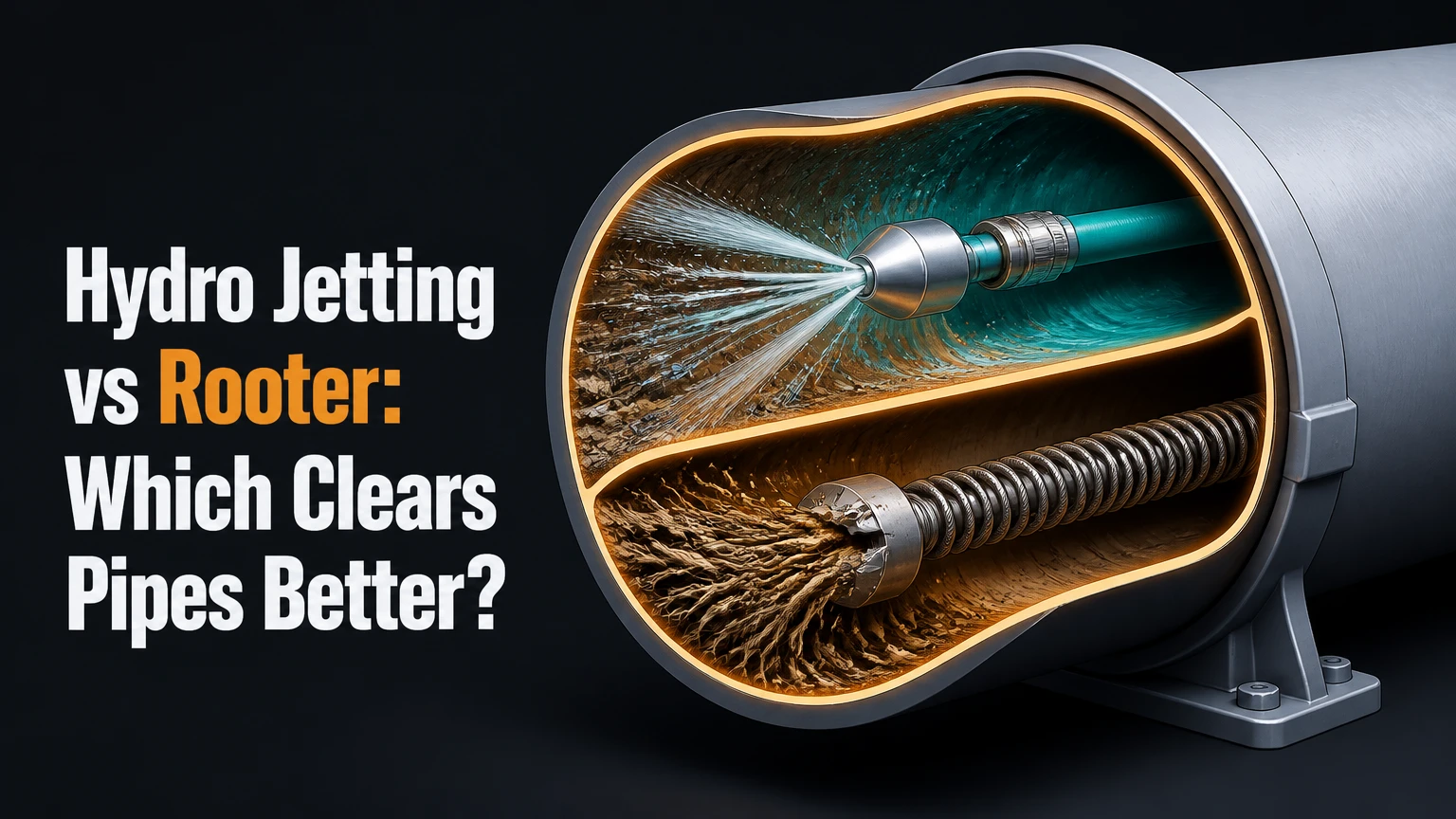
Hydro jetting uses controlled high-pressure water to scour buildup from a drain or sewer pipe, while rooter service uses a rotating cable and cutter to break through an obstruction. Hydro jetting usually cleans grease, sludge, and scale more thoroughly; rooter service usually restores flow faster and at lower cost when a cable can reach the blockage safely.
Key Facts at a Glance
- Hydro jetting typically costs $350-$900 for a residential sewer line and takes about 1.5-3 hours, including inspection.
- Rooter service typically costs $150-$400 for a residential clog and takes about 45-90 minutes.
- Hydro jetting cleans more of the pipe wall, but it cannot repair a collapsed, separated, or badly corroded sewer line.
- Rooter service creates a passage through an obstruction, so grease and root fragments can remain after water flow returns.
- A sewer camera inspection should guide pressure, nozzle, cutter, and repair decisions, especially in older or repeatedly blocked lines.
- Tree roots can be cut by a rooter or specialized jetting nozzle, but neither cleaning method permanently repairs the pipe opening that roots entered.
Hydro Jetting vs Rooter: The Core Difference
Hydro jetting removes deposits with water volume and pressure, whereas rooter service cuts or punctures a blockage with a motorized steel cable. The practical distinction is cleaning depth: a jet can wash a long section of pipe circumference, while a cable normally makes a channel through the obstruction.
“Rooter” is a service term rather than one universal machine. A plumber may use a small handheld auger for a bathroom sink, a drum machine for a branch drain, or a sectional machine with a root-cutting head for a sewer lateral.
| Decision factor | Hydro jetting | Rooter service |
|---|---|---|
| Primary force | Water at typically 1,500-4,000 PSI | Motorized steel cable and cutter |
| Typical residential price | $350-$900 | $150-$400 |
| Typical service time | 1.5-3 hours | 45-90 minutes |
| Main result | Scours deposits from pipe walls | Opens a passage through the clog |
| Best blockage type | Grease, sludge, scale, soft deposits | Hair, wipes, roots, localized solids |
| Inspection need | Strongly recommended before jetting | Recommended for recurring or sewer clogs |
| Main structural limitation | Unsafe for unsound lines if pressure is misapplied | Cannot restore missing, collapsed, or cracked pipe |
Neither method is automatically superior. A single hair clog near a bathroom trap does not justify sewer-line jetting, while a commercial kitchen line coated with years of fat, oil, and grease may close again quickly after a cable only punches a narrow channel.
How Do the Two Methods Work?
Hydro jetting and rooter service attack different physical properties of a blockage. Hydro jetting relies on water velocity, flow, nozzle geometry, and controlled pressure; rooter service relies on torque, cable flexibility, and the cutting head selected for the obstruction.
A technician should first identify the pipe section, access point, material, diameter, and likely obstruction. The correct method depends on those variables more than on the age of the plumbing company’s equipment or the label used in an advertisement.
How Hydro Jetting Works
Hydro jetting sends a flexible hose through a cleanout, then directs water through a specialized nozzle. Rear-facing jets push the hose forward and carry loosened material back toward the access point or downstream outlet, while forward jets help penetrate a dense obstruction.
Typical residential equipment delivers about 2-18 gallons per minute. Pressure is not the only performance measure, because a high-pressure, low-flow nozzle may penetrate a plug but remove less material than a properly matched high-flow nozzle.
The normal sequence is:
- Inspect the line with a sewer camera when access and conditions permit.
- Locate the blockage and evaluate pipe material, joints, deformation, and corrosion.
- Select a nozzle for grease, roots, scale, long-distance cleaning, or penetration.
- Set pressure and flow conservatively for the pipe condition.
- Jet in controlled passes, monitoring downstream flow and water movement.
- Flush and, where appropriate, perform a second camera inspection.
Hydro jetting is a cleaning process, not a pipe-repair process. Water can remove deposits from a sound line, but it cannot rebuild a missing section, close an open joint, or correct a back-pitched sewer.
How Rooter Service Works
Rooter service feeds a rotating cable into the drain until a cutter or auger head contacts the obstruction. The head breaks, cuts, retrieves, or pushes material aside so water can pass through the line.
Common heads include a bulb auger for soft clogs, a spade cutter for scraping, a saw-tooth cutter for roots, and a retrieval tool for cloth or small objects. A sectional machine uses connected cable sections, while a drum machine stores a continuous cable inside a rotating housing.
Rooter service commonly follows these steps:
- Protect the work area and identify the safest access point.
- Choose a cable diameter and head that match the drain size.
- Feed the cable without forcing it through bends or damaged sections.
- Work the cutter through the obstruction with controlled forward and reverse movement.
- Withdraw the cable, clean the head, and test the drain with measured water flow.
- Recommend camera inspection when the blockage returns or roots are suspected.
A rooter clears a route through a clog more often than it polishes the entire pipe. That distinction explains why a drain can work immediately and still become slow again weeks or months later.
Which Method Fits the Blockage?
Hydro jetting is usually the better choice for distributed buildup, while rooter service is usually the better first intervention for a localized obstruction that requires immediate flow restoration. Root intrusion, pipe condition, access, and the type of material determine whether one method or a sequence of both is appropriate.
| Blockage or symptom | More suitable first method | Reason | Typical next action |
|---|---|---|---|
| Bathroom sink hair clog | Small rooter or hand auger | Reaches a short branch drain quickly | Remove trap debris if accessible |
| Kitchen grease buildup | Hydro jetting | Washes deposits from a longer pipe section | Add grease-control maintenance |
| Wet wipes or cloth | Rooter retrieval head | Cable can hook or break up fibrous material | Inspect if objects recur |
| Tree roots in sound pipe | Root-cutting cable or jetting nozzle | Both can remove biological intrusion | Camera-check the entry point |
| Mineral scale in sewer line | Hydro jetting with scale nozzle | Water can scour broader wall area | Repair or line severely damaged pipe |
| Collapsed sewer section | Neither cleaning method | Obstruction is structural, not removable | Excavate, replace, or reline |
| Repeated whole-house backup | Camera-guided diagnosis | Symptoms may indicate a lateral defect | Choose cleaning or repair from findings |
Grease, Scale, and Sludge
Hydro jetting normally has the advantage when grease, soap residue, sediment, or mineral scale coats a significant length of pipe. A cable can open the center of a greasy line while leaving a thick annulus attached to the wall, reducing the effective diameter again.
Jetting is not guaranteed to remove every deposit. Heavy scale may require a specialized nozzle, multiple passes, mechanical descaling, or pipe replacement if the scale is attached to severely corroded metal.
Roots and Hard Intrusions
Rooter cutters are effective when a dense root mass blocks the pipe and the cable can reach it. Hydro jetting can remove smaller root strands and wash fragments away, but a standard grease nozzle is not a substitute for a root-cutting head.
Neither service permanently stops root growth. Roots enter through a crack, offset joint, failed seal, or pipe connection. If the defect remains, regrowth can occur after either cleaning method, sometimes within several months.
Hair, Wipes, and Foreign Objects
A rooter is generally more practical for hair, wipes, paper products, and isolated objects. A cable can retrieve material that water may push farther downstream, although the operator must avoid driving a foreign object into a larger obstruction.
Hydro jetting can move loose material through a line, but it is a poor choice when the main objective is recovering a valuable object. High-volume water can also spread debris into a downstream section that was previously open.
Why Does Pipe Condition Matter More Than Pressure?
Pipe condition determines whether hydro jetting is appropriate because pressure can expose defects that deposits were temporarily masking. Rooter service also carries risk, since an improperly sized cutter can catch on broken pipe edges or become trapped in a deformed line.
Modern, intact PVC, ABS, and many sound clay lines can often tolerate professional jetting when the operator matches pressure, nozzle, and distance to the pipe. Old cast iron with active corrosion, thin-wall Orangeburg pipe, badly cracked clay, or a collapsed line requires a more conservative plan.
A camera cannot identify every material property, but it can reveal:
- Open joints and root entry points
- Bellies where water and solids collect
- Corrosion, flaking, and channeling
- Cracks, holes, offsets, and collapse
- The distance from the cleanout to the obstruction
A practitioner rule of thumb is simple: do not use a powerful cleaning method to compensate for an unknown pipe. Diagnosis should precede escalation.
What Does a Camera Inspection Add?
A sewer camera inspection shows whether the problem is removable buildup or structural failure. The inspection can prevent a contractor from jetting into a collapsed line or repeatedly snaking a pipe that needs excavation or trenchless rehabilitation.
The strongest workflow for a recurring main-line blockage is camera inspection, targeted cleaning, flow testing, and a second camera review when the findings affect repair or warranty decisions. A camera before cleaning may have limited visibility through a full blockage, so the technician may need to open a narrow passage first.
Ask for the recorded footage, the approximate distance to the defect, the pipe material, and a written description of the finding. “Roots present” is less useful than “root intrusion at 42 feet through an offset clay joint, with no visible collapse.”
How Much Do Hydro Jetting and Rooter Service Cost?
Typical United States residential prices range from $150-$400 for rooter service and $350-$900 for hydro jetting, but local labor rates, access, emergency timing, line length, and inspection requirements can move the invoice substantially.
| Service situation | Rooter typical price | Hydro jetting typical price | Typical duration |
|---|---|---|---|
| Single sink or shower branch | $100-$250 | Usually not selected | 30-60 minutes |
| Main sewer line, accessible cleanout | $150-$400 | $350-$900 | 45 minutes-3 hours |
| Root intrusion, camera included | $250-$600 | $500-$1,200 | 1-4 hours |
| Commercial kitchen branch | $300-$700 | $600-$1,500+ | 1-4 hours |
| Difficult access or excavation diagnosis | $400-$1,000+ | $700-$1,800+ | 2-6 hours |
These are typical planning ranges, not regulated prices. A quote should state whether the charge includes a camera, additional access openings, cleanup, disposal, return visits, and tax.
The cheaper service may cost more over time if a cable opens a line that remains heavily coated. Conversely, jetting may be wasted money when a camera shows a fractured pipe that needs replacement.
Which Method Cleans Better and Lasts Longer?
Hydro jetting generally provides a cleaner pipe interior and a longer interval before grease-related recurrence, while rooter service usually provides the faster low-cost response for a single obstruction. No fixed duration applies because occupancy, flushing behavior, root growth, pipe slope, and structural defects control recurrence.
Typical, non-guaranteed maintenance intervals look like this:
| Cause of recurrence | Rooter-only result | Hydro-jet result | Limiting factor |
|---|---|---|---|
| Light kitchen grease | 3-12 months | 12-36 months | Cooking oil entering drain |
| Heavy commercial FOG | 1-6 months | 3-12 months | Grease trap and cleaning schedule |
| Tree roots through open joint | 3-12 months | 6-18 months | Unrepaired joint or crack |
| Mineral scale | 1-6 months | 6-24 months | Corrosion and pipe diameter |
| Collapsed or bellied line | Days-weeks | Days-weeks | Structural defect remains |
The figures above are practitioner planning ranges, not performance guarantees or published universal averages. A jet does not make a defective line permanently clean, and a cable does not necessarily provide only a temporary result when the obstruction was isolated and the pipe is sound.
When Should Both Methods Be Used?
Both methods can be appropriate when roots or a hard obstruction first prevent effective water cleaning. A root-cutting cable can open the route, after which hydro jetting can remove loose root strands and deposits from the surrounding wall.
A sensible combined sequence is:
- Camera-inspect as far as the blockage allows.
- Use a correctly sized root cutter to open the passage.
- Remove the cable and assess whether water flows freely.
- Jet the line with a root-capable or cleaning nozzle if pipe condition permits.
- Camera-inspect the cleaned section and document any entry defect.
- Schedule repair, root management, or periodic maintenance.
This sequence is not appropriate for every old line. If the camera shows extensive corrosion, missing pipe wall, or collapse, additional force can increase damage without solving the cause.
What Are the Main Failure Modes?
The most expensive mistakes involve treating an unknown structural defect as an ordinary clog. Hydro jetting and rooter service should stop when the equipment behaves abnormally, water backs up unexpectedly, or inspection shows that the pipe cannot contain the selected force.
Jetting Without Inspection
Blind jetting can send water into a collapsed or disconnected line. The result may include flooding, soil erosion, contamination, or a newly visible sinkhole near the failed pipe.
Oversized or Misapplied Cutters
A cutter that is too large for the pipe can wedge at a joint or catch on corrosion. Cable selection should match the internal diameter, bend radius, access point, and obstruction.
Treating a Root Symptom as a Root Repair
Cutting roots restores flow but does not close the entry path. Ask whether the recommendation includes pipe repair, localized lining, replacement, or a documented maintenance plan.
Assuming a Clear Drain Means a Sound Sewer
Improved flow proves that water can pass at that moment. It does not prove that the line has correct slope, intact joints, adequate diameter, or structural strength.
Using Chemical Root Killers as a Substitute for Repair
Foaming root-control products may reduce regrowth in some systems, but product legality, municipal rules, pipe material, and environmental restrictions vary. Chemical treatment cannot repair an open joint or replace a damaged sewer.
Which Method Should Different Property Owners Choose?
The best choice depends on the blockage pattern, pipe condition, and desired outcome. A homeowner seeking immediate flow restoration may choose a rooter, while an operator managing recurring grease buildup may prioritize hydro jetting and scheduled inspection.
Single Sink or Toilet Clog
Choose a small rooter or hand auger when one fixture drains slowly and other fixtures work normally. The blockage is likely in a short branch line, where hydro jetting would add cost without improving the diagnosis.
Recurring Whole-House Backup
Request a camera inspection and a main-line cleaning plan. Rooter service may be the emergency first step, but repeated backups justify checking for roots, a belly, offset joints, or collapse rather than repeating the same clearing service.
Older Home With Unknown Sewer Material
Use inspection before high-pressure cleaning. Older clay and cast-iron lines vary widely in condition, and Orangeburg pipe can deform or fail; neither a rooter nor a jet should be selected from age alone.
Restaurant or Commercial Kitchen
Hydro jetting is usually better for FOG-coated branch lines and long laterals because it removes wall deposits more broadly. The maintenance plan should also address grease interceptors, solids control, drain screens, and disposal practices.
Rental Property With Frequent Tenant Clogs
Start with diagnosis rather than assigning every recurrence to tenant behavior. A camera report, fixture-by-fixture pattern, and dated service history can distinguish misuse from a deteriorating shared sewer lateral.
How Should You Evaluate a Plumbing Quote?
A reliable quote identifies the access point, pipe size, inspection scope, method, equipment, exclusions, and expected result. A low flat price without a diagnosis may cover only a cable opening and not the underlying sewer evaluation.
Ask these questions before authorizing work:
- Is the service for a branch drain, building main, or sewer lateral?
- What pipe material and diameter did the technician identify?
- Is a camera inspection included before or after cleaning?
- Which nozzle, cutter, cable size, and pressure range will be used?
- What happens if the line is collapsed or disconnected?
- Does the price include cleanup, access covers, and a return visit?
- Will the company provide video or a written location measurement?
- Is the recommendation cleaning, repair, lining, or replacement?
A responsible contractor should explain what the chosen service cannot accomplish. That limitation is more useful than a promise of permanent results.
FAQ
Is hydro jetting safer than rooter service?
Neither method is universally safer. Hydro jetting can damage unsound or disconnected pipes if pressure and flow are excessive, while a cable can catch, fracture weak pipe, or worsen a damaged joint. Camera findings, pipe material, diameter, and operator control determine the safer option for a particular line.
Can hydro jetting remove tree roots?
Hydro jetting can remove smaller root strands and some root masses when the nozzle is designed for root cutting. Hydro jetting cannot permanently stop roots entering through a crack or open joint. A camera inspection should locate the entry defect and determine whether repair or recurring treatment is necessary.
Is rooter service a permanent solution?
Rooter service can be permanent for an isolated clog in an otherwise sound pipe. Rooter service is usually temporary for recurring grease, mineral scale, or tree-root intrusion because the cable may open a channel while leaving deposits or the underlying entry defect in place.
Can hydro jetting clear a collapsed sewer pipe?
Hydro jetting cannot repair or reliably clear a collapsed sewer pipe. Water may pass through a small opening temporarily, but the structural restriction remains. A collapsed, separated, or severely deformed line generally requires excavation, spot repair, replacement, or a suitable trenchless rehabilitation method.
How often should a sewer line be hydro jetted?
There is no universal schedule. A sound residential line may need jetting only after recurring buildup, while a commercial kitchen may require service every 3-12 months depending on FOG loading and interceptor maintenance. Camera findings and service history should set the interval.
The Bottom Line
Hydro jetting vs rooter is a choice between broader pipe cleaning and faster mechanical obstruction removal. Choose rooter service for a localized clog, foreign object, or dense root blockage when the line is accessible and structurally sound. Choose hydro jetting for grease, sludge, and scale distributed along a sound pipe. For recurring backups, inspect first, use both methods when justified, and repair the structural defect that keeps creating the blockage.