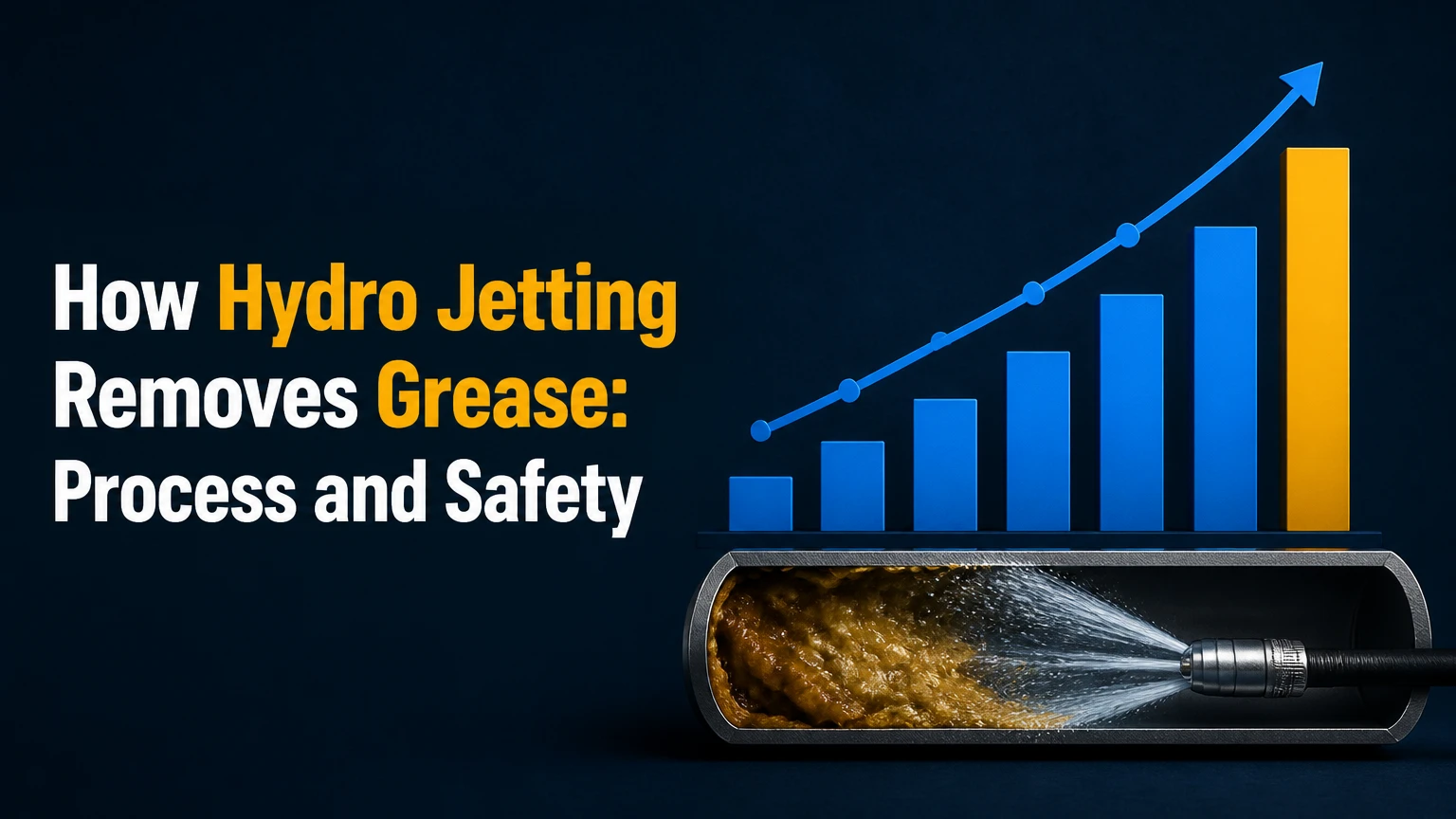
Hydro jetting removes grease by directing high-pressure, high-volume water through a drain-cleaning nozzle that cuts deposits from the pipe wall, breaks apart hardened buildup, and carries loosened material downstream. The process works through water impact, wall shear, nozzle movement, and hydraulic flushing, while hot water can soften some fats before they are washed away.
Key Facts at a Glance
Hydro jetting cleans grease from the pipe circumference, whereas an auger usually creates a narrower passage through the blockage.
Typical sewer jetters operate at approximately 1,500-4,000 PSI and 2-25 gallons per minute, depending on the line and machine.
Flow rate determines how much loosened grease the jetter can transport; PSI determines impact intensity.
A camera inspection should precede jetting when pipe condition, roots, collapse, or severe corrosion is possible.
Hot water can soften animal fats and cooking oils, but it does not remove the need for mechanical scouring and downstream flushing.
Hydro jetting cannot repair a collapsed, disconnected, badly cracked, or structurally unstable pipe.
What Grease Does Inside a Drain Line
Grease in plumbing usually consists of fats, oils, and grease, commonly abbreviated as FOG. Cooking oil may enter a drain as a liquid, but the material cools against pipe walls, combines with food particles and soap residue, and gradually forms a sticky film.
Grease deposits become more difficult when wastewater contains alkaline compounds. Fats can react with alkaline substances through saponification, producing fatty-acid salts that resemble hard soap. In commercial kitchens, repeated discharge creates layered deposits containing grease, starch, grit, detergent residue, and organic solids.
A small opening can therefore conceal a large restriction. A 4-inch sewer pipe with a 1-inch passage may still drain slowly, even though a cable can pass through it. The remaining grease surface continues collecting new material.
The U.S. Environmental Protection Agency advises keeping fats, oils, and grease out of drains because FOG accumulates in private plumbing and public sewer systems. The practical rule is simple: drain cleaning removes existing buildup, but disposal habits determine how quickly buildup returns.
Why Grease Hardens
Grease hardens when temperature falls below the material’s melting range and suspended solids create a framework around it. Animal fats, shortening, and some food-service grease become firm sooner than many vegetable oils, although all can form deposits when mixed with debris.
Grease also changes shape as it moves. A warm discharge may remain mobile near a kitchen fixture, then solidify farther along an unheated basement or exterior line. That is why pouring hot water into a sink can move grease without removing it.
How Hydro Jetting Removes Grease
Hydro jetting removes grease through four interacting effects: direct impact, shear along the pipe wall, abrasion from suspended particles, and downstream transport. A forward-facing jet may penetrate a dense blockage, while angled rear jets scour the internal circumference and propel the hose through the line.
Water pressure is only part of the result. Pressure describes force per unit area at the nozzle, while flow rate describes the volume of water delivered over time. A low-flow jet can cut a small channel but may lack the carrying capacity to move a large grease load through a long sewer.
1. Impact Breaks the Deposit
A focused nozzle orifice converts pump pressure into a fast water stream. When the stream strikes a grease mass, its momentum creates localized stress that fractures brittle soap deposits and erodes softer material.
The impact does not chemically dissolve every deposit. Hydro jetting is primarily a physical cleaning process. Its effectiveness depends on nozzle geometry, stand-off distance, water volume, deposit hardness, and the operator’s pullback speed.
2. Side Jets Apply Wall Shear
Angled jets strike the pipe wall at an oblique angle. Their tangential force scrapes grease film from the surface and reaches areas an auger head may miss, including the upper pipe crown and the joints between deposits.
Rotary nozzles distribute that action around the circumference. A forward penetrator nozzle is useful for gaining access through a blockage, but it is not automatically the best nozzle for final grease removal because a narrow forward stream can leave wall residue behind.
3. Flow Carries the Debris Away
Rear jets create thrust and push water, grease fragments, grit, and wastewater toward the downstream outlet. The effect is hydraulic transport, not a true vacuum generated by the nozzle.
Transport becomes the limiting factor when the downstream line is also restricted. In that condition, additional water can raise the level inside the building faster than the drain can discharge it. A skilled operator pauses, reduces the working distance, or restores downstream passage before adding more water.
4. Heat Softens Some FOG
Hot-water jetters can soften animal fats, shortening, and soap-like deposits. Heat lowers viscosity, allowing the water stream to detach and carry material more easily.
Heat is an aid, not a substitute for scouring. Water temperature also falls along the hose and pipe, and softened grease can resolidify if flushing is inadequate. Commercial operators must also follow local discharge rules and avoid assuming that a hot-water machine is appropriate for every pipe material or facility.
What Happens During a Professional Jetting Job?
A typical residential main-line job takes about 1-3 hours, including inspection, setup, cleaning, and verification. Time increases when the cleanout is buried, the line is unusually long, access is obstructed, or the operator must make several passes.
Step 1: Inspect the Pipe With a Camera
The technician sends a drain camera through an accessible cleanout or fixture. The inspection identifies grease location, pipe diameter, roots, offsets, cracks, standing water, and collapse.
A camera cannot always see every section before water flow improves, particularly when the lens is submerged in a full line. The initial inspection still determines whether jetting is reasonable and where the nozzle should work.
Success checkpoint: The operator knows the pipe material, approximate diameter, blockage location, and apparent structural condition.
Common mistake: Jetting a line with suspected collapse before confirming that the pipe can contain high-pressure water.
Step 2: Select the Access Point
The cleanout should provide enough working room for the hose and a controlled path toward the blockage. A technician may work from the building toward the municipal connection, from the exterior cleanout inward, or in both directions.
Access direction affects containment. Jetting upstream can improve access to a kitchen branch, while downstream work may provide better discharge into an open main. The operator should not assume that gravity alone determines the safest direction.
Success checkpoint: The cleanout is secure, accessible, and positioned to control splash and wastewater.
Common mistake: Removing an old or damaged cleanout plug without planning for trapped pressure or backup water.
Step 3: Match the Nozzle, Pressure, and Flow
Nozzle selection should account for pipe diameter, deposit type, distance, bends, material, and available flow. The pump setting must follow the jetter manufacturer’s instructions and the condition of the pipe.
| Nozzle type | Typical function | Grease application | Main limitation |
|---|---|---|---|
| Penetrator nozzle | Opens a narrow path through a dense blockage | First pass through solid buildup | May leave wall film behind |
| Flushing nozzle | Uses multiple angled jets for transport | General grease removal in 3-6 inch lines | Needs adequate downstream capacity |
| Rotary nozzle | Spins side jets around the pipe | Circumferential film and layered deposits | Requires correct flow and controlled speed |
| Root-cutting nozzle | Concentrates impact on root intrusion | Grease mixed with light roots | Does not repair root entry or pipe damage |
Success checkpoint: The selected nozzle has the correct orifice sizing for the pump’s rated flow and pressure.
Common mistake: Choosing a nozzle by PSI alone while ignoring GPM, pipe diameter, or the hose’s ability to advance.
Step 4: Advance the Hose Through the Grease
The operator starts water flow according to the equipment procedure and feeds the hose gradually. Rear-facing jets pull the nozzle forward, while the operator controls speed so the side streams have time to scour.
Dense grease requires patience. If the operator rushes forward, the nozzle can bore through the center and leave a sleeve of buildup attached to the wall. A slow withdrawal pass often produces better cleaning than a single rapid advance.
Success checkpoint: Water begins draining freely and the hose moves without abnormal resistance or pressure fluctuation.
Common mistake: Forcing a stalled hose under full pressure. The correct response is to stop, relieve pressure according to the equipment procedure, and reassess the nozzle or blockage.
Step 5: Flush and Make a Controlled Return Pass
The operator withdraws the hose while maintaining a controlled cleaning speed. A return pass removes residue that the initial penetration loosened but did not transport.
Flush duration depends on line length and discharge conditions. A 50-foot residential line may need several minutes of flowing water, while a restaurant lateral with heavy FOG may require repeated passes and collection of removed solids.
Success checkpoint: The discharge remains open, carries debris without backing up, and shows sustained flow after the nozzle leaves the line.
Common mistake: Stopping immediately after the first breakthrough, leaving loosened grease farther downstream.
Step 6: Verify the Result
A second camera inspection confirms whether the pipe wall is substantially clear and whether a structural defect remains. Verification matters because a free-flowing line can still retain a thick coating that causes another restriction within weeks.
Success checkpoint: The camera shows an open passage, visible wall circumference, and no new indication of collapse, offset, or root intrusion.
Common mistake: Treating restored flow as proof that the entire pipe is clean.
Which Hydro Jetting Equipment Fits the Line?
Equipment ranges vary by manufacturer, hose length, nozzle design, and application. The figures below are typical operating categories, not universal safe settings.
| Jetter category | Typical pressure | Typical flow | Common application |
|---|---|---|---|
| Compact electric | 1,000-2,000 PSI | 1.5-2.5 GPM | Sink branches and short residential lines |
| Portable gas unit | 2,000-4,000 PSI | 4-8 GPM | Residential building sewers and long laterals |
| Commercial trailer unit | 3,000-4,000+ PSI | 10-25 GPM | Restaurant laterals and larger service lines |
| Hot-water commercial unit | 2,500-4,000 PSI | 4-8 GPM | Animal fats and recurring commercial FOG |
Flow rate often matters more than maximum pressure for transporting grease. A 4,000-PSI machine with insufficient water volume can create an opening without moving the resulting debris effectively.
Pipe condition changes the decision. PVC, ABS, vitrified clay, cast iron, and Orangeburg have different failure modes, and a blanket rule such as “never exceed 2,500 PSI” cannot replace an inspection and equipment-specific risk assessment. Nozzle distance, impact angle, dwell time, and flow can matter as much as the pump gauge.
Does Hot Water Remove Grease Better Than Cold Water?
Hot water usually improves removal of animal fats and shortening, but cold-water jetting can still remove grease when nozzle action and flushing are adequate. Hot water reduces viscosity; it does not guarantee that grease will stay liquid throughout the entire sewer line.
| Grease condition | Cold-water result | Hot-water advantage | Preferred approach |
|---|---|---|---|
| Thin kitchen film | Often removes film with wall jets | Shortens softening time | Low-to-moderate flow and full flush |
| Hardened animal fat | May fracture and transport chunks | Softens surface deposits | Heated jetting with controlled withdrawal |
| Soap-like saponified layer | Requires impact and shear | May soften outer layer | Penetrator followed by rotary or flushing nozzle |
| Long restaurant lateral | Can relocate grease downstream | Improves transport near source | Hot jetting plus downstream inspection |
Restaurants should not use hot jetting as a substitute for grease interceptor pumping. A full interceptor can send removed material back into the line or create a new restriction beyond the cleaned section.
How Much Does Grease Hydro Jetting Cost?
Typical residential hydro jetting costs range from $350-$700 for a main sewer line, while commercial work commonly ranges from $500-$1,200 or more. Local labor rates, access, line length, camera inspection, emergency timing, and the amount of removed grease can move the final price outside those ranges.
| Job situation | Typical price | Typical duration | Main cost driver |
|---|---|---|---|
| Short residential branch | $250-$500 | 1-2 hours | Interior access and setup |
| Residential main sewer | $350-$700 | 1-3 hours | Cleanout location and line length |
| Restaurant lateral | $500-$1,200 | 2-5 hours | FOG volume and multiple passes |
| Large commercial or municipal line | $1,000-$3,000+ | 4-8+ hours | Diameter, traffic control, and disposal |
A written estimate should state whether the price includes the first camera inspection, post-cleaning camera, travel, after-hours labor, water supply, and any removal of grease or debris. A low quote that excludes verification may not represent the lower total cost.
Hydro Jetting Versus Snaking and Chemical Cleaners
Hydro jetting is usually the strongest choice for recurring grease film across a pipe’s circumference, while a mechanical cable is often faster for a single soft blockage or an urgent small-diameter branch. Chemical cleaners are a poor choice for heavy grease because they can create heat, damage materials, and leave the underlying restriction in place.
| Method | Primary action | Typical result on grease | Best use |
|---|---|---|---|
| Hydro jetting | Scours walls and transports debris | Removes film and bulk deposits | Recurring or severe line buildup |
| Mechanical auger | Cuts or punctures a passage | Restores limited flow temporarily | Localized blockage and first response |
| Enzyme treatment | Biologically degrades some organics | Slow reduction of light residue | Maintenance, not emergency clearing |
| Caustic chemical cleaner | Reacts with organic material | Variable and potentially hazardous | Generally unsuitable for unknown systems |
A cable may pass through a grease restriction while leaving a thick ring on the pipe wall. Hydro jetting has a better chance of restoring the effective internal diameter, but it cannot correct poor slope, defective joints, bellies, or a damaged sewer.
Chemical cleaners also create a worker hazard. Residual product can remain in standing water and react with other cleaners or jetting equipment. Tell the technician about every chemical used in the line.
When Should You Avoid Hydro Jetting?
Hydro jetting should be delayed when inspection suggests a collapsed, disconnected, severely cracked, or heavily corroded pipe. Pressurized water can expose a defect that ordinary drainage pressure did not reveal, causing flooding or washing soil through a failed joint.
Hydro jetting is also a poor first choice when the blockage is a solid object, such as concrete, a displaced pipe liner, or a large construction fragment. Water may move around the object without removing it. Root intrusion requires a separate decision because cutting roots can restore flow while leaving the entry defect open.
Pipe and System Risks
Older Orangeburg pipe can deform or collapse under loading. Fragile clay joints may separate, and thin cast iron may shed internal scale. Modern plastic pipe is generally more tolerant, but fittings, transitions, and damaged sections remain vulnerable.
The operator should control water volume as well as pressure. A structurally sound pipe can still overflow inside a building if the downstream line cannot accept the jetter’s discharge rate.
Operator Safety
Water at several thousand PSI can penetrate skin and cause severe injection injuries that look minor at first. The Water Jetting Association and the Water Jetting Association of Australia both emphasize exclusion zones, trained operators, equipment inspection, and pressure-rated protective equipment.
Required controls typically include face and eye protection, waterproof gloves suited to the work, protective footwear, hearing protection, secure hose connections, and a shutoff method within reach. Untrained homeowners should not improvise with a commercial jetter at a cleanout.
What If Grease Returns After Jetting?
Grease returning within days or weeks usually indicates an untreated source, an incompletely cleaned section, a full grease interceptor, inadequate flushing, or a structural defect that traps material. Repeated jetting without diagnosis increases cost while leaving the cause intact.
Use this sequence:
- Confirm whether the backup occurs at one fixture or multiple fixtures.
- Inspect the line beyond the previously cleaned section.
- Check the grease interceptor, trap, and baffle condition.
- Review cooking-oil disposal and dishwasher discharge practices.
- Test for low slope, standing water, offsets, or root entry.
- Repeat cleaning only after identifying the remaining restriction.
A line that stays open for months but repeatedly fails in the same location may have a belly or damaged joint. Hydro jetting removes the symptom, not the geometry that collects new grease.
How Can Homes and Restaurants Prevent Grease Blockages?
Homeowners should allow cooking grease to cool, place it in a container, and dispose of it through the local waste program instead of pouring it into a sink or garbage disposal. Scraping plates before washing also reduces the solids that bind to pipe-wall film.
Restaurants need source control and scheduled maintenance. Grease interceptor pumping, baffle inspection, drain-screen cleaning, and staff training work together; jetting the lateral alone does not manage the entire FOG system.
| Setting | Typical preventive interval | Supporting practice | Escalation signal |
|---|---|---|---|
| Single-family kitchen | As needed, often annually if recurring | Containerize oil and scrape plates | Slow drain at multiple fixtures |
| Small restaurant | Every 3-6 months, adjusted by load | Interceptor pumping and drain screens | Odor, slow floor drains, rising water |
| Large commercial kitchen | Monthly inspection, jetting by condition | FOG records and interceptor service | Repeated lateral backups |
| Apartment complex | Annual main-line review | Tenant disposal guidance and stack inspection | Multiple units backing up |
Intervals should follow actual grease loading, not an arbitrary calendar. A busy fryer operation may need service more often than a low-volume café, while a household with no FOG discharge may never need preventive jetting.
The Bottom Line
Hydro jetting removes grease by combining high-velocity impact, pipe-wall shear, controlled hose movement, and enough water flow to carry loosened deposits away. The method is most effective for recurring FOG buildup across a sewer’s internal diameter, but camera inspection, nozzle selection, downstream capacity, and pipe condition determine whether the cleaning is safe and durable.
For a homeowner, hydro jetting is usually justified when multiple fixtures back up, an auger provides only temporary relief, or inspection confirms broad grease accumulation. For a restaurant, jetting should accompany interceptor maintenance and disposal controls. The central answer to how hydro jetting removes grease is physical scouring plus hydraulic transport, with heat serving as a useful aid rather than a complete solution.
Frequently Asked Questions
Can hydro jetting remove grease from a kitchen sink line?
Hydro jetting can remove grease from a kitchen branch line when the pipe is accessible, structurally sound, and large enough for the selected equipment. A small electric jetter may suit a short branch, while a main sewer requires different flow and access. A technician should protect fixtures and control wastewater before starting.
How long does hydro jetting keep grease away?
Hydro jetting may keep a properly maintained line open for months or years, but no fixed service life applies to every system. Restaurant FOG loading, pipe slope, interceptor condition, and disposal practices dominate recurrence. Grease can return quickly when the source continues discharging oil or when a belly holds wastewater.
Can hydro jetting remove tree roots and grease at the same time?
Hydro jetting can cut light root intrusion while removing grease, provided the pipe can safely contain the water pressure and the nozzle suits both materials. Root cutting does not repair the cracked joint or displaced section that allowed roots inside. A follow-up camera inspection should determine whether excavation or lining is needed.
Is hydro jetting safe for cast-iron pipes?
Hydro jetting can be safe for cast iron when the pipe is structurally sound and the operator uses appropriate pressure, flow, nozzle distance, and dwell time. Severely scaled, thin, or corroded cast iron may fail during cleaning. Camera inspection and a condition-based setting are safer than applying a generic PSI limit.
Can I rent a hydro jetter and remove grease myself?
A homeowner can rent compact drain equipment, but professional hydro jetting is safer for building sewers and unknown pipe conditions. High-pressure water can cause injection injury, flood a structure, damage a weak line, or push grease into an inaccessible downstream section. Rental users should follow the manufacturer’s training, pressure ratings, PPE, and shutdown procedures.
Does hydro jetting remove grease from a grease trap?
Hydro jetting can clean the connected drain piping, but it does not replace grease-trap pumping. A grease trap or interceptor stores FOG and solids that require removal under local rules. Jetting a line connected to an overloaded interceptor can move debris into the trap and create another blockage downstream.