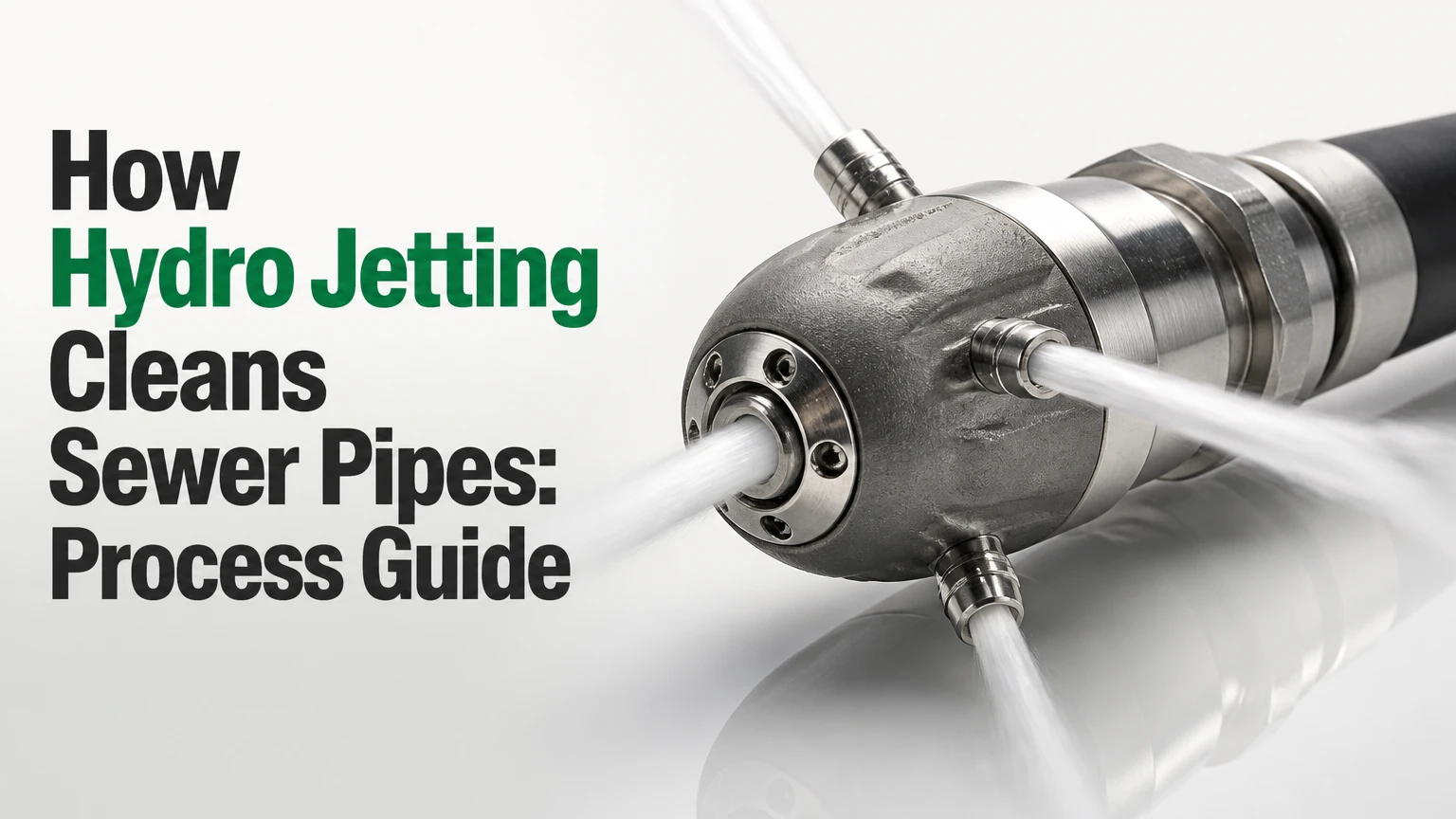
Hydro jetting cleans sewer pipes by sending high-pressure, high-volume water through a specialized nozzle that breaks apart obstructions and scours deposits from the pipe wall. Rear-facing jets propel the hose and flush loosened debris toward an approved discharge point, while a camera inspection helps determine whether the pipe can safely withstand the work.
Key Facts at a Glance
Hydro jetting uses both pressure, measured in PSI, and water volume, measured in GPM, to clean a sewer line.
A sewer jetter removes grease, sludge, mineral scale, sand, and some root growth more completely than a cable auger.
Professional technicians normally inspect the line with CCTV before choosing a nozzle and operating pressure.
Typical residential sewer jetting takes 1.5-3 hours and costs about $350-$800 for an accessible line up to 100 feet.
Hydro jetting cleans and flushes a pipe, but it does not repair collapsed, badly cracked, or structurally failing sections.
Pipe condition, access, diameter, blockage type, and downstream flow capacity determine whether jetting is appropriate.
What Is Hydro Jetting?
Hydro jetting is a sewer-cleaning method that uses a pump, flexible hose, and engineered nozzle to direct pressurized water through a drain or sewer line. Typical residential equipment operates around 1,500-4,000 PSI and 2-18 GPM, although commercial and municipal machines can use higher flow rates and larger hoses.
The water performs two jobs. High velocity cuts, chips, and separates deposits from the pipe surface. High volume carries the separated material through the line instead of leaving a partial opening surrounded by residue.
A cable machine works differently. A rotating auger can pierce a blockage or cut through roots, but its head contacts a limited path. Hydro jetting can wash a much larger portion of the circumference, provided the nozzle is correctly selected and the pipe remains structurally sound.
The phrase “cleans 100% of the pipe” needs qualification. Jetting can reach the full interior circumference in a round, open, structurally intact line, but bends, offsets, standing water, heavy root masses, and damaged surfaces can prevent uniform cleaning.
How Does Hydro Jetting Remove a Clog?
Hydro jetting removes a clog through a sequence of penetration, wall scouring, and hydraulic transport. A forward jet may open a path through dense material, while angled rear jets push the nozzle forward and scour the pipe as the technician retracts the hose.
PSI and GPM perform different jobs
PSI describes force per unit area and strongly affects jet velocity and cutting action. GPM describes the amount of water delivered over time and controls the ability to move sludge, grease fragments, sand, and scale downstream.
A useful field rule is simple: PSI breaks or cuts the obstruction, while GPM transports what the nozzle has detached. A high-PSI machine with insufficient flow may create a narrow channel without carrying the debris away. A high-flow setup with poorly chosen pressure may wash soft material but struggle with hardened scale.
The nozzle’s rear-facing jets also create reaction thrust. That force helps pull the hose into the sewer, although bends, diameter changes, and deposits can reduce forward travel. The operator controls the result by feeding the hose gradually, allowing water to work through the obstruction, then retracting it at a controlled speed.
Why pullback speed matters
Slow pullback gives the jets more dwell time against grease, scale, and biofilm. Rapid withdrawal can leave bands of material on the pipe wall, especially where the line has a heavy accumulation or irregular interior.
Professional operators watch pressure, hose movement, cleanout water level, and discharge behavior together. A pressure change can indicate that a blockage opened, a nozzle entered a larger section, or water is no longer moving freely.
What Does Hydro Jetting Remove?
Hydro jetting removes soft and hardened deposits, including grease, fat, oil residue, sludge, sand, mineral scale, biofilm, and some tree-root growth. The method removes contamination from the pipe wall more thoroughly than a punch-through cable, but it cannot correct a broken pipe or prevent roots from returning through an open defect.
| Material in sewer pipe | Water action | Typical result | Remaining limitation |
|---|---|---|---|
| Kitchen grease | Softens, shears, and disperses deposits | Larger flow area and cleaner wall | Recurs when FOG enters the drain |
| Mineral scale | Chips and fractures hard deposits | Restores part of the lost diameter | Severe corrosion may expose weak iron |
| Tree roots | Cuts and washes away intruding strands | Reopens the passage | Root entry point remains in the pipe |
| Sand and silt | Suspends and transports particles | Clears sediment pockets | Downstream restriction can cause re-accumulation |
| Biofilm | Scrubs slime from the interior | Reduces clingable organic residue | Does not sterilize the sewer |
| Mud and sludge | Breaks apart and carries material | Improves conveyance | Large solids may require vacuum removal |
Root cutting deserves special caution. A root nozzle can remove visible growth, but the pipe joint, crack, or separated connection that allowed the roots inside still exists. Recurrence may require root management, pipe lining, excavation, or another repair rather than repeated cleaning alone.
What Happens During a Professional Service?
A professional hydro jetting service usually follows six operational stages and takes about 1.5-3 hours for an accessible residential line. The pre-service camera inspection is the most important decision point because water pressure cannot fix a collapsed or missing section of sewer.
Step 1: Inspect the sewer with CCTV
The technician inserts a camera through a cleanout or another suitable access point. The inspection identifies pipe material, blockage location, root intrusion, offsets, cracks, standing water, and signs of collapse.
A camera also establishes whether the blockage is local or extends along a long section. If the line is structurally compromised, the technician may recommend a cable, vacuum extraction, spot repair, pipe replacement, or lining instead of jetting.
Step 2: Open the correct access point
Technicians normally use a main sewer cleanout outside the building, in a basement, or near the property connection. Roof vents are generally ventilation components, not preferred jetting access points, because inserting a large hose through a vent can damage fittings and provides poor control.
The access point must allow the operator to manage hose direction and contain wastewater. Indoor access may require protective barriers and a plan for preventing contaminated water from entering finished areas.
Step 3: Match the nozzle and machine
Nozzle choice depends on pipe diameter, deposit type, access distance, bends, and the downstream route. The operator also selects a pressure and flow combination that matches the pipe’s condition.
Step 4: Advance and scour the line
The hose is commonly inserted from the larger or more accessible downstream-side cleanout and advanced toward the restriction, but the correct direction depends on the layout. The nozzle must not be forced through a hard stop.
After opening a path, the technician slowly retracts the hose so the rear jets scour the wall. Water and loosened debris should move toward a functioning downstream sewer or a controlled recovery system.
Step 5: Monitor discharge and pressure
Rising water at the cleanout, unstable pressure, or sewage appearing indoors requires an immediate pump shutdown. The operator must allow the line to drain before changing the feed rate, nozzle, or direction.
Step 6: Verify the result
A post-cleaning camera inspection confirms whether deposits were removed and whether previously hidden defects are visible. Flow testing can supplement the camera, but fast drainage alone does not prove that the entire line is clean or structurally sound.
Which Nozzle and Machine Are Used?
The nozzle and jetter class must match the pipe’s diameter and the obstruction’s physical properties. A small penetrator nozzle may open a mud plug, while a rotary nozzle is more suitable for broad grease or scale deposits.
| Nozzle type | Typical target | Water pattern | Main limitation |
|---|---|---|---|
| Penetrator or chisel | Mud, ice, dense sludge | Forward jet with rear propulsion jets | May create a hole without full-wall cleaning |
| Flushing nozzle | Sand, loose sediment, routine debris | Rear jets emphasize transport | Limited cutting power against scale |
| Rotary nozzle | Grease, biofilm, mineral deposits | Rotating radial jets | Requires adequate flow and hose control |
| Root-cutting nozzle | Fine to moderate root intrusion | Cutting elements plus water jets | Does not repair the entry defect |
| Boring nozzle | Heavy blockage at a defined point | Concentrated forward action | Higher risk if the obstruction is structural |
Portable electric or gas machines commonly handle 1.5-3-inch branch drains at approximately 1,500-2,500 PSI and 2-4 GPM. Contractor-grade units often handle 3-8-inch laterals at about 3,000-4,000 PSI and 8-18 GPM. Municipal combination trucks use substantially greater flow for large mains, culverts, and storm systems.
Machine labels do not tell the whole story. A 4,000-PSI rating is the pump’s capability, not an instruction to apply that pressure to every residential pipe.
Which Pipes Can Be Hydro-Jetted Safely?
Pipe condition matters more than material alone. Sound PVC, ABS, and many serviceable cast-iron lines can be jetted, while brittle clay, severely corroded iron, and Orangeburg pipe require special evaluation or a different method.
| Pipe material | Common field approach | Typical pressure consideration | Main risk |
|---|---|---|---|
| PVC or ABS | Often suitable after inspection | Frequently 2,000-4,000 PSI equipment range | Dislodged fittings or poor joints |
| Cast iron | Jet only after condition check | Lower pressure with useful flow often preferred | Flaking walls and corrosion holes |
| Vitrified clay | Use conservative settings | Often about 1,500-2,000 PSI when condition permits | Cracked joints and shifted sections |
| Orangeburg | Usually avoid aggressive jetting | No universal safe setting for failed material | Wall deformation or collapse |
| Concrete | Depends on age and joints | Commercial assessment required | Joint erosion and surface damage |
Published pressure charts should not be treated as universal safety limits. Nozzle distance, orifice size, hose diameter, water temperature, pipe wall thickness, and the condition of joints all affect the energy reaching the pipe.
Orangeburg pipe, a bitumen-impregnated fiber product used historically in some properties, can deform under load and deteriorate internally. A camera inspection and local plumbing knowledge should guide the decision, with replacement often more appropriate than forceful cleaning.
How Much Does Hydro Jetting Cost and How Long Does It Take?
Typical residential hydro jetting costs about $350-$800 for an accessible sewer main up to 100 feet, while difficult root intrusion, poor access, long footage, or emergency timing can raise the total to $800-$1,500 or more. A standard visit commonly lasts 1.5-3 hours, including inspection, setup, cleaning, verification, and cleanup.
| Service situation | Typical price range | Typical duration | Main price driver |
|---|---|---|---|
| Residential main, accessible, up to 100 feet | $350-$800 | 1.5-3 hours | Camera and cleanout access |
| Severe roots or deep obstruction | $800-$1,500 | 2-5 hours | Nozzle passes and footage |
| Commercial kitchen line | $600-$3,000+ | 2-8 hours | Grease load and total line length |
| Emergency or after-hours visit | $500-$1,500+ | 2-5 hours | Labor timing and response |
| Municipal or large-diameter line | Project-specific | 4 hours to several days | Truck, traffic, disposal, and volume |
Camera inspection may be bundled or charged separately. A typical standalone camera fee is about $250-$500, but local labor rates and service packages vary widely.
The most useful estimate includes pipe diameter, approximate length, access condition, camera inspection, disposal requirements, and whether the price includes a second camera pass. A low quote that excludes inspection may become expensive if the line contains a collapse or requires multiple mobilizations.
Hydro Jetting vs. Snaking and Chemical Cleaners
Hydro jetting is the better cleaning method for long, greasy, scaled, or sediment-filled lines, while a cable auger is often the safer first response for a simple blockage in an old or uncertain pipe. Chemical drain cleaners are poor choices for sewer mains because they rarely remove roots or thick deposits and can expose occupants and technicians to corrosive liquids.
| Criterion | Hydro jetting | Cable auger | Chemical cleaner |
|---|---|---|---|
| Primary action | Wall scouring and flushing | Punching or cutting a passage | Chemical dissolution |
| Typical residential cost | $350-$800 | $150-$400 | $10-$40 |
| Best blockage type | Grease, scale, sludge, roots | Local soft clog or emergency opening | Small organic branch-drain clog |
| Pipe-wall coverage | Broad circumferential cleaning | Narrow path at cable head | Uncontrolled contact |
| Structural risk | High if pipe is weak | Lower for fragile lines | Corrosion and chemical exposure |
| Long-term result | Often longer when deposits caused recurrence | Temporary when residue remains | Frequently temporary |
| Professional verification | CCTV recommended | CCTV useful for recurrence | Rarely provides diagnosis |
Snaking can be the right answer when a toilet is blocked, the line is old, and the immediate goal is restoring flow without applying high-volume water. It can also precede camera inspection when access is limited.
Chemical products should never be mixed, poured into a line containing another cleaner, or used before telling a plumber about them. Residual chemicals can injure workers and complicate wastewater handling.
What Can Go Wrong During Jetting?
The principal hydro jetting risks are applying water to a structurally failed pipe, pushing debris into a downstream restriction, causing contaminated blowback, and using a nozzle or setting that does not match the line. Each risk has a practical warning sign and a required response.
Hard stop in the line
A hose that stops at a fixed point may have encountered a sharp bend, dropped joint, heavy root mass, or collapse. Operators should stop the pump, avoid forcing the hose, and use the camera to locate the obstruction.
Water rising at the cleanout
Water backing up indicates that discharge cannot keep pace with incoming flow. Shut off the pump, wait for the level to fall, and restart only after confirming a safe flow path and reducing feed speed if appropriate.
Blowback into fixtures
Toilet or floor-drain blowback can occur when air and water cannot vent or when a nozzle sends excessive forward force toward branch lines. Stop the pump, protect occupants from contaminated water, and reassess venting, access, and nozzle direction.
Hidden structural failure
Jetting can expose a defect by removing deposits that had temporarily supported a weak section. That outcome does not mean the water created every underlying defect, but it confirms that cleaning cannot substitute for structural repair.
Practitioner rule: Never interpret a pressure gauge as a pipe-condition sensor. A line can hold operating pressure during the first pass and still contain a thin wall, open joint, or unsupported section that only CCTV can reveal.
When Should You Schedule Hydro Jetting?
Schedule hydro jetting when a sewer line repeatedly clogs because of grease, scale, sediment, or roots and the line remains structurally serviceable. Preventive frequency should follow inspection findings and blockage history rather than a fixed promise that every home needs jetting every two years.
| Situation | Reasonable starting interval | Confirmation method |
|---|---|---|
| Restaurant kitchen grease | 6-12 months | Flow test and grease inspection |
| Residential line with recurring grease | 1-3 years | CCTV and service history |
| Known root intrusion | 1-3 years or as symptoms return | Camera location and root growth |
| New, intact residential PVC | As needed | Symptoms or inspection |
| Old mixed-material apartment system | Condition-based | CCTV before each major cleaning |
Restaurants should also control fats, oils, and grease at the source with proper interceptors and waste-handling procedures. Jetting removes accumulated FOG, but it does not correct poor kitchen practices or an undersized grease-management system.
Copper sulfate and foaming root treatments may be restricted by local rules and can have environmental consequences. Ask the plumber and local wastewater authority before using a root-control chemical, especially near wells, streams, or septic systems.
Can You Hydro-Jet a Sewer Pipe Yourself?
Homeowners should not operate a full-size sewer jetter without training, protective equipment, and a confirmed disposal plan. High-pressure water can penetrate skin, propel fittings or debris, damage plumbing, and spread sewage contamination even when the machine appears manageable.
A homeowner can safely gather useful information before service:
- Locate the main cleanout without opening a pressurized or overflowing cap.
- Record which fixtures back up and whether the problem affects one branch or the entire home.
- Ask for CCTV footage, pipe-material identification, and a written cleaning scope.
- Tell the technician about prior chemical cleaners, pipe repairs, septic systems, and repeated root problems.
- Confirm who handles wastewater, camera documentation, and damage found during the work.
A small consumer drain washer for a sink line is not equivalent to a sewer jetter. Equipment advertised at a high PSI may deliver too little GPM to transport debris, while an improvised hose setup lacks the nozzle control needed for a main sewer.
What Should You Ask a Hydro Jetting Contractor?
Ask whether the quoted service includes a pre-cleaning camera inspection, nozzle selection based on the blockage, controlled discharge, and post-cleaning verification. A responsible contractor should explain the pipe’s condition and the limits of cleaning before applying high-pressure water.
Use this checklist:
- What pipe material and internal condition did the camera show?
- Where is the blockage, and how many feet of line require cleaning?
- What pressure and GPM will the technician use?
- Which nozzle matches the deposit or root intrusion?
- Does the price include pre- and post-jetting CCTV?
- What happens if the camera finds a collapse or Orangeburg pipe?
- How will wastewater and loosened debris be controlled?
- Is the service intended as emergency clearing or preventive maintenance?
- Will the company provide recorded footage and a location report?
- What repair is recommended if roots return through the same joint?
A contractor who promises guaranteed full restoration without inspecting the line is making a claim the equipment cannot support. The camera record is more valuable than a pressure number because it shows both the cleaning result and the remaining defect.
Frequently Asked Questions
Does hydro jetting remove tree roots permanently?
No. Hydro jetting cuts and flushes roots from the pipe interior, but roots can return through the same crack, joint, or separated connection. Permanent correction usually requires repairing or replacing the defective section, although permitted root-control products and scheduled cleaning can extend the interval between intrusions.
Will hydro jetting damage old cast-iron pipes?
Hydro jetting can damage severely corroded or thinned cast iron, especially when an operator uses excessive pressure or forces a nozzle through a defect. Sound cast iron may tolerate controlled cleaning, but CCTV inspection, conservative settings, and appropriate flow are necessary before service.
Is hydro jetting safe for a septic system?
Hydro jetting may be appropriate for a house sewer line connected to a septic tank, but the technician must account for tank capacity, outlet baffle condition, and where loosened solids will go. Jetting into a full or poorly maintained septic system can move debris toward the tank and worsen the problem.
How often should a residential sewer line be hydro-jetted?
A residential sewer line should be hydro-jetted when inspection and service history show recurring deposits or roots, not automatically on a universal schedule. Many affected homes use intervals of roughly 1-3 years, while intact newer PVC lines may need service only when symptoms occur.
Does hydro jetting unclog a toilet?
Hydro jetting can clean the building sewer serving a toilet, but a toilet-specific blockage often needs a closet auger first. If several fixtures back up together, the restriction is more likely in the branch or main sewer, where professional camera inspection can identify the appropriate method.
What happens after hydro jetting?
After hydro jetting, the technician should confirm flow, inspect the cleaned section with CCTV when included, document defects, and identify the likely cause of recurrence. The line may drain normally while still needing repair if the camera shows roots, an open joint, a belly, or a collapsed segment.
The Bottom Line
Hydro jetting cleans sewer pipes by combining high-velocity water for cutting with high-volume flow for flushing. The method is particularly effective against grease, mineral scale, sludge, sediment, biofilm, and root intrusion in sound pipes, but it cannot repair structural damage and should not be applied blindly.
The safest process is camera inspection, access selection, nozzle and pressure calibration, controlled jetting, flow monitoring, and post-service verification. When deciding how hydro jetting cleans sewer pipes in a specific property, prioritize pipe condition and blockage cause over the machine’s maximum PSI rating.