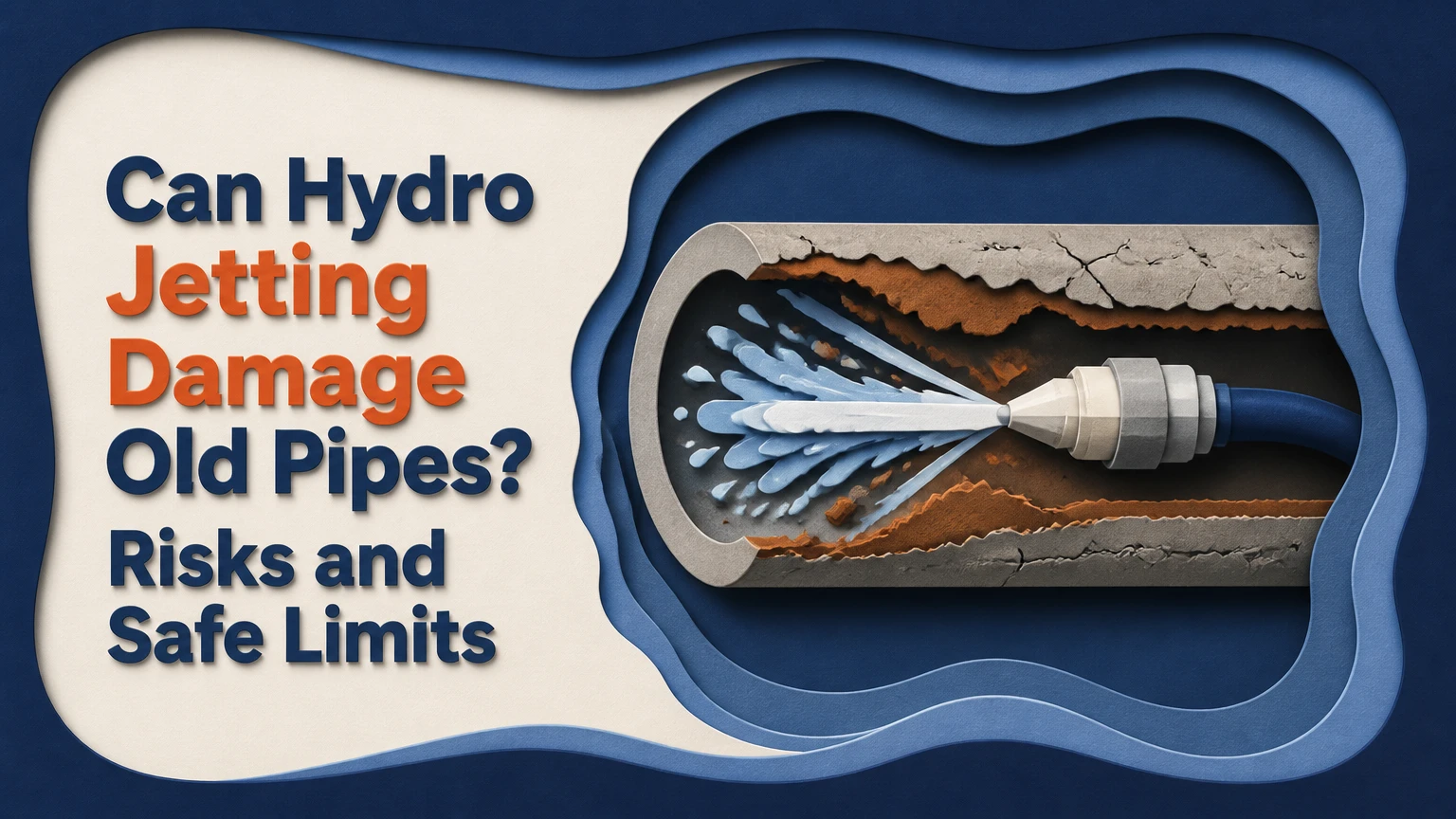
Hydro jetting can damage old pipes when corrosion, cracks, separated joints, or collapse have already weakened the line. Hydro jetting is generally appropriate for structurally sound cast iron, clay, PVC, and ABS when a plumber inspects the pipe first, selects a compatible nozzle, and controls pressure and flow rather than using maximum equipment settings.
Key Facts at a Glance
- A CCTV camera inspection should precede hydro jetting in an old or unknown sewer line.
- Hydro jetting removes grease, sludge, scale, and roots across the pipe wall; a drain snake usually creates a narrower passage.
- PSI alone does not determine safety. Flow rate, nozzle design, distance, pipe diameter, and exposure time also affect force.
- Orangeburg and severely corroded cast iron are poor candidates for aggressive water jetting.
- Hydro jetting cannot repair a collapsed, missing, badly fractured, or structurally unsupported pipe.
- A typical residential main-line visit costs about $350-$600 and takes 1-3 hours, excluding major access or repair work.
What Is Hydro Jetting?
Hydro jetting is a drain and sewer cleaning method that sends pressurized water through a flexible hose and specialized nozzle. Forward-facing jets open a path through an obstruction, while rear-facing jets propel the hose and wash loosened material toward an approved downstream outlet.
Hydro jetting differs from hydrostatic pressure testing. Cleaning uses a moving water stream to scour deposits, whereas pressure testing checks whether a closed system holds a specified pressure. A jetting machine also does not automatically reveal whether a pipe wall can withstand cleaning force.
A plumber may use hydro jetting to remove kitchen grease, soap residue, mineral scale, sediment, and tree-root intrusion. The cleaning can expose defects that deposits had concealed, especially in cast-iron pipe with bottom-channel corrosion. That result can look like jetting “caused” a leak when the pipe was already near failure.
Why Does Water Jetting Affect Old Plumbing?
Hydro jetting affects old plumbing through concentrated hydraulic force and repeated contact with the pipe interior. A nozzle can loosen material that was supporting a weakened wall, dislodge a brittle fragment, or push water into a crack that was already open.
The risk depends on the pipe’s remaining wall thickness and joint condition. A sound 60-year-old cast-iron line may tolerate controlled cleaning, while a newer line with a crushed section may not. Age is therefore a screening clue, not a standalone safety diagnosis.
Can Hydro Jetting Damage Old Pipes?
Hydro jetting can damage old pipes, but the highest risk occurs when the pipe is structurally compromised before cleaning begins. High-pressure water may enlarge a hairline fracture, remove corrosion that was bridging a hole, separate an offset clay joint, or worsen an unsupported section of Orangeburg pipe.
Professional plumbers should not treat a clogged line as automatically suitable for jetting. A camera inspection can show whether the blockage is a removable deposit or a symptom of pipe failure. When the camera finds collapse, major voids, severe channel corrosion, or a disconnected joint, repair or replacement generally comes before full-bore cleaning.
Which Old Pipes Are Most Vulnerable?
Orangeburg, severely corroded cast iron, fractured clay, and badly offset vitrified-clay joints are among the most vulnerable materials. Galvanized steel can also have a narrow, flaky interior, although its service-line condition varies substantially by location and age.
| Pipe material | Typical aging problem | Jetting concern | Usual first decision |
|---|---|---|---|
| Orangeburg, installed mainly before 1970 | Flattening, blistering, delamination | Water can tear or deform softened fiber pipe | Camera inspection, often replacement |
| Cast iron, 50-100 years old | Bottom-channel corrosion, scale, pinholes | Cleaning can expose thin wall sections | Low-impact cleaning only if wall remains continuous |
| Vitrified clay, 50-100 years old | Rooted joints, cracks, offsets | Nozzle can worsen a fractured or displaced joint | Inspect joints, then clean or repair |
| Galvanized steel, 40-70 years old | Internal rust tubercles and restricted bore | Aggressive tools can detach flakes or expose holes | Assess remaining wall and replacement plans |
| PVC or ABS, 20-60 years old | Crushed sections, failed joints, root intrusion | Sound plastic is tolerant, damaged fittings are not | Jet only after camera confirmation |
| Concrete sewer pipe, 50-100 years old | Erosion, joint movement, cracking | High flow can reveal eroded joints | Inspect bedding, joints, and wall condition |
A material label is not enough. A 1930s clay lateral with intact cylindrical walls may be a better cleaning candidate than a 1980s line damaged by excavation or settlement.
Why Is a Camera Inspection Necessary?
A CCTV inspection is necessary because hydro jetting cannot distinguish a removable blockage from a structural defect before the hose enters the line. The camera should identify pipe material, diameter, access points, blockage location, joint alignment, water level, root density, and visible wall loss.
The plumber should record the inspection rather than relying on a brief verbal description. A usable report identifies the distance from the cleanout, clock position of defects, and whether the camera reached the municipal connection or property line.
Findings That Should Stop Jetting
A plumber should pause or reject hydro jetting when the camera shows:
- A full or partial collapse with no continuous passage.
- A large open crack, missing pipe section, or visible soil outside the line.
- Severe bottom-channel corrosion in cast iron.
- A clay joint offset that catches the camera or hose.
- Flattened, blistered, or delaminated Orangeburg.
- Standing water that prevents assessment of the downstream pipe.
- A failed cleanout, loose access fitting, or unstable connection.
Post-jetting camera footage matters too. It confirms whether the pipe cleared and documents new or previously hidden defects. A contractor who cannot explain the inspection findings should not begin aggressive work on an old line.
How Do Plumbers Set Safe Pressure?
Plumbers set safe hydro jetting pressure by matching pressure, flow, nozzle geometry, hose size, and cleaning distance to the pipe material and condition. A pressure number such as 4,000 PSI is not a universal operating recommendation because the water’s delivered force changes with nozzle orifice and flow.
Typical residential settings vary by equipment and task. A small indoor electric machine may operate around 1,500-2,000 PSI at 1.5-2 gallons per minute, while a sewer main-line machine may use roughly 3,000-4,000 PSI at 4-8 gallons per minute. Those figures describe equipment ranges, not safe limits for every old pipe.
| Equipment type | Typical pressure | Typical flow | Common application | Old-pipe implication |
|---|---|---|---|---|
| Compact electric jetter | 1,500-2,000 PSI | 1.5-2 GPM | 1.5-2 inch indoor drains | Lower flow, limited reach |
| Gas cart jetter | 3,000-4,000 PSI | 4-8 GPM | 3-4 inch residential mains | Requires material-specific calibration |
| Trailer jetter | 4,000-6,000 PSI | 10-20 GPM | Long private laterals and commercial lines | Excessive for fragile sections |
| Industrial sewer jetter | 6,000-10,000+ PSI | 20-40+ GPM | Large commercial or municipal mains | Not a default residential setting |
A skilled operator may reduce pressure, choose a wider-angle nozzle, limit dwell time, and pull the hose steadily instead of repeatedly holding a jet against one location. Flow often determines how much debris moves downstream, while pressure and nozzle shape influence cutting action.
Which Nozzles Are Safer for Aged Lines?
Broad-angle flushing nozzles are generally less aggressive than chain-flail or specialized descaling tools, but no nozzle is automatically safe inside a defective pipe. The operator should choose the least aggressive tool that can remove the specific obstruction.
| Nozzle type | Primary action | Typical use | Relative concern in old pipe |
|---|---|---|---|
| Penetrating nozzle | Concentrated forward jet | Initial hole through grease or ice | Localized wall impact |
| Flushing nozzle | Rearward jets and broad spray | Grease, sludge, and sediment | Lower cutting action |
| Rotary nozzle | Rotating 360-degree spray | Circumferential scale removal | Moderate wall contact |
| Root-cutting nozzle | Forward cutting jets | Fine or moderate root intrusion | Higher joint and wall stress |
| Chain-flail nozzle | Spinning chains plus water | Heavy scale and thick roots | Highest risk for brittle pipe |
Chain-flail heads can remove deposits that water alone cannot, but they are a poor first choice for thin cast iron, fractured clay, or Orangeburg. Mechanical contact adds a failure mode that a broad flushing nozzle does not have.
What Happens During a Professional Job?
A professional hydro jetting job typically takes 1-3 hours, including setup, access, cleaning passes, and camera verification. The most important success factor is the pre-jetting condition assessment, because pressure adjustment cannot compensate for a collapsed or unsupported pipe.
The normal sequence is:
- Locate and open a proper access point. The plumber uses a cleanout, not an improvised opening that may fail under flow.
- Perform a CCTV inspection. The operator identifies the pipe’s material, diameter, defect pattern, and obstruction.
- Configure the equipment. Hose diameter, nozzle, pressure, flow, and water recovery plan are selected for the line.
- Insert and advance the hose. The operator uses controlled movement and avoids holding the nozzle against one point.
- Make measured cleaning passes. Grease, roots, mineral scale, and sludge are broken loose and flushed downstream.
- Stop if conditions change. A sudden void, hose movement, pressure change, or backup requires reassessment.
- Perform a post-cleaning camera inspection. The plumber confirms the bore, joints, and structural condition.
You should receive an explanation of where the blockage was, what the camera found, and whether a repair remains necessary. A clear line is not necessarily a healthy line.
When Is Hydro Jetting Appropriate?
Hydro jetting is appropriate for a structurally continuous pipe containing grease, sludge, sediment, moderate roots, or mineral scale. The method is particularly effective when a drain snake repeatedly restores flow but leaves a coating that causes the same blockage to return.
Hydro jetting is often useful in restaurant waste lines because grease coats a large portion of the pipe wall. It can also clean residential sewer laterals with recurring root intrusion, although roots will return unless the damaged joint is repaired or the root source is addressed.
Hydro jetting is a poor choice when the line has collapsed, has a missing section, contains severe wall loss, or cannot safely discharge the cleaning water. It also cannot correct improper slope, a disconnected lateral, settlement, or a broken cleanout.
What Problems Can Hydro Jetting Not Fix?
Hydro jetting cannot repair a structural defect or restore a pipe’s original strength. It may temporarily improve flow through a damaged line, but that outcome can delay necessary replacement and increase the chance of another backup.
| Problem | What jetting can do | What jetting cannot do | Better next action |
|---|---|---|---|
| Kitchen grease coating | Remove wall deposits | Prevent new grease entry | Clean, then change disposal practices |
| Fine root intrusion | Cut and flush roots | Permanently seal the joint | Repair joint or install a liner |
| Collapsed sewer | Clear only loose fragments | Rebuild the passage | Excavation or trenchless replacement |
| Offset clay joint | Possibly clear nearby debris | Realign the pipe | Spot repair or lateral replacement |
| Cast-iron scale | Remove loose scale | Restore lost wall thickness | Assess relining or replacement |
| Poor pipe slope | Clear sediment temporarily | Correct grade | Reconstruct the affected section |
How Does Hydro Jetting Compare With Alternatives?
Hydro jetting provides the most complete deposit removal, while mechanical snaking usually offers the lowest immediate stress on a fragile line. Chemical drain cleaners are generally the least appropriate choice for old sewer pipes because they may damage fixtures, harm workers, and leave the structural problem unresolved.
| Method | Typical cost | Typical duration | Best use | Main limitation |
|---|---|---|---|---|
| Hydro jetting | $350-$600 | 1-3 hours | Grease, sludge, roots, full-wall cleaning | Unsafe for defective lines |
| Mechanical auger | $150-$400 | 30-90 minutes | Single blockage and narrow passages | Often leaves wall deposits |
| Enzyme maintenance product | $20-$80 | 8-24 hours | Organic residue prevention | Does not cut roots or scale |
| Chemical opener | $10-$40 | 15-60 minutes | Limited fixture clogs | Corrosive and ineffective on collapse |
| Cured-in-place liner | $3,000-$10,000+ | 1-3 days | Sealing eligible cracks and joints | Requires suitable pipe geometry |
| Excavation and replacement | $5,000-$20,000+ | 2-7 days | Collapse, severe failure, bad grade | Disruptive and site-dependent |
Mechanical snaking is not risk-free. A cable can become stuck, damage a weak fitting, or punch through a fragile obstruction into a failed section. The difference is that a carefully selected auger may create flow without scouring the entire wall.
How Much Does Hydro Jetting Cost?
Residential hydro jetting typically costs $350-$600 for a main-line visit, while complex emergency work can reach $1,000-$2,000 or more. A separately billed CCTV inspection commonly adds $250-$400, although many companies combine the camera with the cleaning package.
| Cost item | Typical range | What changes the price |
|---|---|---|
| Small interior drain jetting | $100-$300 | Access, distance, blockage severity |
| Residential sewer lateral | $350-$600 | Pipe length, roots, cleanout access |
| Camera inspection alone | $150-$400 | Recording, distance, reporting |
| Emergency or buried access work | $800-$2,000+ | Night service, excavation, difficult entry |
| Commercial kitchen jetting | $500-$1,500+ | Grease volume, line diameter, disposal |
| Spot pipe repair after inspection | $1,500-$5,000+ | Depth, surface restoration, defect location |
Typical figures vary by region and access conditions. Ask whether the quoted price includes both camera inspections, water disposal, extra hose length, root-cutting nozzles, and a written recording.
How Often Should Old Pipes Be Cleaned?
Old pipes should be cleaned according to blockage history and inspection results, not according to a universal calendar. A sound line with recurring kitchen grease may need service every 12-24 months, while a root-intruded lateral may require more frequent cleaning until the joint is repaired.
A two- or three-year preventive schedule can make sense for a structurally sound PVC line with documented grease or root problems. It is a poor rule for a fragile cast-iron or Orangeburg line that has never received a camera inspection.
The maintenance record should track the blockage type, pipe location, camera findings, nozzle used, pressure and flow, and date of service. Repeated cleaning without a repair plan is a sign that the underlying defect remains active.
What If Water Backs Up During Jetting?
If water backs up during hydro jetting, the operator should stop immediately, secure the hose, and determine whether the downstream line is collapsed or fully obstructed. Continuing to pump can flood the building, force contaminated water through fixtures, or drive the hose into an unstable section.
A backup does not prove that hydro jetting caused damage. The obstruction may have shifted, a root mass may have formed a downstream dam, or the camera may have reached a collapse that was previously hidden by standing water.
The plumber should remove pressure, control the contaminated water, inspect from the nearest safe access point, and use a locator if the defect’s position is unclear. The next step may be a smaller auger, excavation, spot repair, or replacement rather than more jetting.
What Are the Most Common Mistakes?
The most damaging mistake is approving aggressive cleaning without knowing the pipe’s condition. A second common error is treating the machine’s maximum PSI as the correct setting for every line.
Avoid these failure patterns:
- Skipping the camera: A blind hose can enter a broken pipe and push debris into surrounding soil.
- Using a chain flail on thin cast iron: Mechanical chains can puncture areas weakened by bottom-channel corrosion.
- Ignoring access-point condition: A cracked cleanout may fail before the sewer line does.
- Jetting against a closed downstream blockage: Water has nowhere to go and may return through fixtures.
- Assuming root removal is permanent: Roots usually indicate an opening that still needs sealing.
- Accepting a verbal “clear” result: Without post-cleaning footage, the homeowner cannot verify the outcome.
One practical rule is worth remembering: the cleaner the pipe looks after jetting, the more important the post-jetting camera becomes. Deposits can conceal defects before cleaning.
Which Option Fits Your Pipe and Symptom?
Older Home With Cast Iron
Choose inspection first when a home has cast-iron drains installed before approximately 1970 and shows repeated backups, rust-colored water, or slow drainage across multiple fixtures. Jetting may be reasonable if the camera shows a continuous wall with moderate scale and no deep corrosion.
Clay Sewer Lateral With Tree Roots
Choose controlled root removal only when the camera shows an intact pipe with localized root intrusion. If joints are offset or cracked, compare spot repair, trenchless lining, and replacement costs before scheduling recurring jetting.
Modern PVC or ABS Drain
Sound PVC and ABS usually tolerate professional hydro jetting well, provided the operator protects fittings and uses an appropriate nozzle. A crushed section, separated joint, or poorly supported connection still requires repair rather than high-pressure cleaning.
Commercial Kitchen Waste Line
Hydro jetting is often the most effective cleaning method for heavy grease, with typical maintenance intervals of 6-12 months based on production volume and inspection history. Hot-water configurations may improve grease removal, but wastewater must be handled under local discharge requirements.
FAQ
Can a plumber jet a sewer line without a cleanout?
A plumber can sometimes access a line by removing a fixture or opening another approved point, but a dedicated cleanout is safer and more efficient. Without proper access, the operator may lack a secure connection, an effective hose angle, and a controlled way to manage wastewater.
Does hydro jetting remove all tree roots?
Hydro jetting can remove many roots within the nozzle’s reach, but it does not permanently stop root growth. Roots return when a cracked or separated joint remains open, so recurring intrusion should lead to repair, lining, or replacement discussions.
Is a sewer camera inspection worth the extra cost?
A sewer camera inspection is usually worth the cost before jetting an old or unknown line because it distinguishes deposits from collapse and wall failure. The recording also documents pipe condition before work and verifies the result afterward.
Can hydro jetting make a leak worse?
Hydro jetting can enlarge an existing leak or dislodge material covering a weakened section. A leak that appears immediately after cleaning may reflect exposed pre-existing corrosion, but the contractor should compare pre- and post-cleaning camera footage.
Should I use chemical drain cleaner before hydro jetting?
Chemical drain cleaner is usually a poor preparation step before hydro jetting. Residual chemicals can expose workers to burns or toxic splashes, and the chemicals do not correct roots, collapsed pipe, severe scale, or structural defects.
Will insurance pay for hydro jetting or pipe damage?
Insurance policies commonly treat routine drain cleaning as maintenance, while coverage for resulting pipe damage depends on the policy, cause, and evidence. Keep camera footage, invoices, photographs, and the plumber’s written findings before filing a claim.
The Bottom Line
Can hydro jetting damage old pipes? Yes, especially when corrosion, cracks, displaced joints, Orangeburg deterioration, or collapse already threatens the line. Hydro jetting remains a strong cleaning method for structurally sound plumbing when a CCTV inspection guides the pressure, flow, hose, and nozzle selection.
Approve the work only after the plumber explains the pipe material, defect findings, equipment settings, stop conditions, and post-cleaning verification. If the camera shows structural failure, cleaning is not the repair.