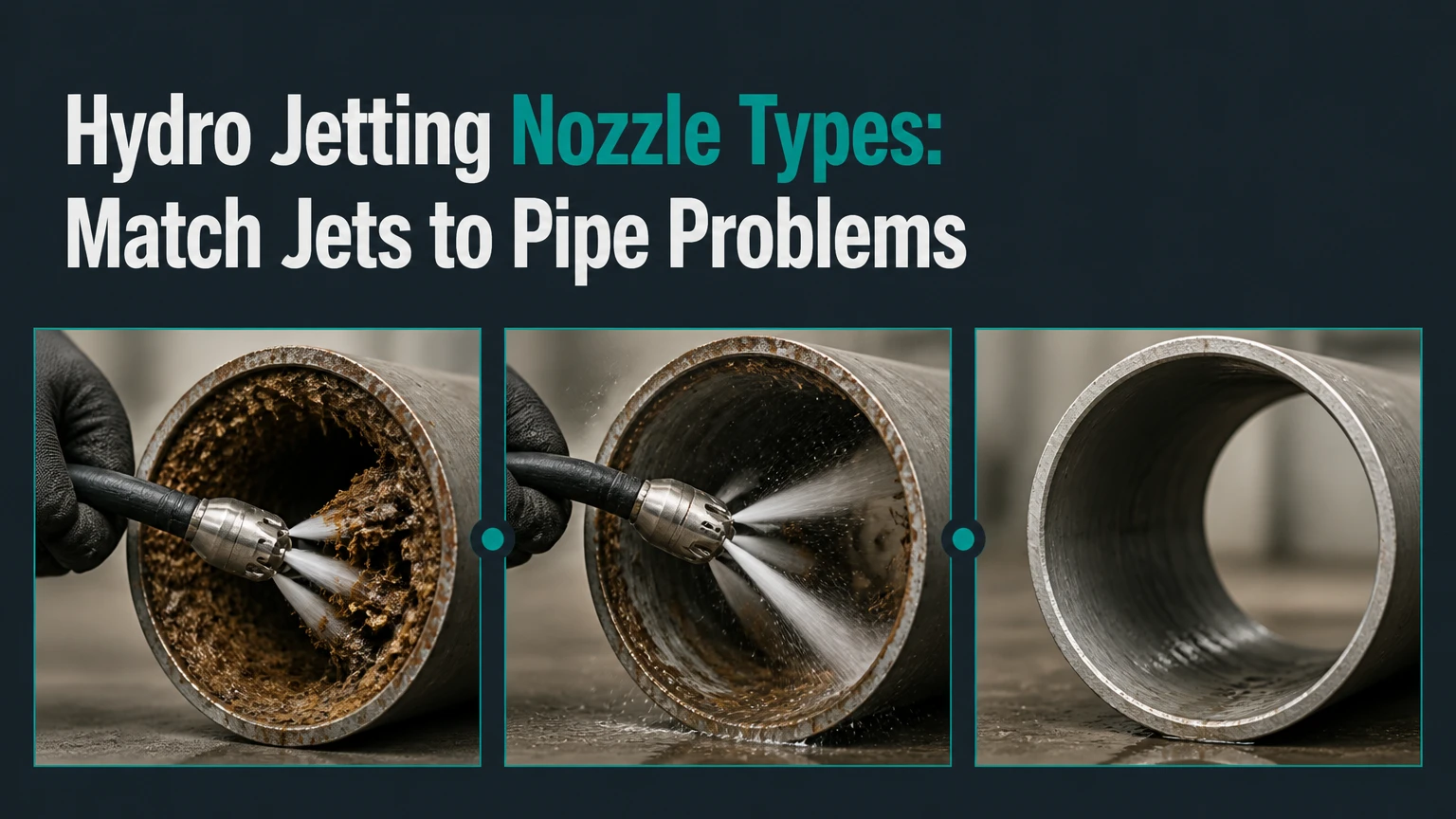
Hydro jetting nozzle types determine whether pressurized water penetrates a blockage, scours pipe walls, cuts roots, or safely navigates bends. The main categories are penetrator, flushing, rotary, root-cutting, and cornering nozzles. Correct selection depends on the obstruction, pipe material, internal diameter, pump PSI, pump GPM, hose size, and structural condition.
Key Facts at a Glance
- A penetrator nozzle usually combines one forward jet with three to six rear thrust jets for dense plugs and complete stoppages.
- A flushing nozzle has no forward jet and uses six to eight wide-angle rear jets to sweep loose debris and film from pipe walls.
- Rotary nozzles improve circumferential cleaning, but their moving parts require inspection and can be unsafe in fragile or damaged pipes.
- Root cutters need substantially more flow than small residential jetters, commonly about 8-12 GPM for heavy mechanical work.
- Nozzle orifices must match the pump’s rated PSI and GPM; an incorrectly sized nozzle reduces cleaning performance or strains the pump.
- A camera inspection should precede aggressive cutters when a pipe may contain fractures, voids, severe corrosion, or incompatible repairs.
What Is a Hydro Jetting Nozzle?
A hydro jetting nozzle is a precision attachment at the end of a high-pressure hose that converts pump pressure and water flow into directional jets. Rear-facing jets create thrust and cleaning force, while forward, side, or rotating jets attack obstructions and deposits.
The nozzle is only one part of the hydraulic system. Pump output, hose friction, water filtration, orifice diameter, nozzle weight, pipe diameter, and jet angle jointly determine performance. A nozzle that works well at 4,000 PSI and 8 GPM may perform poorly on a 2.5 GPM electric pressure washer.
Water entering a restricted orifice accelerates as pressure energy becomes kinetic energy. Bernoulli’s principle helps explain that pressure-to-velocity conversion, while Newton’s third law explains why water expelled rearward pushes the nozzle and hose forward. The practical result is a balance between forward propulsion and useful impact on the obstruction or pipe wall.
Why Do Jet Angles Matter?
Jet angle determines where water energy goes. A 0-degree forward jet concentrates impact at the blockage, 15-25-degree rear jets emphasize forward travel, and 30-45-degree rear jets spread water across more wall area while reducing direct forward thrust.
Angle is not a quality ranking. A wide-angle nozzle is often better for routine wall washing, but it may fail to bore through a compact grease plug. Conversely, a laser-style nozzle may open a passage without removing the residue that caused the restriction.
What Are the Main Hydro Jetting Nozzle Types?
The five principal hydro jetting nozzle types are penetrator, flushing, rotary, mechanical root cutter, and cornering nozzles. Each type assigns the pump’s available energy differently between penetration, propulsion, wall coverage, cutting, and maneuverability.
1. Penetrator Nozzles
Penetrator nozzles are best for dense, centered obstructions that block hose progress. Typical designs use one sharp forward jet, often near 0 degrees, plus three to six rear jets set around 15-25 degrees.
Common names include laser, arrow, chisel, and bullet nozzles. Stainless-steel models often cost about $50-$150, while carbide or specialized commercial versions cost more. Typical working ranges are approximately 2,500-4,000 PSI, although the pump’s flow and the manufacturer’s rating remain decisive.
Penetrators work well against hard grease, compacted sludge, ice, mud, and an initial hole through a complete stoppage. They are poor finishing tools because the narrow forward stream leaves substantial material on the pipe walls.
Practitioner rule: Use a penetrator to create access, then change to a flushing or rotary head after drainage begins. Repeating penetration passes alone can leave a partially open line that blocks again.
2. Flushing and Scouring Nozzles
Flushing nozzles are designed for wall coverage and debris transport rather than frontal drilling. They commonly have zero forward jets and six to eight rear jets angled about 30-45 degrees.
The broad rear spray pushes sand, sludge, loose scale, and grease residue downstream while washing a large portion of the circumference. Flushing heads usually cost about $40-$120 and have fewer moving parts than rotary models, which can reduce maintenance needs.
A flushing nozzle is the normal second pass after a penetrator opens a backed-up line. It is also the preferred head for scheduled maintenance when the pipe contains loose sediment rather than a solid obstruction.
The trade-off is hydraulic. Wide-angle jets spend more energy on wall contact and less on forward propulsion, so a flushing nozzle may stall in a long, heavily blocked line. Hose length and pipe diameter amplify that limitation.
3. Rotary Nozzles
Rotary nozzles use water-driven internal or external motion to distribute jets around the pipe circumference. Some models rotate at roughly 50-300 revolutions per minute for controlled heavy cleaning; high-speed scouring heads may exceed 3,000 RPM.
Rotary heads are effective against widespread scale, hardened grease, concrete slurry residue, and deposits that a fixed nozzle cleans unevenly. Commercial units commonly operate around 3,000-4,000 PSI and may cost $300-$1,500 or more.
Controlled rotation is valuable because it reduces reliance on one fixed spray pattern. However, bearings, seals, brake systems, and internal passages can collect sediment. Manufacturer-directed service intervals may fall around 40-60 operating hours, depending on water quality and workload.
Rotary nozzles are not automatically safe for every pipe. A rotating head can remove weak material from corroded cast iron, damage exposed liners, or worsen defects that should have been repaired first.
4. Root Cutters and Chain Knives
Root cutters combine water jetting with a rotating mechanical assembly. Chains, cables, or carbide-tipped blades expand outward through centrifugal force and cut thick root masses or tuberculated deposits.
Heavy root cutters commonly require at least 8-12 GPM to maintain rotation under load, although exact requirements vary by model and pipe diameter. Industrial assemblies may cost $400-$2,500, and chains or blades can require replacement after roughly 20-30 heavy uses.
Mechanical cutters are intended for structurally sound lines with enough internal clearance. They are poor choices for thin-walled Orangeburg pipe, fractured clay, badly corroded cast iron, or PVC with uncertain wall condition.
A cutter removes the symptom, not the root entry point. Recurring root intrusion usually requires repair, replacement, chemical root control where legally and environmentally appropriate, or a lining solution selected after inspection.
5. Cornering and Negotiator Nozzles
Cornering nozzles are compact, articulated, offset, or spring-assisted attachments that help a hose negotiate bends. Short bodies, radiused edges, and asymmetric jet placement allow the nozzle to turn through traps, elbows, and congested residential plumbing.
These nozzles often measure less than 1.5 inches in length and cost approximately $70-$200. Their strength is navigation, not maximum cutting power. A compact negotiator can reach a blockage that a long, heavy rotary head cannot pass.
Cornering heads are useful in kitchen branches, P-traps, 90-degree elbows, and short-radius transitions. They still require a correctly sized hose and conservative pressure, because a nozzle that rounds a bend may direct a jet into a weak fitting or poorly supported connection.
How Do Hydro Jetting Nozzle Types Compare?
The best nozzle depends on whether the primary need is penetration, wall cleaning, cutting, or navigation. The table below uses typical commercial ranges, not universal specifications, because manufacturers vary in orifice layout, materials, maximum PSI, and service requirements.
| Nozzle type | Typical jet layout | Primary job | Typical cost | Main limitation |
|---|---|---|---|---|
| Penetrator | 1 forward jet, 3-6 rear jets at 15-25 degrees | Dense plugs and initial access | $50-$150 | Leaves wall residue |
| Flushing | 0 forward jets, 6-8 rear jets at 30-45 degrees | Sand, sludge, loose grease, routine cleaning | $40-$120 | Weak frontal penetration |
| Rotary | Rotating side or orbital jets | Scale and uniform wall scouring | $300-$1,500+ | Moving parts and pipe risk |
| Root cutter | Rotating chains, cables, or blades | Thick roots and tuberculation | $400-$2,500 | Requires strong pipe and high flow |
| Cornering | Offset, articulated, or spring-assisted jets | Bends, traps, and elbows | $70-$200 | Moderate cleaning coverage |
Which Nozzle Has the Most Penetration Power?
A penetrator or root cutter has the greatest obstruction-penetration capability, but the two tools solve different problems. A penetrator uses concentrated water and is suited to grease or sediment plugs; a root cutter uses mechanical cutting and is reserved for thick roots in structurally verified pipe.
Which Nozzle Cleans Pipe Walls Best?
A flushing nozzle is the simplest choice for broad routine wall washing, while a controlled rotary nozzle is stronger against persistent deposits distributed around the circumference. Rotary heads generally cost more and demand more maintenance, so they are justified when fixed rear jets leave measurable scale or grease behind.
| Cleaning objective | First choice | Typical operating emphasis | Follow-up |
|---|---|---|---|
| Complete grease blockage | Penetrator | 2,500-4,000 PSI, concentrated forward jet | Flushing pass |
| Loose sand or sludge | Flushing | 30-45-degree rear coverage | Vacuum or downstream removal |
| Circumferential scale | Rotary | 3,000-4,000 PSI, controlled rotation | Camera verification |
| Thick root mass | Root cutter | Usually 8-12 GPM or more | Structural repair assessment |
| Tight residential bend | Cornering | Compact body, conservative pressure | Small flushing head |
How Do You Select a Nozzle for a Specific Pipe Problem?
Select the nozzle by matching obstruction hardness, pipe geometry, structural condition, and pump output in that order. A blockage description alone is insufficient because the same grease, root, or scale condition can require a different tool in a 2-inch branch than in a 12-inch main.
Start With the Pipe
Identify the material, inside diameter, age, access point, and known defects. PVC, ABS, cast iron, vitrified clay, concrete, and Orangeburg pipe do not tolerate identical mechanical or hydraulic treatment.
A camera is particularly important before root cutters or aggressive rotary heads. Look for cracks, offset joints, missing sections, severe corrosion, belly conditions, collapsed areas, and transitions to fragile materials.
| Pipe condition | Safer initial approach | Avoid first | Reason |
|---|---|---|---|
| Sound 4-inch PVC | Penetrator, then flushing | Stationary chain cutter | Concentrated cutting can damage thin sections |
| Fractured clay | Inspection and repair planning | Root cutter or aggressive rotary | Jets can enlarge defects and dislodge fragments |
| Corroded cast iron | Low-aggression flushing | Stationary rotary head | Remaining wall thickness may be limited |
| Orangeburg pipe | Camera and replacement assessment | Mechanical cutter | Fiber-composite wall can deform or collapse |
| Sound concrete main | High-flow flushing or rotary | Small residential nozzle | Low flow cannot transport debris efficiently |
Match the Pump to the Nozzle
Nozzle sizing must match both PSI and GPM. The orifice must allow the pump to reach its intended working pressure without forcing the unloader to bypass or starving the pump of useful velocity.
Manufacturers commonly identify nozzle size through a standardized sizing chart. For example, a 4,000 PSI pump delivering 4 GPM may use a size around 4.5, but the exact designation depends on the manufacturer’s chart and the number of orifices. Never treat that example as a universal insert size.
Use the pump’s actual delivered output, not only its nameplate maximum. A long hose, undersized hose, inlet restriction, dirty filter, or low water supply can reduce flow at the nozzle.
| Pump output | Suitable application | Typical nozzle family | Selection caution |
|---|---|---|---|
| 1.5-2.5 GPM at 2,000-3,000 PSI | Residential branches | Short penetrator or flushing head | Avoid chain cutters |
| 4-6 GPM at 3,500-4,000 PSI | Service plumbing and 3-6-inch lines | Penetrator, flushing, rotary | Verify hose and orifice chart |
| 8-12 GPM at 3,000-4,000 PSI | Heavy roots and larger drains | Root cutter or large rotary | Camera and flow management required |
| 12-80+ GPM at 2,000-3,000 PSI | Municipal mains and culverts | High-flow flushing, skid, or chain head | Nozzle must match pipe diameter |
Consider Hose and Pipe Diameter
A nozzle that is too large for the pipe may not turn or clean the lower invert effectively. A nozzle that is too small may lack weight, thrust, and coverage. Hose diameter also affects friction loss and the ability to deliver flow over long runs.
For residential 3-inch and 4-inch drains, compact heads are often easier to control. Large municipal mains need higher-flow nozzles with patterns designed for the pipe’s diameter, sediment load, and required debris transport.
What Is the Correct Hydro Jetting Workflow?
The correct workflow is inspect, size, select, insert, penetrate, clean, retrieve, and verify. The most important operational control is a slow, deliberate pullback, because the return pass keeps jets engaged with the pipe wall and carries loosened material toward the access point.
- Characterize the line. Confirm pipe material, diameter, access location, approximate length, and structural condition.
- Confirm water supply. Verify inlet flow, filtration, pump output, hose rating, and the manufacturer’s nozzle chart.
- Choose the first pattern. Use a penetrator for a dense stoppage, a flushing head for loose material, and a rotary or cutter only when conditions justify it.
- Inspect the nozzle. Confirm that every orifice is open, round, undamaged, and free of embedded debris.
- Insert the hose before pressurizing. Place the nozzle and at least 3-5 feet of hose inside the pipe before opening high-pressure flow.
- Advance under control. Let rear jets pull the hose forward without forcing the nozzle against an obstruction or fitting.
- Work the obstruction. Pause only briefly while maintaining movement; do not leave a rotating or cutting head stationary.
- Retract slowly. A typical practitioner starting point is about 1 foot per second, adjusted for deposit hardness, pipe size, and equipment instructions.
- Flush and remove debris. Use a wider-angle cleaning head after penetration and manage wastewater so loosened solids do not relocate downstream.
- Verify the result. Test flow and use a camera when recurring blockage, structural damage, or incomplete cleaning is possible.
Never activate a high-pressure jetter with the nozzle exposed. Water jets can puncture skin, inject contaminants into tissue, and cause severe injury even when the stream appears narrow.
What Are the Most Common Selection and Operating Mistakes?
The most damaging mistakes are incorrect orifice sizing, aggressive tooling in weak pipe, static cutter operation, and inadequate filtration. Each mistake either wastes hydraulic energy, increases structural risk, or creates a false impression that the blockage has been permanently solved.
- Using a generic nozzle without checking GPM: Oversized orifices reduce pressure; undersized orifices can trigger unloader bypass, overheat the pump, or reduce delivered flow.
- Running a penetrator as the finishing tool: A small hole through grease does not equal a clean pipe. Follow with wall-scouring passes.
- Using a chain cutter without camera evidence: Roots can hide fractures, voids, or collapsed sections that mechanical tools cannot repair.
- Leaving the head stationary: Concentrated jets and rotating blades can erode old cast iron, cut PVC, or damage a liner.
- Ignoring filtration: Sand and mineral particles erode carbide orifices, enlarge openings, distort spray patterns, and reduce jet velocity.
- Pressurizing outside the line: Exposed nozzles create an immediate high-pressure injury hazard.
- Pushing debris into a downstream obstruction: A successful upstream opening can still cause a secondary blockage if solids are not recovered.
Expert insight: A pressure gauge reading at the pump does not prove that the nozzle is receiving the intended cleaning energy. Hose friction and worn orifices can produce a normal pump reading with weak discharge at the pipe.
How Do You Troubleshoot a Jetter Nozzle?
Troubleshoot a jetter nozzle by comparing pump behavior, pressure stability, spray symmetry, and mechanical movement. Remove pressure before inspection, isolate the water supply, and follow the equipment manufacturer’s lockout procedure.
| Symptom | Likely cause | Inspection | Corrective action |
|---|---|---|---|
| Violent pump pulsing | Blocked orifice or restricted inlet | Inspect filter and every jet | Back-clear with a nozzle-cleaning pin |
| Pressure drops at steady RPM | Enlarged worn orifices | Compare spray pattern and insert size | Replace nozzle or jet inserts |
| Nozzle stalls in pipe | Excessive blockage, low flow, or wrong angle | Check pump GPM and hose friction | Use a penetrator or correct flow match |
| Rotary head stops spinning | Sediment in bearing or damaged seal | Test rotation with clean water | Service only to manufacturer specification |
| Hose advances poorly | Wrong rear-jet angle, oversized head, or undersized flow | Check nozzle layout and pipe diameter | Select a compact or higher-thrust model |
| Debris remains after cleaning | Penetration pass without scouring | Camera or visual flow check | Follow with flushing or rotary cleaning |
Do not enlarge an orifice with a drill. Even a small change can alter total flow, pressure, thrust, and the load placed on the pump.
What Does Each Nozzle Type Cost?
Typical nozzle purchase prices range from about $40 for a basic flushing head to more than $2,500 for an industrial chain-cutting assembly. Total operating cost also includes hose wear, jet inserts, seals, rotary rebuilds, filtration, water disposal, and labor.
| Equipment item | Typical purchase range | Typical service interval | Main cost driver |
|---|---|---|---|
| Basic flushing nozzle | $40-$120 | 80-120 operating hours | Orifice erosion |
| Penetrator nozzle | $50-$150 | 50-100 operating hours | Abrasive water and impact |
| Cornering nozzle | $70-$200 | 60-100 operating hours | Joint and body wear |
| Rotary nozzle | $300-$1,500+ | 40-60 hours before inspection or rebuild | Bearings, seals, braking system |
| Root cutter | $400-$2,500 | Blades or chains after 20-30 heavy uses | Mechanical wear and replacement parts |
These figures are typical market ranges rather than fixed prices. Stainless steel, carbide inserts, proprietary rotation systems, larger flow ratings, and manufacturer support can shift the price substantially.
Which Nozzle Should Each User Choose?
Homeowners generally need a short penetrator and a basic flushing nozzle, while service plumbers benefit from a broader set that includes controlled rotation and compact cornering. Municipal contractors require high-flow, large-footprint tools designed around pipe diameter and debris transport rather than residential PSI figures.
Homeowners and Light-Duty Users
For a 1.5-2.5 GPM electric or small gas machine, choose a manufacturer-rated short penetrator and flushing head. Avoid chain cutters because small pumps often cannot drive them correctly, and residential pipes may not tolerate their mechanical action.
Commercial Plumbers
A 4-9 GPM trailer or cart jetter can support penetrator, flushing, rotary, and negotiator tools. A practical service kit includes fixed stainless-steel heads, a controlled-rotation head, a compact bend-capable nozzle, replacement inserts, a filter, and a camera access plan.
Municipal and Industrial Contractors
Municipal work commonly uses 12-80+ GPM equipment with specialized bottom-cleaning, large rotary, expanding chain, and culvert nozzles. Tool choice must account for pipe diameter, sediment volume, traffic control, wastewater recovery, and the distance required to transport loosened debris.
Are Rotary Nozzles Better Than Fixed Nozzles?
Rotary nozzles are better for uniform scale and circumferential deposits, while fixed penetrator and flushing nozzles are usually better for simple blockages, lower cost, easier maintenance, and tight access. The rotary head wins only when its cleaning coverage justifies its higher cost and mechanical risk.
Fixed nozzles are easier to inspect because their jet pattern is visible and their body has no bearing assembly. Rotary heads can clean more evenly, but poor maintenance or sediment contamination can stop rotation while leaving the operator unaware.
A staged approach is often more effective than choosing one “best” nozzle. Penetrate with a fixed head, flush loose debris, then rotate only where camera evidence or deposit resistance requires it.
When Is Hydro Jetting the Wrong Solution?
Hydro jetting is the wrong first solution for a collapsed, severely fractured, inaccessible, or structurally unstable pipe. Water can remove deposits, but it cannot restore missing pipe wall, correct a major belly, reconnect offset joints, or permanently eliminate root entry through a damaged joint.
Alternatives include a cable machine for a narrow access opening, excavation for a collapsed section, pipe replacement for severe failure, and cured-in-place lining when the host pipe meets rehabilitation requirements. Chemical treatment may complement root management, but it does not replace structural repair.
A sewer camera provides the information needed to distinguish a cleanable obstruction from a repair problem. Cleaning first can be reasonable when the line is stable and the obstruction is known, but aggressive cutting without inspection is an avoidable gamble.
Frequently Asked Questions
How often should hydro jetting nozzles be replaced?
Replace a nozzle when its orifices are visibly enlarged, asymmetrical, cracked, damaged, or unable to produce the expected pressure and spray pattern. Typical fixed nozzles may last 50-120 operating hours, while rotary heads may need inspection or rebuilding after 40-60 hours and cutters may consume chains or blades after 20-30 heavy uses.
Can a hydro jetting nozzle get stuck in a pipe?
A hydro jetting nozzle can become stuck because of a collapsed section, severe offset, oversized body, insufficient thrust, or a hose kink. Stop forcing the hose, reduce pressure according to the equipment procedure, and determine whether the obstruction is structural before attempting retrieval.
What nozzle removes tree roots from a sewer line?
A root cutter with chains, cables, or carbide blades removes thick tree roots when the pipe is structurally sound and the jetter supplies the required flow. A penetrator may open a small passage through soft root material, but it usually cannot provide the durable mechanical removal achieved by a properly sized cutter.
Does nozzle size affect PSI or GPM?
Nozzle orifice size affects both pressure and flow at the pump’s operating point. Larger total orifice area generally permits more flow but lowers pressure, while smaller area raises restriction and can reduce delivered flow or cause unloader bypass; use the pump manufacturer’s sizing chart.
Is hydro jetting safe for old cast-iron pipes?
Hydro jetting can be safe for old cast iron when inspection confirms adequate wall thickness and stable joints, but aggressive rotary or cutting heads can remove fragile corrosion layers or expose defects. Start with conservative fixed-pattern cleaning and verify the pipe before increasing mechanical intensity.
Is hydro jetting better than snaking?
Hydro jetting is usually better for removing grease film, sludge, scale, and deposits across the pipe circumference, while snaking is often faster for creating a narrow path through a simple localized blockage. Neither method repairs structural damage, and a camera may be needed when the blockage repeatedly returns.
The Bottom Line
Hydro jetting nozzle types are specialized tools, not interchangeable attachments. Use penetrators for dense plugs, flushing heads for broad debris removal, rotary nozzles for persistent circumferential deposits, root cutters for verified structural lines with sufficient flow, and cornering nozzles for difficult bends.
The correct choice begins with pipe condition and ends with pump-to-orifice matching. For the most reliable result, inspect the line, size the nozzle to actual PSI and GPM, insert the hose before pressurizing, work the head continuously, retract slowly, and verify that the cleaning removed the cause rather than creating only a temporary opening.