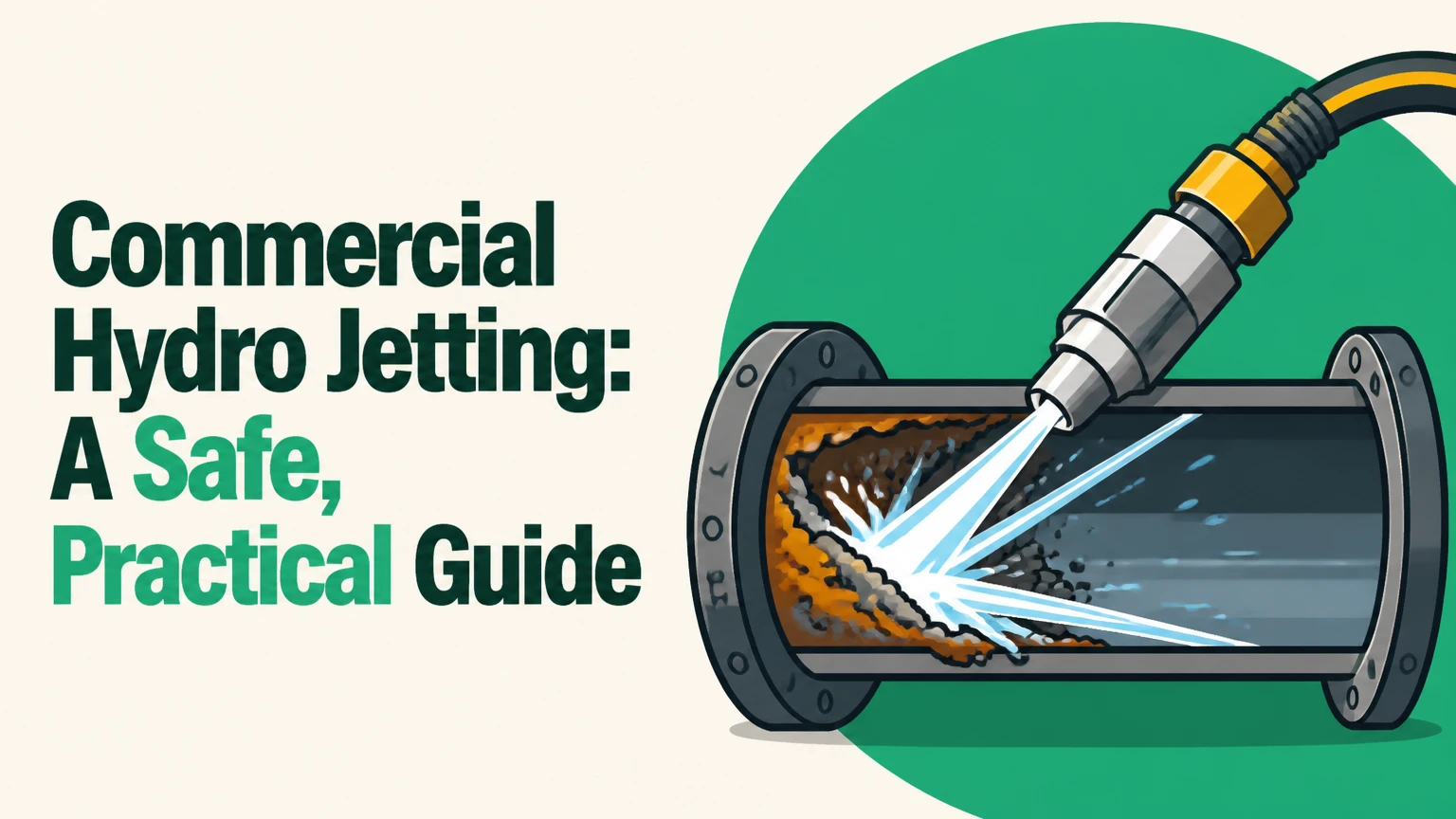
Commercial hydro jetting is a professional drain and sewer cleaning method that propels high-volume water through a specialized nozzle to break apart blockages and scour deposits from pipe walls. It is suited to commercial grease, roots, mineral scale, sludge, and large sewer lines, but a camera inspection must confirm that the pipe can safely withstand the selected pressure and flow.
Key Facts at a Glance
- Commercial hydro jetting typically uses 3,000-4,000 PSI and 12-25 GPM for building drain and sewer lines.
- Industrial and municipal jetting equipment may exceed 4,000 PSI, 30 GPM, and 48-inch pipe capacity.
- Gallons per minute determine flushing and transport capacity; PSI determines cutting and penetration.
- A camera inspection should identify cracks, collapse, offsets, corrosion, and blockage location before jetting.
- Typical commercial service costs range from $400-$800 for an internal branch line and $800-$1,800 for a main sewer line.
- A standard service call usually takes 2-5 hours, including inspection, setup, cleaning, verification, and cleanup.
What Is Commercial Hydro Jetting?
Commercial hydro jetting is high-pressure water cleaning for commercial plumbing, sanitary sewer, stormwater, and industrial process lines. A motor-driven pump sends water through a reinforced hose and engineered nozzle, where forward jets penetrate the obstruction and rear jets propel the hose while washing the pipe circumference.
The method differs from a cable machine because water removes material from the pipe wall instead of creating a narrow passage through it. A restaurant line, for example, may remain hydraulically restricted after a cable clears the center of a grease blockage. A properly selected jetting nozzle can remove the surrounding grease layer and carry loosened material toward a downstream access point.
Commercial systems handle longer runs, larger diameters, higher debris loads, and more difficult access than typical residential equipment. Trailer jetters may carry 300-1,000 gallons, while portable cart units can enter a high-rise mechanical room or freight elevator. The correct machine depends on pipe diameter, distance, access, material, blockage composition, and available water.
Hydro jetting is a cleaning method, not a structural repair. It cannot restore a collapsed sewer, seal a separated joint, replace missing pipe, or correct inadequate pipe slope.
How Does Commercial Hydro Jetting Work?
Commercial hydro jetting converts pump pressure and water volume into cutting, propulsion, suspension, and flushing forces. A nozzle’s forward or angled jets attack the blockage, while rear-facing jets pull the hose upstream and scour deposits from the pipe circumference.
The operator inserts the hose through a cleanout, manhole, or other engineered access point. Jetting normally proceeds against the direction of drainage so loosened material can wash back toward the downstream outlet. The operator controls hose speed, pump output, nozzle position, and pullback rate rather than leaving the nozzle stationary.
A useful operating distinction is simple: PSI supplies impact, while GPM supplies transport. High PSI with insufficient GPM may bore a small channel through grease without moving the resulting mass out of the line. Excessive pressure or a stationary nozzle can damage weak pipe, erode joints, or force water into the building.
What Do the Nozzle Jets Do?
Forward jets penetrate compacted grease, paper, sludge, or ice-like deposits. Rear jets create thrust and wash the loosened material downstream. Rotating heads distribute impact around the pipe wall, while root-cutting heads combine water force with mechanical chains or cutters.
Nozzle selection must match the obstruction and line geometry. A nozzle designed for a 6-inch grease line is not automatically suitable for a 24-inch storm culvert, and a root cutter may be inappropriate where the pipe wall has severe corrosion.
What Happens During a Commercial Hydro Jetting Service?
A safe commercial hydro jetting service has four operational phases: diagnosis, setup, controlled cleaning, and verification. Skipping the diagnostic or post-cleaning camera step makes the result harder to validate and increases the risk of jetting a failed pipe.
Phase 1: Inspect the Line
The technician runs a waterproof inspection camera through a cleanout or manhole to locate the obstruction and evaluate the pipe. The inspection should document cracks, collapse, root intrusion, mineral scale, grease depth, offsets, standing water, and the approximate distance to the problem.
A structurally compromised line may require excavation, spot repair, pipe lining, or replacement instead of aggressive cleaning. Old Orangeburg, badly corroded cast iron, fractured clay, and collapsed PVC require particular caution because pressure can worsen an existing defect.
Phase 2: Prepare Access and Safety Controls
The crew opens an access point that allows debris and water to move away from the building. Workers protect nearby fixtures, isolate affected drains where necessary, establish a hose route, confirm water supply, and control public access around open manholes or cleanouts.
The operator selects pressure, flow, nozzle, and hose size according to the inspected pipe. Commercial work also requires a plan for wastewater and removed solids, especially where grease, chemical residue, sewage, or industrial contaminants may require controlled disposal.
Phase 3: Jet and Flush the Line
The operator advances the nozzle upstream in controlled passes, then retracts it slowly so the rear jets scour the full circumference. Several passes may be needed for thick grease or scale, and the operator may change nozzles after the first pass opens the route.
The nozzle should keep moving when high pressure is active. Holding a jet in one location can cut weakened PVC, erode a defective joint, or expose a thin section of corroded metal. The downstream cleanout, manhole, or interceptor must remain open and monitored so the removed material does not form a second blockage.
Phase 4: Verify Flow and Condition
A second camera inspection confirms whether deposits, roots, and residual debris remain. A flow test from representative fixtures checks whether the line accepts expected commercial discharge without backing up.
A useful completion record includes before-and-after video, access points used, pipe diameter and material, nozzle type, operating pressure and flow, cleaning length, debris findings, and recommendations. Property managers can use that record to compare recurring blockages and plan capital repairs.
Which Equipment and Nozzles Are Used?
Commercial jetting equipment ranges from portable cart machines for internal branches to trailer-mounted units for long, large-diameter sewer lines. Equipment capacity should be selected from hydraulic requirements, not from the highest PSI printed on the machine.
| Equipment configuration | Typical PSI and GPM | Reach and water capacity | Common commercial use |
|---|---|---|---|
| Portable electric cart | 1,500-3,000 PSI, 4-12 GPM | 100-300 feet, building water supply or 50-100 gallon tank | Office branches, high-rise stacks, indoor mechanical rooms |
| Portable gas cart | 2,500-4,000 PSI, 8-18 GPM | 150-400 feet, 50-200 gallon tank | Restaurants, retail drains, apartment mains |
| Van or skid unit | 3,000-4,000 PSI, 12-25 GPM | 200-500 feet, 200-500 gallon tank | Commercial building sewers and long branch lines |
| Trailer-mounted sewer jetter | 3,000-6,000 PSI, 20-60 GPM | 300-1,000 feet, 300-1,500 gallon tank | Main sewers, parking lots, campuses, municipal access |
| Industrial jetter | 4,000-10,000+ PSI, 30-120+ GPM | 500-1,000+ feet, 600-3,000+ gallon tank | Process lines, heavy scale, sludge, culverts, industrial sites |
Which Nozzle Fits the Blockage?
| Nozzle type | Typical jet pattern | Best application | Main limitation |
|---|---|---|---|
| Penetrator | 15-30 degree forward jets | Hardened grease, compacted sludge, ice-like plugs | May open a channel without fully cleaning walls |
| Flusher | Rear-facing jets, 15-30 degrees | General transport and routine sewer cleaning | Less aggressive against hard scale |
| Rotating spinner | Rotating 360-degree spray | Grease film, soft scale, broad wall cleaning | Requires adequate flow and nozzle clearance |
| Root cutter | Rear jets plus chains or blades | Dense root intrusion in sound pipe | Unsafe for fragile or heavily damaged pipe |
| Descaling nozzle | Abrasive or concentrated impact pattern | Mineral scale and hardened deposits | Can remove weak pipe material with the scale |
| Large-line nozzle | High-volume rear jets | Storm drains, culverts, and large sewers | Inefficient in undersized branch lines |
What Are the Technical Operating Ranges?
Typical commercial hydro jetting operates at 3,000-4,000 PSI and 12-25 GPM, while heavy industrial and municipal work may reach 10,000 PSI and more than 100 GPM. Actual settings must follow the pipe material, nozzle orifice, diameter, blockage, access, and equipment manufacturer guidance.
| Operating metric | Typical building service | Heavy commercial service | Industrial or municipal service |
|---|---|---|---|
| Pressure | 1,500-4,000 PSI | 3,000-6,000 PSI | 4,000-10,000+ PSI |
| Water volume | 4-18 GPM | 12-40 GPM | 30-120+ GPM |
| Pipe diameter | 2-8 inches | 6-24 inches | 12-48+ inches |
| Hose reach | 100-400 feet | 200-700 feet | 500-1,000+ feet |
| Tank capacity | 50-200 gallons | 200-750 gallons | 600-3,000+ gallons |
A machine’s pressure gauge does not reveal the pressure delivered at the obstruction. Hose length, elevation, nozzle orifice, bends, and water temperature create pressure loss. Experienced operators therefore evaluate cleaning progress, downstream discharge, hose movement, and camera evidence rather than treating a PSI number as a guarantee.
How Much Does Commercial Hydro Jetting Cost?
Commercial hydro jetting typically costs $400-$800 for an internal branch line, $800-$1,800 for an exterior main sewer up to about 200 feet, and $2,000-$4,500 or more for severe industrial, root, scale, or multi-day work. Emergency service may add $250-$600 or increase labor rates by 1.5-2 times.
| Service scope | Typical price | Typical active work | Common cost drivers |
|---|---|---|---|
| Internal branch line | $400-$800 | 1-2 hours | Kitchen grease, access, camera inspection |
| Main sewer up to 200 feet | $800-$1,800 | 1-3 hours | Manholes, diameter, hose distance, debris removal |
| Root-intruded line | $1,200-$3,000 | 2-4 hours | Root density, cutter passes, recurring intrusion |
| Severe scale or industrial sludge | $2,000-$4,500+ | 4 hours to several days | Disposal, containment, specialized nozzles |
| After-hours emergency | Base price plus $250-$600 | Variable | Night, weekend, holiday, traffic, response time |
A quote should state whether it includes camera inspection, water, setup, traffic or confined-space controls, debris removal, wastewater disposal, video files, additional passes, and emergency premiums. A low initial price can become expensive if the contractor charges separately for every camera run, nozzle change, or cleanup stage.
Is Hydro Jetting Better Than Snaking?
Commercial hydro jetting is usually better for wall-to-wall grease, sludge, soft scale, and recurring buildup, while mechanical snaking is often safer for a small obstruction in a fragile or structurally uncertain pipe. The correct choice depends on whether the objective is temporary passage, full cleaning, or diagnosis of a failed line.
| Decision factor | Commercial snaking | Commercial hydro jetting |
|---|---|---|
| Primary action | Cable cuts or punches through blockage | Water cuts, scours, suspends, and flushes debris |
| Typical branch-line price | $150-$500 | $400-$800 |
| Grease removal | Limited wall cleaning | Strong wall and deposit removal |
| Root response | Opens a central path | Can remove roots flush with sound pipe walls |
| Fragile pipe suitability | Often lower hydraulic risk | Requires inspection and calibrated settings |
| Large-line performance | Limited by cable size and distance | Available for 12-48+ inch lines |
| Recurrence after heavy grease | Often high | Usually lower when source control improves |
| Main limitation | Leaves deposits behind | Cannot repair collapse, cracks, or missing pipe |
Snaking remains useful when a tenant needs immediate passage, access is limited, or inspection suggests a fragile line. Hydro jetting is not automatically the better first move when the pipe is collapsed, badly offset, or filled with a foreign object that needs retrieval rather than pulverization.
When Should a Business Schedule Jetting?
Restaurants commonly schedule commercial hydro jetting every three to six months, but the correct interval comes from blockage history, grease interceptor performance, menu, operating hours, and post-cleaning camera findings. Preventive cleaning should occur during a closing period and should not substitute for grease control or compliant interceptor maintenance.
| Facility type | Typical obstruction | Starting maintenance interval | Useful control |
|---|---|---|---|
| Restaurant kitchen | FOG, starch, food solids | 3-6 months | Interceptor maintenance, drain screens, hot-water procedures |
| Apartment or high-rise | Hair, soap, scale, foreign objects | 6-12 months | Stack inspection, tenant education, fixture monitoring |
| Hospital or care facility | Fats, linens, disinfectant residue | 6-12 months | Infection-control planning, restricted access |
| Manufacturing plant | Scale, slurry, chemical residue | Monthly to annually | Process isolation, waste characterization, line records |
| Retail or office building | Paper, sediment, low-flow buildup | Annually or after symptoms | Mainline camera baseline and flow testing |
| Stormwater system | Sand, silt, roots, trash | Before wet season or annually | Catch-basin cleaning and debris disposal |
A preventive program works best when the owner tracks location, blockage type, cleaning date, footage, flow result, and recurrence interval. Three blockages at the same station may indicate a slope, joint, root, or structural problem that jetting alone will not solve.
What Are the Main Risks and Failure Modes?
The largest commercial hydro jetting risks are jetting a structurally failed pipe, selecting inadequate water volume, allowing debris to migrate downstream, and exposing workers or occupants to high-pressure water and contaminated wastewater. Corrective controls begin with inspection, access management, calibrated equipment, PPE, and a documented discharge plan.
- Collapsed or cracked pipe: Stop cleaning and arrange repair or replacement.
- Pressure loss: Check intake filters, nozzle orifices, water supply, bypass regulator, and hose damage.
- Hose stuck underground: Do not pull with a vehicle or winch. Reduce pressure, pulse carefully, feed forward slightly, rotate, and withdraw under controlled tension.
- Water backing into fixtures: Slow insertion, confirm downstream relief, and close or isolate vulnerable fixtures.
- Secondary downstream clog: Monitor the discharge point and remove solids before they travel farther.
- Damaged pipe wall: Reduce pressure, change nozzle geometry, keep the head moving, and reassess with a camera.
- Contaminated water exposure: Use face, hand, foot, and body protection appropriate to sewage or process waste, plus site-specific hygiene controls.
The Water Jetting Association and the Water Jetting Association Australia both emphasize task-specific risk assessment, operator competence, exclusion zones, and equipment inspection. Commercial crews should also follow applicable OSHA requirements, local confined-space rules, and wastewater-disposal regulations.
Which Businesses Need Extra Planning?
Commercial kitchens need grease-focused cleaning and careful scheduling. Industrial facilities need process isolation, chemical compatibility checks, waste classification, and a method for containing removed solids.
High-rise buildings may require portable equipment because a trailer cannot reach an upper mechanical room. Property managers should also account for vertical stack access, tenant notification, elevator protection, and water movement between floors.
Manufacturing lines can contain mineral scale, abrasive solids, acids, solvents, or biological residue. The contractor should receive process information before selecting a nozzle because water jetting can aerosolize contaminants or mobilize waste that cannot enter a sanitary sewer.
Stormwater and municipal work introduces different concerns. Sediment, petroleum residue, and trash must be captured and disposed of under local requirements rather than flushed into a waterway.
How Can a Buyer Evaluate a Jetting Contractor?
A qualified commercial contractor should provide a written scope, pre-cleaning camera findings, equipment specifications, safety controls, disposal method, and post-cleaning evidence. The buyer should evaluate the proposed process rather than selecting solely on hourly price or maximum PSI.
Ask these questions before authorizing work:
- Will the crew inspect the pipe before applying high pressure?
- What pipe material, diameter, length, and defect findings determine the settings?
- What PSI, GPM, hose length, and nozzle will the crew use?
- Where will loosened grease, roots, sediment, or sewage be captured?
- Does the price include before-and-after video?
- What happens if the camera finds collapse or a separated joint?
- Are after-hours, water, disposal, traffic control, and additional passes included?
- Will the crew provide a maintenance recommendation based on the actual blockage?
A contractor who cannot explain the relationship between pipe condition, GPM, nozzle design, and debris control is not offering enough technical information for high-consequence commercial work.
Frequently Asked Questions
Can Hydro Jetting Damage PVC or Cast-Iron Pipes?
Yes, commercial hydro jetting can damage PVC, cast iron, clay, Orangeburg, or other pipe when pressure, flow, nozzle type, or operating technique is unsuitable. Sound pipe generally tolerates calibrated cleaning, but a camera inspection should identify thin walls, failed joints, collapse, and corrosion before jetting begins.
How Long Does Commercial Hydro Jetting Take?
A typical commercial service call takes 2-5 hours, including 45-90 minutes for diagnosis and setup, 1-3 hours of active jetting, and 30-60 minutes for final camera inspection and cleanup. Long lines, heavy scale, confined access, disposal requirements, and multiple passes can extend the work into a full day.
Does Hydro Jetting Remove Tree Roots Permanently?
Hydro jetting can remove existing roots from a sound pipe, but it does not permanently prevent regrowth when roots continue entering through joints or cracks. Recurring root intrusion may require joint repair, pipe lining, excavation, replacement, or a legally appropriate root-management program.
Is Hot Water Required for Commercial Grease Lines?
Hot water can soften some grease deposits, but temperature alone does not replace mechanical scouring and adequate flow. Nozzle design, GPM, line diameter, grease composition, and downstream debris handling determine whether a commercial kitchen line is actually cleaned.
Can Hydro Jetting Clear a Collapsed Sewer?
No. Commercial hydro jetting may remove loose debris near a defect, but it cannot restore a collapsed, severely offset, missing, or structurally separated sewer. Camera evidence should guide excavation, spot repair, cured-in-place lining, pipe bursting, or replacement.
What Should Happen After Jetting?
The contractor should complete a post-cleaning camera run, perform a representative flow test, document the cleaned length, and identify remaining defects. Commercial owners should retain the video and service report because those records help distinguish recurring deposits from structural failures.
The Bottom Line
Commercial hydro jetting is the strongest routine cleaning option for many large grease, scale, sludge, and root blockages because high-volume water removes deposits from the pipe wall rather than merely punching a passage through them. The safest and most economical result depends on camera inspection, correct GPM and PSI, suitable nozzle selection, downstream debris control, and post-service verification.
Use commercial hydro jetting for a sound line that needs deep cleaning. Use snaking for limited access or a cautious temporary opening, and use repair or replacement when inspection reveals structural failure. A documented, calibrated service is more valuable than a machine advertised with the highest pressure.
Title tag: Commercial Hydro Jetting: Costs, Specs, and Safe Use
Meta description: Compare $400-$4,500 commercial jetting jobs, 3,000-10,000 PSI systems, and snaking. Choose the safe option for grease, roots, or scale.