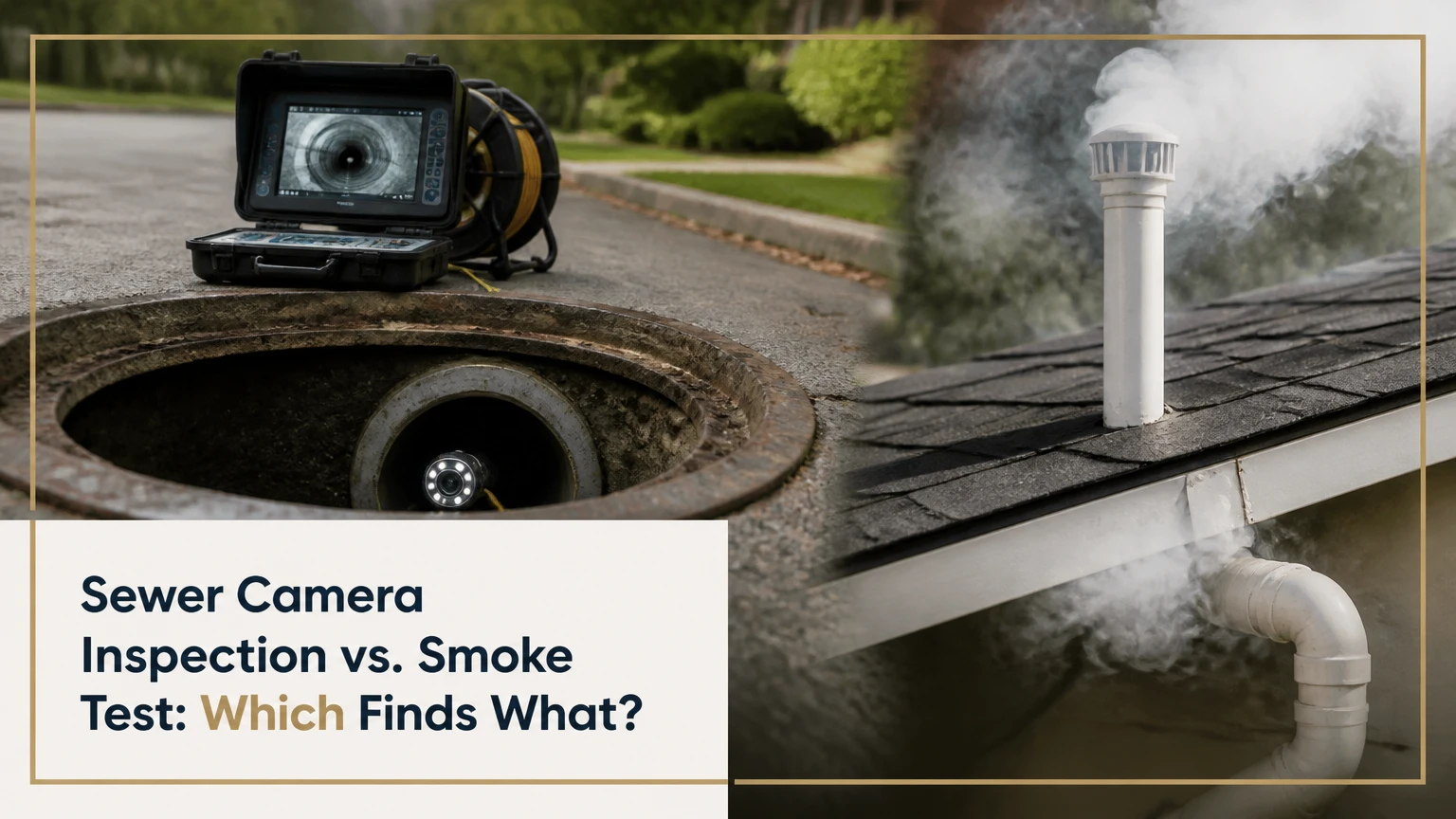
A sewer camera inspection shows the pipe’s internal condition, including roots, cracks, offsets, grease, scale, blockages, and standing water. A sewer smoke test traces air pathways from a sewer line to the surface or a building, revealing odor routes, defective connections, and inflow sources. Choose the camera for structural proof and the smoke test for pathway discovery.
Key Facts at a Glance
- A sewer camera inspection provides direct video evidence of the pipe interior.
- A sewer smoke test shows where smoke exits, but it does not display the entire pipe wall.
- Camera inspections are usually the first choice for recurring backups and home purchases.
- Smoke testing is better for unexplained sewer odors, roof-drain connections, and broad inflow screening.
- A camera can locate a defect by sonde, while smoke can reveal several connected openings in one test.
- A combined test often produces the strongest repair evidence for complex private or municipal systems.
Sewer Camera Inspection vs. Smoke Test: What Is the Difference?
The primary difference is the evidence each test produces. A camera inspection answers, “What is inside the pipe, and where is the defect?” A smoke test answers, “Where can sewer air travel out of the system or enter it?”
A camera head travels through an accessible drain or sewer and transmits video to a technician. The operator can identify pipe material, joint separation, roots, grease, collapsed sections, and water conditions. A radio sonde behind the camera head can often provide an approximate surface location and depth.
A smoke test temporarily isolates a sewer section and pushes non-toxic smoke through it at low pressure. Smoke emerging from a roof drain, yard, cleanout, basement fixture, pavement crack, or building cavity identifies a connection or pathway that should be investigated.
Neither method proves every possible defect. A camera may miss the outside of a pipe or a small opening above the waterline, while smoke cannot grade the severity of a buried crack that produces no visible plume.
How Does a Sewer Camera Inspection Work?
A sewer camera inspection normally begins at a cleanout, although a technician may remove a toilet or use another access point when no cleanout is available. The operator feeds a waterproof camera through the line, records the footage, logs observations, and uses a sonde locator to mark important findings above ground.
A typical residential inspection covers approximately 50-150 feet and takes 45 minutes to two hours, depending on access, pipe condition, cleaning requirements, and the number of branches. Push cameras suit many 2-6 inch private laterals. Motorized crawlers are more appropriate for larger municipal or commercial mains, often from 8 inches upward.
Standing water does not automatically prevent an inspection, because many sewer cameras operate underwater. Thick grease, sludge, roots, or opaque sediment can coat the lens and produce unusable footage. Cleaning may be necessary before the inspection, but high-pressure water can also disturb fragile pipe sections, so the operator should document pre-cleaning conditions where possible.
The report should identify the access point, pipe direction, distance counter, pipe material, defect type, clock position, and recommended next action. A video file without location references is weaker evidence than a video tied to a marked site plan.
What Can a Camera Inspection Find?
A sewer camera can directly show internal defects that affect flow or structural stability. Common findings include root intrusion at joints, broken or shifted pipe segments, grease deposits, heavy scale, foreign objects, open joints, cracks, holes, and collapsed sections.
Camera footage can also reveal a belly, which is a section of pipe that has lost its intended slope and retains water. A small low spot is not automatically a failed sewer. The practical question is whether the retained water collects solids, causes repeated backups, or results from a broader settlement problem.
The camera can often show Orangeburg, clay, cast iron, PVC, ABS, concrete, or vitrified clay pipe. Material identification matters because repair options, expected failure modes, and replacement costs differ. For example, tree roots commonly enter separated joints, while cast-iron corrosion may create a rough interior surface without an obvious full-wall collapse.
A camera cannot reliably determine soil conditions outside the pipe. It also cannot prove that a hairline external leak exists when no opening is visible internally, especially if water obscures the defect or the camera cannot pass a blockage.
How Does a Sewer Smoke Test Work?
A sewer smoke test uses a blower to move visible smoke through an isolated section of sanitary sewer. Technicians observe the ground, buildings, rooflines, and drainage features for smoke plumes, then map each emergence point for investigation or repair.
A residential test may focus on a private lateral or building drain. A municipal survey usually uses plugs or inflatable devices to isolate a manhole-to-manhole section, with public notices issued before crews begin. Municipal programs commonly test during dry weather because recent rainfall can saturate soil and reduce the visibility of smoke rising through ground defects.
Building occupants should run water into every trap before testing. A dry floor-drain trap, unused shower, or vacant bathroom can allow smoke to enter a building even when the plumbing system has no broken pipe. Technicians should also check roof vents and explain the test to occupants before smoke is introduced.
Smoke pressure remains low by design. The exact operating pressure depends on the equipment and procedure, but the operator should follow the manufacturer’s limits and local specifications rather than treat a generic pressure figure as universal. Excessive pressure can disturb trap water and create misleading indoor smoke.
What Can a Smoke Test Find?
A smoke test is especially effective at finding unintended connections and pathways. Examples include roof leaders tied to sanitary sewer, area drains, foundation drains, uncapped cleanouts, broken vent connections, abandoned building drains, and leaks that permit sewer air to reach a basement or wall cavity.
Smoke can also identify multiple openings during one setup. That makes the method efficient for screening long sewer sections or tracing a persistent odor when the internal pipe condition is unknown.
Smoke does not provide a continuous view of the pipe. A buried crack may release no visible smoke because soil, groundwater, pipe geometry, or low airflow prevents a surface plume. Smoke also cannot measure root size, determine whether a belly causes solids accumulation, or grade a collapse with the precision of recorded video.
A smoke plume identifies a pathway, not automatically the repair method. The opening may be in a private drain, a vent, a cleanout seal, a storm connection, or a municipal main, so follow-up inspection remains necessary.
Which Problems Does Each Test Find Best?
The best test depends on the symptom and the decision that follows. Camera inspection is stronger for internal condition and blockage diagnosis, while smoke testing is stronger for air-pathway discovery and connection screening.
| Problem or decision | Better first test | Evidence produced | Typical follow-up |
|---|---|---|---|
| Recurring main-line backup | Camera inspection | Video of roots, grease, offset, or collapse | Cleaning, repair, lining, or replacement |
| Sewer odor indoors | Smoke test | Visible smoke pathway | Trap repair, vent repair, or targeted camera work |
| Home purchase | Camera inspection | Recorded lateral condition and defect locations | Seller negotiation or repair estimate |
| Roof drain connection | Smoke test | Smoke at roof leader or drain | Disconnect or reroute stormwater |
| Suspected pipe belly | Camera inspection | Standing water and grade-related footage | Survey, spot repair, or replacement |
| Municipal I&I screening | Smoke test | Mapped smoke at ground or private property | CCTV verification and rehabilitation design |
| Unknown blockage | Camera after safe access | Obstruction type and distance | Jetting or excavation planning |
| Groundwater entering a sewer | Camera plus flow assessment | Video evidence, sometimes water movement | Dye testing, manhole inspection, or rehabilitation |
Is a Sewer Camera Better for a Homebuyer?
A sewer camera inspection is usually the better first choice for a homebuyer because the purchase decision depends on the private sewer lateral’s physical condition. The inspection can reveal roots, fractures, offsets, Orangeburg deterioration, cast-iron corrosion, and repairable blockages before closing.
A buyer should request the original video, not only a one-page “pass” statement. The report should show the entire accessible run, identify the starting point, state whether the camera reached the municipal connection, and distinguish observed defects from recommendations.
A smoke test may add value when the property has sewer odors, an unusual number of floor drains, suspected storm connections, or a history of wet-basement complaints. It cannot replace a sewer scope for evaluating internal wear that has not created an open air pathway.
One important limitation is access. If the camera cannot reach the street connection because a toilet was removed or a blockage stopped progress, the uninspected segment should be stated explicitly. A partial scope is not a full lateral inspection.
Should an Odor Complaint Start With Smoke Testing?
An unexplained sewer odor usually justifies smoke testing first, especially when no fixture backup or visible leak exists. Smoke can travel through a failed trap, disconnected vent, cracked drain, abandoned branch, or wall cavity and make the odor pathway visible.
Before testing, occupants should add water to all floor drains, sinks, showers, and rarely used fixtures. They should close interior doors where appropriate, report sensitive occupants or respiratory concerns, and ensure the technician knows whether smoke-sensitive alarms or ventilation equipment are present.
A camera remains useful when the odor coincides with backups, gurgling, wet spots, or a known damaged line. Smoke may show where sewer air exits, but camera footage can reveal whether the underlying defect is a separated joint, root opening, broken fitting, or collapsed pipe.
How Much Do Sewer Camera Inspections and Smoke Tests Cost?
Typical U.S. residential pricing is approximately $200-$500 for a sewer camera inspection and $350-$800 for a private smoke test. Actual quotes vary with access, travel, cleaning, pipe length, crew size, municipal requirements, and whether the contractor provides mapping and video.
| Service scope | Typical price | Active field time | Main price drivers |
|---|---|---|---|
| Residential camera, existing cleanout | $200-$400 | 45-90 minutes | Length, access, recording |
| Residential camera, toilet removal | $300-$600 | 1-2 hours | Resetting fixture, difficult access |
| Private smoke test | $350-$800 | 1-3 hours | Crew size, trap preparation, observation |
| Commercial camera survey | $400-$1,200+ | 2-6 hours | Diameter, cleaning, crawler equipment |
| Municipal smoke survey | $0.50-$1.20 per foot | Setup plus field survey | Notification, traffic control, mapping |
| Municipal CCTV survey | $1.50-$4.00 per foot | Variable by footage | Cleaning, access, coding, rehabilitation report |
These are typical planning ranges, not guaranteed 2026 prices. A camera inspection becomes more expensive when jetting is required first, while smoke testing becomes more expensive when multiple buildings, traffic lanes, or private-property observers are involved.
Ask whether the quote includes cleaning, a downloadable video, defect coding, surface marks, a written report, and return access if the first attempt cannot pass a blockage.
Which Test Provides Better Location Accuracy?
Camera inspection generally provides the stronger defect location because the operator can correlate the distance counter with a sonde signal, surface mark, and measured depth. Accuracy still depends on pipe bends, signal interference, calibration, and whether the distance counter was reset correctly at the access point.
Smoke testing provides excellent pathway location at the surface but weaker information about the buried defect’s depth and severity. A plume in a yard may originate from a lateral, a cleanout, a foundation drain, or a nearby joint, so excavation based only on smoke can target the wrong component.
| Location task | Camera inspection | Smoke test | Practical confidence |
|---|---|---|---|
| Internal distance from cleanout | Distance counter | Not measured | Camera, typically in feet |
| Surface position | Sonde and locator wand | Visible plume | Both, with field verification |
| Pipe depth | Locator estimate | Usually unavailable | Camera, subject to soil conditions |
| Defect severity | Video and clock position | Smoke presence or volume | Camera |
| Multiple pathway screening | One route at a time | Several openings per setup | Smoke |
| Exact repair component | Often identifiable | Requires confirmation | Camera plus smoke when needed |
What Can Make Results Wrong?
Poor preparation can create false negatives and false positives in both methods. Camera footage can fail because grease or sediment covers the lens, while smoke can enter a building through a dry trap even when the buried sewer is intact.
Common failure modes include:
- Camera stops at a blockage: Record the stopping distance, clean the line if appropriate, and repeat the inspection. Do not label the unseen downstream section “clear.”
- Camera counter is inaccurate: Confirm the zero point at the access opening and compare the counter with sonde marks.
- Smoke enters through a dry trap: Add water to every trap before testing and repeat the smoke observation.
- Smoke disappears in wet soil: Reschedule after persistent rain and follow the local utility’s weather criteria.
- Wind disperses smoke: Use a calmer testing window because outdoor plumes become difficult to distinguish.
- Overpressure creates a false alarm: Follow equipment limits and monitor trap seals during the test.
- Smoke is mistaken for a pipe collapse: Treat the plume as evidence of an air pathway, then use a camera or targeted inspection to classify the defect.
A practitioner rule of thumb is simple: never convert a test limitation into a clean bill of health. “No smoke observed” means no visible pathway under those conditions, not that the pipe has no cracks.
What Should Happen After a Failed Test?
The next step should match the failed finding. A smoke plume at a roof drain calls for connection tracing, while a camera-observed collapse calls for hydraulic and structural repair planning.
Use this verification sequence:
- Document the location: Photograph the smoke plume or mark the camera’s sonde position.
- Identify ownership: Determine whether the defect lies in a private lateral, public main, storm drain, foundation drain, or building vent.
- Confirm the pathway: Use a camera, dye test, cleanout access, or fixture tracing.
- Assess consequence: Separate active backups, groundwater infiltration, odor exposure, and illegal stormwater connections.
- Choose repair scope: Consider spot repair, root treatment, relining, replacement, trap repair, or disconnection.
- Retest the repair: Repeat the relevant diagnostic method and retain before-and-after records.
Smoke testing often works as a screening tool followed by CCTV. A camera inspection often works as a condition survey followed by cleaning, repair, or a smoke test when odors or connections remain unexplained.
Are There Alternatives to Both Tests?
Alternatives exist, but each answers a narrower question. A plumbing dye test can trace fixture or stormwater connections, acoustic equipment can locate flowing water or pressurized leaks, and flow testing can assess capacity without showing pipe-wall condition.
| Diagnostic method | Best use | Typical limitation | Example result |
|---|---|---|---|
| Plumbing dye test | Trace a fixture or drain connection | Does not grade structural damage | Blue dye appears at a storm outlet |
| Hydrostatic or pressure test | Check a contained piping section | Requires isolation and safe test conditions | Pressure drops over a measured interval |
| Acoustic leak detection | Locate active water movement | Weak for dry, buried cracks | Sensor identifies continuous leak noise |
| Drain flow test | Assess discharge and obstruction behavior | Does not show pipe material or wall defects | Fixture drains slowly under known flow |
| Manhole inspection | Review public access points | Cannot inspect private lateral interior | Offset or infiltration visible at bench |
Alternatives should supplement, not casually substitute for, the test that matches the decision. A dye test can prove a connection, but it cannot replace a camera inspection for a homebuyer concerned about roots.
Which Should You Choose?
Choose a Camera Inspection for Backups
Choose a camera inspection when the main symptom is a backup, slow drain, gurgling, root recurrence, or concern about a property’s sewer lateral. The video can distinguish a cleaning problem from a structural repair problem and provide evidence for an estimate.
Choose Smoke Testing for Odors and Connections
Choose smoke testing when sewer gas appears without a clear plumbing failure, when roof or foundation drains may connect to sanitary sewer, or when a utility needs to screen many properties efficiently. Fill every trap first and plan testing around weather and ventilation.
Choose Both for Complex or High-Cost Decisions
Choose both methods when the system has recurring backups plus odors, when a municipal smoke plume requires repair design, or when a commercial property needs evidence about both structural condition and inflow sources. The tests complement each other because one views the interior and the other traces pathways beyond the pipe wall.
Choose Neither as the First Step for an Active Emergency
A fully backed-up building may require safe isolation and drain clearing before a camera can pass. A suspected sewer gas exposure requires immediate ventilation and professional assessment, not an unsupervised smoke test. A utility or licensed plumber should determine whether testing is safe.
Frequently Asked Questions
Can a sewer camera detect a sewer gas leak?
A sewer camera can sometimes show the broken pipe, open joint, failed fitting, or disconnected branch associated with a sewer gas leak, but it does not directly measure sewer gas movement. Smoke testing is usually better for tracing the pathway by which odor enters a room, wall cavity, basement, or yard.
Will a smoke test find tree roots?
A smoke test may reveal an opening where roots have separated a joint, but it cannot show the root mass or measure its obstruction. A sewer camera is the appropriate method for confirming root intrusion, estimating its extent, and deciding whether cleaning, root control, spot repair, or replacement is suitable.
Is smoke from a sewer test dangerous inside a house?
Professional sewer smoke is generally designed for diagnostic use and is introduced at low pressure, but occupants should avoid unnecessary exposure and follow the contractor’s instructions. Smoke entering through a dry trap indicates an unsealed air pathway, so occupants should ventilate the area and report symptoms or sensitive conditions.
How often should a sewer camera inspection be performed?
There is no universal annual schedule for private sewer laterals. A camera inspection is reasonable before purchasing an older property, after repeated backups, before major excavation, or when a known root or corrosion problem returns. Properties with documented recurring roots may need periodic inspections based on cleaning history.
Can a smoke test prove that a sewer line is watertight?
A smoke test cannot prove watertightness. Smoke confirms that air can travel through a pathway under test conditions, while a pipe may still admit groundwater or leak liquid without producing a visible plume. Water testing, dye testing, CCTV, or a specified integrity test may be needed.
What should I request from the contractor?
Request the complete video, access-point details, footage direction, defect distances, surface marks, pipe material observations, and a written report that separates observed conditions from recommendations. Ask whether the camera reached the public connection and whether cleaning or inaccessible sections limit the conclusion.
The Bottom Line
The correct choice in sewer camera inspection vs. smoke test depends on the evidence you need. Use a camera to see internal defects and locate repair targets. Use smoke to expose hidden sewer-air pathways and unintended connections. For recurring backups combined with odors, complex commercial systems, or municipal rehabilitation, perform a smoke screen followed by targeted camera verification.