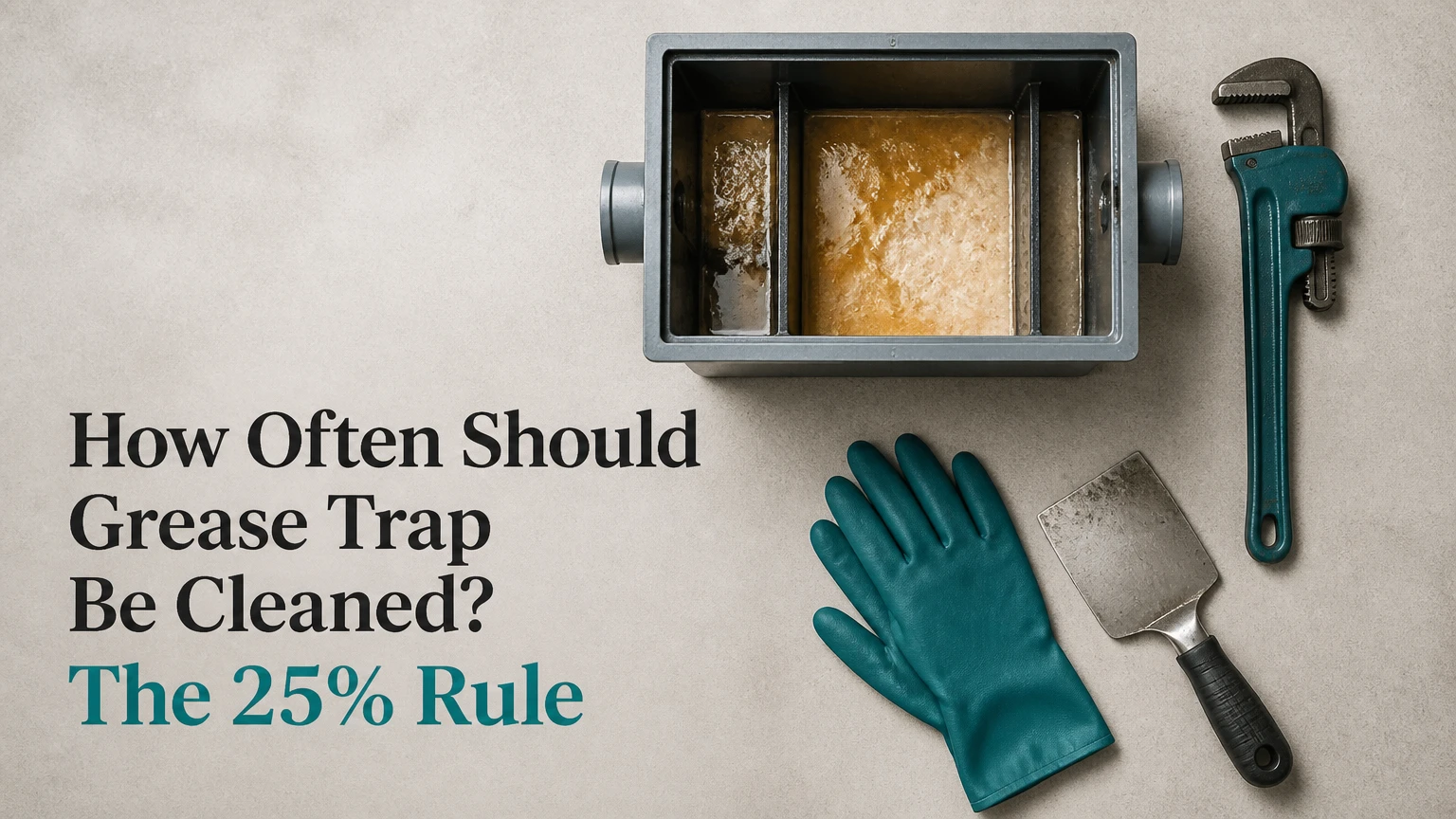
A commercial grease trap should usually be cleaned every 1-3 months, but the correct interval is the earliest of the local legal deadline, the manufacturer’s schedule, or the point when floating grease plus settled solids reaches 25% of the liquid depth. High-volume kitchens may need cleaning weekly or every 2-4 weeks, while a low-volume café may operate safely for 60-90 days.
Key Facts at a Glance
Clean a grease trap before fats, oils, grease, and solids occupy 25% of the trap’s liquid depth.
A high-volume fryer kitchen commonly needs service every 2-4 weeks.
A low-volume café commonly needs service every 60-90 days, subject to local code.
Outdoor grease interceptors usually require professional vacuum pumping, not staff scooping.
The 25% rule is widely used, but local sewer authorities can require a shorter interval.
A complete service removes both the floating grease layer and the settled sludge layer.
How Often Should Grease Trap Be Cleaned?
Most commercial kitchens should begin with a 30-day cleaning schedule, then extend or shorten it after measuring actual grease and solids accumulation. A small under-sink trap serving a fryer, dishwasher, and three-compartment sink can fill in 1-4 weeks; a lightly used café interceptor may remain below the threshold for 60-90 days.
The schedule must follow the strictest applicable requirement. A city sewer-use ordinance may require monthly service, a manufacturer may specify a maintenance interval, and the 25% rule may require earlier cleaning. The phrase “every 90 days” is therefore a common operating ceiling, not a universal permission to wait 90 days.
| Kitchen profile | Typical equipment | Typical cleaning interval | First adjustment to make |
|---|---|---|---|
| Food truck or small kiosk | 5-20 gallon indoor trap | 1-7 days | Measure after the busiest service |
| Fast-food or fryer-heavy restaurant | 20-100 gallon trap or 750-2,000 gallon interceptor | 2-4 weeks | Reduce the interval if frying volume rises |
| Full-service restaurant | 50-100 gallon trap or outdoor interceptor | 4-8 weeks | Inspect solids as well as grease |
| Café, bakery, or deli | 20-50 gallon trap | 60-90 days | Shorten service for heavy dishwashing |
| School, hotel, or hospital kitchen | Large interceptor or multiple units | 2-8 weeks | Coordinate with meal volume and local code |
| Vacant or seasonal kitchen | Isolated trap or interceptor | Inspect before reopening | Pump if water is stagnant or buildup is present |
A practical operator rule is to inspect the first three service cycles. If the combined grease and solids layer reaches 20% after 21 days, schedule service at 21 days rather than waiting for the formal 25% limit. The remaining margin allows for weekend peaks, inaccurate visual estimates, and uneven buildup around baffles.
What Is the 25% or 1/4th Rule?
The 25% rule means a grease interceptor should be serviced when the combined thickness of floating FOG and settled solids reaches one-quarter of the liquid depth, or sooner if local regulations require it. The threshold protects the middle water zone needed for gravity separation, although authorities define measurement details differently.
For example, if the liquid depth is 24 inches, the floating grease layer and bottom solids should total no more than 6 inches. A 4-inch grease layer plus 2 inches of sludge reaches the threshold. Measuring only the top crust produces a false result because bottom sludge also reduces effective capacity.
The rule is associated with grease-control programs, plumbing guidance, and sewer authority inspection practices. It is not a single worldwide statute. The US Environmental Protection Agency describes fats, oils, and grease as a major source of sanitary sewer blockages, but the EPA does not impose one national restaurant cleaning calendar. Cities, counties, water utilities, and sewer districts set their own enforceable requirements.
Some local rules specify a maximum number of days, such as 90 days, even when measured accumulation is below 25%. Other authorities require a licensed transporter, a written maintenance plan, or a specific inspection method. Confirm the rule with the utility that receives the kitchen’s wastewater.
How Does a Grease Trap Work?
A grease trap separates wastewater by reducing flow and allowing lighter FOG to float while heavier food particles settle. The device needs sufficient retention time, working volume, intact baffles, and moderate wastewater temperature to keep grease from passing into the sewer.
Kitchen wastewater enters through an inlet and loses velocity inside the tank. As the water cools, fats and grease become less mobile. Floating material forms the upper layer, solids settle into sludge, and a comparatively clearer middle layer exits through the outlet.
A baffle prevents a direct high-speed path from inlet to outlet. The outlet arrangement also helps prevent the surface grease layer from leaving the tank. When grease and sludge occupy too much space, wastewater has less separation volume and moves through accumulated material, increasing carryover.
The 25% threshold therefore concerns functional capacity, not merely appearance. A trap with a thin surface crust can still be impaired by deep sludge, blocked baffles, or a clogged inlet. Biological additives cannot restore lost volume or repair a failed internal component.
Which Grease Trap Type Changes the Cleaning Schedule?
A small passive trap generally requires more frequent hands-on attention than a large outdoor gravity interceptor, while an automatic grease removal device reduces floating grease accumulation but still requires inspection and solids management. Equipment type changes labor, access, and service method, but kitchen load remains the main variable.
| Equipment type | Common capacity or rating | Usual location | Typical service method |
|---|---|---|---|
| Passive under-sink trap | 10-100 gallons | Under a sink or counter | Staff inspection, complete pump-out, or approved manual cleaning |
| Hydromechanical trap | 7-50 gallons | Indoor near fixtures | Frequent cleaning of basket, baffles, and tank |
| Gravity interceptor | 500-2,000+ gallons | Exterior underground | Licensed vacuum truck pumping |
| Automatic grease removal device | 4-50 gallons, often 10-50 GPM | Indoor mechanical room or kitchen | Automatic skimming plus periodic tank and solids cleaning |
Indoor traps are accessible but often neglected because opening the lid releases concentrated odors. Outdoor interceptors hold more material, yet their buried location makes inspection difficult and creates a risk of unnoticed accumulation. An automatic grease removal device removes floating FOG mechanically, but staff must empty its collection container and maintain electrical and moving components.
When Does an Outdoor Interceptor Need Pumping?
An outdoor grease interceptor commonly needs pumping every 30-90 days, or earlier when combined grease and sludge reaches 25% of liquid depth. A vacuum truck should remove the entire contents, clean the tank walls and baffles, and return the unit to operating condition.
A partial pump-out is inadequate because liquid left behind contains residual grease and sludge. The service provider should inspect inlet and outlet conditions, replace or report damaged covers, and provide a manifest showing date, location, volume removed, destination, and transporter information.
How Do You Set a Grease Trap Cleaning Schedule?
Set a cleaning schedule by measuring accumulation over several operating cycles, then choose the shorter of the measured interval, the legal maximum, and the manufacturer’s instruction. Menu, operating hours, fixture flow, staff practices, and trap sizing determine how quickly FOG and solids accumulate.
Use this calibration process:
- Record the trap size, connected fixtures, service date, and kitchen operating hours.
- Measure grease and sludge after 7, 14, 21, or 30 days, depending on the starting risk.
- Record fryer use, dishwashing volume, catering events, and unusual wastewater discharges.
- Calculate the percentage of liquid depth occupied by surface grease plus bottom solids.
- Schedule service before the measurement reaches 25%.
- Recheck after three cycles and revise the interval using the busiest normal period.
- Keep the service date earlier than any local maximum, even when the measured percentage is low.
A restaurant that usually serves 100 meals can require weekly service during a holiday event, festival, or catering contract. A calendar-only program misses those changes. Measurement converts a generic interval into an operating control.
How Do You Measure Grease and Sludge Depth?
Measure grease and sludge with a calibrated dipstick, sludge judge, or other tool designed for grease interceptors, while following the local utility’s inspection procedure. A simple visual check cannot reliably measure the bottom layer because the liquid may look clear above dense settled solids.
For a basic field check, a trained worker can lower a dipstick through the access opening, identify the grease line, and separately assess the bottom sludge depth using a sludge-measuring device. Avoid pushing a rigid stick through a hardened layer, damaging baffles, or entering the tank.
| Measurement | What it indicates | Example reading | Action |
|---|---|---|---|
| Liquid depth | Total usable wastewater depth | 24 inches | Use as the denominator |
| Floating grease | Surface FOG accumulation | 4 inches | Add to sludge depth |
| Settled solids | Food and organic sludge | 2 inches | Add to grease depth |
| Combined accumulation | Threshold percentage | 6 of 24 inches, 25% | Schedule service immediately |
| Outlet condition | Carryover or blockage risk | Grease at outlet | Request full inspection |
Professional service is preferable for buried interceptors, deep access points, confined spaces, heavy odors, or suspected structural damage. Never climb into or enter a grease interceptor. Toxic gases, oxygen deficiency, and engulfment hazards can kill a person inside the tank.
How Much Does Grease Trap Cleaning Cost?
Typical US grease trap cleaning costs range from about $125-$300 for a small indoor unit and $450-$1,000 or more for a large outdoor interceptor. Price depends on tank capacity, access, region, disposal fees, emergency timing, travel distance, and whether the provider performs only pumping or a full inspection.
These are planning ranges, not fixed prices. A city service contract, rural travel charge, difficult excavation, or after-hours backup can move the invoice substantially.
| Service type | Typical planning range | Typical duration | Main cost driver |
|---|---|---|---|
| Small indoor trap cleaning | $125-$300 | 30-90 minutes | Access and odor-control labor |
| 500-1,000 gallon interceptor | $350-$750 | 1-2 hours | Truck access and disposal volume |
| 1,000-2,000 gallon interceptor | $600-$1,200+ | 1.5-3 hours | Capacity and pumping distance |
| Emergency pump-out | $300-$1,500+ | Same day to several hours | Urgency, blockage, and after-hours labor |
| Downstream hydro-jetting | $300-$900+ | 1-4 hours | Grease hardened in the sewer lateral |
A low quote may cover removal of the floating layer only. Ask whether the price includes complete evacuation, baffle cleaning, tank-bottom removal, disposal documentation, and a written condition report. Repeated partial service can cost more than routine full pumping because grease remains in the tank and outlet line.
Can Staff Clean an Indoor Grease Trap?
Trained staff may clean some small indoor passive traps when local rules, the manufacturer, and the facility’s safety program allow it. Staff should not manually clean a large buried interceptor, enter any tank, handle unknown chemicals, or dispose of grease in a drain or unauthorized waste container.
Before starting, provide:
- Chemical-resistant gloves, eye protection, waterproof apron, and slip-resistant footwear.
- A compatible lid tool, scraper, absorbent pads, solid waste bags, and labeled containers.
- Ventilation and a spill-control plan.
- A maintenance log and a legal disposal route.
- A shutdown period long enough to prevent active wastewater flow.
The service objective is complete removal of floating FOG, liquid waste, settled solids, and wall residue. Do not pour grease back into the drain, use gasoline or solvents, or mix cleaning chemicals.
How Should an Indoor Grease Trap Be Cleaned?
A small indoor grease trap should be isolated from wastewater, opened with protective equipment, emptied completely, cleaned without solvents, reassembled with intact baffles and gasket, and refilled with clean water. The process commonly takes 30-90 minutes, but local disposal rules may require a professional hauler.
- Stop wastewater flow. Close or avoid connected sinks and equipment for at least 30-60 minutes, allowing hot grease to cool.
- Protect the work area. Place absorbent material around the trap, ventilate the room, and keep food-contact equipment away from splash risk.
- Open and inspect the lid. Loosen fasteners carefully, check the gasket, and photograph the internal layout before removing components.
- Remove the floating layer. Scoop surface grease into a sealed, labeled waste container rather than a drain.
- Remove liquid and sludge. Pump or scoop the contents into an approved container, then remove settled solids from the bottom.
- Clean internal parts. Scrape baffles, baskets, walls, and the outlet area using tools that will not damage the unit.
- Wash with approved detergent. Use warm water and a compatible degreasing detergent; never use caustic drain opener, bleach mixtures, gasoline, or solvent.
- Reassemble the trap. Install baffles in their original orientation, tighten the lid evenly, and replace a cracked or flattened gasket.
- Prime with clean water. Fill the trap with clean water before returning fixtures to service. Do not reuse contaminated wastewater.
- Document the service. Record date, cleaner, estimated grease and sludge depth, waste quantity, defects, and next scheduled date.
The success checkpoint is a sealed trap with clean baffles, no visible sludge, an intact gasket, and clean water at the operating level. If the outlet remains slow after cleaning, the downstream line may be blocked and needs a plumber or drain contractor.
What Mistakes Shorten the Cleaning Interval?
The most damaging mistakes are sending solids and hot grease into the trap, removing only the surface layer, and treating chemicals as substitutes for capacity. These practices create downstream blockages even when the trap appears recently cleaned.
- Pouring fryer oil into a sink: Collect used oil in a dedicated container for recycling or approved disposal.
- Using boiling water to chase grease: Hot water can transport liquid FOG beyond the trap, where cooling promotes deposits in the lateral.
- Connecting a garbage disposal: Food grinders add concentrated solids and can overwhelm a small interceptor.
- Skimming only the crust: Bottom sludge continues occupying separation volume.
- Adding enzymes without approval: Biological products do not remove sludge and may violate a sewer authority’s pretreatment rules.
- Rinsing plates before scraping: Scrape food into solid waste first, then use a sink strainer to capture particles.
- Ignoring a damaged baffle: A missing or displaced baffle can create a direct path to the sewer.
- Leaving the lid gasket flattened: Odors and sewer gas can escape even when the tank is otherwise functional.
A useful practitioner rule is to fix the source before shortening the calendar. Scrape plates, use drain screens, keep mop water and restroom fixtures separate, and repair leaking hot-water valves that discharge continuously into the trap.
Why Does a Grease Trap Smell or Back Up?
A grease trap smells when anaerobic decomposition occurs in stagnant FOG and sludge, when the lid gasket leaks, or when the trap remains dirty after a partial cleaning. A backup indicates restricted flow in the trap, inlet, outlet, or downstream sewer lateral and requires prompt water reduction.
| Symptom | Likely location | Immediate response | Required follow-up |
|---|---|---|---|
| Rotten-egg odor at the lid | Trap contents or gasket | Stop unnecessary water use | Full cleaning and gasket inspection |
| Slow sink drainage | Inlet, trap, or outlet | Stop adding grease and solids | Inspect and pump, then test flow |
| Water rising in the trap | Outlet or downstream lateral | Shut down connected fixtures | Plumber or drain contractor |
| Floor drain backup | Main kitchen lateral or sewer | Stop kitchen discharge | Emergency line diagnosis |
| Grease outside the tank | Cracked body, lid, or fitting | Isolate spill area | Repair or replacement assessment |
Do not assume every backup requires hydro-jetting. A full trap may need pumping, while a clean trap with a blocked outlet requires line inspection. Hydro-jetting removes deposits from pipe walls but does not correct an undersized interceptor, poor staff practices, or a failed baffle.
What Records Should a Restaurant Keep?
A restaurant should retain dated service manifests, inspection measurements, invoices, disposal information, repair notes, and the next scheduled service date for the period required by its sewer authority. Three years is a common record-retention period in local programs, but the enforceable period varies by jurisdiction.
A defensible log identifies the facility, trap or interceptor location, capacity, service provider, quantity removed, waste destination, observed defects, and person who performed the inspection. Keep photographs when measurements are disputed or when a baffle, gasket, or cover needs repair.
The National Association of Sewer Service Companies promotes proper FOG management through sewer maintenance practices, while local pretreatment departments provide the controlling requirements. Ask the local water utility for its grease-control ordinance, approved hauler list, inspection form, and retention period before relying on a generic online schedule.
When Is a Grease Trap Too Small?
A grease trap is too small when normal fixture flow, solids loading, or FOG production repeatedly reaches the cleaning threshold before the legally practical service interval. A larger tank may reduce frequency, but it cannot compensate for an incorrectly routed dishwasher, garbage disposal, damaged baffle, or excessive discharge rate.
Review these indicators:
- The trap reaches 25% accumulation in less than one week under normal operation.
- Water enters faster than the trap’s rated flow capacity.
- Several high-flow fixtures discharge simultaneously.
- The kitchen has added fryers, dishwashers, or meal periods since installation.
- The outlet carries visible grease after a complete cleaning.
- Staff cannot access the lid safely for required inspections.
- The interceptor repeatedly causes backups despite documented full pumping.
A plumbing engineer or qualified grease-control professional should review fixture flow rates, pipe sizing, hydraulic capacity, retention time, and local sizing rules. Do not select capacity by gallons alone. A 1,000-gallon interceptor can fail if inlet flow bypasses the intended separation path or if the tank is poorly maintained.
Which Alternatives Reduce Grease Loading?
Source-control practices, used-oil recycling, drain screens, and properly approved automatic grease removal devices reduce grease loading; none eliminates required inspection or service. The best alternative depends on whether the problem is excess FOG, excess solids, limited space, or insufficient interceptor capacity.
| Alternative or control | Primary target | Typical implementation | Limitation |
|---|---|---|---|
| Plate scraping | Food solids | Scrape before rinsing | Does not remove dissolved grease |
| Sink drain screens | Coarse particles | Fit each connected sink | Requires daily emptying |
| Used-oil recycling | Bulk fryer oil | Store oil in sealed containers | Does not control wash water |
| Automatic grease removal device | Floating FOG | Skimmer and collection container | Needs power and daily attention |
| Larger gravity interceptor | Flow and storage | Engineer-sized outdoor tank | Higher installation cost |
| Staff training | Source behavior | Written closing checklist | Requires supervision and auditing |
An automatic device is useful where indoor space prevents a large interceptor, but its collection container must be emptied before overflow. A biological additive may be allowed by one utility and prohibited by another, so written approval matters more than product claims.
What Is the Bottom-Line Schedule?
The safest answer to “how often should grease trap be cleaned” is to inspect frequently, begin with a 30-day schedule, and service the unit before combined grease and sludge reaches 25% of liquid depth. Move to weekly or 2-4 week service for fryer-heavy kitchens, and never allow a local maximum interval to override the measured threshold.
Use the following operating decision:
- Below 20% after inspection: Continue the current schedule and recheck.
- At 20-25%: Shorten the interval and book service before the next peak period.
- At or above 25%: Schedule immediate full cleaning or pumping.
- Slow drainage or backup: Stop unnecessary discharge and arrange urgent diagnosis.
- Repeated early saturation: Investigate sizing, fixture routing, solids control, and staff practices.
A documented, measured schedule protects the sewer line better than a calendar copied from another restaurant. Local code remains the final authority.
Frequently Asked Questions
Can a grease trap go three months without cleaning?
A low-volume café or deli may go 60-90 days between cleanings when measurements remain below 25% and local rules permit that interval. A fryer-heavy restaurant may exceed the threshold within two weeks. Three months is a possible interval for some facilities, not a universal standard.
Should a grease trap be cleaned before or after an inspection?
A grease trap should be measured before routine cleaning when the purpose is to establish accumulation and prove the service interval. After cleaning, document the empty condition, baffle condition, gasket condition, and clean-water level. A regulator may require its own inspection method.
Can grease trap cleaning chemicals replace pumping?
Grease trap chemicals cannot replace complete pumping because they do not remove settled solids, restore tank volume, or repair baffles and blocked pipes. Enzymes and surfactants may also violate local sewer rules. Obtain written utility approval before adding any treatment product.
How long can a restaurant operate with a full grease trap?
A restaurant should stop or sharply reduce connected wastewater discharge when a grease trap is full, reaches the 25% threshold, drains slowly, or backs up. Continued operation can push FOG into the sewer lateral, cause a sanitary blockage, and create cleanup or compliance costs.
Does a dishwasher need its own grease trap?
A dishwasher may need a dedicated or specially sized grease-control connection depending on its discharge temperature, flow rate, detergent use, and local plumbing code. High-temperature discharge can keep grease mobile and increase downstream carryover. A licensed plumber or local authority should approve the connection design.