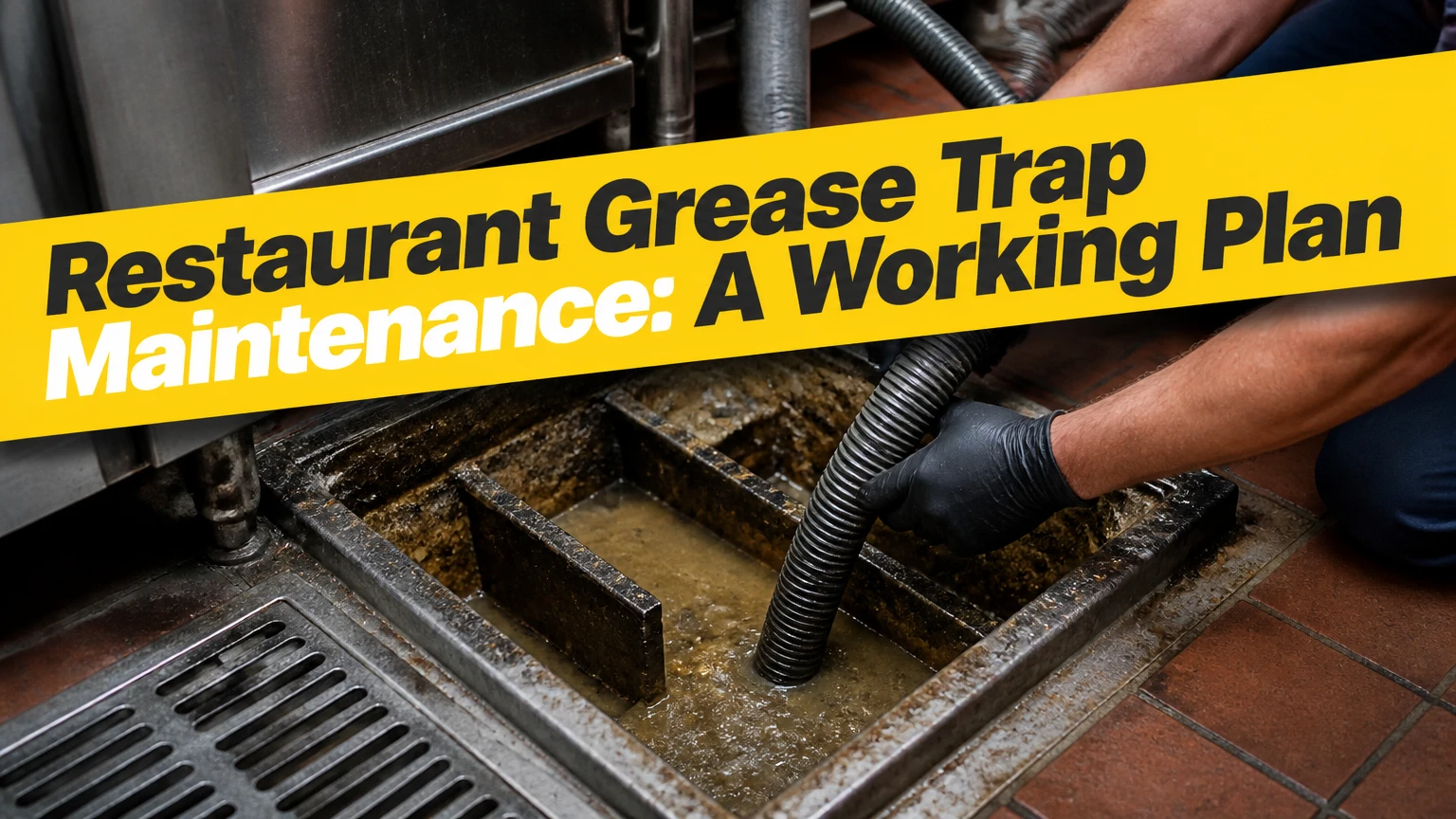
Restaurant grease trap maintenance is the scheduled inspection, cleaning, repair, and documentation of equipment that removes fats, oils, grease, and food solids from commercial kitchen wastewater. A reliable program combines source control with cleaning before the trap is overloaded, while local wastewater rules determine required frequency, records, and disposal.
Key Facts at a Glance
A grease interceptor separates floating FOG from water and settled food solids through gravity, baffles, and controlled flow.
The 25% rule is a common operating benchmark, but the local sewer authority determines the enforceable threshold.
Typical indoor trap service costs $150-$300, while large outdoor interceptor pumping often costs $400-$900 or more.
Scraping food waste into trash before washing equipment can reduce grease loading more effectively than drain additives.
A cleaned indoor trap must be refilled with clean water so its hydraulic seal can function.
A recurring backup after cleaning usually indicates a blocked downstream line, inadequate capacity, damaged baffles, or excessive flow.
What Does Restaurant Grease Trap Maintenance Include?
Restaurant grease trap maintenance includes measuring accumulated grease and solids, removing retained waste, washing accessible surfaces, checking baffles and gaskets, testing flow, repairing defects, and retaining disposal records. Maintenance is complete only when the device can receive wastewater, retain FOG, and discharge without causing a downstream restriction.
A grease trap is usually a smaller hydromechanical unit installed under or near a sink. A grease interceptor is a broader term that includes larger outdoor gravity tanks. Some jurisdictions use “grease trap” for both, so the equipment name on a permit or service record matters more than casual terminology.
Maintenance protects four systems at once: kitchen drainage, the building sewer, the municipal collection network, and the restaurant’s compliance position. A neglected unit can cause slow sinks first, then odor, overflow, line blockage, pest activity, emergency closure, or a wastewater surcharge.
The U.S. Environmental Protection Agency commonly summarizes source control with the direct guidance, “The most effective way to control FOG is to keep it out of the sewer system.” That principle matters because a trap is a capture device, not a license to send unlimited grease into the drain.
How Does a Commercial Grease Trap Work?
A commercial grease trap slows wastewater long enough for density separation to occur. Grease, which is generally less dense than water, rises into a top layer; food solids sink; the middle water layer passes through the outlet while baffles limit the escape of both layers.
Wastewater enters from a sink, floor drain, or approved kitchen fixture. An inlet baffle reduces turbulence, increasing retention time inside the chamber. Floating FOG accumulates above the water, while sludge and food particles settle below it.
A second baffle or outlet tee draws water from the relatively clearer middle zone. The system does not chemically destroy grease. It stores separated material until staff or a licensed hauler removes it.
Excessive discharge can defeat the design. A high-volume dishwasher, multiple fixtures draining simultaneously, or a trap with an undersized flow rating can create turbulence that carries grease through the outlet. A correctly cleaned trap can therefore continue to fail when the hydraulic design is wrong.
Which Grease Trap or Interceptor Type Fits a Restaurant?
The best equipment depends on wastewater flow, menu, available space, local plumbing approval, and access for service. Passive hydromechanical units suit small kitchens, automatic grease removal devices reduce manual skimming where electricity is available, and gravity interceptors handle larger wastewater volumes outside.
| Equipment type | Typical capacity or flow | Normal location | Typical service pattern |
|---|---|---|---|
| Passive HGI | 10-50 gallons per minute | Under or beside a sink | Cleaning every 1-4 weeks |
| Automatic GRD | 15-70 gallons per minute | Indoor service area | Collection container daily, internal cleaning every 2-4 weeks |
| Gravity GGI | 500-5,000+ gallons | Underground exterior tank | Pumping every 1-3 months, subject to loading |
| Large custom interceptor | 1,500-10,000+ gallons | Exterior vault or tank room | Contract pumping and scheduled structural inspection |
Passive hydromechanical interceptors
Passive HGIs are compact boxes with removable lids, baffles, and flow controls. Polyethylene resists many corrosive conditions and is light to handle, while stainless steel offers durability but can still suffer from poor cleaning, gasket failure, or aggressive chemicals.
These units work well for a coffee shop, small café, bakery prep sink, or low-volume sandwich operation. They are poor choices for a fryer-heavy restaurant if the unit receives wastewater from several fixtures and staff cannot clean it frequently.
Automatic grease removal devices
GRDs use a motorized skimmer, heater, timer, or sensor to remove floating grease into a collection container. A GRD reduces manual scooping, but it does not eliminate inspection, sludge removal, baffle checks, or electrical and mechanical maintenance.
A GRD can fit a basement kitchen or food court where excavation is impossible. The owner must verify that local rules approve the device and must keep the collection container from overflowing, because a full container can stop the skimming process.
Gravity grease interceptors
GGIs are large, usually underground tanks made from concrete, fiberglass, or polyethylene. Their capacity supports hotels, hospitals, schools, institutional kitchens, and high-volume restaurants, but pump trucks need safe access to the covers.
Outdoor placement reduces indoor odor exposure. It does not eliminate risk: buried tanks can develop cracked inlet tees, displaced covers, root intrusion, settled piping, or structural deterioration that routine pumping alone will not correct.
Grease Trap Versus Grease Interceptor: What Is the Difference?
A grease trap usually describes a smaller indoor hydromechanical device, while a grease interceptor generally describes a larger device with greater retention volume, often installed outside. Local plumbing and wastewater authorities may use the terms differently, so approval documents and equipment specifications control.
| Decision factor | Passive HGI | Automatic GRD | Gravity GGI |
|---|---|---|---|
| Typical initial equipment cost | $300-$2,000 | $2,000-$10,000+ | $5,000-$25,000+ installed |
| Excavation required | $0 in existing installation | $0 in existing installation | Often $3,000-$20,000 |
| Staff labor | 30-60 minutes per cleaning | 5-15 minutes daily plus deep cleaning | Minimal staff labor |
| Typical service cost | $150-$300 | $100-$300 for service | $400-$900+ |
| Truck access needed | No | No | Usually yes |
| Main failure exposure | Rapid overloading | Motor, heater, or sensor failure | Blocked tees or structural damage |
The least expensive equipment is not always the least expensive system. An undersized indoor trap can require weekly service and repeated line cleaning, while a correctly sized outdoor interceptor may cost more initially but reduce emergency downtime.
How Often Should a Restaurant Clean Its Grease Trap?
A restaurant should clean a grease trap before accumulated floating grease and settled solids reach approximately 25% of the liquid depth, or more frequently when local rules require it. Typical intervals range from weekly for heavily loaded indoor traps to every one to three months for large outdoor interceptors.
The 25% benchmark measures the combined thickness of the grease layer and settled solids against the operating depth, not merely the visible grease on top. Some authorities specify a different threshold, a fixed schedule, a quarterly minimum, or a required pump-out interval.
Use measurement and service history together. A restaurant that reaches 25% in ten days should not wait for a monthly appointment merely because the calendar says monthly.
| Kitchen profile | Typical cleaning interval | Main loading factor | Recommended control |
|---|---|---|---|
| Coffee shop or wine bar | Every 2-4 weeks | Milk, cream, dishwashing | Screen drains and measure monthly |
| Bakery or café | Every 1-3 weeks | Butter, dairy, washdown water | Dry-scrape bowls and pans |
| Full-service diner | Weekly to every 2 weeks | Dish volume and sauces | Inspect after peak weekends |
| Fryer-heavy or barbecue kitchen | Weekly or more often | Oil, meat fat, solids | Pump by measurement, not habit |
| Large institutional kitchen | Every 1-3 months | Multiple fixtures and flow | Use a documented hauling contract |
What changes the schedule?
Menu, fixture count, water temperature, dishwasher discharge, tank size, employee habits, and seasonal volume all change the interval. A new fryer, catering program, or second shift can double grease loading without changing the trap itself.
Track the date, measured grease and solids depth, gallons removed, unusual findings, disposal destination, technician, and next recommended service date. Three consecutive records provide a better schedule baseline than a generic monthly appointment.
How Much Does Grease Trap Maintenance Cost?
Typical restaurant grease trap maintenance costs $150-$300 for an indoor unit and $400-$900 or more for an outdoor gravity interceptor pump-out. Emergency drain cleaning, hydro-jetting, traffic control, difficult access, after-hours work, and disposal surcharges can increase the total substantially.
| Service | Typical price | Typical duration | Cost drivers |
|---|---|---|---|
| Indoor trap pump or cleanout | $150-$300 | 30-60 minutes | Size, access, waste volume |
| Outdoor interceptor pump-out | $400-$900+ | 1-2 hours | Gallons, hose distance, access |
| Hydro-jetting downstream line | $500-$1,500 | 1-4 hours | Pipe length, blockage severity |
| Emergency overflow response | $300-$1,500+ | Same day or overnight | Labor, containment, disposal |
| Lid, gasket, or baffle repair | $50-$1,500+ | 30 minutes to 1 day | Part availability and tank damage |
A low quote may exclude disposal documentation, water removal, baffle cleaning, or a written condition report. Request an itemized quote that states pumping volume, included inspection, disposal method, travel charges, and emergency rates.
How Do You Clean a Small Indoor Grease Trap?
Small indoor grease traps can be cleaned by trained staff when local rules permit, the unit is accessible, and the waste can be legally contained. The job typically takes 30-60 minutes and requires gloves, eye protection, absorbent material, a scraper, a lidded waste container, and a way to measure the grease layer.
Before you start
- Schedule work when food preparation has stopped.
- Wear chemical-resistant gloves, eye protection, waterproof footwear, and protective clothing.
- Keep absorbent pads, a scraper, bucket, disposable bags, and clean water nearby.
- Do not use a household wet vacuum unless the equipment is approved for contaminated waste.
- Confirm whether a licensed hauler must remove the contents.
Step 1: Isolate and open the unit
Stop sink use and remove the lid carefully without bending it. Inspect the lid, fasteners, gasket, inlet, outlet, and visible baffles before disturbing the contents.
You will know the opening is safe when the lid is stable, the surrounding floor is protected, and no damaged fitting can fall into the chamber. A common mistake is forcing a seized lid and cracking the tank or gasket.
Step 2: Measure and record the contents
Use a grease dipstick or marked rod to measure the floating grease and bottom sludge layers. Record the readings, date, trap identification, and employee or contractor responsible.
A useful checkpoint is a complete measurement before removal. Skimming first can hide the actual loading level and weaken the record needed for schedule decisions.
Step 3: Remove grease and solids
Skim the top layer into a sealed, compatible container, then remove settled solids from the bottom with a scraper or scoop. Keep food waste, wastewater, and recovered cooking oil separated when the disposal contractor requires separate streams.
Do not pour liquid grease into a floor drain or trash container that can leak. The trap is clean enough for the next step when no thick floating mat or compacted bottom sludge remains.
Step 4: Clean baffles and interior surfaces
Remove serviceable baffles according to the manufacturer’s instructions and scrape accumulated material into the waste container. Wash accessible walls with warm water and a brush, avoiding solvents, drain opener, and concentrated caustic chemicals.
The checkpoint is a clear inlet, outlet, and baffle path. Do not scrape aggressively against a brittle plastic fitting, because a small crack can become a large leak during service.
Step 5: Reassemble and refill
Replace damaged gaskets, reinstall baffles in their original orientation, secure the lid, and fill the trap completely with clean water. Water restores the hydraulic seal and allows the device to separate incoming wastewater correctly.
The job is complete when the lid does not leak, the trap remains full, and the sink drains without gurgling. Record parts replaced and the next measurement date.
When Should a Professional Pump an Outdoor Interceptor?
A professional should pump an outdoor interceptor when the grease and sludge approach the local limit, when access covers require heavy equipment, when the tank holds hundreds of gallons, or when the restaurant has experienced a backup. Commercial pumping removes the entire liquid, grease, and sludge mixture rather than merely skimming the surface.
A typical service sequence is:
- Locate and safely open all access covers.
- Measure the tank and inspect inlet and outlet conditions.
- Vacuum the full contents into the pump truck.
- Wash accumulated scale from walls and baffles when appropriate.
- Inspect tees, covers, seals, and tank structure.
- Refill or verify water levels as the design requires.
- Obtain a manifest showing gallons removed and disposal destination.
Hydro-jetting is not automatically part of every pump-out. Jetting is appropriate when downstream lines contain hardened FOG or scale, but excessive pressure can damage fragile pipes or force debris toward a public sewer connection.
Which Maintenance Mistakes Cause the Most Trouble?
The most damaging mistakes are sending grease to the drain, relying on additives instead of removal, cleaning without measuring, and failing to investigate repeat symptoms. These practices can create a clean-looking trap while grease remains in the building sewer.
- Pouring boiling water into drains: Hot water can temporarily mobilize grease, allowing it to cool and deposit farther downstream.
- Using chemical drain openers: Solvents and caustic products can damage gaskets, metal, concrete, and wastewater treatment processes.
- Treating enzymes as a replacement for pumping: Biological products may reduce odor in some systems, but they do not remove accumulated solids and may conflict with local rules.
- Ignoring source control: Food scraps, fryer oil, dairy residue, and sauces should enter trash or approved recovery containers, not the sink.
- Leaving the unit empty after cleaning: A dry trap loses its water seal and can allow sewer odors into the kitchen.
- Keeping no records: Missing manifests and measurements make it difficult to prove compliance or identify a worsening load pattern.
A practitioner’s rule is simple: if a product claims to make pumping unnecessary, treat the claim as a warning. Physical accumulation still needs physical removal.
How Can a Restaurant Prevent Grease Backups?
A restaurant prevents grease backups by controlling FOG at each fixture, limiting solids, maintaining the trap, and inspecting the downstream line when symptoms recur. Prevention begins before wastewater reaches the interceptor and costs less than emergency extraction, sanitation, and lost service.
Use the following operating controls:
- Dry-scrape plates, pans, and fryer equipment into waste containers.
- Store recovered fryer oil in a sealed rendering or recycling container.
- Install and clean drain screens at food-preparation sinks.
- Keep mop water, paint, chemicals, and construction debris out of grease fixtures.
- Do not connect restroom, stormwater, or unrelated high-flow lines to the interceptor.
- Train opening and closing staff to identify odors, slow drainage, and missing baffles.
- Compare water-flow changes after installing a dishwasher or new kitchen fixture.
- Review service records after menu changes, holidays, and catering increases.
Dishwashers deserve special attention because their discharge can be hot and high volume. The wastewater may carry grease through a small trap before separation occurs, even when the unit appears clean.
What Do Odors, Slow Drains, and Overflow Mean?
Odors usually indicate a dry seal, failed gasket, accumulated waste, blocked vent, or inadequate cleaning; slow drains indicate restriction, overloading, or excessive flow; and an overflow requires immediate source isolation and professional assessment. Symptoms identify the system problem, not always the trap alone.
| Symptom | Likely cause | Immediate response | Escalation point |
|---|---|---|---|
| Rotten-egg odor indoors | Dry seal, lid gasket, blocked vent | Refill trap and inspect gasket | Plumber if odor persists |
| Slow sink drainage | Full trap or downstream FOG blockage | Stop grease discharge and measure | Drain contractor if cleaning fails |
| Grease beyond outlet | Missing baffle or excessive flow | Inspect baffles and flow rating | Licensed plumber for redesign |
| Outdoor overflow | Full interceptor or blocked outlet | Stop fixtures and isolate area | Pump truck immediately |
| Repeated backup after pumping | Downstream scale, roots, damaged pipe | Request camera inspection | Plumbing repair or jetting |
| Crumbling concrete | Structural deterioration or corrosion | Restrict use and document damage | Tank specialist or replacement |
Never hose an overflow into a storm drain or public area. Contain the material, protect food-contact surfaces, notify the responsible manager, and follow the local wastewater authority’s spill procedure.
A recurring backup is an information signal. Repeatedly pumping the same tank without checking the building sewer can waste money while the actual blockage remains in place.
How Should You Choose a Grease Trap Service Provider?
Choose a service provider that can document legal disposal, provide itemized invoices, inspect the equipment, respond within the restaurant’s risk window, and explain findings in measurable terms. The cheapest pump-out is unsuitable if it leaves sludge, omits manifests, or cannot access the full interceptor.
Ask these questions before signing:
- Is the company licensed or registered where local law requires it?
- Does the quoted service remove the entire tank contents?
- Will the invoice state gallons pumped and disposal destination?
- Are baffle, gasket, tee, and cover inspections included?
- Does the provider offer emergency response during operating hours?
- Are hydro-jetting and line inspection priced separately?
- Can the company recommend a schedule based on measured accumulation?
- Does the contract address missed appointments, access problems, and after-hours charges?
A useful contract defines service frequency but also permits earlier visits when measurements exceed the limit. Fixed calendar pumping without measurement can under-service a busy kitchen or over-service a low-volume one.
What Should Different Restaurants Do?
Low-volume cafés should prioritize compact equipment and consistent staff cleaning, while high-volume kitchens should use measured professional pumping and verify hydraulic capacity. Space, menu, and discharge volume determine the practical answer more reliably than restaurant seating count.
| Restaurant situation | Likely equipment fit | Starting maintenance plan | Main warning |
|---|---|---|---|
| Coffee shop, 20-40 covers | 20-35 GPM passive HGI | Measure monthly, clean every 2-4 weeks | Milk and grounds still create solids |
| Bakery with dough and dairy | 20-50 GPM HGI or approved GRD | Scrape mixers, inspect weekly | Flour solids can settle rapidly |
| Fryer-heavy fast food | Large HGI, GRD, or GGI | Weekly measurement and frequent removal | Oil volume can overwhelm small units |
| Full-service barbecue restaurant | 1,500-2,500 gallon GGI | Professional monthly or bi-monthly pumping | Meat fat and washdown increase loading |
| Basement or food-court kitchen | Approved GRD or indoor HGI | Daily container check, scheduled deep cleaning | Electrical failure can stop removal |
| Seasonal operation | Sized interceptor with adjustable schedule | Measure before peak season and after it | Holiday volume invalidates old intervals |
A GRD is not automatically the best confined-space solution. It needs power, replacement parts, trained operators, and an approved discharge arrangement. A passive unit may be more reliable when staff can access and clean it consistently.
FAQ
Can restaurant employees clean a grease trap?
Employees can often clean a small indoor trap if the owner, manufacturer, and local authority permit staff service. Employees should not pump large underground interceptors or transport regulated waste without the required equipment and authorization. Training must cover protective equipment, containment, measurement, reassembly, water refilling, and recordkeeping.
Can enzymes replace grease trap pumping?
Enzymes cannot replace grease trap pumping. Biological additives may help with limited odor control in systems where the wastewater authority allows them, but they do not remove settled solids or guarantee that FOG will not accumulate downstream. Mechanical removal remains necessary when the trap reaches its measured service limit.
What happens after a grease trap overflows?
Stop using connected fixtures, isolate the affected area, contain the spill, protect food and equipment, and call the appropriate pump or plumbing contractor. Do not wash grease into a storm drain. After cleanup, identify whether the cause was a full tank, blocked outlet, failed baffle, inadequate capacity, or downstream sewer restriction.
Should a restaurant connect a dishwasher to a grease trap?
A dishwasher should connect to a grease trap only when the approved plumbing design and interceptor flow rating can handle its discharge. High temperature and rapid flow can reduce separation performance. Confirm fixture connections with the plumbing designer and wastewater authority before adding or rerouting a commercial dishwasher.
How long does a grease trap cleaning take?
An indoor grease trap cleaning typically takes 30-60 minutes, while an accessible outdoor interceptor pump-out usually takes 1-2 hours. Difficult covers, long hose runs, hardened deposits, blocked lines, traffic controls, and post-cleaning repairs can extend the appointment considerably.
When should a restaurant replace its grease interceptor?
Replace an interceptor when structural cracks, failed tees, chronic leakage, inadequate capacity, inaccessible covers, or repeated backups make repair uneconomical. A replacement assessment should include actual flow, fixture connections, menu loading, local approval requirements, excavation cost, and at least twelve months of service records.
The Bottom Line
Restaurant grease trap maintenance works when the kitchen keeps FOG and solids out of drains, measures accumulation, cleans before the applicable limit, and documents every service. Use the 25% level as a common benchmark rather than assuming it is universal, and confirm the enforceable schedule with the local wastewater authority.
For a small indoor trap, train staff to clean safely and refill the unit with water. For a large outdoor interceptor, use a qualified pump contractor who removes the full contents, checks the tees and structure, and supplies disposal records. If slow drains or odors return soon after cleaning, investigate flow, baffles, vents, and downstream piping instead of simply scheduling another pump-out. A documented, measurement-based restaurant grease trap maintenance program prevents more failures than emergency cleaning alone.