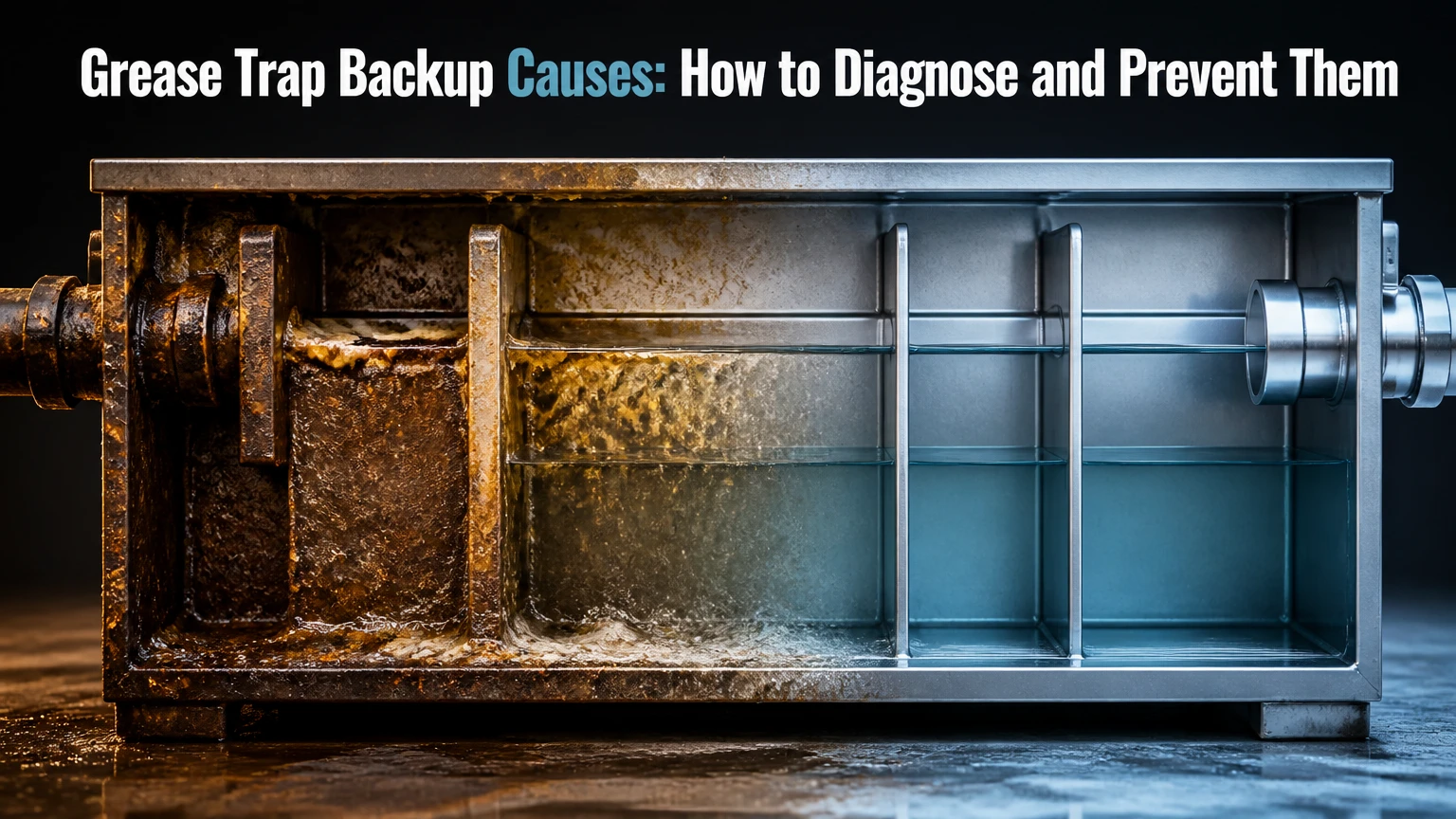
Grease trap backup causes usually fall into four locations: an overfilled interceptor, a blocked outlet baffle, a clogged pipe downstream, or an obstruction before the trap. Excess fats, oils, grease, food solids, undersized equipment, hot discharge, and missed pumping allow wastewater to reverse into sinks and floor drains.
Key Facts at a Glance
- A grease interceptor separates floating FOG, clarified wastewater, and settled solids by reducing flow velocity.
- A full trap can back up even when the connected sinks and drain lines are clear.
- A normal-looking trap with rising water usually indicates a blockage between the interceptor and the building sewer or public sewer.
- The 25% grease-and-solids benchmark is widely used for scheduling service, but local plumbing codes may impose different limits.
- Hot water can carry liquefied grease beyond the interceptor, where cooling turns the grease into a downstream blockage.
- Chemical degreasers and emulsifiers often move FOG deeper into the sewer instead of removing it from the system.
What Causes a Grease Trap to Back Up?
A grease trap backs up when wastewater cannot pass through the interceptor at its designed rate. The restriction may come from accumulated grease, settled food solids, a blocked baffle, a clogged connecting pipe, inadequate capacity, or a downstream sewer obstruction.
A commercial grease trap, also called a hydromechanical grease interceptor in smaller installations, must slow wastewater long enough for materials with different densities to separate. FOG floats, heavy solids settle, and the water layer exits through the outlet. When grease or sludge consumes too much working volume, the separation zone becomes ineffective and the outlet can close.
The most frequent operational cause is delayed cleaning. A restaurant may experience a backup after weeks of normal drainage because grease accumulation reduces usable volume gradually, then blocks the outlet abruptly. A second common cause is a downstream blockage that has no direct connection with the amount of grease currently visible inside the tank.
How Does a Grease Interceptor Separate Waste?
A grease interceptor separates waste by reducing hydraulic velocity and retaining wastewater inside a baffled chamber. Floating FOG remains near the surface, solids settle at the bottom, and partially clarified water travels beneath or through an outlet baffle toward the sewer.
The process only works within a designed flow range. A sudden discharge from a dishwasher, a large sink, or several fixtures at once can carry grease and solids through the tank before separation occurs. An interceptor also loses performance when inlet and outlet baffles are missing, reversed, cracked, or buried under accumulated material.
Gravity interceptors generally provide more retention volume than under-sink units. Neither type can compensate for food scraps, excessive flow, or a blocked building sewer.
Grease Trap Backup Causes by Failure Location
The most useful first question is where the restriction sits. A short inspection can often distinguish an upstream fixture clog from a full interceptor or a downstream sewer blockage, although opening an outdoor interceptor may require a licensed plumber or grease-service technician.
| Failure location | Typical symptom | First diagnostic action | Common repair |
|---|---|---|---|
| Sink-to-trap pipe | One sink drains slowly; trap level remains normal | Check the trap inlet and run a fixture test | Mechanical cable or pipe cleaning |
| Trap interior | Multiple connected fixtures back up; tank contains thick FOG or sludge | Inspect tank level and baffles | Pump-out, scraping, and baffle cleaning |
| Trap outlet | Water remains high inside the interceptor | Compare static water level with outlet elevation | Outlet-line cleaning or jetting |
| Building sewer | Several drains back up, often with odors | Inspect downstream cleanout and use a camera | Hydro-jetting, repair, or pipe replacement |
| Public sewer connection | Backup continues after private lines are clear | Contact utility and document flow conditions | Municipal investigation or coordinated repair |
| Structural defect | Repeated backups after cleaning; cracked tank or shifted pipe | Camera inspection and tank examination | Resealing, excavation, or replacement |
Why Does an Overfilled Trap Cause Reverse Flow?
An overfilled trap causes reverse flow because grease and sludge reduce the open cross-sectional area available for wastewater. The remaining passage cannot accept incoming discharge, so water rises to the lowest upstream fixture and exits through sinks, floor drains, or cleanouts.
The 25% rule commonly refers to grease plus settled solids occupying approximately one-quarter of the liquid depth or tank capacity, depending on the local standard and measurement method. It is a practical service trigger, not a universal engineering law. Some jurisdictions specify pumping at 25%, while others use a shorter interval, a different depth measurement, or a maximum scum-and-sludge thickness.
A trap can fail before reaching that threshold if its outlet baffle is obstructed or if the incoming flow exceeds its rated capacity. Conversely, a large gravity interceptor may continue passing water after visible accumulation exceeds a preferred maintenance threshold, while already sending FOG into the sewer.
How Does an Outlet Baffle Block the System?
An outlet baffle blocks a grease trap when floating FOG, paper, or settled solids cover the baffle opening and prevent clarified water from leaving. Grease may also harden around the outlet pipe, especially after cooling or chemical treatment.
Baffles control the direction and depth of flow. They are not decorative dividers. An inverted outlet tee normally draws water from below the grease layer, while an inlet baffle disperses incoming flow and reduces turbulence. A missing or reversed baffle allows floating grease to escape, causes short-circuiting, or makes the tank fill faster than expected.
Technicians should verify orientation against the manufacturer’s diagram. Cleaning personnel who reinstall a removable baffle backward can create an immediate backup even after pumping.
Why Hot Water, Food Solids, and Chemicals Create Blockages
Hot discharge, food particles, and cleaning chemicals affect different parts of the grease system. Hot water transports FOG farther downstream, food particles consume settling capacity, and emulsifiers disperse grease temporarily so it can redeposit in colder pipes.
Commercial dishwashers commonly discharge water around 140°F or higher, depending on the model and sanitation cycle. Heat liquefies many fats, but it does not eliminate them. When the effluent cools in a building sewer, the grease adheres to pipe walls and combines with solids.
Saponification is another possible mechanism. Fatty acids can react with alkaline materials and calcium-rich deposits, producing hard soap-like masses. The exact chemistry depends on the grease type, cleaning product, water chemistry, temperature, and pipe conditions. A hardened blockage may require mechanical removal or hydro-jetting rather than ordinary snaking.
What Happens When a Garbage Disposal Feeds the Trap?
A garbage disposal sends finely ground food solids into the grease interceptor, where the particles settle and occupy the sludge zone. The result is less liquid retention, faster accumulation, more frequent pumping, and a greater chance that solids will enter the outlet line.
Many commercial plumbing authorities restrict or prohibit routing food waste through a grease interceptor. A disposal can also disguise the problem because small particles pass through strainers and accumulate gradually. A better control is scraping plates into waste or organics collection before washing, followed by a removable sink strainer sized for the fixture.
Enzymes and biological additives do not substitute for removing grease and solids. Products that claim to digest FOG may reduce odors or alter short-term flow, but they cannot restore lost tank volume or repair a blocked sewer.
Does a Grease Trap Need Hot or Cold Water?
A kitchen should avoid using very hot water as a grease-management strategy. Warm water is needed for sanitation and normal washing, but prolonged high-temperature discharge can carry liquefied FOG beyond the interceptor.
The practical control is source reduction. Scrape pans, wipe plates with disposable towels where permitted, collect fryer oil separately, and keep solid debris out of floor drains. Follow the dishwasher manufacturer’s sanitation requirements rather than lowering temperatures unsafely.
The U.S. Environmental Protection Agency describes FOG as a material that can build up in sewer pipes and cause blockages and overflows. That guidance supports a simple operational distinction: heat may improve temporary fixture flow, but it does not remove FOG from the wastewater system.
Which Grease Trap Type Is Most Prone to Backup?
Small hydromechanical units are generally most sensitive to missed cleanings and sudden flow surges because they hold less grease and solids. Large gravity interceptors have more storage volume, but they still back up when pumping is delayed, the outlet line is blocked, or the tank is incorrectly sized.
| Interceptor type | Typical capacity | Typical location | Typical service pattern | Main backup exposure |
|---|---|---|---|---|
| Hydromechanical interceptor | 10-75 gallons per minute | Under sink or recessed floor | Every 1-4 weeks | Small storage volume |
| Gravity grease interceptor | 750-5,000+ gallons | Outdoor underground tank | Often every 30-90 days | Delayed pumping or outlet blockage |
| Automatic grease removal device | 15-50 gallons per minute | Near pot sink | Daily solids and oil checks; quarterly deep cleaning | Mechanical or electrical failure |
| Passive floor interceptor | 20-100 gallons | Indoor floor recess | Weekly to monthly inspection | Poor access and heavy solids |
Capacity figures are typical operating ranges, not universal specifications. The correct size depends on fixture flow, drainage fixture units, retention time, local code, kitchen menu, peak discharge, and whether food solids enter the system.
Automatic grease removal devices can reduce routine pumping volume, but they are not maintenance-free. Their screens, heaters, skimmers, motors, and sensors require inspection. A neglected automatic unit can produce the same downstream failure as a neglected passive trap.
How Can You Tell Where the Blockage Is?
A static-level test provides the clearest first distinction. If no fixtures are running and the interceptor water level is unusually high or above the outlet, the restriction is probably at the outlet or downstream; if the tank level is normal but a sink backs up, the obstruction is more likely upstream.
Use this diagnostic sequence:
- Stop water use at every connected fixture.
- Check whether one fixture or several fixtures are affected.
- Inspect an accessible cleanout without entering the tank or excavation.
- If trained and authorized, compare the interceptor’s liquid level with the outlet pipe.
- Run a brief, low-volume fixture test while observing flow.
- Arrange a camera inspection when cleaning does not restore drainage.
| Observation | Most likely location | Confidence | Next action |
|---|---|---|---|
| One sink backs up, other fixtures drain | Upstream branch | High | Snake or inspect branch line |
| All sinks back up, trap full of grease | Interceptor interior | High | Pump and clean interceptor |
| Trap water remains high at rest | Outlet or downstream line | High | Clear outlet and inspect sewer |
| Trap appears clean, recurring backup persists | Undersized system or structural defect | Medium | Flow assessment and camera |
| Backup follows heavy rain | Infiltration or municipal surcharge | Medium | Check cleanouts and utility conditions |
| Odor without slow drainage | FOG accumulation or dry trap seal | Medium | Inspect, clean, and verify trap seal |
Never enter a grease interceptor. Tanks may contain hydrogen sulfide, methane, oxygen-deficient air, and biological waste. OSHA’s permit-required confined-space rules can apply to tanks and vaults, and atmospheric testing alone does not make an untrained person qualified to enter.
What Should You Do During an Active Backup?
During an active backup, stop wastewater production, isolate contaminated areas, and call a qualified grease-service or plumbing contractor. Do not keep flushing fixtures, pour caustic chemicals into the system, or remove a heavy interceptor cover without suitable lifting equipment.
Immediate Response Steps
- Stop dishwashing, food preparation, ice-machine discharge, and mop-sink use.
- Keep staff away from sewage-contaminated water and use gloves, eye protection, and waterproof footwear.
- Prevent wastewater from reaching food, chemicals, electrical equipment, and public walkways.
- Photograph the liquid level, affected drains, and equipment condition for records.
- Contact the grease hauler, plumber, property manager, and sewer utility as appropriate.
- Arrange cleaning and disinfection according to local health requirements.
A sewage backup is a contamination event, not merely a slow drain. Porous flooring, cardboard, stored food packaging, and exposed equipment may require disposal or professional remediation. Electrical circuits near standing water should be isolated by qualified personnel, not by staff working in the contaminated area.
How Much Do Grease Trap Cleaning and Repairs Cost?
Typical professional service costs range from $150-$400 for an indoor manual trap cleaning and $400-$1,200 or more for an outdoor gravity interceptor pump-out. Downstream hydro-jetting commonly costs $500-$1,500 for an emergency visit, while excavation or interceptor replacement can increase the project cost substantially.
| Service or project | Typical time | Typical cost | Cost driver |
|---|---|---|---|
| Indoor trap cleaning | 30-45 minutes | $150-$400 | Access, volume, disposal |
| Outdoor interceptor pumping | 1-2 hours | $400-$1,200+ | Tank size and hauling distance |
| Sewer camera inspection | 1-2 hours | $250-$700 | Access and recording requirements |
| Main-line hydro-jetting | 1.5-3 hours | $500-$1,500+ | Grease hardness and pipe length |
| Baffle repair or replacement | 1-3 hours | $200-$1,000 | Material and access |
| Interceptor replacement | 1-3 days | $6,000-$20,000+ | Excavation, permits, capacity |
These are typical U.S. commercial ranges, not guaranteed quotes. Disposal fees, after-hours labor, local permits, traffic control, tank depth, and emergency access can change the final invoice.
A low cleaning price may exclude transportation, waste disposal, baffle scraping, or documentation. Ask whether the service includes pumping the bottom solids, removing the grease layer, rinsing the walls, inspecting baffles, and providing a manifest or service report.
How Often Should a Commercial Grease Trap Be Cleaned?
A commercial grease trap should be cleaned before grease and solids reach the local regulatory threshold or before the trap loses reliable flow capacity. Typical intervals range from every 1-4 weeks for small under-sink units and every 30-90 days for large outdoor interceptors.
| Facility profile | Typical interceptor | Starting service interval | Trigger to shorten interval |
|---|---|---|---|
| Office breakroom | 10-20 GPM HGI | Every 4-8 weeks | Frequent catering or oily food |
| Small cafe | 15-35 GPM HGI | Every 2-4 weeks | Milk, fryer, or breakfast volume |
| Burger or fried-food kitchen | 750-1,500 gallon GGI | Every 30-60 days | Thick scum or heavy sludge |
| Wok or high-oil restaurant | 1,000-3,000 gallon GGI | Every 30-45 days | Peak service surges |
| Food court or shared facility | 3,000+ gallon GGI | Every 30-60 days | Uneven tenant loading |
The first schedule should be treated as a measured baseline. Record pump-out dates, grease depth, solids depth, menu changes, peak flow, odors, and backup incidents. After three or four service cycles, adjust the interval so the tank is cleaned before accumulation reaches the governing limit.
The phrase “every 90 days” is not a universal legal standard. Local sewer authorities may require more frequent service, written manifests, annual inspections, or specific sampling and maintenance records.
When Should You Repair or Replace the System?
Repair is appropriate when the tank remains structurally sound and the failure comes from a blocked line, damaged baffle, missing gasket, or inadequate maintenance. Replacement becomes more reasonable when the interceptor is cracked, undersized, inaccessible, corroded, repeatedly bypassing, or incompatible with the kitchen’s peak flow.
A cleaned tank that backs up again within days needs investigation rather than another routine pump-out. Possible explanations include an obstructed outlet, collapsed building sewer, root intrusion, displaced pipe, excessive hydraulic loading, or a tank installed below the required capacity.
Replacement decisions should include a hydraulic calculation. Count connected fixtures, calculate peak discharge, review the kitchen menu, identify dishwasher flow, and check local plumbing and wastewater requirements. A larger tank does not solve a collapsed outlet pipe, and an automatic device does not solve poor solids control.
What Practices Prevent Recurring Backups?
The most effective prevention program combines source control, scheduled cleaning, flow management, and documented inspections. Pumping alone is insufficient when staff continue sending fryer oil, food scraps, and excessive discharge into the drainage system.
Use the following controls:
- Scrape plates and pans before washing.
- Keep fryer oil in a dedicated collection container.
- Install removable strainers on pot sinks and pre-rinse fixtures.
- Keep garbage disposals out of the grease line unless the authority specifically permits them.
- Avoid using drain chemicals, emulsifiers, and unapproved additives.
- Spread high-volume discharges when operations allow.
- Inspect baffles after every accessible cleaning.
- Maintain service logs with grease depth and solids depth.
- Train new employees during onboarding and after menu changes.
- Keep cleanouts accessible and label the grease-line route.
A counterintuitive maintenance rule is that a trap can look clean at the top while carrying a dangerous bottom sludge load. Technicians should measure or remove settled solids rather than judging condition from surface appearance alone.
Another practitioner rule is to shorten the cleaning interval after a menu change. Adding frying, wok cooking, barbecue, or high-volume catering can change FOG loading faster than historical schedules reveal.
Facility-Specific Prevention Plans
Small Cafe or Breakroom
A small cafe commonly fits a 15-35 GPM hydromechanical interceptor, but fixture flow and local code determine the final specification. Begin with cleaning every 2-4 weeks, a dry-wipe policy, and a 1/8-inch to 1/4-inch removable sink strainer where permitted.
The main failure risk is limited storage. Staff should inspect the unit weekly, record grease thickness, and report slow drainage immediately. A small interceptor is not suitable for a high-volume fryer line merely because it fits under the sink.
High-Grease Restaurant
A burger, fried-food, or wok kitchen usually needs a larger gravity interceptor or a properly sized automatic grease removal device. Start with 30-60 day pump-outs for a gravity unit, then adjust according to measured accumulation and local requirements.
Use dedicated fryer-oil recovery, pre-rinse strainers, and separate solids collection. Dishwashers should discharge through the approved drainage design, but operators should not rely on high temperature to dissolve FOG.
Multi-Tenant Food Court
A shared food court needs a loading assessment for every tenant, not an assumption that a central tank is adequate. A 3,000-gallon or larger gravity interceptor may provide useful capacity, but uneven tenant behavior can fill the system faster than the property manager expects.
The operator should assign responsibility for cleaning costs, require tenant maintenance logs, inspect shared cleanouts, and consider level monitoring. An ultrasonic sensor can provide an alert, but sensor data does not replace physical inspection when grease coats the probe or solids settle unevenly.
FAQ
Can a grease trap back up after it was just cleaned?
Yes. A recently cleaned grease trap can back up because the outlet line, building sewer, or upstream branch remains blocked. A reversed baffle, collapsed pipe, undersized interceptor, or municipal surcharge can also cause an immediate recurrence. Check static water level and obtain a camera inspection if a second backup follows cleaning.
Why does only one kitchen sink back up?
One kitchen sink usually backs up because its branch pipe or strainer is obstructed before the shared grease interceptor. Food particles, hardened grease, paper, or a poorly sloped line can restrict that branch. If other fixtures drain normally and the interceptor level is normal, start with the affected branch rather than pumping the entire tank.
Can bleach unclog a grease trap?
Bleach does not remove accumulated grease or settled solids from a grease trap. Bleach may reduce some surface odors, but it cannot restore tank capacity and can create hazardous chemical exposure when mixed with other cleaners. Physical removal, approved pumping, and line cleaning are the appropriate controls.
Does rain cause a grease trap backup?
Rain can coincide with a backup when stormwater enters damaged private sewer lines, groundwater infiltrates a defective interceptor, or the public sewer becomes surcharged. Stormwater should not enter a sanitary grease system. Inspect covers, seals, cleanouts, and buried lines when backups occur only during heavy rainfall.
How do I know whether the city sewer is blocked?
A city sewer may be involved when private fixtures, the interceptor, and the building sewer are clear but wastewater continues to rise, or when neighboring properties report simultaneous backups. A plumber’s camera report and utility investigation can distinguish a private lateral defect from a public-main obstruction.
The Bottom Line
The main grease trap backup causes are excessive FOG accumulation, settled food solids, blocked baffles, hot grease transport, undersized equipment, and obstructions in upstream or downstream pipes. Stop water use first, identify the blockage location with a static-level and fixture test, and use professional pumping or line cleaning rather than chemicals.
Prevent recurrence by scraping food waste, collecting fryer oil separately, controlling dishwasher discharge, inspecting baffles, and scheduling service before grease and solids reach the applicable threshold. The correct cleaning interval depends on tank type, capacity, kitchen menu, peak flow, and local wastewater rules.