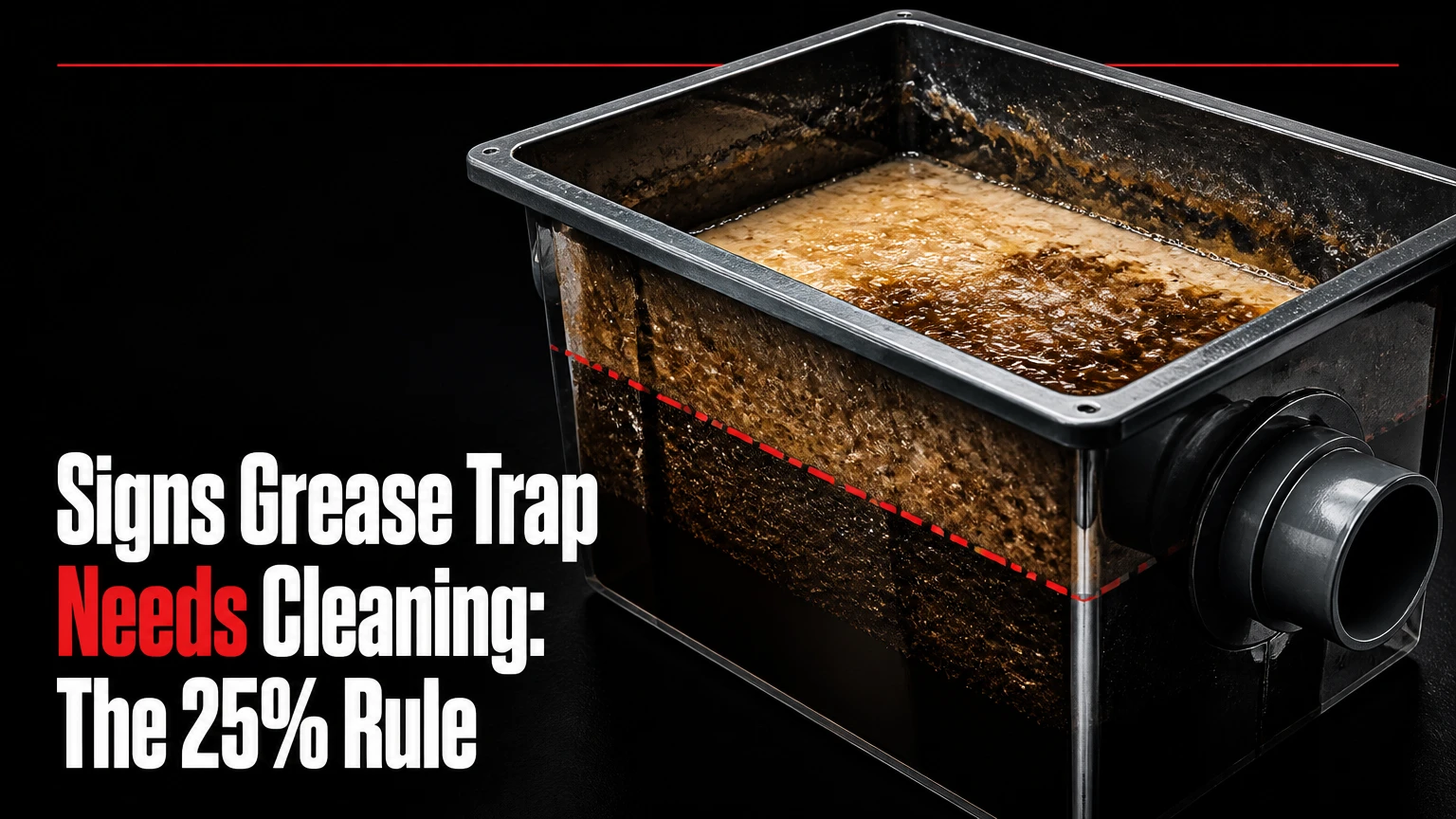
The clearest signs a grease trap needs cleaning are a grease or sludge layer reaching about 25% of the trap’s liquid depth, slow drains, rancid odors, gurgling, rising wastewater, or grease appearing downstream. A backup requires immediate service because a full trap can obstruct kitchen fixtures and discharge fats, oils, and grease into sewer lines.
Key Facts at a Glance
- A grease trap separates floating fats, oils, and grease from heavier food solids before wastewater reaches the sanitary sewer.
- The 25% rule means cleaning when the combined thickness of the floating grease layer and settled solids layer reaches 25% of the liquid depth, subject to local requirements.
- Odor alone does not prove a full trap; a damaged gasket, blocked vent, stagnant drain, or bacterial buildup can create the same symptom.
- A small under-sink hydromechanical interceptor may need service every 1-4 weeks, while an outdoor gravity interceptor commonly needs pumping every 1-3 months.
- Chemical degreasers, emulsifiers, and boiling water can move grease beyond the trap instead of removing it from the waste stream.
- Wastewater regulations, inspection rules, and required service intervals vary by municipality, facility type, and interceptor design.
What Does a Grease Trap Do?
A grease trap, also called a grease interceptor, slows kitchen wastewater so floating FOG and heavy food particles separate before the liquid exits to the sewer. The device protects building drain lines, public sewers, lift stations, and wastewater treatment equipment from accumulated grease and solids.
Commercial sinks, pot-washing areas, food preparation fixtures, and sometimes dishwashers can discharge into a grease control device. The exact fixtures allowed to connect depends on the plumbing design and local authority. A grease trap is not a general-purpose filter, septic tank, or substitute for scraping food waste into a bin.
How does separation work?
A grease trap uses reduced flow velocity, buoyancy, settling, and internal baffles. Wastewater enters the chamber, slows down, and remains long enough for lighter grease to rise while heavier solids fall. A submerged or inverted outlet draws comparatively clearer middle-layer water toward the sewer connection.
The process has limits. Hot water keeps grease liquid, detergents can disperse grease into small droplets, and excess food solids reduce the available settling volume. When the top scum layer and bottom sludge layer become too thick, wastewater can pass through without adequate separation.
The American Society of Plumbing Engineers describes gravity grease interceptors as systems that depend on retention time and density differences. That principle explains why capacity, inlet flow, wastewater temperature, and cleaning frequency matter more than the trap’s exterior appearance.
What Are the Signs Grease Trap Needs Cleaning?
The most reliable signs are measurable layer buildup, restricted drainage, sewage or rancid odors, gurgling, visible grease outside the trap, and wastewater backup. One symptom can have another plumbing cause, so the strongest diagnosis combines the symptom with an inspection of the trap and connected lines.
1. The grease and sludge reach the 25% threshold
The 25% rule is the primary maintenance benchmark used by many sewer authorities and service programs. Clean the interceptor when the combined depth of floating grease and settled solids reaches approximately one-quarter of the operating liquid depth, or sooner if local regulations specify a stricter limit.
Measure from the liquid surface to the bottom, then measure the grease layer and sludge layer separately. Add the two measurements and divide that total by the liquid depth. For example, a 20-inch liquid depth with 3 inches of grease and 2 inches of solids equals 5 inches, or 25%.
The threshold is not universal law. Some authorities specify a frequency, a maximum grease thickness, a solids limit, or a different percentage. A facility should follow its permit, plumbing code, wastewater utility, and written service agreement when those requirements differ.
2. Sinks and floor drains empty slowly
Slow drainage often means grease has narrowed the inlet line, outlet line, or trap passage. A full interceptor may still accept water briefly, but flow becomes sluggish when accumulated FOG and solids reduce the open cross-sectional area around the baffles.
Observe where the restriction begins. If only one sink drains slowly, the branch line may be blocked. If several fixtures slow at the same time, the interceptor or downstream main becomes more likely. A professional should inspect both sides of the trap because pumping the tank will not remove a hardened blockage in an upstream pipe.
3. Rancid odors come from the trap or drains
A strong sour, rancid, or decomposing-food odor usually indicates accumulated organic material, inadequate cleaning, poor ventilation, or a defective cover seal. The smell may escape through an open lid, floor drain, sink drain, cleanout, or vent connection.
Odor is an early warning, but it is not a capacity measurement. A recently pumped trap can still smell if grease remains on the walls, the gasket leaks, the outlet baffle is dirty, or the plumbing vent cannot release sewer gases correctly.
4. Drains gurgle after fixtures discharge
Gurgling occurs when restricted wastewater flow forces air through the drainage system. A trap filled with grease and solids can produce the sound, but a partially blocked downstream line or obstructed roof vent can produce it as well.
Record when the noise occurs. Gurgling only after a high-volume dishwasher cycle points toward flow restriction or an undersized device. Gurgling from a floor drain when a remote sink empties suggests shared piping or a downstream obstruction.
5. Grease appears downstream
Grease at a downstream cleanout, floor drain, inspection point, or sewer connection means the grease control system is no longer containing the FOG load effectively. Possible causes include a full tank, missing or damaged baffles, excessive flow, hot discharge, incorrect piping, or chemical emulsification.
Visible grease outside the interceptor deserves prompt attention even when fixtures still drain. Discharged FOG can cool and adhere to sewer walls, creating a progressively narrower passage that may later produce a high-cost backup.
6. Wastewater rises, backs up, or overflows
A backup is an urgent service condition, particularly when wastewater contains food solids or greasy black residue. Stop using connected fixtures, keep staff away from contaminated water, and contact a licensed plumber or permitted liquid-waste hauler.
Do not keep running hot water to force the obstruction through. That action can move grease farther downstream and spread contaminated wastewater across kitchen floors.
How Can You Confirm a Full Grease Trap?
A visual inspection and layer measurement provide better confirmation than odor or drainage speed alone. Open-access inspections should occur only when the unit is safe to access, the cover can be lifted without injury, and local procedures permit staff inspection.
Use a calibrated dipstick, sludge judge, or inspection rod designed for grease interceptors. Record:
- Date and time of inspection
- Liquid depth
- Floating grease thickness
- Bottom solids thickness
- Combined percentage
- Odor, color, and visible damage
- Last pump-out date and hauled volume
| Inspection result | Interpretation | Recommended action | Typical urgency |
|---|---|---|---|
| 0-15% combined layer | Normal operating reserve | Continue scheduled checks | Routine |
| 15-24% combined layer | Approaching service point | Book cleaning and increase monitoring | Within 1-3 weeks |
| 25-40% combined layer | Separation performance is compromised | Pump or clean promptly | Within days |
| More than 40% combined layer | High overflow and discharge risk | Stop nonessential discharge and arrange emergency service | Same day |
| Visible grease downstream | Containment failure or line problem | Inspect trap, baffles, and connected piping | Same day |
| Wastewater backup | Active blockage or hydraulic failure | Stop fixtures and call a professional | Immediate |
A service technician should inspect the inlet and outlet tees, baffles, gasket, tank walls, and connected pipes. A pump-out that removes the liquid but leaves settled solids or wall grease is incomplete maintenance.
Which Grease Trap Type Needs Which Maintenance?
Hydromechanical grease interceptors generally require frequent manual cleaning, gravity grease interceptors require scheduled pumping, and automatic grease removal devices require daily operator attention plus periodic internal service. The best schedule follows grease production and measured accumulation, not the equipment label alone.
| Device type | Typical location and capacity | Routine maintenance | Typical service cost |
|---|---|---|---|
| Hydromechanical interceptor | Indoor, 20-50 gallons per minute | Manual cleaning every 1-4 weeks | $150-$350 per visit |
| Gravity interceptor | Outdoor, 500-5,000+ gallons | Pump-out every 1-3 months | $400-$900 or more |
| Automatic grease removal device | Indoor, about 15-35 gallons per minute | Empty collector daily; inspect monthly | $2,500-$7,000 equipment cost |
| Large custom interceptor | Exterior, above 5,000 gallons | Contract pumping based on measured layers | Often $900 or more per service |
Hydromechanical interceptors
Hydromechanical grease interceptors are compact units installed beneath or near commercial sinks. Their flow-control fittings and baffles slow incoming water, but their small volume means a busy fryer kitchen can fill one rapidly.
These units suit cafés, small bakeries, bars, and limited-preparation kitchens when correctly sized. Staff must remove captured grease and solids rather than treating the device as a maintenance-free drain fitting.
Gravity grease interceptors
Gravity grease interceptors are larger tanks installed underground or outside a building. Their performance depends on volume and retention time, so they can handle more fixtures and higher wastewater loads than a small under-sink unit.
Outdoor interceptors require a permitted hauler, a vacuum truck in many cases, safe access to buried covers, and disposal documentation. A service interval of 60-90 days is common for many commercial sites, but high-volume operations may need more frequent pumping.
Automatic grease removal devices
Automatic grease removal devices use mechanical skimming, collection, or related separation mechanisms to remove FOG into a separate container. The device reduces manual tank scraping, but it does not eliminate inspections, solids management, electrical maintenance, or required internal cleaning.
Heating wastewater to keep grease fluid can improve operation in some systems, yet it can also increase downstream discharge risk if the device is poorly maintained or incorrectly configured. Follow the manufacturer’s installation and service instructions.
How Often Should a Grease Trap Be Cleaned?
A small interceptor commonly needs cleaning every 1-4 weeks, while an outdoor gravity interceptor often needs pumping every 1-3 months. Those ranges are starting points, not guarantees; the correct interval is the shortest schedule that keeps measured grease and solids below the applicable limit.
| Facility profile | Grease load | Starting interval | Adjustment trigger |
|---|---|---|---|
| Coffee shop with light food prep | Low | Every 4-8 weeks | Dairy, breakfast, or frying increases load |
| Small bakery or café | Low to medium | Every 2-4 weeks | Grease layer reaches 20% before service |
| Full-service restaurant | Medium to high | Every 30-60 days | Multiple cooking shifts or frequent backups |
| Fast-food or fryer-heavy kitchen | High | Every 2-4 weeks | Heavy FOG production or limited interceptor volume |
| School, hotel, or institution | Variable | Every 30-90 days | Menus, occupancy, and seasonal volume change |
| Food production facility | Very high | Weekly to monthly | Production batch and wastewater testing data |
The practical method is simple: inspect before each scheduled service for two or three cycles. If the combined layer reaches 25% after 18 days, a 14-day interval is safer than a 30-day calendar. If the tank remains below 15% after a quarter, the responsible authority may allow a longer interval.
What Does Professional Cleaning Include?
Professional grease trap cleaning removes liquid, floating FOG, settled solids, wall residue, and contaminated material from the interceptor, then documents the work. A complete service usually includes vacuum pumping, interior scraping or washing, baffle inspection, cover-seal inspection, and lawful waste disposal.
Typical small-unit service takes 30-45 minutes. A large outdoor pump-out commonly takes 1-2 hours, excluding truck access problems, line jetting, or repairs.
| Service component | Small indoor unit | Outdoor gravity interceptor |
|---|---|---|
| Access | Remove bolted or latched lid | Open secured underground covers |
| Removal method | Scoop, wet vacuum, or pump | Vacuum tanker pump-out |
| Inspection | Baffles, gasket, inlet, outlet | Tees, baffles, walls, covers, lines |
| Typical duration | 30-45 minutes | 1-2 hours |
| Documentation | Date, volume, condition | Manifest, disposal site, pumped volume |
| Extra work | Line snaking or gasket replacement | Hydro-jetting, excavation, structural repair |
A professional cleaning does not automatically clear a blocked building drain. If sinks back up immediately after service, the obstruction may sit in the inlet branch, outlet line, building sewer, or municipal connection.
Can Staff Clean a Small Grease Trap?
Trained staff can often clean a small, accessible hydromechanical interceptor, but outdoor tanks, large commercial interceptors, contaminated backups, and regulated waste generally require qualified service providers. Local rules may also prohibit disposal of trap waste in ordinary trash or require manifests.
Safe small-unit cleaning steps
- Stop fixture use and cool the wastewater. Allow at least 30 minutes without hot discharge. Wear chemical-resistant gloves, eye protection, waterproof footwear, and protective clothing.
- Protect the work area. Place absorbent pads, a secondary containment tray, and sealed waste containers around the lid. Keep food, utensils, and customers away from the area.
- Open the lid carefully. Remove fasteners without damaging the gasket. Lift vertically because grease buildup can make the cover heavy and slippery.
- Measure before removing material. Record liquid depth, grease thickness, and solids thickness. Photographs can support maintenance records and reveal changes over time.
- Remove floating grease and liquid. Scoop or pump the surface material into a legally approved container. Do not pour liquid grease, solids, or wash water into a sink, floor drain, storm drain, or outdoor soil.
- Remove settled solids. Scrape the bottom and walls, then clean the inlet, outlet, and baffles according to the manufacturer’s instructions. Do not bend, drill, or permanently remove internal components.
- Inspect the device. Look for cracks, corrosion, loose fittings, blocked tees, displaced baffles, and a brittle or torn gasket.
- Reassemble and refill. Reinstall every baffle in its original orientation, replace the seal if damaged, secure the lid, and refill the interceptor with clean water when the design requires a liquid seal.
The work is complete when the tank is visibly free of loose FOG and solids, the baffles sit correctly, the lid seals, and the connected fixtures drain without leakage. Kitty litter or absorbent granules can solidify waste for some small units, but disposal rules still apply.
Which Cleaning Mistakes Cause More Problems?
The most damaging mistakes are chemical emulsification, boiling-water flushing, incomplete solids removal, incorrect baffle installation, and disposal through another drain. These actions can make a trap look cleaner while transferring FOG into the building sewer.
- Enzymes and emulsifiers: Biological products may reduce odor or alter grease in limited conditions, but they do not remove the captured waste. Chemical dispersants can carry FOG past the interceptor, where it cools and adheres downstream.
- Boiling water: Hot water liquefies surface grease temporarily. The material can bypass the separation zone and solidify in a cooler pipe.
- Incomplete pump-out: Removing only the liquid leaves the bottom sludge layer and wall coating in place, so the trap reaches its limit again quickly.
- Wrong baffle orientation: A displaced inlet or outlet tee changes flow direction and can allow grease to escape directly.
- Damaged gasket: A faulty cover seal permits odor and sewer gases to enter the kitchen even after a cleanout.
- No water refill: Some designs need water restored after cleaning to maintain the intended hydraulic seal and separation conditions.
A useful practitioner rule is to compare hauled volume with interceptor capacity. If a 1,000-gallon tank routinely produces only 100 gallons of waste at service, the contractor may not be removing all accumulated material, or the recorded capacity may be wrong.
What If the Trap Smells or Backs Up After Cleaning?
Persistent odors after cleaning usually indicate residue, a leaking gasket, a dry drain trap, or a blocked vent; immediate backups usually indicate an obstruction in the inlet, outlet, or downstream sewer. Repeating the same pump-out without inspecting connected piping wastes time and can hide the actual failure.
| Symptom after service | Likely cause | Diagnostic check | Corrective action |
|---|---|---|---|
| Odor from lid | Torn or displaced gasket | Inspect seal and lid contact | Replace gasket and secure cover |
| Odor from floor drain | Dry plumbing trap or residue | Add water, inspect drain, compare odor location | Restore trap seal and clean residue |
| Backup at one sink | Local branch blockage | Test other fixtures | Snake or jet the branch line |
| Backup at several fixtures | Outlet or building sewer restriction | Check interceptor levels and cleanouts | Professional line clearing |
| Grease downstream | Undersizing, heat, chemicals, or baffle failure | Inspect tees and review kitchen practices | Repair, resize, or change operations |
| Fast refilling after cleaning | Excess FOG or solids load | Measure layer weekly | Increase frequency or reduce discharge |
A camera inspection can identify hardened grease, collapsed piping, root intrusion, or a damaged building sewer beyond the interceptor. A vent inspection is appropriate when multiple fixtures gurgle but the trap measurement remains low.
How Can a Kitchen Reduce Grease Trap Problems?
A kitchen reduces interceptor buildup by keeping food solids and bulk oil out of the drain, controlling wastewater temperature, and matching service frequency to measured loading. Prevention lowers the amount of material entering the trap, but it never replaces required inspection and pump-out.
Use drain screens on food-preparation sinks. Scrape plates and pans into solid-waste containers before washing. Collect fryer oil in a dedicated recycling container, wipe greasy cookware before rinsing, and keep mop water containing grease out of unrelated drains.
Dishwashers can send high-temperature, detergent-rich wastewater into a grease interceptor. Whether that connection is allowed depends on local code and the interceptor design, so facility operators should confirm the approved fixture schedule with the plumbing authority or engineer.
Do not select a smaller trap merely because it costs less. A low-capacity device can require weekly service, create odor complaints, and fail during peak meal periods. Correct sizing considers fixture flow rates, grease production, retention time, kitchen schedule, and local approval requirements.
When Should a Grease Trap Be Repaired or Replaced?
Repair or replacement is appropriate when the tank leaks, the cover cannot seal, baffles are missing, structural cracks permit groundwater entry, or correct cleaning cannot keep grease below the required limit. Frequent backups alone do not prove replacement is necessary because a blocked line or poor operating practice may be the real cause.
Replacement becomes more likely when:
- The interceptor is undersized for current fixture flow.
- Concrete, fiberglass, or polyethylene walls have structural damage.
- Internal tees or baffles are corroded beyond repair.
- The lid creates a trip hazard or cannot support required loading.
- The device lacks approved access for inspection and pumping.
- The kitchen’s menu has changed from light preparation to fryer-heavy production.
- Repeated service at short intervals costs more than a properly sized upgrade.
Automatic equipment may reduce manual labor, but mechanical parts, controls, skimming components, and electrical systems introduce new failure points. An automatic device is a poor choice where staff cannot empty its collector daily or where the wastewater contains large amounts of settleable solids.
Frequently Asked Questions
Can a grease trap be full without smelling?
Yes. A grease trap can reach its service threshold without producing a strong odor, particularly when the lid seals well and ventilation is effective. Layer measurement and maintenance records are more reliable than smell. Operators should not extend service solely because the kitchen has no odor complaints.
Does a grease trap need cleaning if water still drains?
Yes, if the grease and sludge layers have reached the applicable limit. Drainage can remain normal until separation performance has already declined, especially during low-flow periods. A trap should be inspected on schedule rather than waiting for a backup.
Can I use drain cleaner in a grease interceptor?
Avoid conventional drain cleaners unless the plumbing authority and equipment manufacturer specifically approve the product. Caustic chemicals can damage components, create hazardous reactions, and disperse grease beyond the interceptor. Mechanical cleaning and line service address the waste without transferring it downstream.
How long can a restaurant operate with a slow grease trap?
A restaurant should treat worsening slow drainage as a same-day maintenance issue, especially when several fixtures are affected. Continued discharge raises the chance of an overflow during peak service. Stop using affected fixtures if wastewater rises, backs up, or contains visible grease.
Does a residential kitchen need a grease trap?
A residential kitchen usually does not need a commercial grease interceptor, but local plumbing rules and unusually high cooking volumes can create exceptions. Homes with frequent frying, accessory food businesses, or sewer restrictions should ask the local wastewater authority before installing or bypassing a device.
Who is responsible for grease trap cleaning?
The property owner or food-service operator is commonly responsible for inspection, cleaning, repairs, and disposal records, but contracts and local ordinances determine the legal duty. Keep invoices, manifests, layer measurements, and repair records available for health, plumbing, or wastewater inspections.
The Bottom Line
The strongest signs grease trap needs cleaning are a combined grease-and-sludge layer near 25% of liquid depth, slow drainage, rancid odors, gurgling, downstream grease, and rising wastewater. Confirm symptoms with a measurement, follow local rules, and arrange prompt professional service for backups or visible discharge. A correctly sized interceptor, documented schedule, and disciplined kitchen practices prevent most repeat failures.