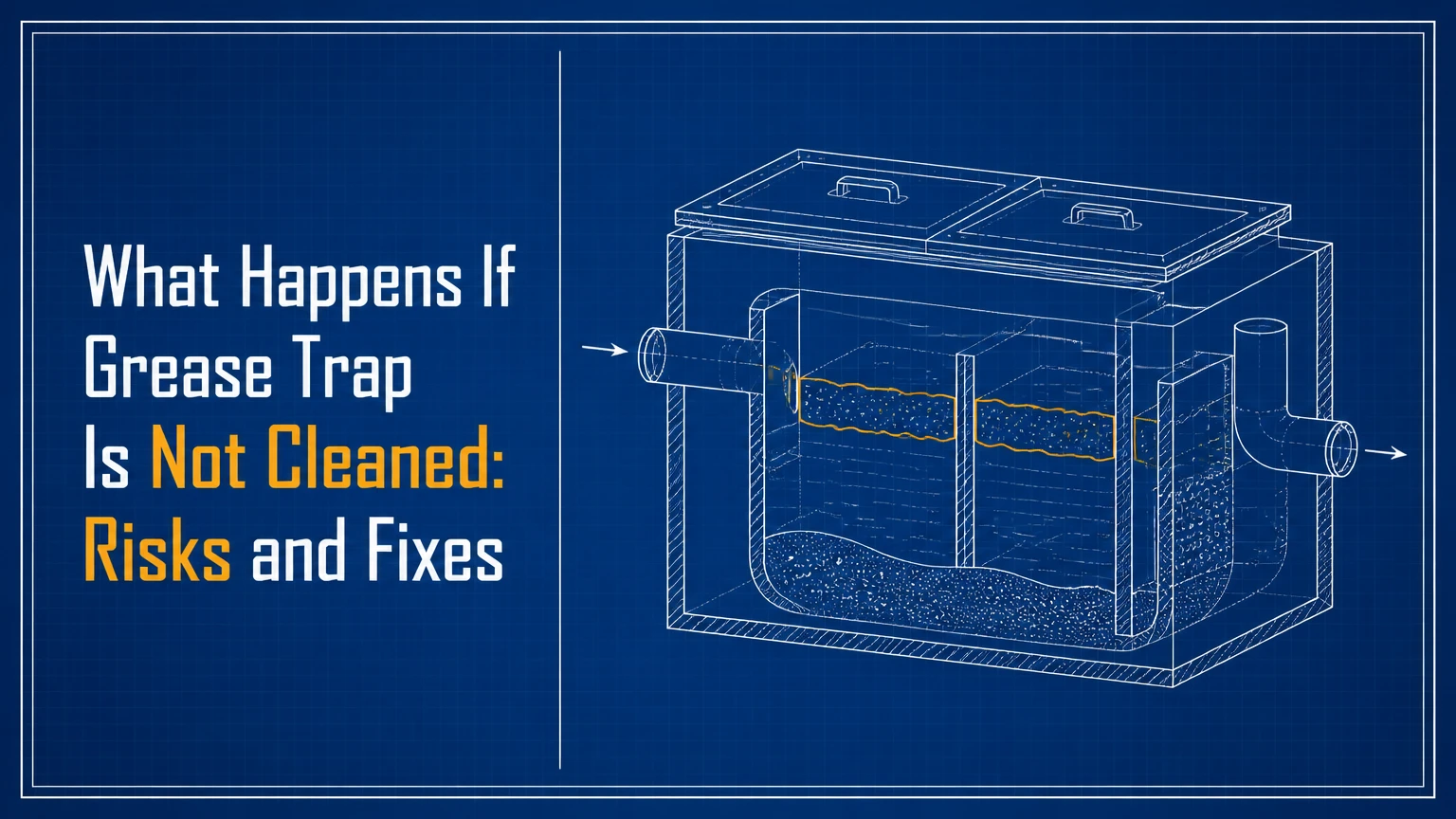
What happens if grease trap is not cleaned is a predictable progression from reduced capacity to slow drains, foul odors, blockages, sewage backups, equipment damage, and regulatory penalties. A neglected grease trap allows fats, oils, grease, food solids, and wastewater to pass into downstream plumbing after the unit loses effective retention capacity.
Key Facts at a Glance
- A grease trap separates FOG, meaning fats, oils, and grease, from wastewater before discharge reaches a sewer line.
- Food solids settle at the bottom while grease accumulates in a floating or emulsified layer.
- Many local programs use a 25% combined FOG-and-solids threshold, but the enforceable rule depends on the authority having jurisdiction.
- Small under-sink grease traps may need cleaning weekly, while large gravity interceptors often require pumping every 30-90 days.
- Skimming only surface grease does not restore full capacity because settled solids and wall deposits remain inside the tank.
- A sewage backup, strong rotten-egg odor, or wastewater returning immediately after pump-out requires professional plumbing or waste-service evaluation.
What Happens If Grease Trap Is Not Cleaned?
A grease trap that is not cleaned gradually loses usable volume, so wastewater has less time to slow, cool, and separate. Grease then leaves the trap, sticks to downstream pipes, traps food debris, and eventually restricts flow. The business may experience odors first, followed by slow sinks, overflowing fixtures, emergency plumbing costs, and possible enforcement action.
The sequence is usually gradual rather than sudden. A restaurant can continue operating while the interceptor is already sending grease into its building drain. By the time wastewater appears on the kitchen floor, the original problem may include a full trap, a blocked outlet, a contaminated drain line, or a municipal sewer restriction.
Why Does a Grease Trap Overflow?
A grease trap overflows when accumulated FOG and solids reduce the inlet or outlet opening, or when downstream plumbing cannot accept the discharged wastewater. Excess grease may form a floating cap, a bottom sludge layer, or a hardened coating on baffles and pipe connections.
Common progression:
- Reduced separation: The trap retains less wastewater and loses effective settling time.
- Outlet restriction: Grease and solids narrow the outlet path.
- Slow drainage: Sink fixtures drain slowly, especially during busy service periods.
- Upstream backup: Wastewater rises in floor sinks, floor drains, or the grease trap itself.
- Downstream contamination: Grease enters the building sewer and may continue toward the public main.
A trap can also refill quickly after pumping when a blockage remains beyond the outlet. In that situation, repeated pump-outs treat the symptom but do not clear the restricted drain.
What Damage Does Escaped Grease Cause?
Escaped grease cools and adheres to pipe interiors, where it reduces diameter and collects solids. The result can be a private-side blockage beneath the kitchen, a building sewer backup, or a larger obstruction in the public collection system.
The U.S. Environmental Protection Agency identifies fats, oils, and grease as a cause of sewer blockages and sanitary sewer overflows. A practical field rule is simple: a grease trap protects downstream plumbing only while it has capacity and remains correctly maintained.
Grease-related damage may include:
- Repeated drain snaking and emergency callouts
- Contaminated floor drains and food-preparation areas
- Damaged cast-iron fittings or deteriorated interceptor components
- Excavation and under-slab plumbing repairs
- Cleanup, disinfection, business interruption, and lost inventory
- Liability when a discharge affects neighboring property or a public sewer
How Does a Grease Trap Work?
A grease trap uses hydraulic slowing, density separation, baffles, and cooling to retain FOG and food solids while allowing a middle layer of wastewater to exit. Grease is less dense than water and generally floats, while heavier solids settle below the outlet flow path.
Wastewater enters through the inlet. An inlet baffle reduces turbulence, allowing grease to rise and solids to settle. A second baffle limits direct movement of the surface grease layer toward the outlet. The outlet draws from the relatively clearer middle zone.
The system does not destroy grease. It stores grease and solids until a complete service removes them.
What Is Inside a Neglected Trap?
A neglected grease trap typically contains a floating grease layer, gray wastewater, settled food solids, and hardened deposits on the lid, baffles, walls, and inlet or outlet pipes. Anaerobic decomposition of retained food waste can produce strong odors, while repeated exposure to acidic waste may damage certain materials.
| Trap condition | Typical physical sign | Likely operational effect | Recommended response |
|---|---|---|---|
| Grease layer under 1 inch | Thin soft surface layer | Normal separation capacity | Monitor and follow the service schedule |
| Grease layer 1-3 inches | Thick floating mat | Reduced retention and odor risk | Arrange inspection or cleaning |
| Combined grease and solids near 25% | Measurable upper and lower layers | Greater carryover to sewer | Schedule pump-out promptly |
| Hardened baffles or outlet | White, yellow, or brown deposits | Slow drainage and poor separation | Complete cleaning and inspect flow |
| Liquid above the lid or tank rim | Standing wastewater or overflow | Active blockage or capacity failure | Stop affected fixtures and call a professional |
The 25% figure is widely used by municipal FOG programs, including guidance from cities such as Sioux City, Iowa. It is not a universal engineering law. Some authorities specify a different limit, and a manufacturer may require service sooner.
What Is the 25% Rule?
The 25% rule generally means grease and settled solids should not occupy more than one-quarter of the operating depth of a trap or interceptor. The measurement commonly considers the combined thickness of the floating grease layer and bottom solids layer, although local inspection procedures differ.
At approximately this level, the unit may still appear to accept wastewater, but separation performance is declining. A high-volume fryer operation can reach the threshold far faster than a coffee shop using the same nominal tank size.
Operators should record:
- Date and time of inspection
- Grease thickness
- Solids thickness
- Liquid depth
- Cleaning date and hauler name
- Manifest, receipt, or disposal record
- Observed inlet, outlet, gasket, and baffle condition
Records help establish a defensible maintenance history when a health department or wastewater authority inspects the premises.
How Often Should a Grease Trap Be Cleaned?
A small hydromechanical grease trap commonly requires weekly or biweekly cleaning, while a large gravity interceptor often requires pumping every 30-90 days. Actual frequency depends on tank capacity, gallons per minute, cooking volume, menu, solids control, wastewater temperature, and the local sewer authority’s rule.
Use the shortest interval that prevents the combined grease-and-solids layer from reaching the applicable threshold.
| Kitchen profile | Device example | Typical service interval | Stronger scheduling trigger |
|---|---|---|---|
| Coffee shop | 10-20 GPM under-sink trap | 7-14 days | Milk, cream, food prep, or frequent dishwashing |
| Small cafe | 20-50 GPM hydromechanical trap | 1-4 weeks | Daily cooking and limited solids screening |
| Full-service restaurant | 500-1,500 gallon interceptor | 30-60 days | Fryers, grill grease, and high meal volume |
| High-volume kitchen | 1,500-5,000 gallon interceptor | 30-45 days | Heavy frying, multiple shifts, or catering |
| Seasonal facility | Outdoor interceptor | Before opening and during operation | Long shutdowns, flooding, or stormwater intrusion |
A calendar alone is insufficient. Measure the trap, compare the result with local requirements, and shorten the interval when the business changes its menu or operating hours.
How Is a Grease Trap Properly Cleaned?
A complete grease trap cleaning removes the grease layer, wastewater, settled solids, and attached deposits, then verifies the inlet, outlet, baffles, lid, and seals. Professional service usually takes 20-60 minutes for a small unit and 1-3 hours for a large interceptor, excluding travel and difficult access.
Step 1: Stop Wastewater Flow and Prepare the Area
Stop using connected sinks, dishwashers, floor drains, and food-processing equipment. Keep absorbent pads, a container for removable debris, protective gloves, eye protection, and ventilation available.
Hydrogen sulfide can accumulate in confined spaces. Never enter a grease interceptor, lean over an open tank, or work alone in a poorly ventilated area.
Step 2: Open and Measure the Trap
Remove the lid carefully without damaging the gasket. Measure the grease and solids layers with a calibrated probe or inspector’s gauge, and photograph the condition when records are required.
A measurement provides useful maintenance data. A visual glance at the top surface does not.
Step 3: Remove All Contents
Pump out floating grease, liquid, and bottom solids. A complete pump-out is necessary because settled sludge occupies capacity and can continue decomposing after surface grease is removed.
The service provider should transport waste to an approved receiving facility. The operator should retain the invoice, waste manifest, or disposal record required by local rules.
Step 4: Scrape and Wash Internal Components
Remove hardened deposits from the lid, walls, baffles, inlet, and outlet. Use tools and wash methods allowed by the equipment manufacturer and wastewater authority.
Do not flush thick grease into the drain. That transfers the blockage instead of removing it.
Step 5: Inspect and Test Flow
Check the gasket, lid, baffles, tank walls, inlet pipe, outlet pipe, and access risers. Run clean water through connected fixtures and confirm that the level rises and falls normally.
You know the service worked when wastewater drains without surging, the outlet remains open, the lid seals correctly, and no new overflow appears.
Which Grease Control Device Does a Kitchen Need?
A hydromechanical trap suits lower-volume kitchens with accessible under-sink space, a gravity interceptor suits high-volume commercial kitchens, and an automatic grease removal device suits operations that can support powered mechanical skimming. Device selection should follow hydraulic flow, menu, local plumbing code, and access requirements rather than tank capacity alone.
| Device type | Typical capacity | Typical service need | Best-fit operation |
|---|---|---|---|
| Hydromechanical trap | 10-50 GPM | Weekly to monthly | Cafe, bakery, small restaurant |
| Gravity interceptor | 500-5,000+ gallons | Every 30-90 days | Hotel, school, full-service restaurant |
| Automatic grease removal device | 15-50 GPM | Daily solids and grease removal | High-use kitchen with limited space |
| Passive floor or sink unit | 7-25 GPM | Several times monthly | Small prep area with modest FOG load |
An automatic device reduces manual skimming but does not eliminate inspection, solids removal, electrical maintenance, or compliance records. A large interceptor provides more storage, but poor access can make each pump-out slower and more expensive.
How Much Does Cleaning Cost?
Typical U.S. service pricing ranges from $75-$250 for a small under-sink trap and $300-$1,200 or more for a large outdoor interceptor. Emergency drain clearing, hydro-jetting, access excavation, contaminated-area cleanup, and municipal penalties are separate costs.
| Service or consequence | Typical price range | Typical duration | Main price variable |
|---|---|---|---|
| Small trap cleaning | $75-$250 | 20-60 minutes | Access and waste volume |
| Outdoor interceptor pump-out | $300-$1,200+ | 1-3 hours | Tank size and truck access |
| Commercial drain snaking | $150-$500 | 1-3 hours | Blockage location |
| Hydro-jetting | $500-$2,000+ | 2-6 hours | Line length and condition |
| Under-slab repair | $2,000-$15,000+ | 1-5 days | Excavation, pipe depth, finishes |
| FOG violation penalty | Local variation | Immediate to weeks | Jurisdiction and offense history |
These are typical planning ranges, not quotations. Local labor rates, after-hours premiums, disposal charges, and access constraints can change the final invoice substantially.
The cheapest preventive service is usually scheduled pump-out. The expensive version includes wastewater cleanup and interrupted operations.
What Should You Do During a Backup?
During a grease-related backup, stop using all connected fixtures, keep employees and customers away from contaminated water, and call a licensed plumber or qualified grease-service provider. Do not pour boiling water, bleach, acid, caustic drain opener, or biological additives into an overflowing system.
Use this response sequence:
- Shut down sinks, dishwashers, garbage disposals, and nearby floor drains.
- Isolate contaminated food, packaging, utensils, and cleaning equipment.
- Keep wastewater away from electrical equipment and hot cooking surfaces.
- Photograph the overflow and note the time, location, and fixtures affected.
- Contact the grease-trap service and plumbing contractor.
- Ask the contractor to identify whether the restriction is before the trap, inside the trap, after the trap, or in the public main.
- Clean and disinfect according to local health requirements before reopening the affected area.
A pump-out alone will not fix a blocked outlet line. If the trap refills immediately, downstream inspection or hydro-jetting may be necessary.
Which Cleaning Products Should You Avoid?
Avoid chemical drain openers, boiling water, and routine bleach discharge as grease-control methods. These products can move liquefied grease into colder downstream pipes, damage plumbing or seals, kill useful biological activity, and create hazardous reactions with other chemicals.
| Product or practice | Apparent short-term effect | Actual risk | Safer control |
|---|---|---|---|
| Boiling water | Melts surface grease | Pushes FOG into cooler pipes | Scrape food and schedule removal |
| Caustic drain opener | Opens a narrow path | Corrosive exposure and downstream deposits | Professional line clearing |
| Acid drain cleaner | Attacks deposits | Chemical injury and pipe damage | Mechanical cleaning |
| Bleach | Reduces some surface odor | Does not remove grease and harms biology | Remove source and inspect seals |
| Enzyme additive | May reduce selected residues | Cannot replace pump-out or fix blockage | Follow authority and manufacturer rules |
Some wastewater programs permit specific biological products, while others prohibit them because they can mask buildup or interfere with treatment. Confirm local rules before using any additive.
Why Does a Cleaned Trap Still Smell?
A cleaned grease trap can still smell when food residue remains in the inlet, the lid gasket leaks, a nearby floor-drain P-trap is dry, or downstream sludge remains in the building sewer. Odor does not prove that the trap is full, and a full trap does not always produce a strong odor.
Check the following in order:
- Confirm that the trap was fully evacuated, not surface-skimmed.
- Inspect the lid gasket and replace brittle or compressed rubber.
- Refill nearby floor-drain P-traps with water.
- Check whether the vent system is blocked or improperly terminated.
- Inspect the inlet and outlet for retained deposits.
- Identify whether odor increases during wastewater discharge.
- Request gas monitoring if workers must investigate a confined or poorly ventilated space.
Hydrogen sulfide has a rotten-egg odor at low concentrations, but smell is an unreliable safety indicator because the sense of smell can become fatigued. Workers should not treat odor as a safe exposure gauge.
What Records and Local Rules Apply?
Commercial kitchens usually need to follow the wastewater utility, building department, health department, and waste-hauling requirements that apply to their address. Rules may specify interceptor size, access, cleaning frequency, the 25% threshold, approved transporters, manifests, and inspection access.
Requirements differ by location. One city may require monthly pumping, while another may allow a documented performance-based schedule. Some authorities require records for one to three years, but the business should confirm the retention period directly with its local FOG program.
A responsible compliance file contains:
- Current trap or interceptor size and location
- Installation or plumbing approval documents
- Cleaning invoices and dates
- Layer measurements
- Waste manifests or disposal receipts
- Inspection reports and corrective actions
- Contractor licenses or authorization details
- Staff procedures for scraping plates and using strainers
The business remains responsible for its discharge even when a contractor performs the cleaning. Use a licensed or locally authorized hauler and verify where collected grease goes.
What Are the Most Common Maintenance Mistakes?
The most damaging maintenance mistake is treating a grease trap as a drain-cleaning device instead of a waste-storage device. Operators often remove visible surface grease, continue pouring food solids into sinks, or rely on chemicals while the lower sludge layer keeps reducing capacity.
Practitioner rules that prevent repeat failures include:
- Scrape before washing: Removing food from plates prevents solids from occupying interceptor volume.
- Measure, do not guess: A trap can look acceptable from the lid while the outlet is restricted.
- Service by load, not calendar alone: A fryer-heavy menu may require twice-monthly service even when a calendar suggests monthly cleaning.
- Protect access: Buried or obstructed lids increase service time and encourage delayed pump-outs.
- Separate stormwater: Rainwater entering an interceptor changes hydraulic loading and may cause premature overflow.
A grease trap is also not a substitute for a properly sized plumbing system. Recurrent backups after documented cleaning can indicate inadequate flow capacity, defective baffles, poor venting, damaged pipework, or an obstruction outside the trap.
FAQ
Can a grease trap go months without cleaning?
A large, lightly used interceptor may operate for several months, but a small under-sink unit often cannot. The correct interval depends on measured grease and solids, local rules, and kitchen loading. A business should not extend service beyond the interval that keeps the combined layer below the applicable threshold.
Can I clean a small grease trap myself?
Some jurisdictions allow trained staff to clean small hydromechanical traps, but the work still requires complete evacuation, protective equipment, sanitary handling, and legal waste disposal. Staff should not enter tanks or handle sewage without proper training. Commercial operators should confirm local requirements before assigning this task.
Does grease trap bacteria or enzyme treatment replace pumping?
No. Biological products may affect selected residues, but they do not remove accumulated solids, hardened wall deposits, or an outlet blockage. Some wastewater authorities prohibit additives because they can transfer FOG downstream. Pumping and inspection remain the primary maintenance controls.
Why is water backing up into the grease trap after it was pumped?
Water that returns immediately after pump-out usually indicates a blockage downstream, a closed or damaged outlet, a sewer surcharge, or incorrect reconnection. The contractor should inspect flow from the interceptor toward the building sewer and public main instead of repeatedly emptying the tank.
Is a grease trap required for every restaurant?
Many commercial kitchens that discharge FOG require a grease trap or interceptor, but the exact requirement depends on local plumbing code, wastewater rules, fixture type, and discharge volume. Coffee shops, bakeries, mobile kitchens, and residential users may face different requirements, so the local authority having jurisdiction provides the final answer.
The Bottom Line
What happens if grease trap is not cleaned is a chain reaction: usable capacity falls, FOG escapes, drains slow, odors increase, blockages form, and wastewater may back up into the kitchen or public sewer. Schedule cleaning before the measured grease-and-solids layer reaches the local limit, keep complete service records, and treat any active overflow as a plumbing and sanitation emergency.