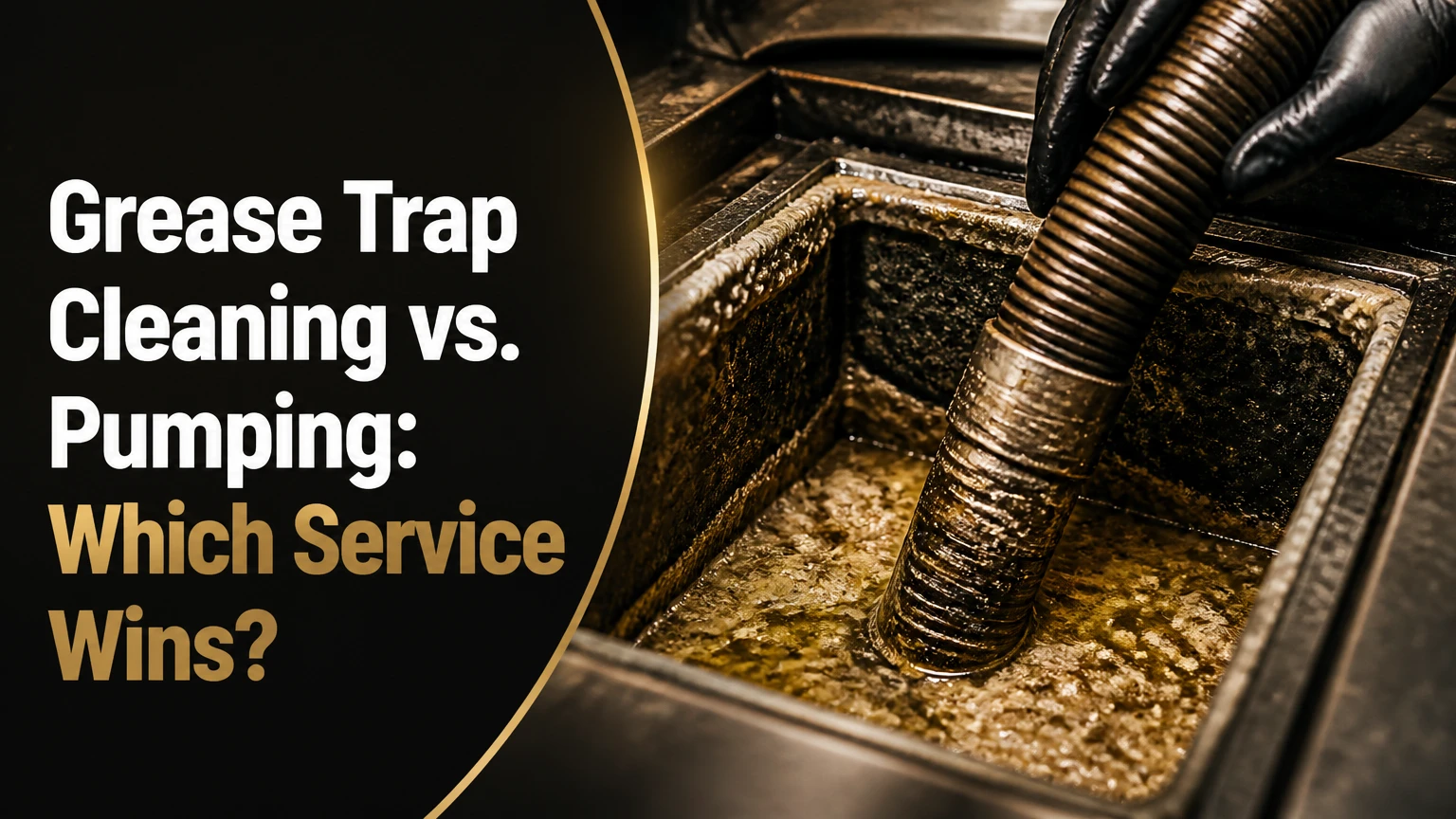
Grease trap cleaning removes liquid waste, settled solids, floating FOGS, and hardened deposits from walls and baffles, while grease trap pumping primarily evacuates the trap’s contents by vacuum. Pumping is faster and cheaper for routine removal, but full cleaning is required when grease scaling, odor, restricted capacity, inspection, or recurring blockage makes residual buildup a problem.
Key Facts at a Glance
- Grease trap pumping removes waste by vacuum, but suction alone may leave adhered grease on walls, floors, baffles, and inlet or outlet tees.
- Grease trap cleaning includes pumping plus scraping, washing, final vacuuming, component inspection, and secure reassembly.
- A common service benchmark is the 25% rule, meaning floating grease and settled solids reach 25% of the operating depth, but the enforceable threshold comes from the local sewer authority.
- Typical indoor interceptor pumping costs $75-$200, while a full small-trap cleaning commonly costs $150-$350.
- Outdoor gravity interceptor service commonly costs $300-$800 for pumping and $600-$1,500 or more for pump-and-clean work.
- A service record should identify the waste volume, measured grease and solids depth, disposal destination, defects found, and work performed.
What Is the Difference Between Grease Trap Cleaning and Pumping?
Grease trap pumping is waste extraction. Grease trap cleaning is waste extraction plus physical removal of deposits that remain attached to the interceptor’s internal surfaces and components.
A pump-out places a vacuum hose into an indoor hydromechanical grease interceptor or outdoor gravity grease interceptor. The hose removes floating grease, wastewater, and some settled sludge. The result can be adequate when the unit has little adhered residue and local rules define routine service as complete evacuation.
Full cleaning takes the trap out of service temporarily. A technician pumps the contents, scrapes the tank and baffles, washes the remaining film or scale, vacuums the dislodged material, checks fittings and seals, and restores the water level. The two terms are sometimes used interchangeably by contractors, so the written scope matters more than the label.
The National Association of Sewer Service Companies describes grease interceptor maintenance around the principle of removing accumulated grease and solids before they impair function. In practical terms, a vacuum hose cannot reliably remove a hard layer bonded to a wall or trapped behind a baffle.
Is Pumping Enough for a Grease Trap?
Pumping is enough for a routine service when the interceptor is accessible, its walls and internal parts are substantially free of hardened grease, and the service report confirms that settled solids were removed. Pumping is not enough when a crust, sludge mat, blockage, odor source, or reduced working volume remains.
A restaurant with a clean 20-gallon under-sink trap may need frequent pump-outs because its capacity is small. An outdoor 1,000-gallon interceptor may require a more detailed inspection because solids can remain beneath the liquid even after the surface looks clear.
A useful contractor instruction is: “Pump the unit completely, then expose and inspect the walls, floor, baffles, tees, and lid.” If the technician cannot see those surfaces after evacuation, the service was extraction rather than verified cleaning.
Pumping Versus Cleaning by Service Attribute
| Attribute | Pumping | Full cleaning |
|---|---|---|
| Typical indoor price | $75-$200 | $150-$350 |
| Typical outdoor price | $300-$800 | $600-$1,500+ |
| Small-unit duration | 20-45 minutes | 45-90 minutes |
| Large-unit duration | 45-120 minutes | 1-3 hours |
| Primary equipment | Vacuum truck or slurry pump | Vacuum equipment, scrapers, brushes, wash tools |
| Wall deposits addressed | Sometimes, if soft | Yes, by scraping or washing |
| Baffle inspection | Limited during extraction | Included after evacuation |
| Odor-source removal | Moderate | High when deposits are removed |
| Documentation quality | Volume and disposal record | Volume, measurements, defects, photos, disposal record |
How Does Professional Grease Trap Cleaning Work?
Professional cleaning follows a pump, remove, inspect, wash, and restore sequence. A typical small interceptor takes 45-90 minutes, while a large outdoor gravity interceptor can take 1-3 hours, depending on access, buildup, hose distance, and disposal requirements.
Step 1: Isolate and document the interceptor
The technician identifies the correct unit, protects nearby food-service areas, and stops discharge temporarily if the design requires it. The technician records the lid condition, access depth, grease depth, solids depth, and any visible overflow.
The 25% benchmark is commonly calculated from the operating depth, not merely from the tank’s total gallon rating. Local rules may define the measurement differently, so the city or sewer district’s written standard controls.
Step 2: Pump the contents completely
The vacuum hose removes floating FOGS, wastewater, and settled solids. A responsible operator avoids pushing the hose through a baffle in a way that damages the tee or leaves a hidden sludge pocket in the second chamber.
For an outdoor interceptor, technicians may use multiple hose positions. Agitation can loosen soft sediment, but agitation does not substitute for scraping hardened grease.
Step 3: Scrape walls, floors, baffles, and tees
Scrapers and stiff brushes remove caked grease from the lid underside, tank walls, floor, divider, inlet tee, outlet tee, and baffle surfaces. Some contractors use hot water or controlled hydro-jetting, but the method must prevent grease from being displaced into the downstream sewer.
Cleaning is complete only when the waste has been captured for disposal. Washing grease out of the interceptor and into the drain is a transfer of the problem, not treatment.
Step 4: Vacuum the dislodged material
The technician makes a second extraction pass after scraping and washing. Remaining water, flakes, sludge, and grease fragments should enter the vacuum hose or approved collection container.
You will know this step worked when the floor is visible, no thick sludge mat remains, and the contractor can identify the condition of the baffles and tees.
Step 5: Inspect components and the structure
The inspection covers cracked concrete, warped polyethylene, corroded metal, displaced baffles, broken tees, damaged gaskets, blocked flow-control devices, and roots around buried access points.
Hydrogen sulfide can corrode concrete and create a serious confined-space hazard. Workers should follow applicable confined-space procedures rather than entering an interceptor casually.
Step 6: Restore the hydraulic seal
The interceptor is refilled with clean water when the manufacturer or local authority requires it. Replacing lost water helps the unit resume its designed separation function and prevents an empty trap from allowing odors to move upstream.
The lid must sit evenly, the gasket must seal, and the access cover must be secured against traffic, pests, and accidental opening.
Which Grease Interceptor Types Need Each Service?
Hydromechanical grease interceptors usually need frequent pump-outs because their small capacity fills quickly, while gravity grease interceptors need deeper inspection because settled solids can accumulate across a much larger tank. Automatic grease removal devices reduce daily grease loading but still require periodic internal cleaning.
| Interceptor type | Typical capacity | Common location | Starting service pattern | Main risk |
|---|---|---|---|---|
| Hydromechanical interceptor | 10-100 gallons | Under sink or floor recess | Every 1-4 weeks | Rapid capacity loss |
| Gravity interceptor | 500-5,000+ gallons | Outdoor underground tank | Every 1-3 months | Hidden settled solids |
| Automatic grease removal device | 10-100+ gallons | Indoor process line | Daily skimming plus periodic cleaning | Neglected bottom sludge |
| Grease-laden floor drain trap | 5-50 gallons | Kitchen floor or wash area | Weekly to monthly inspection | Localized blockage |
Capacity alone does not determine frequency. A high-volume fryer kitchen can load a 1,000-gallon interceptor faster than a low-volume café loads a 50-gallon unit. Wastewater temperature, menu, dishwashing practices, scraping procedures, and the number of connected fixtures also change the interval.
The Plumbing and Drainage Institute distinguishes hydromechanical and gravity separation by flow conditions and retention behavior. That distinction matters because a small trap often needs hands-on service at the sink, whereas a large interceptor may require a vacuum truck, long hose run, traffic control, and disposal manifest.
How Much Do Pumping and Cleaning Cost?
Typical grease trap pumping costs $75-$200 for a small indoor unit and $300-$800 for a large outdoor interceptor. Full cleaning commonly costs $150-$350 for a small unit and $600-$1,500 or more for a large tank, with access difficulty, hydro-jetting, emergency timing, and disposal volume driving the final quote.
| Cost factor | Small indoor unit | Large outdoor interceptor |
|---|---|---|
| Routine pumping | $75-$200 | $300-$800 |
| Full cleaning | $150-$350 | $600-$1,500+ |
| Typical service time | 20-90 minutes | 1-3 hours |
| Emergency surcharge | $50-$250 typical | $150-$500 typical |
| Long hose or difficult access | $25-$150 typical | $100-$500 typical |
| Hydro-jetting add-on | $100-$400 typical | $300-$1,000 typical |
These figures are typical North American service ranges, not regulated prices. Local labor rates, fuel, waste-transfer fees, access requirements, and municipal disposal rules can change the quote substantially.
A low pump-out price becomes expensive if it leaves 2 inches of wall scale in a 20-gallon trap. The retained material reduces effective capacity, shortens the next interval, and can create a second charge for emergency drain cleaning.
Which Service Has the Lower Annual Cost?
Pumping has the lower cost per visit, but a pump-and-clean program can have the lower annual cost when residual buildup repeatedly causes odor, slow drainage, or emergency work. Compare total annual service cost, not the invoice for one visit.
For example, a café paying $125 every two weeks spends about $3,250 per year on 26 pump-outs. If quarterly full cleaning at $225 prevents two emergency drain calls costing $500 each, the higher-scope schedule may produce a lower operating cost even though each cleaning invoice is larger.
What Does the 25% Rule Actually Mean?
The common 25% rule means service is due when floating grease and settled solids occupy about one-quarter of the interceptor’s operating depth, but the rule is not universal wording or a substitute for local regulations. Sewer authorities may impose a fixed interval, a different percentage, or a written maintenance plan.
The measurement should distinguish the top grease layer, middle wastewater layer, and bottom solids layer. A technician can use a sludge judge, dipstick, or calibrated measurement method appropriate to the interceptor.
A 1,000-gallon tank does not automatically meet the rule because its total volume is large. If grease and solids together occupy 25% of the liquid operating depth, separation performance may already be impaired even when substantial water remains.
The U.S. Environmental Protection Agency identifies fats, oils, and grease as a major source of sanitary sewer blockages and recommends source control alongside interceptor maintenance. The local wastewater utility remains the authority for enforceable requirements.
How Should a Restaurant Choose a Service Schedule?
A restaurant should begin with the manufacturer’s instructions and the local sewer authority’s rules, then adjust the interval using measured grease and solids accumulation. A practical starting schedule is every 2-4 weeks for small busy traps and every 30-90 days for many outdoor gravity interceptors.
| Business profile | Likely interceptor | Starting interval | Cleaning trigger |
|---|---|---|---|
| Coffee shop with light cooking | 20-50 gallon HGI | 3-4 weeks | Odor, 25% accumulation, slow sink |
| Quick-service fryer kitchen | 20-100 gallon HGI | 1-2 weeks | Rapid crust formation or daily solids |
| Full-service restaurant | 500-1,500 gallon GGI | 30-60 days | 25% benchmark or local schedule |
| Hotel or institutional kitchen | Multiple HGIs and GGIs | 14-60 days by line | Cross-line loading or audit requirement |
| High-volume commissary | 1,000-5,000+ gallon GGI | 14-30 days | Measured loading and downstream samples |
The schedule should be evidence-based. Measure the layers at each visit, record the kitchen’s operating volume, and shorten the interval if accumulation approaches the limit before the next scheduled service.
A quarterly deep clean is a useful practitioner pattern for small indoor traps that receive routine pumping, but it is not a universal legal requirement. Heavy-use kitchens may need full cleaning more often.
What Should a Grease Trap Service Report Include?
A defensible service report should record the unit location, measured grease and solids depth, waste volume, service scope, defects, disposal destination, and technician or vehicle identification. A vague invoice reading “grease trap pumped” does not prove that the interceptor was cleaned or that the required waste was lawfully managed.
Request these items:
- Asset identification: interceptor location, capacity, manufacturer, and access point.
- Measurements: total operating depth, floating grease depth, and settled solids depth.
- Work performed: pump-out only, scraping, washing, hydro-jetting, component inspection, and refill.
- Waste record: estimated gallons, transporter, receiving facility, and disposal or recycling method.
- Condition evidence: photographs of the open tank, baffles, tees, gasket, and final condition.
- Follow-up: defects, recommended interval, repair estimate, and next service date.
A contractor who refuses to define “cleaning” in writing creates avoidable compliance and quality risk. Ask whether the price includes all chambers, internal baffles, the lid underside, final vacuuming, and disposal.
Can Chemicals or Enzymes Replace Pumping?
Chemicals, hot water, surfactants, and enzymes cannot replace physical grease interceptor service. These products may liquefy or disperse FOGS temporarily, allowing material to leave the trap and cool farther downstream, where it can attach to private plumbing or a municipal sewer.
The same principle applies to pouring boiling water into a drain. Heat can change grease viscosity without removing its mass. Enzyme products may have a role only where the sewer authority and interceptor manufacturer approve them, and they do not eliminate accumulated solids or structural inspection.
Kitchen source control is more reliable:
- Scrape plates and pans into a solid-waste or used-oil collection container.
- Dry-wipe fryer equipment before washing.
- Keep mop water and food scraps out of grease fixtures.
- Maintain drain screens and flow-control devices.
- Train staff not to discharge concentrated fryer oil into sinks.
Why Does a Grease Trap Smell After Pumping?
A grease trap can smell after pumping when hardened residue remains on the lid, walls, baffles, or sludge floor, or when the lid gasket, vent, or nearby plumbing trap allows odor into the kitchen. Pumping removes the liquid carrier but may leave the decaying material that produces the odor.
Check the odor source in this order:
- Inspect the lid underside and gasket for grease film, cracks, or misalignment.
- Confirm that all chambers and baffles were evacuated.
- Check whether the plumbing P-trap has dried out.
- Inspect the vent and flow-control assembly for blockage.
- Determine whether odor is coming from a downstream drain rather than the interceptor.
- Schedule full cleaning if deposits remain visible.
A persistent odor immediately after a documented full cleaning can indicate a damaged seal, poor ventilation, a dry fixture trap, or a separate sewer-line problem. Repeating pump-outs without locating the source wastes service visits.
What Problems Does Pumping Alone Create?
Pumping alone creates problems when it leaves a shrinking layer of hardened grease or settled sludge inside the interceptor. The retained material reduces working volume, obstructs baffles, increases odor, and allows FOGS to pass into downstream drainage.
Rapid grease return
A thick layer appearing within days can mean the contractor performed a superficial pump-out, the kitchen bypassed grease controls, or the interceptor is undersized for the discharge load. Compare service photographs with kitchen practices before assuming the tank failed.
Slow drains after service
Slow drainage after a recent pump-out often indicates a blocked inlet tee, flow-control device, private sewer lateral, or downstream line. The grease interceptor may be clean while the restriction remains elsewhere.
Overflow or wastewater backup
An overflow requires immediate fixture isolation and professional diagnosis. Do not keep adding chemicals or repeatedly running water, because continued discharge can spread contaminated wastewater and move grease into the sewer.
Damaged baffles or tees
A cracked baffle or missing outlet tee allows grease to bypass separation. Cleaning exposes these defects, while a murky pump-out may leave them undiscovered.
Unsafe access
A grease interceptor is a confined-space hazard. Never enter the tank, lean into an open access point, or allow untrained staff to perform an internal inspection.
Which Service Should Different Businesses Choose?
The right choice depends on interceptor size, accumulation rate, local rules, and the consequence of failure. Small kitchens generally need frequent pumping with scheduled deep cleaning, while high-volume or regulated facilities need documented full-scope service at measured intervals.
Small cafés and delis
Choose routine pumping every 2-4 weeks when measurements remain below the local threshold and walls stay free of scale. Add full cleaning at least quarterly as a practical starting point, or sooner when odor and residue return quickly.
Fryer-heavy quick-service restaurants
Choose shorter intervals, often weekly or biweekly for small interceptors. Full cleaning becomes the better option when fryer oil, solids, or grease crust repeatedly consumes capacity between visits.
Full-service restaurants and hotels
Choose a combined pump-and-clean contract when the outdoor interceptor is large, buried, or difficult to inspect. Require chamber-by-chamber measurements, photographs, disposal records, and a defined response time for backups.
Hospitals, universities, and campuses
Choose asset-based maintenance across every interceptor rather than one calendar interval for the entire facility. Automatic grease removal devices can reduce loading on selected lines, but main interceptors and downstream drainage still need inspection and cleaning.
How Can You Compare Contractor Quotes?
Compare the included work, not the word “cleaning” in the headline. A quote should state whether the contractor will evacuate every chamber, remove adhered deposits, inspect components, refill the unit, transport the waste, and provide compliance records.
Ask these questions before booking:
- Does the price include pumping and manual scraping?
- Will the contractor clean the lid, baffles, tees, and floor?
- Is hydro-jetting included, optional, or prohibited by the site’s discharge controls?
- How many gallons of waste are included?
- Is disposal included in the quoted price?
- Will the report show grease and solids measurements?
- Are photographs provided?
- What happens if the baffle, gasket, or tank is damaged?
- Does the company carry required waste-hauling and environmental licenses?
- Can the contractor service the sampling port and downstream cleanout?
An unusually low quote often reflects pump-out-only scope, limited hose time, or disposal exclusions. The cheapest visit is not the cheapest maintenance plan when it increases emergency backups.
The Bottom Line
Grease trap cleaning vs pumping is a scope decision, not merely a choice between two names. Pumping is appropriate for routine evacuation when the interceptor is lightly scaled and the service record confirms removal of liquid waste and settled solids; full cleaning is the better choice when deposits, odor, restricted capacity, component defects, or compliance inspection require visible internal surfaces.
Use the local sewer authority’s rule first, then track measured accumulation over time. Require written scope, photographs, waste documentation, and a clear distinction between pump-out and complete cleaning.
Frequently Asked Questions
How long can a restaurant operate after a grease trap pump-out?
A restaurant can operate immediately after a properly completed pump-out, provided the interceptor is reassembled, flow is restored, and no defect or blockage remains. The next service date depends on measured accumulation, not a universal number. A busy fryer kitchen may need service within one week, while a low-volume café may last three or four weeks.
Should a grease trap be full of water after cleaning?
A grease trap normally contains water during operation because the liquid creates the separation environment. After service, clean water should be restored when the interceptor design or local procedure requires it. An empty unit can permit odors and reduce immediate separation performance until wastewater refills it.
Can a grease trap be cleaned without a vacuum truck?
A small indoor interceptor can sometimes be serviced with a portable slurry pump and approved containers, but the waste still requires lawful transport and disposal. Large outdoor gravity interceptors generally need vacuum-truck equipment because their volume, access depth, and settled solids exceed practical manual handling.
Does a grease trap need cleaning if the restaurant is temporarily closed?
A closed restaurant may not need its normal service frequency, but the interceptor should be inspected before reopening. Existing grease and sludge can continue to smell, harden, attract pests, and obstruct flow even without new kitchen discharge. A long-closed unit may require full cleaning before operations resume.
Who enforces grease trap maintenance requirements?
The local wastewater utility, sewer district, municipality, or environmental health authority usually enforces grease interceptor requirements. Rules vary by jurisdiction and may specify service intervals, measurement thresholds, manifests, sampling points, and approved disposal methods. The contractor’s recommendation cannot override a written local requirement.