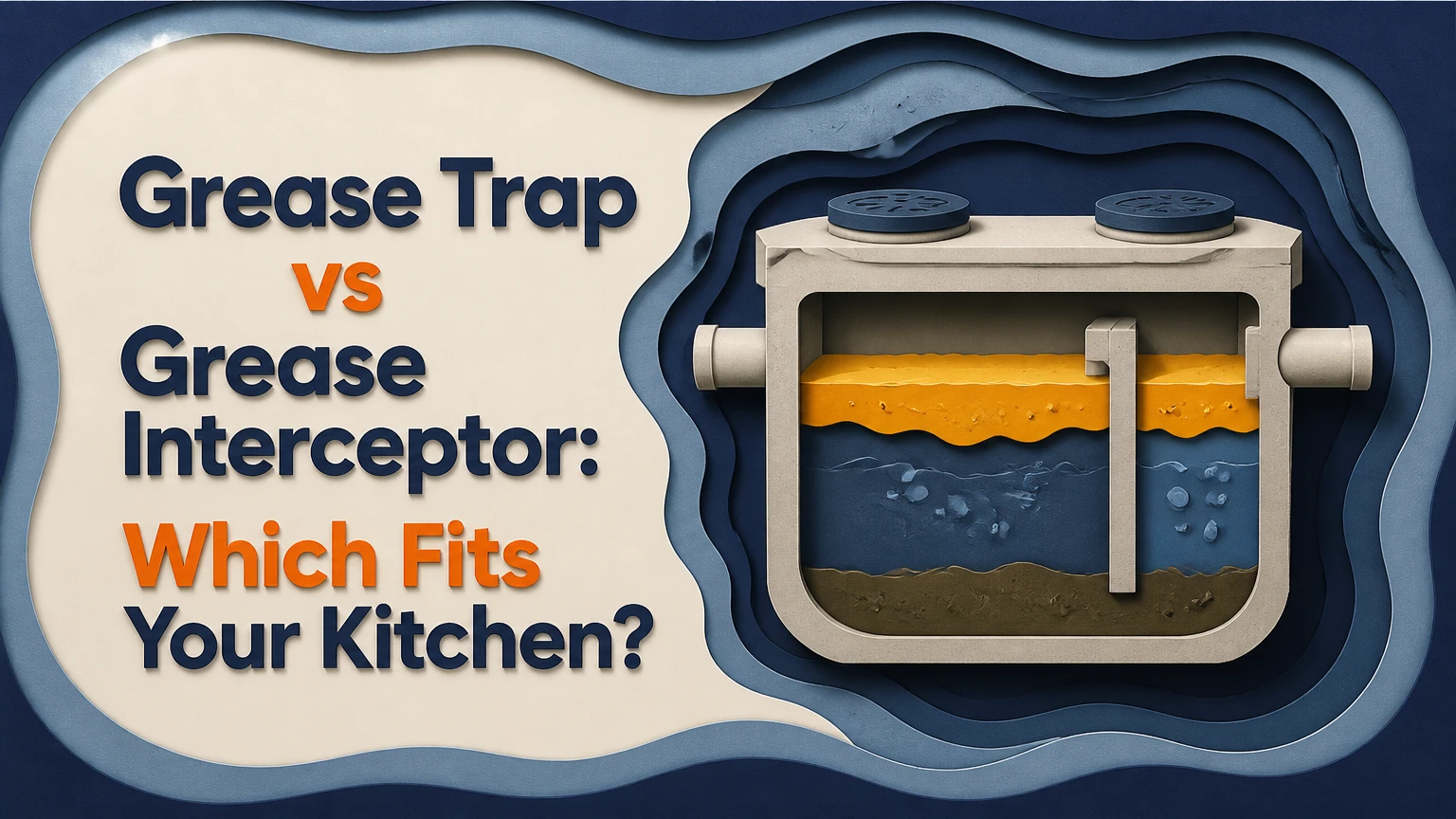
A grease trap is a compact hydro-mechanical grease interceptor, usually installed indoors near one or more kitchen fixtures, while a grease interceptor commonly means a larger gravity tank installed outside or below ground. Both remove fats, oils, and grease from wastewater, but flow rate, retention volume, installation location, maintenance access, and local code determine the correct choice.
Key Facts at a Glance
Hydro-mechanical grease traps are commonly rated by flow, such as 10, 20, or 50 gallons per minute, plus grease-holding capacity in pounds.
Gravity grease interceptors are commonly specified by liquid volume, with typical commercial sizes ranging from 500 to 2,500 gallons.
A trap usually protects selected fixtures; an interceptor can receive wastewater from much of a commercial kitchen.
ASME A112.14.3 and PDI G101 commonly relate to hydro-mechanical units, while gravity interceptor requirements depend on the product standard and local authority.
The often-cited 25% rule is a common maintenance threshold, not a universal requirement in every city.
A low purchase price does not make an indoor trap cheaper when frequent cleaning, odors, labor, and access problems are included.
Grease Trap vs Grease Interceptor: What Is the Difference?
The primary difference is hydraulic scale. A hydro-mechanical grease trap slows a controlled stream from nearby fixtures inside a relatively small chamber, whereas a gravity grease interceptor uses a much larger tank and longer detention period to separate FOG from high-volume wastewater.
Terminology creates avoidable confusion. In the United States, “grease trap” may refer specifically to a small hydro-mechanical unit, but some plumbing officials and manufacturers use “grease interceptor” as the broader category for both hydro-mechanical and gravity devices. A specification should therefore identify the device by design, rated flow, liquid capacity, standard, and installation location rather than by name alone.
A typical under-sink unit may be rated at 10-50 GPM and hold approximately 20-100 pounds of grease. A gravity tank may hold 500, 1,000, 1,500, or 2,500 gallons, although local requirements and site conditions can produce smaller or larger designs. The figures are typical commercial ranges, not universal limits.
| Decision factor | Hydro-mechanical grease trap | Gravity grease interceptor |
|---|---|---|
| Common location | Under or beside a sink, indoors | Exterior underground vault or tank |
| Typical rating | 10-50 GPM and 20-100 lb grease capacity | 500-2,500 gal liquid capacity |
| Protected area | One fixture group or limited branch | Several kitchen fixtures or an entire facility |
| Separation method | Flow control, baffling, and short detention | Large volume, baffling, and gravity detention |
| Installation disruption | Approximately 4-8 hours for a straightforward retrofit | Approximately 3-7 days for excavation and inspection |
| Typical equipment price | $250-$1,500 manual; $2,500-$7,000 automatic | $4,000-$12,000 tank |
| Typical installed cost | Approximately $500-$3,500 | Approximately $10,000-$40,000 or more |
| Routine service | Weekly to monthly for many busy kitchens | Often monthly to quarterly, subject to loading and code |
How Do Grease Traps and Interceptors Work?
Both devices separate wastewater by density, but neither one destroys grease. FOG is generally less dense than water and rises when turbulence, temperature, and detention conditions allow separation; food solids and sediment commonly settle at the bottom.
Wastewater enters through an inlet designed to reduce turbulence. Internal baffles, tees, or flow-control fittings keep the incoming stream from passing directly to the outlet. As hot wastewater cools, liquid fats can coagulate and join the surface scum layer. Heavier food particles settle into the sludge layer.
The middle liquid zone contains the treated effluent that leaves for the building drain or sewer. Separation fails when flow exceeds the rated capacity, solids occupy too much space, baffles are damaged, or detergents and very hot water keep grease emulsified. A device can therefore be correctly sized on paper and still discharge FOG if kitchen operating practices defeat its hydraulic design.
Hydro-Mechanical Separation
A hydro-mechanical unit uses a compact chamber, internal baffles, and a flow-control device to create separation within a small footprint. The flow-control fitting is not optional decoration. Without it, a sink discharge can exceed the unit’s rated GPM and carry grease through before cooling and stratification occur.
Automatic grease removal devices, often called GRDs, add mechanical skimming. A motorized wheel, belt, or similar mechanism removes accumulated grease into a separate container, while the device still requires periodic inspection and cleaning. Automatic removal reduces manual scooping but does not eliminate solids, sludge, venting, or code obligations.
Gravity Separation
A gravity interceptor depends primarily on tank volume and detention time. Multiple compartments and submerged inlet and outlet fittings create a relatively calm path, allowing surface FOG and bottom solids to remain in the tank while clarified water exits.
The frequently quoted 30-minute retention period is a design benchmark used in some guidance and specifications, not a universal rule for every jurisdiction. Designers should confirm the required hydraulic retention, tank volume, and fixture connections with the local wastewater authority and the approved manufacturer data.
Which Standards and Codes Apply?
The applicable requirement comes from the authority having jurisdiction, not from the product label alone. A city sewer department, plumbing official, building department, or water utility may prescribe an approved standard, minimum capacity, sampling access, pumping interval, or fixture connection arrangement.
ASME A112.14.3 and PDI G101 are commonly associated with hydro-mechanical grease interceptors. Gravity products may be evaluated under standards such as IAPMO Z1001, ASTM C1613, or other jurisdictionally accepted specifications. The exact standard depends on product type, material, certification, and location.
A compliant installation normally requires more than a certified tank. The plan may need venting, cleanouts, access covers, flow control, a solids-management strategy, approved pipe slopes, structural loading calculations, and documentation that the pumping contractor can reach the service opening.
Which Option Handles More Wastewater?
A gravity interceptor handles greater peak volume because its tank provides more liquid volume and detention space. An indoor trap is better suited to a limited fixture group whose combined discharge remains within the device’s certified flow rating.
| Kitchen scenario | Typical wastewater pattern | Usually favored device | Reason |
|---|---|---|---|
| Coffee shop with one three-compartment sink | Low to moderate flow, limited cooking grease | 10-20 GPM hydro-mechanical trap | Small fixture group and limited peak discharge |
| Smoothie or juice bar | Low FOG, but possible fruit solids | Trap plus solids control | FOG load is modest, while solids can fill the chamber |
| Fast-casual kitchen | Multiple sinks, fryer, dishwasher, and peak surges | Gravity interceptor or approved GRD | Combined flow can exceed an under-sink rating |
| Full-service restaurant | High grease, hot wash water, frequent dishwashing | Outdoor gravity interceptor | Large detention volume and service outside customer areas |
| Ghost kitchen in leased premises | High production but no excavation permission | Automatic GRD or engineered indoor system | Retrofit constraint determines the feasible solution |
| Food hall with shared drainage | Variable tenants and simultaneous peaks | Engineered shared interceptor | Shared capacity and access require hydraulic review |
A dishwasher deserves special attention. High-temperature discharge can keep grease liquid and increase turbulence, while detergent can emulsify FOG so it travels farther before separating. The final connection arrangement must follow the local authority’s requirements rather than an informal “send everything to the nearest trap” approach.
Which Device Costs Less to Install and Operate?
The hydro-mechanical trap costs less to buy and install in an existing kitchen, but the gravity interceptor often reduces indoor labor, odor exposure, and cleaning frequency. Total cost depends on excavation, pumping access, staff time, disposal fees, emergency blockages, and the consequences of noncompliance.
| Cost category | Hydro-mechanical trap | Automatic GRD | Gravity interceptor |
|---|---|---|---|
| Typical equipment price | $250-$1,500 | $2,500-$7,000 | $4,000-$12,000 |
| Typical installation | $500-$2,000 | $1,500-$3,500 | $10,000-$40,000+ |
| Typical cleaning charge | $150-$300 | $200-$400 | $300-$1,000 |
| Typical service interval | 1-4 weeks | Daily skimming, quarterly deep cleaning | 1-3 months |
| Main hidden cost | Staff labor and indoor odor | Electricity, parts, and container handling | Excavation, access, and pump-truck logistics |
These figures are typical North American commercial ranges, not bids. Excavation depth, pavement restoration, groundwater, traffic loading, utility relocation, disposal distance, and municipal inspection requirements can change an interceptor project by tens of thousands of dollars.
A practical lifecycle calculation should convert staff cleaning time into money. For example, a trap cleaned every week by two employees for 30 minutes each creates approximately 52 labor events annually, before emergency service or replacement gaskets are counted. A larger tank may cost more upfront while reducing that recurring indoor burden.
How Should a Grease Trap or Interceptor Be Sized?
Sizing must begin with the authority’s formula and the manufacturer’s certified data, not with the largest available tank or a guess based on restaurant seating. Common inputs include fixture flow, sink dimensions, drainage load, menu, operating hours, dishwasher discharge, solids, and whether multiple branches combine upstream.
For a hydro-mechanical unit, the designer generally compares the expected peak flow with the certified GPM rating and confirms the grease capacity in pounds. A 20 GPM unit is not automatically adequate because a sink can receive a sudden surge greater than its average daily flow.
Gravity interceptor sizing usually considers liquid volume, peak flow, detention, fixture drainage, and the required grease and solids storage. A 1,000-gallon tank is common in some commercial applications, but a local authority may require a different minimum, a larger tank, or a specific compartment arrangement.
What Should a Sizing Review Include?
- List every fixture that will discharge through the device, including sinks, prep tables, dishwashers, wok drains, and floor drains.
- Separate fixtures that should not connect, such as toilets, storm drains, and some garbage-disposal systems.
- Calculate peak simultaneous flow rather than relying on average daily volume.
- Add the menu and process load, including fryer oil, meat preparation, dairy, sauces, and high-temperature wash water.
- Confirm the approved device, standard, venting, access, and pumping requirements with the local authority.
- Obtain manufacturer installation data and preserve the approved plans for future maintenance staff.
Garbage disposals can introduce enough food solids to fill a small unit rapidly. Many jurisdictions prohibit direct disposal discharge to a grease device or require a solids interceptor first. A solids separator does not replace FOG control, because the two devices address different contaminant loads.
Which Materials and Configurations Are Suitable?
Concrete gravity tanks provide substantial structural mass and can tolerate traffic-rated installations when engineered correctly, but acidic wastewater and biological activity can damage concrete and internal components over long service periods. Fiberglass and polyethylene resist many corrosion mechanisms and weigh less, although lightweight tanks may require anchoring where groundwater can cause flotation.
| Construction or configuration | Best installation context | Main advantage | Main limitation |
|---|---|---|---|
| Stainless-steel hydro-mechanical trap | Indoor commercial kitchen | Cleanable, compact, and widely available | Requires frequent access and corrosion inspection |
| Polyethylene hydro-mechanical trap | Indoor retrofit or corrosive environment | Low weight and chemical resistance | Can deform if poorly supported or improperly installed |
| Precast concrete interceptor | Exterior, traffic-rated installation | High mass and structural durability | Heavy transport, excavation, and potential corrosion |
| Fiberglass interceptor | Restricted-access site or corrosive soil | Lightweight and corrosion resistant | Requires engineered bedding and anti-flotation measures |
| Automatic GRD | High labor cost or indoor-space constraint | Reduces manual grease removal | Uses power and still needs deep cleaning |
| Interceptor with solids separation | High food-particle load | Extends grease-device capacity | Adds equipment, space, and maintenance |
An outdoor tank is not automatically superior. A site with a high water table, no pump-truck access, shallow utilities, or a lease that prohibits pavement removal may make an indoor certified device more practical. Conversely, placing a small trap under a high-volume dishwasher usually creates a maintenance and bypass problem.
What Are the Maintenance Requirements?
A grease device should be serviced before accumulated grease and solids reduce effective liquid volume. The common 25% rule means pumping or cleaning when the combined thickness of the floating grease layer and settled solids reaches 25% of the wetted capacity, but the enforceable threshold may differ by city or permit.
Hydro-mechanical traps often need inspection and cleaning every one to four weeks in busy kitchens. Gravity interceptors commonly receive pump-outs every one to three months, but a heavily loaded fryer operation may require more frequent service, while a low-FOG café may qualify for a different documented interval.
Operators should record the date, device identification, measured grease and solids layers, waste quantity, manifest, contractor, and any defects. The record helps establish an evidence-based interval and demonstrates compliance during an inspection.
What Does Proper Cleaning Include?
- Remove the lid carefully and inspect the gasket, bolts, and access opening.
- Measure or visually assess surface grease and bottom solids before removal.
- Remove the entire contents, not only the floating grease.
- Scrape accumulated material from the walls, baffles, tees, and corners.
- Inspect flow-control fittings, baffles, vents, and outlet piping.
- Replace damaged seals and confirm that the lid is secured without crushing the gasket.
- Dispose of the waste through an authorized hauler and retain the receipt.
A pump-out that leaves sludge on the bottom is incomplete. Residual solids consume detention volume and can generate odor even when the surface appears clean.
What Common Mistakes Cause Failure?
Boiling water does not remove FOG from the waste stream. Hot water can temporarily liquefy grease inside the device, allowing it to move into colder downstream piping where it can solidify and create a blockage.
Chemical degreasers and enzyme products can also create a false sense of control. Surfactants may emulsify grease and carry it past the interceptor, while biological products cannot compensate for inadequate capacity, missing baffles, or poor cleaning.
Five Failure Modes to Prevent
- Missing flow control: An indoor trap receives unrestricted discharge and exceeds its certified GPM rating. Install the specified control and verify its venting.
- Direct garbage-disposal connection: Food particles rapidly occupy the sludge zone. Use a permitted solids separator or follow the authority’s disposal prohibition.
- Inaccessible outdoor lid: Landscaping, parked vehicles, or pavement cover prevents scheduled pumping. Place access openings where a service truck can reach them.
- Improper fixture connections: Toilets, stormwater, or unrelated high-flow drains overload the device. Keep sanitary and process drainage paths distinct.
- Damaged internal baffles: Short-circuiting allows influent to reach the outlet directly. Inspect the internal parts after backups, impact, or structural movement.
An odor problem is not proof that grease is the only cause. Dry floor-drain traps, failed lid gaskets, blocked vents, and decomposing solids can produce sulfur odors even when the device is hydraulically functioning.
Which Device Should Different Kitchens Choose?
The best choice follows the kitchen’s peak flow, grease load, available space, maintenance capacity, and local approval. A small trap fits a low-volume fixture group, while a gravity interceptor is generally the stronger choice for a high-output kitchen with multiple simultaneous discharges.
Small Café or Coffee Shop
Choose a certified 10-20 GPM hydro-mechanical trap when one sink group handles limited cooking grease and the authority permits that arrangement. Coffee grounds and food solids still require control because a low FOG load does not prevent sludge accumulation.
Ghost Kitchen or Leased Restaurant
Choose an automatic GRD when excavation is prohibited and the device is approved for the expected flow. Confirm electrical service, container storage, cleaning access, noise, and landlord responsibility before signing off on the design.
Full-Service Restaurant
Choose an outdoor gravity interceptor when the site supports excavation and the kitchen combines fryers, multiple sinks, high-temperature dishwashing, and substantial peak flow. The larger device keeps routine service away from food preparation and customer areas.
Food Hall or Shared Commercial Building
Use a hydraulic review before selecting a shared tank. Tenant turnover, simultaneous peak discharge, unequal maintenance practices, and unclear ownership can make a shared interceptor fail even when its nominal gallon capacity appears adequate.
Can Both Devices Be Used Together?
A hydro-mechanical trap and a gravity interceptor can be used in series when the plumbing design and authority permit staged treatment. The arrangement may protect a sensitive branch while a larger downstream interceptor manages the building-wide load, but two devices also create additional head loss, access points, maintenance duties, and failure locations.
Do not install both as an informal workaround for poor sizing. A small upstream trap can become a neglected restriction, and an unapproved configuration may violate local plumbing rules. The engineer or plumbing official should define the purpose of each unit, the fixture groups served, and the cleaning sequence.
What Happens When the System Is Undersized?
An undersized device usually shows slow drainage, recurring backups, visible grease in downstream cleanouts, odors, or a pumping interval that becomes impractically short. Continued operation can cause sewer surcharges, emergency plumbing costs, environmental claims, and enforcement action under a local FOG program.
A sludge judge or calibrated measuring tool can help confirm layer thickness, but measurement does not replace a professional inspection when baffles, piping, or the tank structure may be damaged. If FOG is already reaching the municipal line, stop adding grease, arrange service, and ask the authority whether documentation or corrective work is required.
FAQ
Is a grease interceptor better than a grease trap?
A gravity grease interceptor is better for high-volume kitchens, multiple fixtures, and operations that need longer service intervals. A hydro-mechanical grease trap is better for a small fixture group, limited space, or an existing building where excavation is impractical. Local approval and peak flow matter more than the label.
How often should a restaurant pump its grease interceptor?
Many commercial gravity interceptors are pumped every one to three months, but the correct interval depends on measured grease and solids accumulation. Pump before the combined layers reach the locally enforceable threshold, commonly 25% of liquid capacity, and shorten the interval if the kitchen produces heavy fryer or food solids.
Can a dishwasher discharge into a grease trap?
A dishwasher may connect only when the device, plumbing design, and local authority allow that connection. High-temperature water and detergent can increase turbulence and emulsify FOG, so the designer must verify peak flow, temperature, flow control, venting, and the approved fixture schedule.
Can a grease trap be installed outside?
Some hydro-mechanical units can be installed outdoors if the manufacturer permits outdoor exposure and the installation protects the device from freezing, traffic, flooding, and unauthorized access. An outdoor location does not turn a small trap into a gravity interceptor or increase its certified flow rating.
What should never go into a grease trap?
Paint, solvents, motor oil, stormwater, toilet waste, concentrated drain chemicals, and excessive food solids should not enter a grease device. Used fryer oil should be collected separately for recycling or licensed disposal, because pouring bulk oil into a trap can fill its storage capacity rapidly.
Who decides whether a kitchen needs a trap or interceptor?
The local authority having jurisdiction, together with the plumbing designer and approved manufacturer data, determines the acceptable device and installation. A landlord, equipment salesperson, or previous tenant cannot override the sewer authority’s capacity, certification, access, venting, and maintenance requirements.
The Bottom Line
A grease trap is the compact, flow-rated choice for a limited fixture group, while a grease interceptor is the larger, volume-based choice for high-flow commercial kitchens. Compare the two by peak wastewater flow, FOG and solids load, installation access, maintenance labor, lifecycle cost, and local code. Before purchasing either device, obtain written approval for the exact product, size, connections, and service plan.