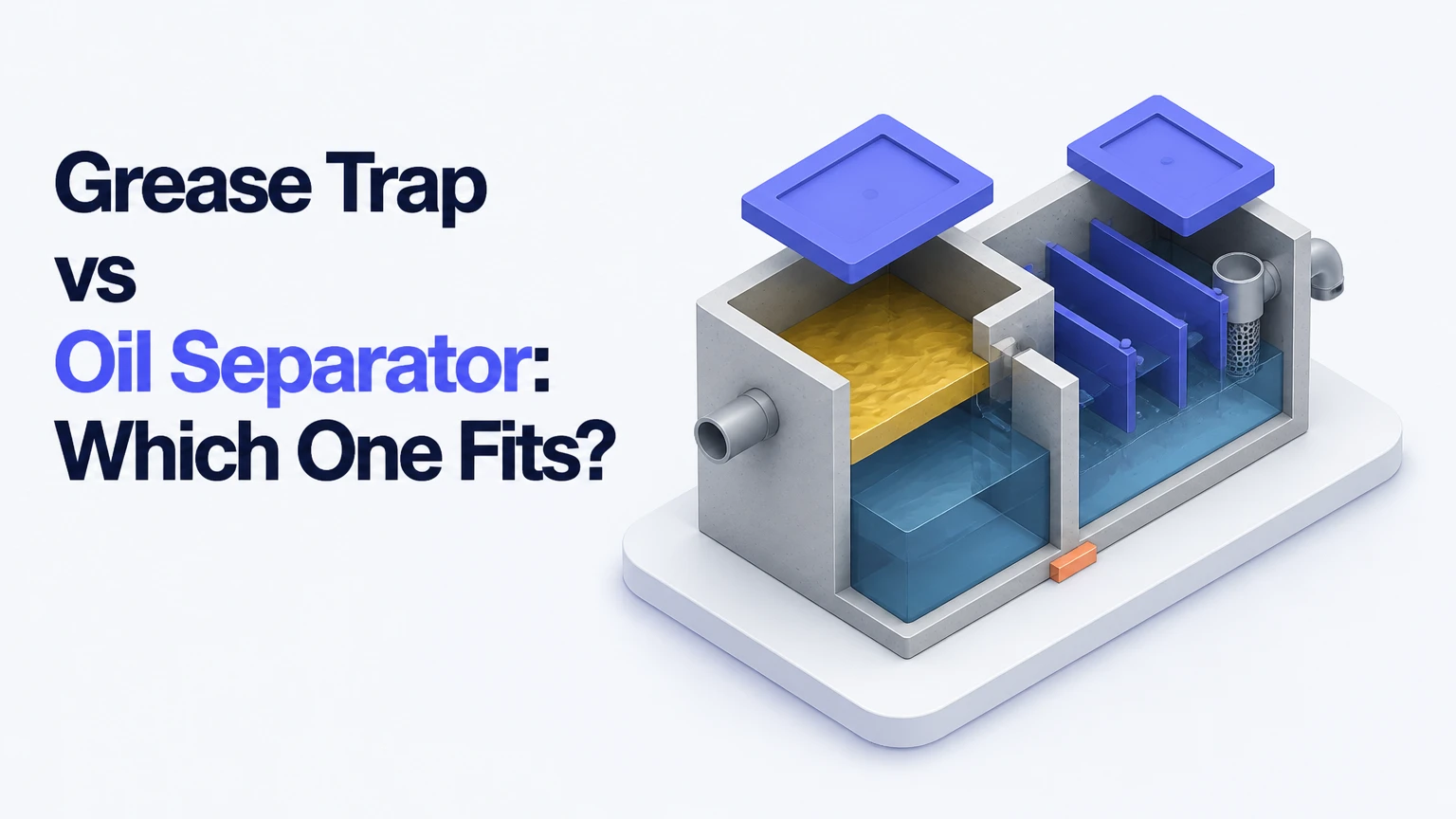
A grease trap captures fats, oils, and grease from commercial kitchen wastewater, while an oil separator captures petroleum-based hydrocarbons from vehicle, fuel, and industrial drainage. The correct choice depends first on the pollutant source, then on flow rate, solids, drainage type, discharge limits, and whether oils are emulsified.
Key facts at a glance
Grease traps target animal fats, vegetable oils, cooking grease, and food solids from sanitary kitchen drains.
Oil separators target diesel, gasoline, hydraulic fluid, lubricating oil, and other mineral hydrocarbons from wash bays and industrial runoff.
Gravity grease interceptors commonly range from approximately 500 to 5,000 gallons, while small hydromechanical units often handle about 10-50 GPM.
Coalescing oil separators can improve removal of small free-oil droplets, but detergents and solvents can emulsify hydrocarbons and defeat gravity separation.
A grease trap is not a substitute for an oil separator, and an oil separator is not a substitute for a grease trap.
Local plumbing, wastewater, stormwater, fire, and environmental requirements determine the permitted design and discharge target.
Grease Trap vs Oil Separator: Core Difference
The primary difference is the material each interceptor is designed to remove. A grease trap separates biodegradable food-service FOG, whereas an oil separator separates persistent mineral hydrocarbons from water, usually after grit and sediment have been removed.
The distinction matters because “oil” describes several chemically different materials. Vegetable oil and animal fat usually originate in kitchens and are managed as FOG. Motor oil, diesel, kerosene, and hydraulic fluid originate in mechanical or fueling operations and require hydrocarbon containment and disposal controls.
Both systems use density differences. Water has a density near 1.0 g/cm³, many kitchen fats and oils fall near 0.88-0.92 g/cm³, and petroleum products commonly float as well. Separation fails when turbulence, excessive flow, solids, temperature, or detergent-induced emulsification prevents droplets from rising.
| Decision criterion | Grease trap or interceptor | Oil separator or interceptor |
|---|---|---|
| Primary contaminant | Cooking fats, vegetable oil, animal grease | Diesel, gasoline, motor oil, hydraulic fluid |
| Typical drainage | Three-compartment sinks, prep sinks, floor drains | Wash bays, parking areas, workshops, fueling pads |
| Main separation action | Gravity, baffling, settling, cooling | Gravity, sedimentation, coalescing media |
| Typical small-system flow | 10-50 GPM | 5-150 GPM for compact coalescing units |
| Typical large-system size | 500-5,000+ gallons | 50-500+ GPM for gravity systems |
| Main maintenance waste | FOG, food solids, sludge | Petroleum hydrocarbons, grit, contaminated water |
| Major failure cause | Excess grease, solids, hot wastewater | Emulsified oil, sediment blockage, hydraulic overload |
| Common governing framework | Local plumbing code, PDI G101, ASME A112.14.3 | Local environmental rules, EN 858 or equivalent specifications |
What Does Each System Remove?
A grease trap removes free-floating and settleable kitchen contaminants, while an oil separator removes free petroleum hydrocarbons and associated sediment. Neither device is a general-purpose treatment plant for dissolved chemicals, detergents, solvents, or every contaminant entering a drain.
Grease trap contaminants
Kitchen wastewater can contain butter, lard, shortening, meat drippings, sauces, dairy fat, and vegetable oil. Food particles and heavier solids settle below the water layer. The interceptor retains these materials so they do not cool inside downstream pipes and form a blockage.
Grease traps are especially sensitive to temperature. Hot wastewater keeps FOG mobile, reducing immediate capture; cooling inside the interceptor allows grease to solidify and accumulate. A dishwasher connected directly to a small unit can therefore cause carryover even when the nominal flow rating appears adequate.
Oil separator contaminants
An oil separator captures free-phase petroleum hydrocarbons such as lubricating oil, diesel, fuel oil, and some hydraulic fluids. A sediment chamber or upstream grit box removes sand, metal particles, tire residue, and dirt before the water reaches coalescing media.
Oil separators do not reliably remove dissolved hydrocarbons or stable oil-water emulsions. A facility using alkaline cleaners, solvents, or high-pressure detergent systems may need source control, chemical treatment, dissolved air flotation, filtration, or biological treatment after the separator.
How Do Grease Traps and Oil Separators Work?
Grease traps and oil separators both require calm hydraulic conditions, but grease interceptors emphasize FOG cooling and retention, while oil separators often add sedimentation and coalescing surfaces for smaller droplets. The equipment cannot separate pollutants that remain dissolved or chemically dispersed in the water.
A typical grease interceptor follows this sequence:
- Wastewater enters through an inlet that limits turbulence.
- Internal baffles distribute flow and extend retention time.
- Food solids settle at the tank bottom.
- FOG rises into a floating blanket as wastewater cools.
- The middle water layer exits through an outlet designed to avoid the surface and sludge zones.
A typical oil separator follows a different sequence:
- Oily runoff enters a grit or sediment chamber.
- Heavy particles settle before reaching the separation compartment.
- Free oil droplets contact plates, tubes, or coalescing media.
- Small droplets merge into larger droplets.
- Larger droplets rise into an oil storage layer.
- An oil-locked outlet allows water to leave below the floating hydrocarbon layer.
The governing design variables are retention time, flow velocity, droplet size, temperature, viscosity, and solids accumulation. A separator rated for 100 GPM under a manufacturer’s test conditions may perform poorly when a wash bay sends a short 180 GPM surge containing sand and detergent.
Which Types and Specifications Matter?
The useful equipment categories are hydromechanical grease interceptors, gravity grease interceptors, automatic grease removal devices, gravity oil interceptors, and coalescing plate separators. A device should be selected from measured or calculated peak flow, contaminant loading, access conditions, and the applicable authority’s approval requirements.
| Equipment type | Typical capacity or size | Best-fit setting | Main limitation |
|---|---|---|---|
| Hydromechanical grease interceptor | 10-50 GPM | Café, small kitchen, under-sink installation | Limited solids and peak-flow capacity |
| Gravity grease interceptor | 500-5,000+ gallons | Hotel, food court, institutional kitchen | Excavation, access, and regular pumping |
| Automatic grease removal device | 15-35 GPM | High-FOG kitchen with suitable indoor access | Moving parts, power use, and cleaning |
| Gravity oil interceptor | 50-500+ GPM | Large industrial yard or stormwater area | Large footprint and weaker fine-droplet removal |
| Coalescing plate separator | 5-150 GPM | Vehicle wash bay or compact workshop | Media fouling and sensitivity to emulsions |
| Dissolved air flotation system | 100-1,000+ GPM | Industrial wastewater with difficult emulsions | Higher capital, controls, and operating complexity |
Hydromechanical grease interceptors
Hydromechanical units fit near sinks and use flow-control fittings, baffles, and sometimes air entrainment to improve separation. The Plumbing and Drainage Institute’s PDI G101 framework is commonly associated with grease-interceptor testing and rated flow, but local authorities may impose additional requirements.
These units suit controlled fixtures. They are poor choices for unrestricted floor drainage, high-volume pot washing, or a kitchen with a garbage disposal unless the design specifically accommodates solids.
Gravity grease interceptors
Gravity units provide greater volume and longer retention time. Typical underground tanks range from 500 to 5,000 gallons, although required capacity depends on fixture count, meal volume, wastewater temperature, local sizing rules, and pumping intervals.
Tank material is a site decision rather than a universal ranking. Concrete, fiberglass, polyethylene, and coated steel each have different structural, buoyancy, corrosion, traffic-loading, and installation requirements.
Oil-water separators
Gravity oil interceptors use a large chamber and sufficient residence time for free oil to rise. Coalescing plate models reduce the footprint by giving droplets surfaces on which to merge, with some manufacturer designs claiming capture of droplets around 20 microns under specified conditions.
A 20-micron claim is not a universal discharge guarantee. Testing conditions, oil density, viscosity, flow, temperature, media cleanliness, and influent chemistry determine actual performance.
Which System Fits Each Facility?
Restaurants, bakeries, hotels, and food-processing kitchens generally need a grease interceptor, while auto repair shops, vehicle wash bays, fueling stations, airports, and industrial yards generally need an oil separator. Mixed-use facilities may require separate drainage systems and both technologies.
| Facility scenario | Main pollutant | Usually appropriate equipment | Additional control |
|---|---|---|---|
| 30-seat café | FOG and food solids | 10-20 GPM hydromechanical interceptor | Sink screens and scheduled cleaning |
| Hotel kitchen | High FOG, hot wastewater, solids | 1,500-2,500 gallon gravity interceptor | Flow control and external pumping access |
| Auto detailing bay | Petroleum residue and grit | 25-75 GPM coalescing separator | Upstream sediment trap |
| Fleet maintenance shop | Oil, fuel, metal grit | 50-150 GPM oil separator | Spill response and waste profiling |
| Fueling station forecourt | Hydrocarbon-contaminated runoff | Oil separator sized for drainage and rainfall | Shutoff, bypass, and spill containment |
| Food plant with machinery area | FOG plus mineral oil | Separate sanitary and industrial systems | No shared drain without engineering review |
A restaurant does not become an oil-separator application merely because vegetable oil is present. Food-service FOG belongs in a grease-management system, while petroleum contamination requires hydrocarbon controls and may trigger hazardous-waste obligations.
A vehicle wash bay may need more than a separator. Heavy grit, detergents, dissolved metals, and high-pressure flow can require sedimentation, pH control, sampling, or additional treatment before discharge.
Can One Replace the Other?
A grease trap cannot replace an oil separator, and an oil separator cannot replace a grease trap. Their chambers may look similar, but their hydraulic design, waste handling, approval basis, and intended pollutant differ.
An oil separator may capture some free-floating vegetable oil physically, but that does not make it an approved kitchen interceptor. Conversely, a grease interceptor may retain some motor oil, but it is not designed for petroleum-contaminated stormwater, spill containment, or environmental reporting.
The strongest practical rule is to separate incompatible waste streams at the source. A kitchen drain should not receive workshop runoff, and a vehicle-wash drain should not discharge through a food-service interceptor. Combining streams increases contaminant complexity and can turn a manageable gravity problem into an emulsion and disposal problem.
How Should Capacity and Flow Be Sized?
Sizing begins with peak simultaneous flow and pollutant loading, not the average daily water bill. A designer should calculate fixture discharge, drainage area, rainfall or wash-bay flow, solids loading, required retention time, and the authority’s approved sizing method.
Typical reference ranges illustrate the scale difference:
| Design variable | Small kitchen interceptor | Large grease interceptor | Compact oil separator | Industrial oil interceptor |
|---|---|---|---|---|
| Nominal flow range | 10-50 GPM | 50-500+ GPM | 5-150 GPM | 50-500+ GPM |
| Typical liquid volume | 20-100 gallons | 500-5,000+ gallons | 50-500 gallons | 500-10,000+ gallons |
| Primary loading | FOG and food solids | High FOG and solids | Free oil and wash grit | Runoff, oil, fuel, and sediment |
| Installation location | Under or beside sink | Underground or exterior | Indoor or buried | Buried or concrete civil structure |
| Access requirement | Lid or service panel | Traffic-rated manholes | Removable access cover | Manholes, sampling point, alarms |
| Key sizing hazard | Dishwasher surge | Infrequent pumping | Media fouling | Rainfall or spill surge |
The “25% rule” is commonly used operational guidance for grease interceptors: when the combined thickness of the floating grease layer and bottom solids approaches 25% of the effective liquid depth, cleaning is due. The exact rule may vary by jurisdiction or manufacturer, so the permit or local sewer authority controls.
For stormwater oil separators, rainfall intensity and drainage area can dominate the calculation. A separator sized only for normal vehicle washing may be overwhelmed by a storm, while a bypass arrangement that protects the tank during high flow must still prevent accumulated oil from being flushed into the receiving system.
How Much Do These Systems Cost?
Typical installed costs range from approximately $800-$2,700 for a small under-sink grease interceptor, $7,000-$29,000 for a large buried grease installation, and $6,500-$19,000 for a small coalescing oil separator. Industrial oil-separator projects can exceed $15,000-$60,000 when excavation, structural work, controls, and sampling systems are included.
| System and project type | Typical equipment cost | Typical installed cost | Main cost driver |
|---|---|---|---|
| Passive under-sink grease interceptor | $300-$1,200 | $500-$1,500 | Plumbing access and approvals |
| Automatic grease removal device | $3,500-$8,500 | $5,000-$11,500 | Power, controls, and retrofit work |
| 1,000+ gallon grease interceptor | $4,000-$9,000 | $10,000-$29,000+ | Excavation, traffic cover, and tie-ins |
| Coalescing oil separator | $4,500-$12,000 | $6,500-$19,000 | Grit pretreatment and installation |
| Industrial API-style interceptor | $15,000-$60,000+ | $20,000-$100,000+ | Civil construction and environmental controls |
These are typical planning ranges, not quotations. Soil conditions, groundwater, pavement restoration, traffic loading, freight, permitting, sampling chambers, alarms, and confined-space requirements can change the final price substantially.
Lifecycle cost often decides the selection. A cheap interceptor requiring weekly emergency pumping can cost more than a larger unit with predictable monthly or quarterly service, while a coalescing separator can reduce excavation but add media-cleaning and replacement costs.
What Maintenance Does Each System Require?
Grease interceptors usually need frequent inspection and pumping because food solids and organic FOG accumulate quickly. Oil separators require inspection of the oil layer, sediment depth, coalescing media, shutoff devices, and waste documentation, with service frequency determined by loading rather than a universal calendar.
| Maintenance task | Grease interceptor | Oil separator | Typical trigger |
|---|---|---|---|
| Visual inspection | Check grease layer, inlet, outlet, baffles | Check oil layer, sediment, media, alarm | Weekly to monthly |
| Pumping or vacuum service | Remove FOG and settled food solids | Remove oil and grit separately when possible | Layer or depth limit |
| Baffle inspection | Confirm baffles and tees remain intact | Check plates, flow paths, and outlet lock | During service |
| Flow check | Verify dishwasher and sink discharge | Verify wash pump and stormwater peak flow | After operational changes |
| Waste documentation | Record volume and disposal route | Profile petroleum waste and retain manifests | Every service event |
| Odor or discharge review | Investigate rotten odors and grease carryover | Investigate sheen, fuel odor, or visible oil | Immediately |
Grease waste may be recyclable when it is clean enough for rendering, but trap contents mixed with wastewater and solids are not automatically the same as recoverable fryer oil. Oil-separator contents may require characterization and disposal through an approved waste contractor, especially when fuel, solvents, or metals are present.
Never rely on bacterial additives or drain solvents as a substitute for pumping. Detergents can disperse grease temporarily, allowing it to travel downstream before separating again in a sewer line.
What Problems Cause Interceptor Failure?
The most common failures are hydraulic overload, inadequate solids control, damaged internal components, poor access, and chemical emulsification. Correct diagnosis requires identifying whether pollutant escape occurs during normal flow, a surge, a storm, or after chemical cleaning.
Grease trap failure modes
- Grease appears in the outlet: The unit may be undersized, overfilled, too hot, or missing a baffle.
- Rotten-egg odor develops: Anaerobic decomposition, excessive retention, poor venting, or a failed seal may be responsible.
- Fixtures drain slowly: Food solids may block the inlet, outlet, or downstream line.
- The trap fills rapidly: A garbage disposal, scraped food waste, or unusually high meal volume may be entering the system.
- Grease remains liquid: Wastewater may be too hot, or the interceptor may lack sufficient cooling and retention time.
Oil separator failure modes
- Visible sheen leaves the outlet: The oil layer may be full, the outlet lock may be damaged, or flow may exceed design capacity.
- Media becomes blocked: Sediment pretreatment is inadequate or service intervals are too long.
- Oil passes through despite clean media: Detergents, solvents, or surfactants may have created a stable emulsion.
- A storm causes discharge: The system may lack suitable hydraulic bypass protection or have an incorrectly set shutoff.
- The unit has no measurable oil layer: Hydrocarbon may be dissolved, chemically dispersed, or entering a different drainage route.
An oil separator is not good at dissolved petroleum, and a grease trap is not good at solvent-dispersed FOG. Where laboratory results show emulsified or dissolved contaminants, the remedy is process control or additional treatment, not simply a larger passive tank.
Which Standards, Permits, and Tests Apply?
Local authorities determine the legal design and discharge requirements, while product standards help establish construction and performance criteria. Common references include PDI G101 and ASME A112.14.3 for grease-interceptor products, and EN 858 for many European petroleum separator applications.
The U.S. Environmental Protection Agency regulates industrial discharges through the National Pollutant Discharge Elimination System and local pretreatment programs, but no single nationwide grease or oil limit applies to every facility. Sewer-use ordinances may specify FOG limits, inspection access, sampling points, pumping records, or prohibited discharges.
EPA Method 1664 measures oil and grease using n-hexane extractable material, but a local permit may require a different analytical method or a separate total petroleum hydrocarbon test. A product brochure’s removal percentage therefore cannot replace an approved sampling and compliance plan.
Before purchase, confirm:
- Whether the drain enters a sanitary sewer, storm sewer, or private treatment plant.
- The authority’s required equipment listing and sizing calculation.
- Peak flow, rainfall contribution, and expected solids loading.
- Required sampling manholes, alarms, shutoffs, and access covers.
- Pumping records, waste manifests, and inspection frequency.
- Whether a spill plan or secondary containment is required.
When Is Neither Device Enough?
Neither a grease trap nor a basic oil separator is sufficient for dissolved contaminants, stable emulsions, high biochemical oxygen demand, heavy metals, or wastewater requiring disinfection. Those conditions call for source reduction or engineered treatment such as screening, equalization, pH adjustment, dissolved air flotation, media filtration, activated carbon, or biological treatment.
A food processor with high organic loading may need screening and equalization before FOG separation. A metalworking facility may require oil separation followed by metals treatment. A large vehicle wash may need reclaim-water treatment, detergent management, and discharge sampling rather than a standalone separator.
The lowest-cost improvement is often source control. Dry-wipe pans before washing, keep food solids out of kitchen drains, use low-emulsifying wash chemicals, contain fuel spills immediately, and install a grit chamber upstream of an oil separator.
Which Should You Choose?
Choose a grease trap for food-service wastewater and an oil separator for petroleum-contaminated runoff or industrial wash water. At mixed-use facilities, choose both only when separate waste streams justify them and an engineer confirms the hydraulic and regulatory design.
Small restaurant or café
A 10-50 GPM hydromechanical interceptor may fit a small café with controlled sink discharge and limited cooking volume. A larger gravity interceptor or automatic grease removal device becomes more appropriate when dishwasher flow, meal volume, or underground access makes a compact unit unreliable.
Hotel, hospital, or institutional kitchen
A gravity grease interceptor commonly provides better surge capacity for a high-volume kitchen. Typical planning volumes of 1,500-2,500 gallons must still be validated against local sizing rules, fixture discharge, pumping access, and the facility’s operating schedule.
Auto repair or detailing shop
A coalescing oil separator paired with a grit chamber is often the practical starting point for a small wash bay. Keep floor drains, spill response, detergent selection, and used-oil storage under the same pollution-prevention plan.
Fleet yard or fueling station
Use an oil separator designed for the drainage area, peak flow, sediment burden, and spill risk. Add isolation or shutoff controls where a release could reach a stormwater system, and verify the design with the environmental authority before construction.
A Practical Selection Workflow
Use this sequence before requesting quotes:
- Identify the pollutant: FOG, petroleum, sediment, dissolved chemical, or a mixture.
- Trace each drain: Mark sanitary, stormwater, process, and contaminated areas separately.
- Calculate peak flow: Include simultaneous fixtures, pumps, wash equipment, and design rainfall.
- Measure solids loading: Include food scraps, sand, metal particles, and tire residue.
- Check chemistry: List detergents, solvents, degreasers, pH, and temperature.
- Confirm the authority: Obtain code requirements, approved models, testing, and discharge limits.
- Compare lifecycle cost: Include pumping, media, waste disposal, access, excavation, and alarms.
- Plan verification: Specify inspection points, sampling locations, commissioning tests, and records.
The best system is the smallest approved unit that handles the actual peak hydraulic and contaminant load without creating an unmanageable maintenance burden. Oversizing can increase stagnant storage and cost, while undersizing produces carryover, blockages, and noncompliance.
FAQ
Can a grease trap capture motor oil?
A grease trap may retain some free-floating motor oil because motor oil is less dense than water, but it is not an approved petroleum separator. Motor oil can contaminate FOG waste, damage downstream treatment assumptions, and create disposal obligations that the kitchen interceptor was never designed to manage.
Does a dishwasher need a larger grease interceptor?
Usually, yes. A dishwasher can discharge hot water at a high instantaneous rate, and hot wastewater keeps FOG mobile until it exits the interceptor. The designer should account for dishwasher flow, temperature, fixture concurrency, flow-control fittings, and the local authority’s sizing method rather than relying on sink count alone.
How often should an oil separator be pumped?
An oil separator should be serviced when the oil or sediment layer reaches the manufacturer’s or authority’s limit, not according to a universal monthly schedule. Low-loading sites may need quarterly or annual service, while busy wash bays can require monthly inspection and more frequent pumping.
Are oil separators required at every auto repair shop?
No. Requirements depend on the site’s drainage, local sewer or stormwater rules, vehicle-washing activities, spill risk, and whether petroleum-contaminated water can leave the property. An indoor repair area with no drain may need spill containment rather than a separator, while an outdoor wash pad commonly requires engineered treatment.
Can detergent make an oil separator fail?
Yes. Surfactants and solvents can break free oil into small, stable droplets that do not rise through gravity or coalescing media. Facilities should use approved low-emulsifying chemicals, prevent unnecessary degreaser discharge, and test wastewater when visible oil persists despite correct separator maintenance.
Does a larger separator always perform better?
No. A larger tank can provide more retention time and storage, but poor inlet hydraulics, short-circuiting, inadequate sediment removal, damaged baffles, or emulsified contaminants can still cause failure. Design quality, maintenance access, and chemical control matter as much as nominal volume.
Conclusion: Grease Trap or Oil Separator?
The choice between a grease trap and oil separator follows the pollutant source: food-service FOG requires grease management, while petroleum-contaminated drainage requires hydrocarbon separation. Compare peak flow, solids, temperature, detergents, drainage destination, local standards, maintenance access, and disposal costs before selecting equipment. For a mixed-use site, separate the streams rather than forcing one interceptor to handle both.