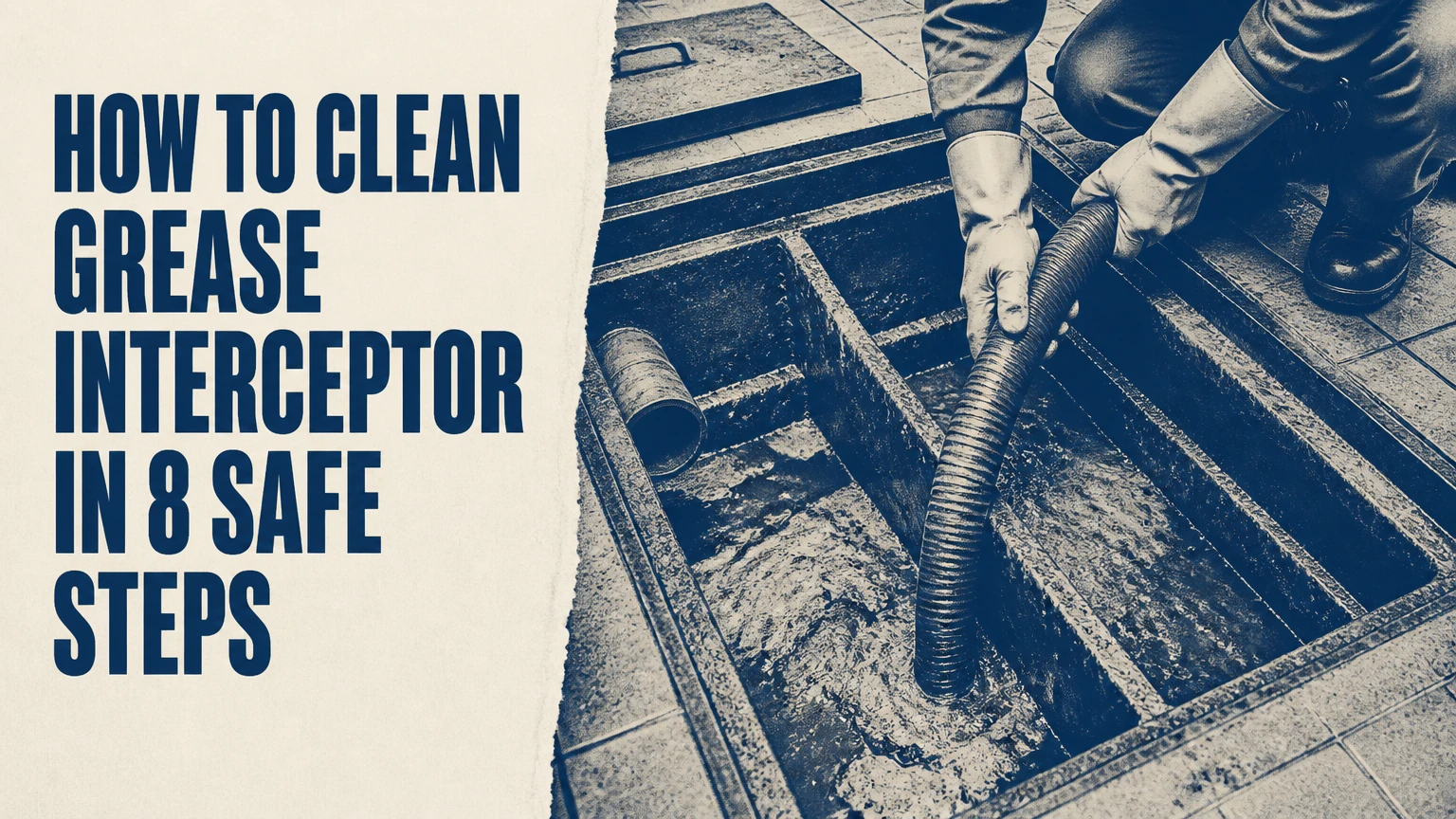
To clean a grease interceptor, shut down connected fixtures, cool the wastewater, remove the lid, measure the grease and sludge layers, scoop out solids, scrape and wash the tank and baffles, then reinstall the components and gasket correctly. A small under-sink interceptor usually takes 30-60 minutes; an outdoor gravity interceptor normally requires licensed pumping equipment.
Key Facts at a Glance
A grease interceptor should be serviced before grease and settled solids occupy approximately 25% of its effective liquid capacity, unless the local authority requires a stricter interval.
A small hydromechanical interceptor can usually be cleaned manually, while a buried gravity interceptor requires a vacuum truck or approved pumping contractor.
Hot water, bleach, caustic degreasers, enzymes, and emulsifying additives can move FOG downstream instead of removing it from the wastewater system.
The lid gasket, inlet baffle, outlet baffle, flow-control device, and outlet opening determine whether a cleaned interceptor works correctly.
Used grease and sludge require disposal through an approved waste route, not a floor drain, sink, storm drain, dumpster, or sewer opening.
Cleaning records should include the date, measured grease and solids depth, waste quantity, hauler, destination, and defects found.
What Is a Grease Interceptor?
A grease interceptor is a plumbing vessel that separates fats, oils, grease, and food solids from commercial wastewater before the wastewater enters a building drain or public sewer. Grease floats because its density is lower than water, while heavier food particles settle; the middle water layer exits through the outlet.
The terms grease trap and grease interceptor are often used interchangeably, although plumbing standards commonly distinguish smaller hydromechanical units from larger gravity interceptors. The equipment does not destroy grease. It temporarily stores separated material until an operator removes it.
A typical unit has an inlet, an outlet, internal baffles or tees, a removable lid, and sometimes a flow-control fitting. The inlet slows incoming wastewater, the baffles limit turbulence, and the outlet is positioned below the floating grease layer. If the tank fills beyond its working capacity, FOG can pass through the outlet.
The U.S. Environmental Protection Agency identifies fats, oils, and grease as a major source of sanitary sewer blockages and recommends preventing FOG from entering drains rather than relying on downstream treatment. Local sewer authorities apply that principle through food-service permits, inspection programs, and maintenance requirements.
How Does Separation Work?
Gravity separation requires time, low turbulence, and an adequate temperature difference between wastewater and stored grease. Food solids settle at the bottom, floating FOG accumulates at the top, and clarified wastewater travels through the center toward the outlet.
The separation process becomes less reliable when a kitchen sends very hot water, detergent-rich wash water, large food particles, or excessive flow into the interceptor. Hot wastewater keeps FOG liquid, while high flow can carry suspended grease and solids across the tank before separation occurs.
Which Type Are You Cleaning?
Identify the interceptor before opening it because a removable under-sink trap and a buried outdoor tank require different cleaning methods, tools, and waste controls. A hydromechanical unit is accessible for hand cleaning; a gravity interceptor is normally pumped from an access riser; an automatic device needs both solids removal and mechanical inspection.
| Interceptor type | Typical capacity | Typical location | Normal service method | Typical service interval |
|---|---|---|---|---|
| Hydromechanical trap | 10-100 gallons | Under a sink or in a service room | Hand removal and washout | 1-4 weeks |
| Gravity interceptor | 500-5,000+ gallons | Buried outdoors | Full pump-out by vacuum truck | 1-3 months |
| Automatic grease removal device | 15-50 gallons | Indoor kitchen equipment area | Skimming, solids removal, mechanical service | Daily skimming plus scheduled service |
| Passive floor or sink unit | 10-50 gallons | Beneath fixtures or in a cabinet | Hand cleaning and baffle inspection | 1-3 weeks |
Capacity and intervals are typical operating ranges, not universal legal limits. The approved design flow rate, kitchen volume, local plumbing code, wastewater authority, and manufacturer instructions control the actual requirement.
How Can You Identify the Unit?
Read the nameplate, lid label, installation drawing, or maintenance log before relying on appearance. Record the manufacturer, model, rated gallons per minute, liquid capacity, inlet and outlet size, and whether the unit contains a removable flow-control device.
A small rectangular stainless-steel or plastic box beneath a three-compartment sink is usually hydromechanical. A large round or rectangular lid at grade, often located outside the building, usually covers a gravity interceptor. A unit with a motor, skimmer wheel, heater, control panel, or grease collection container is an automatic grease removal device.
When Should You Clean It?
Clean a grease interceptor when the combined floating grease and settled solids reach roughly one-quarter of the liquid depth, or sooner when local rules, the manufacturer, or an inspection program requires it. A calendar interval alone is unreliable because a busy fryer kitchen can fill a small trap several times faster than a low-volume café.
The widely used 1/4 rule measures accumulated FOG plus bottom solids against the interceptor’s operating depth, not simply the thickness of the top grease layer. Use a calibrated gauge or measuring stick, follow the manufacturer’s measurement method, and document the result.
| Kitchen situation | Typical cleaning frequency | Main reason for variation | Recommended control |
|---|---|---|---|
| Coffee shop with light cooking | Every 2-4 weeks | Low fryer and dishwashing load | Weekly visual check |
| Fast-food kitchen | Every 1-2 weeks | High fryer and peak flow volume | Measure twice monthly |
| Full-service restaurant | Every 1-3 weeks | Menu, seating, and dish volume | Adjust after four records |
| School or institutional kitchen | Every 2-6 weeks | Meal schedule and batch washing | Inspect after service days |
| Large commercial kitchen | Every 1-3 months for outdoor tanks | Tank capacity and flow rate | Contract scheduled pumping |
A practical schedule starts with the shortest reasonable interval, then changes only after documented measurements. If a trap reaches 25% capacity after ten days, a monthly appointment is already too late.
What Should You Prepare Before Cleaning?
Prepare 30-60 minutes, two pairs of chemical-resistant gloves, eye protection, waterproof footwear, absorbent pads, a headlamp, plastic scraper, scoop, marked buckets, heavy-duty waste bags, detergent, stiff nylon brush, replacement gasket, and a camera or log sheet. Turn off connected fixtures and allow wastewater to cool before opening the lid.
Before You Start
| Requirement | Typical specification | Why it matters |
|---|---|---|
| Work time | 30-60 minutes | Covers removal, washing, and reassembly |
| Minimum crew | 1 person for small traps, 2 for heavy lids | Prevents lifting and spill injuries |
| Protective gloves | Chemical-resistant, 15-20 mil | Protects against contaminated wastewater |
| Waste containers | 2-5 marked buckets or sealed drums | Separates liquids, grease, and sludge |
| Scraper | Plastic or non-sparking hand scraper | Removes hardened FOG without damaging plastic |
| Cleaning solution | Warm water plus mild detergent | Removes residue without emulsifying FOG into drains |
| Spill protection | 2-4 absorbent pads or a containment tray | Protects floors and nearby equipment |
Do not enter a tank, place your head over an open access point, or work alone around a large interceptor. Confined-space hazards can include oxygen deficiency, hydrogen sulfide, methane, and sudden wastewater inflow. A vacuum truck operator or trained commercial contractor should handle outdoor tanks.
How to Clean a Grease Interceptor
The following procedure applies to an accessible hydromechanical interceptor that the manufacturer permits manual cleaning. The objective is complete physical removal of FOG and solids, not dilution or chemical dispersal.
Step 1: Stop Flow and Protect the Work Area
Stop dishwashing and prevent water from entering every fixture connected to the interceptor. Place absorbent pads beneath the lid and along the likely spill path, then confirm the wastewater is cool enough to handle without producing steam.
You will know the area is ready when no fixture adds water for several minutes and the floor has a containment layer. A common mistake is opening the trap during a dishwashing shift, which sends fresh wastewater into the work area and contaminates clean components.
Step 2: Remove the Lid Carefully
Loosen bolts or release clamps evenly, then lift the lid slowly while standing to the side rather than directly above the opening. Keep the lid screws, washers, and gasket in a clean container, and photograph the internal layout before removing baffles.
You will know the lid is safely removed when the gasket remains identifiable and no fastener has fallen into the tank. Do not force a bonded lid with a sharp tool against a plastic housing, because a cracked rim can prevent an airtight seal.
Step 3: Measure the Grease and Solids
Lower a marked measuring stick vertically through the access opening and record the total liquid depth, top FOG depth, and bottom sludge depth. Take a second reading near the opposite side if the unit is wide enough for uneven accumulation.
You will know the measurement is useful when the log shows separate top and bottom layers rather than one combined estimate. A common mistake is measuring only the visible grease cap, which understates capacity use when food solids occupy the tank bottom.
Step 4: Remove the Floating FOG
Skim the floating grease layer with a scoop or shallow container and place it directly into a sealed, labeled waste container. Work around the inlet and baffles without pushing the grease into the water layer or outlet opening.
You will know the top layer is removed when the water surface is visible across the tank and no thick mat remains around the baffles. Do not pour liquid grease into a trash bag without support, because warm FOG can leak through seams and create a floor hazard.
Step 5: Remove Settled Food Solids
Scoop the bottom sludge into a separate container, taking care not to bend the baffles or damage the tank floor. Remove disposable strainers and visible debris, but do not send the material into a sink, floor drain, toilet, storm drain, or sewer cleanout.
You will know the solids are removed when the scraper reaches the tank floor without a thick compacted layer. A common mistake is removing only the top grease, allowing the bottom sludge to reduce the retention volume and trigger another bypass soon after service.
Step 6: Clean the Walls, Baffles, and Flow Control
Remove only the baffles, tees, and flow-control components identified as removable by the manufacturer. Scrape hardened FOG from the tank walls, lid, inlet, outlet, baffles, and flow-control opening, then wash the parts with warm water, mild detergent, and a stiff nylon brush.
You will know the internal parts are clean when openings are unobstructed and the baffle edges are visible. Do not use a metal chisel on a plastic interceptor, and do not direct wash water into the connected drain while the trap is open.
Step 7: Inspect Components Before Reassembly
Check the inlet and outlet baffles for cracks, missing fasteners, distortion, and incorrect orientation. Inspect the flow-control device, lid rim, gasket, bolts, access cover, and nearby unions for damage or leakage.
You will know the interceptor is serviceable when the baffles are secure, the flow-control opening is clear, and the gasket is flexible enough to seal continuously. Replace a cracked baffle or hardened gasket rather than compensating with excessive bolt torque.
Step 8: Refill, Reassemble, and Test
Reinstall every baffle and flow-control component in its original position, then fill the interceptor with clean water until the normal operating level reaches the outlet elevation. Fit the gasket evenly, tighten the lid hardware in a cross pattern, and run cool water through the connected fixture while checking for leaks.
You will know the cleaning succeeded when water enters without backing up, the outlet flows normally, the lid remains sealed, and no wastewater escapes around fittings. Record the date, measured layers, waste quantity, defects, and next service date before returning the kitchen to operation.
Can You Clean a Large Outdoor Interceptor?
A large outdoor gravity interceptor should be fully pumped by a licensed or approved grease-waste contractor, not cleaned with buckets or a portable drain machine. The contractor should remove the entire contents, wash the tank and baffles as permitted, inspect the inlet and outlet, and provide a disposal record.
Partial pumping leaves settled solids and grease on the tank floor and walls, reducing the effective capacity. A proper service normally removes the floating layer, liquid contents, settled sludge, and accumulated material around the baffles. The access covers can be heavy, unstable, or located in a traffic area, so barricading and lifting controls matter.
Ask the contractor to document the vehicle or permit number, estimated gallons removed, disposal facility, service date, and observed defects. If the interceptor has two chambers, both chambers and the connecting passage require inspection. Never enter the tank to verify cleaning.
Which Chemicals and Methods Should You Avoid?
Avoid bleach, caustic drain cleaner, solvent degreasers, enzyme products marketed to dissolve grease, emulsifiers, and boiling-water flushes. These products may liquefy or disperse FOG temporarily, but the material can cool farther downstream and attach to the building drain or public sewer.
Warm water and mild detergent are appropriate for washing removed components when the wastewater is collected and disposed of properly. The cleaning objective is physical capture and approved disposal, not chemical disappearance.
Why Is Hot Water a Problem?
Hot water can carry liquid grease through the interceptor before the grease separates. When the wastewater cools in a drain line, the FOG can solidify against pipe walls, combine with paper or solids, and create a blockage beyond the interceptor.
A small amount of warm wash water used during contained cleaning is different from flushing a large volume of boiling water through the connected plumbing. Temperature, flow rate, detergent concentration, and pipe distance determine how much FOG remains mobile.
How Do You Fix Common Problems?
Common grease interceptor problems require diagnosis of flow, separation, sealing, and maintenance records rather than repeated chemical treatment. Odor usually points to residue, a failed gasket, poor venting, or infrequent service; slow drainage can indicate a full trap, blocked baffle, or downstream line restriction.
| Symptom | Likely cause | Immediate action | When to call a contractor |
|---|---|---|---|
| Sewer odor at lid | Cracked gasket or loose bolts | Replace gasket and retighten evenly | Odor persists after cleaning |
| Slow sink drainage | Full trap or blocked inlet | Stop FOG flow and inspect trap | Drain remains slow after service |
| Grease at outlet | Missing baffle or excess flow | Inspect baffles and flow control | Outlet line needs opening |
| Wastewater backing up | Full interceptor or blocked drain | Shut fixtures and contain spill | Any sewage spill or repeated backup |
| Tank fills unusually fast | Food solids or undersized unit | Improve scraping and measure flow | Design review or replacement needed |
| Water leaks at lid | Warped rim or damaged seal | Replace gasket and inspect rim | Housing or access cover is damaged |
What If the Interceptor Still Smells?
Clean residue from the lid underside, baffles, and upper walls, then inspect the gasket and plumbing vent. A clean interceptor can still smell if the lid does not seal, the vent is obstructed, or wastewater remains stagnant in an upstream branch.
Do not mask the odor with fragrance or pour disinfectant into the trap. Those approaches leave the source in place and can introduce chemicals into the wastewater system.
What If the Sink Is Still Slow?
Check the interceptor inlet and outlet first, then inspect the flow-control fitting and the downstream building drain. If the trap is clean but the sink remains slow, a grease deposit may already exist in the line between the interceptor and sewer connection.
Do not use chemical drain opener in a commercial kitchen line connected to an interceptor. A plumber can mechanically clear and inspect the line while protecting workers from corrosive residues.
What If Grease Has Reached the Sewer?
Stop using the affected fixtures, contain any overflow, and notify the responsible facilities manager or wastewater authority when required by the local permit. Arrange an interceptor service and a downstream line inspection, then correct the source condition, such as excess flow, missing baffles, or an undersized unit.
Municipal response varies. Some authorities require written reports, corrective maintenance, or follow-up inspections after a confirmed discharge, while others use a routine inspection schedule.
Which Maintenance Approach Fits Your Kitchen?
Small cafés generally benefit from employee cleaning every 1-3 weeks with a measurement log. High-volume restaurants need shorter intervals or scheduled pumping, while large buried interceptors should use a recurring contractor arrangement based on measured accumulation rather than an arbitrary monthly promise.
| Kitchen profile | Equipment commonly found | Best maintenance approach | Typical direct service cost |
|---|---|---|---|
| Café, 1-2 sinks | 10-25 gallon indoor trap | Employee cleaning every 1-3 weeks | $0-$150 per service |
| Mid-size restaurant | 25-100 gallon trap or AGRD | Employee checks plus contractor service | $150-$500 per service |
| Large restaurant | 500-1,500 gallon outdoor tank | Licensed pump-out every 1-3 months | $300-$1,000 per service |
| Hotel or food plant | 1,500-5,000+ gallon interceptor | Contract pumping and inspection | $600-$2,000+ per service |
These are typical U.S. commercial ranges and exclude emergency excavation, line jetting, replacement parts, access problems, and regional disposal charges. Local rates and permit rules can change the total substantially.
Which Unit Is Better for Limited Space?
| Option | Space requirement | Labor requirement | Main limitation | Suitable setting |
|---|---|---|---|---|
| Under-sink hydromechanical | 10-100 gallons indoors | Manual service every 1-4 weeks | Limited retention capacity | Café or breakroom |
| Outdoor gravity interceptor | 500-5,000+ gallons below grade | Vacuum pumping every 1-3 months | Excavation and access cost | Restaurant or hotel |
| Automatic removal device | 15-50 gallons plus power | Skimming and mechanical checks | Motor and sensor maintenance | High-grease kitchen |
| Multiple small traps | Several cabinet or floor locations | Several separate cleaning points | Uneven maintenance | Renovated kitchen |
An automatic device reduces daily manual skimming but does not eliminate maintenance. Its scraper, heater, motor, sensor, grease drawer, and solids area still require inspection and cleaning according to the manufacturer’s schedule.
Common Mistakes and How to Fix Them
- Cleaning only the grease cap: Remove bottom sludge as well, because solids reduce liquid volume and can block the inlet.
- Using a calendar without measuring: Record actual layer depths and shorten the interval when the 1/4 threshold arrives early.
- Reinstalling baffles backward: Photograph the layout first and compare every component with the manufacturer diagram.
- Leaving the gasket dirty or dry: Wipe the sealing surfaces, replace flattened rubber, and tighten bolts evenly.
- Disposing of waste in a dumpster: Use an approved grease-waste hauler or the disposal route required by the local authority.
- Ignoring a recurring backup: Inspect the downstream drain and confirm the interceptor has adequate rated flow for the connected fixtures.
A counterintuitive maintenance fact is that a trap can look clean at the surface while its sludge layer has already consumed most of its retention volume. Measuring both layers is more reliable than judging the unit by odor or appearance.
Another practitioner rule is to clean after the busiest service period only when the kitchen can remain out of operation long enough for the wastewater to cool and settle. Opening a recently active trap increases splash, odor, and exposure risk.
The interceptor is not a substitute for source control. Scrape plates into waste containers, collect fryer oil separately, dry-wipe greasy cookware before washing, use sink strainers, and keep food scraps out of the drain.
What Records Should You Keep?
Maintain a service log with the interceptor location, equipment identification, date, worker or contractor, top grease depth, bottom solids depth, total liquid depth, waste volume, disposal destination, gasket condition, baffle condition, and next scheduled date. Retain invoices, manifests, photographs, and inspection notices according to local requirements.
| Record item | Example entry | Review frequency | Operational value |
|---|---|---|---|
| Top FOG depth | 2 inches | Every service | Shows floating accumulation |
| Bottom sludge depth | 3 inches | Every service | Shows lost retention volume |
| Total liquid depth | 20 inches | Every service | Enables 1/4-rule calculation |
| Waste quantity | 18 gallons | Every service | Checks service completeness |
| Next service date | 14 days later | Every service | Creates accountable scheduling |
| Defect noted | Outlet baffle cracked | Immediately | Triggers repair before bypass |
A log also reveals changes in kitchen behavior. If grease accumulation doubles after adding a fryer or extending operating hours, the maintenance interval, source controls, or interceptor design may need revision.
Frequently Asked Questions
Can I clean a grease interceptor without removing all the water?
You can skim floating FOG and remove some solids without bailing all the water, but a complete manual service requires enough liquid removal to expose and wash the tank floor, walls, baffles, and flow-control parts. Outdoor gravity interceptors should receive a full pump-out rather than a partial surface skim.
How long does a grease interceptor take to clean?
A small under-sink grease interceptor typically takes 30-60 minutes, including preparation, waste removal, washing, inspection, and testing. A large outdoor interceptor commonly takes 30-90 minutes for pumping, although traffic control, multiple chambers, difficult access, or downstream inspection can extend the visit.
Can restaurant employees clean a grease trap?
Restaurant employees can usually clean an accessible small hydromechanical trap when the employer provides training, protective equipment, waste containers, and a lawful disposal route. Employees should not enter tanks, open hazardous outdoor access points, operate vacuum equipment, or handle a spill beyond their training.
What happens if a grease interceptor is not cleaned?
An unmaintained grease interceptor loses separation capacity, causes slow drains and odors, and can send FOG and food solids into the building sewer or public main. The resulting response may involve emergency pumping, drain cleaning, property damage, regulatory reporting, and local penalties.
Should a grease interceptor be full of water after cleaning?
A passive grease interceptor should contain water after reassembly because the liquid creates the separation chamber and supports the intended outlet elevation. Fill it with clean water to the manufacturer’s operating level, then check that the inlet and outlet connections remain leak-free.
How do I dispose of grease interceptor waste?
Store removed FOG and sludge in sealed, labeled containers and transfer them through an approved grease-waste or wastewater contractor. Disposal rules differ by jurisdiction, but pouring the material into a drain, sewer cleanout, storm drain, soil, or ordinary trash is unsafe and commonly prohibited.
The Bottom Line
How to clean a grease interceptor correctly depends on the equipment type. Hand-clean a small accessible trap by measuring both accumulation layers, physically removing FOG and sludge, washing the internal parts with contained warm water, checking baffles and seals, and documenting the service. Have a qualified contractor pump buried gravity interceptors and automatic devices. Schedule the next service before accumulated grease and solids reach approximately one-quarter of the interceptor’s effective capacity, while following the local wastewater authority’s stricter rule when one applies.