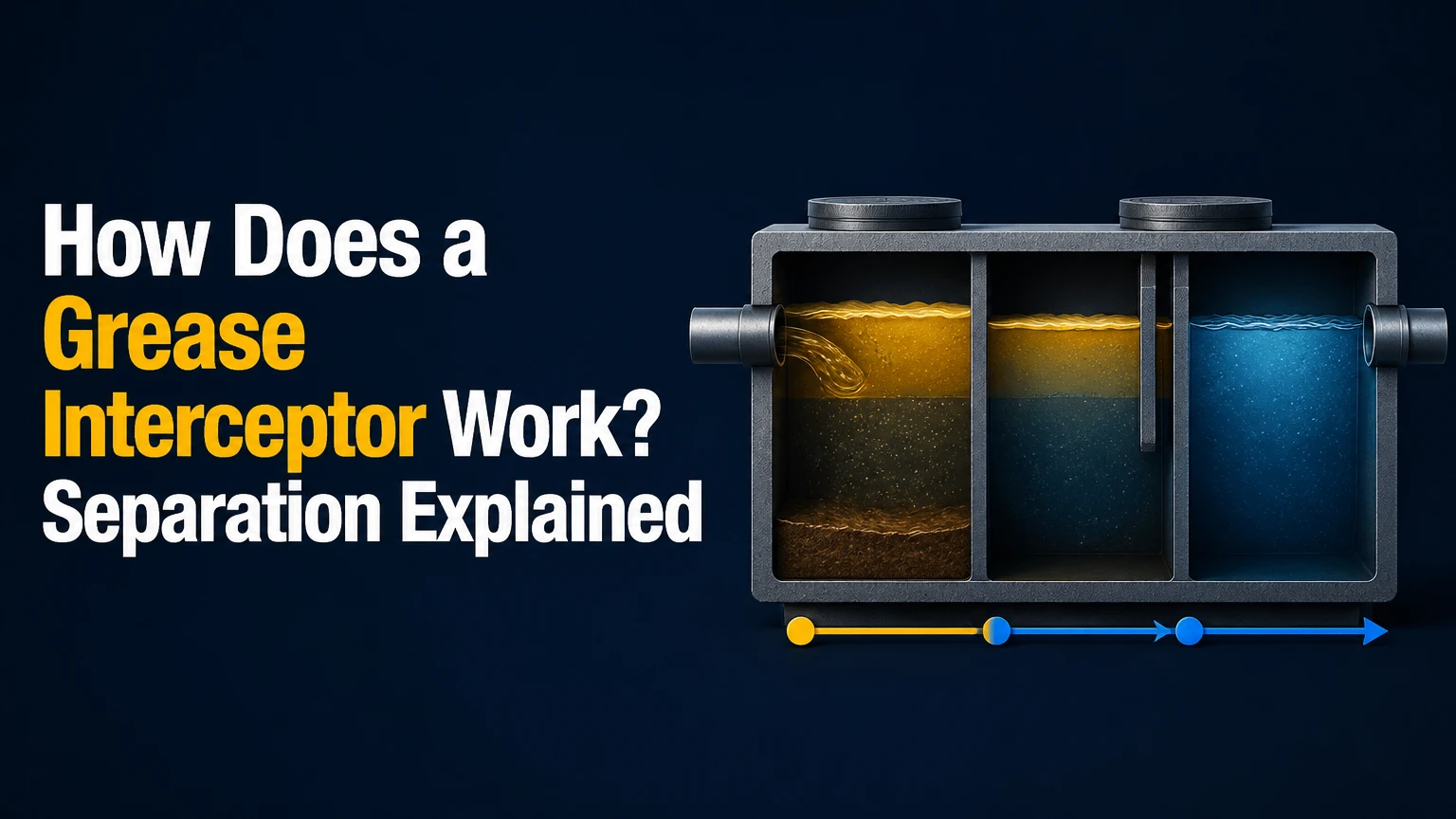
A grease interceptor separates fats, oils, grease, and settleable food solids from commercial kitchen wastewater before discharge to the sanitary sewer. Controlled flow gives the wastewater enough calm volume for lighter FOG to float and heavier solids to settle, while baffles direct the clearer middle layer toward the outlet.
Key Facts at a Glance
- A grease interceptor uses density difference, detention volume, baffling, and controlled flow rather than a filter membrane.
- FOG floats because common fats and oils have a lower specific gravity than water, while food solids generally settle.
- The outlet baffle helps prevent the floating grease layer and bottom sludge from leaving with the effluent.
- A 25% combined grease-and-solids rule is widely used for service decisions, but the enforceable interval comes from the local sewer authority.
- Hydro-mechanical units are compact and fixture-adjacent; gravity interceptors provide more storage but require excavation.
- Hot water, detergents, and emulsifying chemicals can reduce capture by keeping grease dispersed until it reaches downstream piping.
What Is a Grease Interceptor?
A grease interceptor is a plumbing pretreatment device that removes fats, oils, grease, and settleable solids from wastewater generated by food preparation. The terms grease trap and grease interceptor are often used interchangeably, although some plumbing codes distinguish a smaller hydro-mechanical trap from a larger gravity interceptor.
The device protects the sanitary sewer rather than making wastewater potable. Captured material remains inside the tank until staff or a licensed pumping contractor removes it. If the tank is neglected, stored grease and sludge reduce its effective volume, increase turbulence, and allow FOG to pass into the building drain or public sewer.
Municipal sewer programs regulate these units because restaurant grease can accumulate at pipe walls, combine with solids, and restrict sewer capacity. The U.S. Environmental Protection Agency identifies fats, oils, and grease as a common cause of sanitary sewer overflows, while local authorities set connection, sizing, inspection, and pumping requirements.
A grease interceptor is different from an oil-water separator. Grease interceptors target kitchen FOG and food solids. Oil-water separators target petroleum hydrocarbons, such as diesel or lubricating oil, and often use different design standards, coalescing media, and discharge requirements.
How Does a Grease Interceptor Work?
A grease interceptor works through a controlled sequence of entry, turbulence reduction, separation, and middle-zone discharge. Wastewater enters through a flow-control assembly, slows behind an inlet baffle, separates into floating FOG and settled solids, then exits through an outlet positioned below the grease layer and above the sludge layer.
1. Wastewater Enters the Inlet
Water from sinks, pot-wash stations, prep sinks, floor drains, and selected dishwashing fixtures flows through the building drain into the interceptor. The inlet pipe may connect to a flow-control fitting that limits the discharge rate to the unit’s rated capacity.
Flow control matters because a high-volume surge can carry grease through the tank before separation occurs. A correctly sized interceptor still performs poorly when several fixtures discharge simultaneously at a rate above the device rating.
2. The Inlet Baffle Reduces Turbulence
An inlet baffle turns or diffuses incoming wastewater so the tank contents remain comparatively calm. Without that baffle, the incoming jet can stir settled food particles and break floating grease into smaller droplets.
The inlet baffle does not remove grease by itself. Its function is hydraulic: it spreads the incoming flow and protects the separation zone from excessive velocity.
3. Grease Floats and Solids Settle
The separation chamber creates a vertical density gradient. Most kitchen FOG has a specific gravity below water, commonly around 0.88-0.95 depending on the material and temperature, so it rises toward the surface. Sand, food particles, bone fragments, and other dense solids move toward the bottom.
The middle layer contains wastewater with less visible grease and fewer settleable solids. That water is not fully treated wastewater in the municipal treatment sense. It has simply passed through a physical pretreatment stage.
4. The Outlet Draws From the Middle Zone
The outlet baffle, tee, or inverted outlet pipe takes flow from below the upper scum layer and above the lower sludge layer. The arrangement keeps the two captured waste layers inside the tank while allowing the intermediate liquid to continue toward the sanitary sewer.
A damaged, missing, short, or incorrectly installed outlet assembly can defeat the separation process. The tank may look full of grease even while the outlet sends grease-laden water downstream.
5. Captured Waste Accumulates
The upper layer becomes a grease cap or scum layer. The lower layer becomes sludge that contains food particles, settled grease, and wastewater solids. Both layers consume usable liquid volume.
The interceptor is therefore a storage device as well as a separator. Cleaning restores the separation volume; it does not permanently eliminate the incoming FOG load.
What Happens Inside the Tank?
The tank normally contains three operating zones: floating scum, intermediate liquid, and settled sludge. Layer thickness changes with menu, temperature, fixture use, cleaning practices, and time since service.
| Internal zone | Main contents | Where it accumulates | Operational risk |
|---|---|---|---|
| Upper scum layer | FOG, floating food particles, grease cap | Tank surface and underside of lid | Grease carryover when outlet is submerged or turbulence increases |
| Middle liquid zone | Pretreated kitchen wastewater | Between scum and sludge | Reduced separation when detention volume becomes too small |
| Lower sludge layer | Food solids, grit, settled organic matter | Tank floor and corners | Blocked baffles, odors, and reduced liquid capacity |
The layers are not perfectly sharp. Warm wastewater, detergents, agitation, and biological activity create emulsions and suspended particles that can remain dispersed. A visual layer diagram is useful for explaining the principle, but actual tank contents can be thick, mixed, or difficult to measure.
Which Components Make Separation Possible?
A grease interceptor depends on several components working together. Tank volume alone cannot compensate for an obstructed baffle, excessive inlet flow, or a poor fixture connection.
| Component | Typical function | Failure symptom | Inspection focus |
|---|---|---|---|
| Flow-control fitting | Limits inlet flow, often to a rated GPM | Grease in outlet, turbulent contents | Confirm rating and unobstructed air intake |
| Inlet baffle | Dissipates incoming energy | Scum layer churns or sludge resuspends | Check attachment, corrosion, and blockage |
| Separation chamber | Provides detention volume | Short service interval and carryover | Measure grease and solids accumulation |
| Outlet baffle or tee | Draws from middle liquid zone | Cloudy, greasy discharge | Confirm correct depth and secure fit |
| Access cover and gasket | Contains odors and permits service | Kitchen odor or leakage | Inspect seal, bolts, and lid condition |
| Vent connection | Balances air pressure and supports drainage | Slow drainage or odors | Verify code-compliant venting |
A flow-control device may include an air intake. Blocking that air passage can alter the hydraulic behavior of the fitting and cause drainage problems. The exact configuration depends on the product listing and local plumbing code.
What Are the Main Types of Grease Interceptors?
Commercial kitchens generally use hydro-mechanical grease interceptors, gravity grease interceptors, or automatic grease removal devices. The correct category depends on available space, fixture flow, grease production, access for service, local approval, and the building’s drainage layout.
| Type | Typical location | Rating basis | Typical maintenance pattern |
|---|---|---|---|
| Hydro-mechanical interceptor | Under a sink, beside a fixture, or recessed indoors | Flow in GPM and grease capacity in pounds | Inspection and cleaning often weekly to monthly |
| Gravity interceptor | Outside, underground, or in a dedicated service area | Liquid volume in gallons and calculated flow | Pumping commonly every 1-3 months, sometimes less often |
| Automatic grease removal device | Indoor, near connected fixtures | Flow in GPM and grease capacity | Daily or frequent solids-bin attention plus periodic service |
| Passive point-of-use trap | Directly below one approved fixture | Manufacturer flow rating | Frequent manual cleaning and local inspection |
Hydro-Mechanical Interceptors
Hydro-mechanical grease interceptors use a compact tank, internal baffles, and controlled flow to separate FOG close to the source. Stainless steel and polymer bodies are common, and many units fit below a commercial sink.
Their small capacity makes access easy but service intervals short. A café with limited cooking may manage a small unit successfully, while a fryer-heavy restaurant can fill the same device rapidly.
Hydro-mechanical units are not automatically suitable for every sink. A floor drain, wok station, pot sink, or dishwasher can add a large solids or hot-water load that exceeds the unit’s intended application.
Gravity Grease Interceptors
Gravity grease interceptors use a larger tank and longer hydraulic detention than compact indoor units. Outdoor tanks may hold hundreds or thousands of gallons, giving the operator substantially more storage for grease and solids.
Gravity does not mean wastewater remains in the tank for several hours in every installation. Actual detention depends on tank volume, operating flow, peak discharge, short-circuiting, and the design standard used. PDI G101 and ASME A112.14.3 address grease interceptor performance and construction, but local authorities may impose additional criteria.
Concrete, fiberglass, and polyethylene are common materials. Concrete provides structural mass, while polymer tanks resist some forms of chemical degradation but still require correct bedding, anchoring, traffic loading, and groundwater protection.
Automatic Grease Removal Devices
An automatic grease removal device, often called a GRD, combines separation with mechanical skimming. A motorized wheel, belt, wiper, or similar mechanism removes floating grease into a separate container.
GRDs can reduce manual removal of the surface layer, especially where outdoor excavation is impossible. They still need inspection, electrical maintenance, solids removal, and periodic internal cleaning. Automatic skimming does not mean the unit can accept unlimited food particles or bypass local pumping rules.
How Are Grease Interceptors Sized?
Grease interceptor sizing requires fixture flow, fixture volume, drainage layout, grease production, solids load, and local code criteria. A device selected only by sink size or by the number printed on a product page can be undersized.
Designers commonly calculate fixture drainage flow using a method specified by the authority having jurisdiction. The calculation may consider sink compartments, gallons discharged, drainage time, fixture units, or a manufacturer’s approved sizing procedure.
| Kitchen scenario | Common load characteristics | Typical starting point | Main sizing concern |
|---|---|---|---|
| Coffee shop | Beverage washing, light food preparation, low fryer use | Small hydro-mechanical unit, often 15-25 GPM | Peak sink discharge and available access |
| Bakery | Dough residue, washdown, moderate solids | Hydro-mechanical or small gravity unit | Flour, batter, and solids accumulation |
| Full-service restaurant | Multiple sinks, cooking oils, dishwashing | Larger hydro-mechanical or gravity unit | Combined fixture flow and grease production |
| High-volume fryer kitchen | Continuous FOG and frequent pot washing | Gravity interceptor or approved GRD system | Storage capacity, pump access, and peak flow |
| Institutional kitchen | Batch cooking and scheduled cleanup | Engineered gravity or GRD arrangement | Large intermittent surges and solids load |
The “25% rule” commonly means service is required before the combined thickness or volume of the grease and solids layers reaches 25% of the interceptor’s liquid capacity. It is a useful operating benchmark, not a universal law. A city may specify a fixed pumping interval, a different percentage, inspection logs, or a more frequent schedule.
How Often Should a Grease Interceptor Be Cleaned?
A grease interceptor should be cleaned before accumulated grease and solids reduce performance, with the interval established by measured buildup and local requirements. Typical service ranges are weekly to monthly for small indoor units and roughly one to three months for many outdoor commercial interceptors, but kitchen loading can shorten either interval.
| Unit or business condition | Typical inspection interval | Typical cleaning or pumping interval | Adjustment trigger |
|---|---|---|---|
| Small café, low FOG | Weekly visual check | Every 1-4 weeks | Rapid scum buildup or odor |
| Bakery with high solids | Weekly | Every 1-3 weeks | Bottom sludge reaches outlet depth |
| Restaurant with moderate cooking | Weekly to biweekly | Every 2-8 weeks | 25% combined accumulation |
| High-volume fryer operation | Several times weekly | Weekly to monthly | Grease cap thickens between visits |
| Large gravity interceptor | Monthly or according to permit | Every 1-3 months, sometimes longer | Local ordinance or measured layer depth |
Operators should record service date, grease depth, solids depth, hauler information, destination, and unusual conditions. Records help demonstrate compliance and reveal whether the unit is correctly sized.
Cleaning means removing the grease and sludge, then inspecting baffles, fittings, walls, and seals. Pumping only the liquid while leaving thick waste in the tank restores little capacity.
How Much Does Installation Cost?
Typical commercial installation costs range from about $500-$2,000 for a straightforward indoor hydro-mechanical unit and $7,000-$30,000 or more for an outdoor gravity system. Local labor rates, excavation, permits, traffic loading, pump access, replacement of concrete, and wastewater rerouting create wide variation.
| Installation type | Equipment range, typical | Installation range, typical | Common timeframe |
|---|---|---|---|
| Small indoor hydro-mechanical | $300-$1,500 | $300-$2,000 | 2-8 hours |
| Larger indoor HGI | $1,000-$4,000 | $1,000-$5,000 | 1-2 days |
| Indoor GRD | $2,000-$8,000 | $1,000-$5,000 | 1-2 days |
| Outdoor gravity interceptor | $2,000-$12,000 | $7,000-$30,000+ | 3-10 business days |
These are planning ranges, not bids. A gravity system may require a permit drawing, utility locating, excavation protection, concrete work, risers, traffic-rated covers, sampling access, and a vacuum truck access route.
A low equipment price can conceal high lifecycle cost. An indoor unit may need frequent labor-intensive cleaning, while a gravity tank costs more initially but stores substantially more waste.
Can a Dishwasher Connect to a Grease Interceptor?
A dishwasher should connect to a grease interceptor only when the unit, drainage design, temperature, and local authority allow that connection. High-temperature discharge can liquefy accumulated grease, while detergent can emulsify FOG and carry it through the separator.
Commercial dishwashers also create rapid, high-volume discharges. The relevant question is not whether a pipe can physically connect, but whether the interceptor is rated and approved for the temperature, flow, detergent chemistry, and grease load.
Ask the plumbing designer or sewer authority to confirm:
- The dishwasher’s peak discharge temperature and gallons per cycle.
- The interceptor’s listed flow and temperature limitations.
- Whether a cooling or tempering arrangement is required.
- Whether local code requires the dishwasher to bypass a small point-of-use trap.
- Whether the selected unit has documented performance for that fixture.
Never use cold water as a substitute for correct sizing. Cooling may solidify grease inside the drain line rather than improve capture.
What Should Never Enter the Interceptor?
Food businesses should keep concentrated grease, disposable wipes, plastic, packaging, chemicals, and excessive solids out of the drainage system. Staff should scrape plates and pans into a waste container, collect fryer oil separately, and use dry cleanup methods before washing.
Common practices that reduce performance
- Pouring boiling water into a sink can melt grease in the interceptor and move it downstream.
- Strong degreasers and emulsifying detergents can disperse FOG into fine droplets that escape capture.
- Garbage disposals can grind solids into a high-volume sludge load and shorten the service interval.
- Enzyme or bacterial additives do not replace pumping and may conflict with local pretreatment rules.
- Mop water from heavily greasy floors can overload a small unit.
- Pouring fryer oil into a drain adds concentrated FOG that no properly sized separator should be expected to absorb quickly.
A practical rule is to remove grease before water contacts it. Scrape, wipe, collect, and then wash.
Why Does a Grease Interceptor Smell?
A grease interceptor smells when anaerobic decomposition, trapped solids, exposed grease, poor ventilation, or a failed cover seal allows odorous gases into the work area. Odor alone does not identify the cause, so inspect the lid, gasket, vent, inlet, outlet, and waste layers before adding chemicals.
| Symptom | Likely cause | First corrective action |
|---|---|---|
| Odor near the lid | Failed gasket or loose cover | Replace seal and tighten fasteners evenly |
| Odor after cleaning | Residual sludge or dirty lid underside | Wash approved surfaces and inspect corners |
| Odor from a drain | Dry trap or venting problem | Restore trap seal and check vent |
| Odor with slow drainage | Blocked baffle or downstream pipe | Stop discharge and inspect the interceptor |
| Persistent odor after pumping | Structural defect or overloaded system | Arrange plumbing and interceptor inspection |
Do not seal a required vent to hide odor. A sealed cover with defective venting can create drainage and pressure problems.
Why Is a Kitchen Drain Slow or Backed Up?
A slow or backed-up kitchen drain usually indicates an overfilled interceptor, blocked baffle, obstructed inlet or outlet, grease-coated downstream piping, or inadequate venting. Stop sending wastewater through the affected fixtures, then inspect and pump the interceptor before assuming the municipal sewer is responsible.
If the tank is full of thick grease and sludge, a complete pump-out is the appropriate first action. The contractor should verify that the baffles remain attached and that the outlet tee is open.
A backup that returns immediately after cleaning suggests a second problem. Common causes include a collapsed or grease-filled building drain, a missing flow-control fitting, excessive fixture flow, a dishwasher connection that violates the design, or a tank too small for the kitchen.
Do not use caustic drain opener as a routine response. It can create a worker hazard, damage components, and move contaminants without correcting the hydraulic cause.
Why Is Grease Escaping Into the Sewer?
Grease escapes when the wastewater moves too quickly, remains too hot, contains emulsified FOG, or passes through a damaged separation system. An overfilled tank has less effective volume, so incoming flow disturbs both the scum and sludge layers.
Check these conditions in order:
- Measure the combined grease and solids depth.
- Confirm the inlet flow-control assembly is present and unobstructed.
- Inspect inlet and outlet baffles for corrosion, displacement, or missing sections.
- Compare actual fixture flow with the rated GPM.
- Check whether hot dishwasher or washdown water enters the unit.
- Inspect downstream piping for accumulated grease.
- Review cleaning records and the kitchen’s grease-handling practices.
A cloudy discharge does not always mean the interceptor is defective. Detergent, starch, flour, and fine food particles can remain suspended even when the baffles are intact.
Grease Trap Versus Grease Interceptor: What Is the Difference?
The difference is usually size, location, and terminology, although definitions vary by jurisdiction and manufacturer. A grease trap commonly describes a smaller hydro-mechanical device installed near a fixture, while a grease interceptor often describes a larger gravity tank serving multiple fixtures.
| Decision factor | Small grease trap or HGI | Gravity grease interceptor | Automatic GRD |
|---|---|---|---|
| Typical setting | Under-sink or indoor | Underground or exterior | Indoor near source |
| Typical capacity | 15-100 GPM; 30-200 pounds | 500-5,000+ gallons | 15-100 GPM; model-specific |
| Excavation | None | Required in most installations | None |
| Grease removal | Manual | Pump truck | Mechanical skimming |
| Best constraint | Limited space and short pipe runs | High load and available exterior space | No excavation and labor reduction |
| Main limitation | Frequent service and low storage | High construction cost | Moving parts and electrical dependence |
A local plumbing or wastewater authority may use the terms differently. Approval and sizing criteria matter more than the label on a sales page.
Which Type Fits Different Kitchens?
A low-volume café often fits a properly sized indoor hydro-mechanical interceptor when staff can access and clean it regularly. A fryer-heavy restaurant usually benefits from a gravity interceptor because the larger storage volume tolerates higher FOG and solids loading.
A GRD may fit a high-rise or dense urban kitchen where excavation is impossible and daily operational attention is available. It is a poor choice where electrical reliability is weak, staff cannot empty the collection container, or solids loading is extreme.
Practitioner insights
The hottest wastewater is often the least reliable for grease capture. Warm grease stays mobile, and detergent keeps it dispersed. A separator needs the wastewater to enter within its approved operating conditions, not simply to be as hot as possible for cleaning.
The largest tank is not automatically the best tank. A gravity interceptor with poor access, inadequate venting, or incorrect inlet and outlet elevations can underperform despite its volume.
The 25% rule is a trigger, not a design method. A unit can pass grease while below 25% if flow is excessive or baffles are damaged. Conversely, a correctly operating unit may require service sooner because local rules use fixed intervals.
What Is a Grease Interceptor Not Good For?
A grease interceptor is not designed to remove dissolved detergents, solvents, petroleum fuel, heavy metals, pathogens, or every suspended contaminant. The device provides physical FOG and solids separation, not complete wastewater treatment.
A separator also cannot correct poor kitchen practices. Excess fryer oil, large food scraps, disposable materials, and unregulated chemical additives create loads that overwhelm even a correctly sized unit.
Outdoor gravity tanks have limitations too. They need safe access for pumping, protection from vehicle loading, adequate burial conditions, and inspection of structural components. Indoor units avoid excavation but transfer more maintenance responsibility to kitchen staff.
FAQ
Does a grease interceptor filter water?
A grease interceptor does not filter water through a replaceable screen or membrane. The device separates wastewater by gravity, buoyancy, detention, and baffling, removing floating FOG and settleable solids while the intermediate liquid exits toward the sanitary sewer.
How long does grease stay in an interceptor?
Grease remains in an interceptor until it is manually pumped, removed during cleaning, or mechanically skimmed by an approved GRD. The wastewater residence time is much shorter and depends on flow and tank volume, so a large tank does not mean water remains inside for hours.
Can a residential kitchen use a commercial grease interceptor?
A residential kitchen can use a grease interceptor when local plumbing rules require or permit one and the unit matches the fixture load. Most ordinary homes generate too little commercial FOG to justify a large outdoor tank, while home-based food businesses may face commercial pretreatment requirements.
Can grease be recycled after removal?
Collected grease can sometimes be recycled into rendering, biodiesel, or another approved recovery stream. The material must be kept separate from wastewater, documented through the hauler, and accepted by a licensed recycler because contaminated interceptor solids may not qualify.
What happens if a grease interceptor is too small?
An undersized grease interceptor fills quickly, experiences higher flow velocity, and sends more FOG and solids into downstream piping. The symptoms are short cleaning intervals, persistent odors, cloudy discharge, backups, and repeated sewer complaints despite apparently regular pumping.
Is a grease interceptor required by law?
Requirement depends on the local sewer authority, plumbing code, building use, and discharge characteristics. Restaurants, institutional kitchens, bakeries, and food manufacturers commonly require approved pretreatment, but the authority having jurisdiction determines whether a specific fixture or business must connect to one.
The Bottom Line
A grease interceptor works by slowing controlled kitchen wastewater long enough for buoyant FOG to rise and dense food solids to settle, while an outlet baffle removes water from the middle layer. Correct sizing, moderate inlet temperature, intact baffles, and cleaning before excessive accumulation determine whether the system protects the sewer.
For a small low-volume kitchen, a hydro-mechanical unit may be practical. For a high-volume restaurant with exterior space, a gravity interceptor usually provides more storage. Where excavation is unavailable, an automatic grease removal device can reduce surface-skimming labor, but it still requires solids management and maintenance.
Understanding how a grease interceptor works is only the first step. The reliable result comes from matching the device to actual fixture flow, following local rules, recording service, and keeping concentrated grease and solids out of the drain.