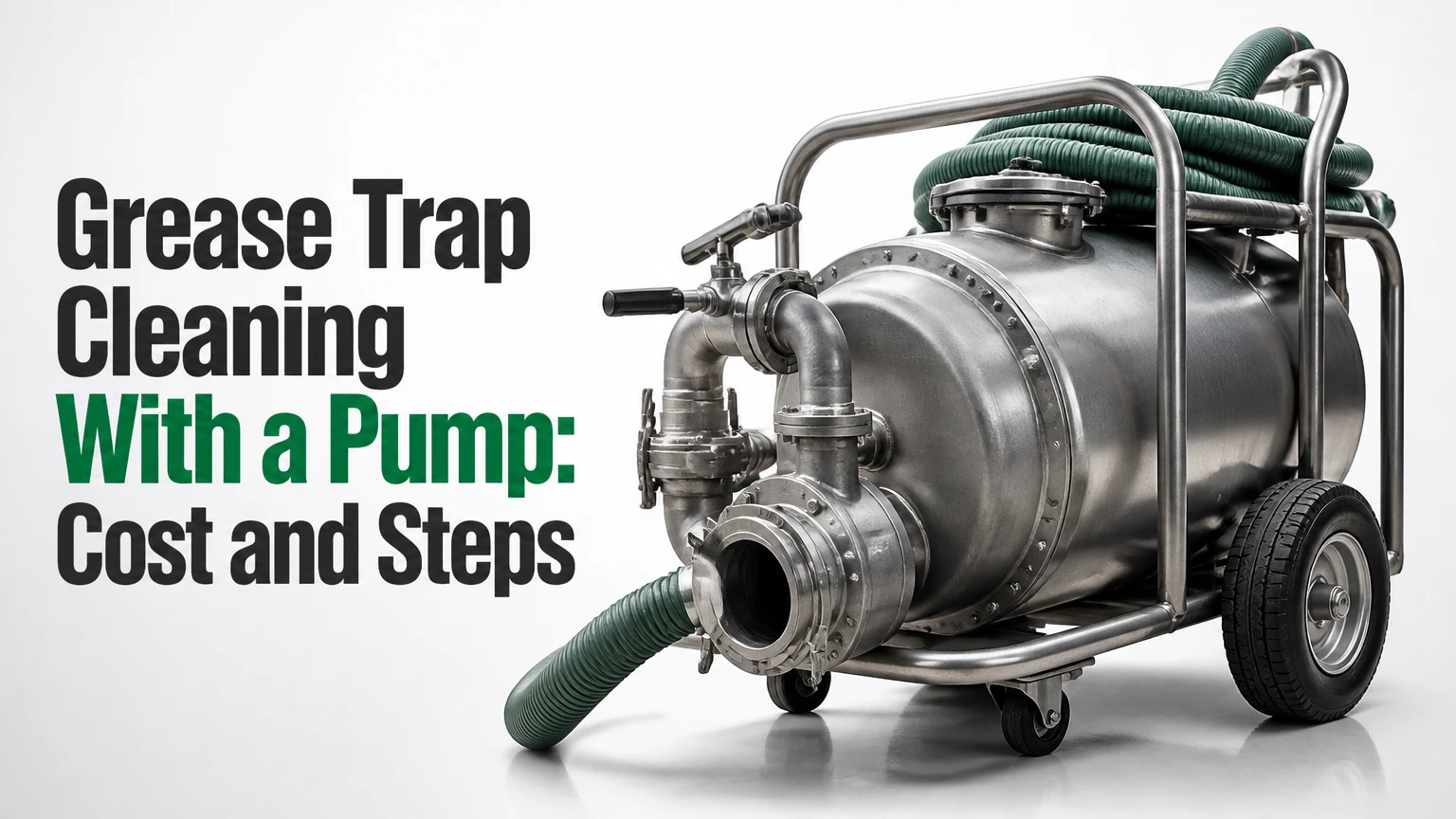
Grease trap cleaning with a pump removes wastewater, fats, oils, grease, and settled solids from a plumbing interceptor so the trap can separate kitchen waste correctly. A complete service isolates the fixture, measures accumulated layers, extracts the bottom sludge and floating grease, cleans accessible components, inspects the tank, refills it with water, and documents legal disposal.
Key Facts at a Glance
- A grease trap must be pumped from the bottom and the top, not skimmed only at the surface.
- The commonly cited 25% rule refers to FOG and solids occupying about one-quarter of the trap’s operating depth; the enforceable threshold depends on the local sewer authority.
- A portable diaphragm or air-operated double-diaphragm pump suits some small indoor traps, while outdoor interceptors generally require a vacuum truck.
- A wet-dry vacuum is not automatically safe or suitable because grease, wastewater, electrical equipment, and sewer gases create separate hazards.
- Typical commercial pumping costs range from $125-$180 for a small indoor trap and $225-$600 for a 1,000-1,500 gallon interceptor.
- Pumping does not repair blocked inlet pipes, outlet lines, damaged baffles, cracked tanks, or undersized interceptors.
What Is Grease Trap Cleaning With a Pump?
Grease trap cleaning with a pump is the controlled removal of liquid wastewater, floating FOG, and settled food solids from a grease interceptor. The pump transfers waste into a sealed container or vacuum truck tank for approved disposal, after which workers clean accessible surfaces and restore the trap to operating condition.
“Grease trap” commonly describes a small hydromechanical interceptor beneath a sink, whereas “grease interceptor” often describes a larger gravity tank outside the building. Both devices protect downstream drainage by slowing flow and separating materials with different densities, but their access, pump capacity, hose length, and service requirements differ.
A complete pumpout is more than removing the liquid center layer. A technician must reach the bottom solids, remove the grease cap, clear accumulated material around baffles, and verify that the outlet remains open. Leaving sludge behind can reduce effective volume even when the water level appears normal.
How Does a Pumped Grease Trap Work?
A grease interceptor works because cooling, density separation, and reduced flow allow grease to float and food solids to settle. Incoming hot kitchen wastewater cools inside the tank; lower-density fats and oils rise, while heavier particles sink, and baffles retain both layers away from the outlet.
The middle water layer exits toward the building drain or sewer. Baffles do not chemically destroy grease, and they do not make an overfilled trap effective. Once grease and solids occupy too much of the working depth, FOG can pass through the outlet and accumulate in downstream pipes.
The U.S. Environmental Protection Agency gives the basic prevention instruction, “Never pour fats, oils, or grease down the drain.” That rule matters even when a kitchen has an interceptor, because excessive FOG increases pumping frequency and can cause sewer blockages beyond the property.
What Does the 25% Rule Mean?
The 25% rule is a maintenance benchmark stating that floating grease, settled solids, or their combined depth should not exceed roughly one-quarter of the trap’s operating depth. It is not a single nationwide legal standard, so the local wastewater utility, plumbing code, or pretreatment permit controls the enforceable limit.
Measure both layers with a calibrated sludge judge or grease-level rod. Record the total liquid depth, grease-cap depth, and bottom-solids depth; a surface skim alone cannot establish whether the trap is near capacity.
What Equipment Is Needed for Pumped Cleaning?
The right equipment depends on trap volume, waste viscosity, access distance, electrical conditions, and local disposal rules. Small indoor units may accept a sanitary diaphragm pump, while outdoor tanks need a vacuum hose and truck capable of extracting thick sludge over a long hose run.
| Equipment or material | Typical specification | Primary use | Important limitation |
|---|---|---|---|
| Air-operated diaphragm pump | 1-2 inch ports, 15-30 GPM | Small indoor interceptor | Requires compressed air and compatible waste hose |
| Electric utility pump | 1-2 inch discharge, 20-40 GPM | Wastewater transfer only | Not suitable for thick grease or hazardous atmospheres |
| Vacuum truck | 1,000-4,000 gallon tank | Outdoor interceptor pumping | Requires truck access and legal disposal route |
| Suction hose | 2-4 inch diameter, 25-100 feet | Sludge and grease extraction | Longer hoses reduce effective suction |
| Sludge judge or grease rod | 6-12 foot graduated tool | Layer measurement | Must be cleaned and sanitized after use |
| Scraper and stiff brush | Plastic or non-sparking hand tools | Baffles and wall residue | Does not replace extraction |
| PPE | Chemical gloves, goggles, waterproof clothing | Splash and contact protection | Ordinary dust masks do not protect against H2S |
Do not select a pump by gallons per minute alone. A pump that moves thin wastewater may stall on cold grease or fail to lift compacted food solids. Pump manufacturers also specify maximum particle size, temperature range, hose length, and chemical compatibility.
Which Trap Types Need Which Pump?
Small under-sink traps usually have 10-50 gallons per minute flow ratings and may hold approximately 20-100 gallons, depending on the model. Large gravity interceptors commonly range from 500 to more than 3,000 gallons, so a truck-mounted vacuum system is normally the practical choice.
| Trap type | Typical location | Typical capacity | Usual service method |
|---|---|---|---|
| Hydromechanical trap | Under or beside a sink | 20-100 gallons | Portable diaphragm pump or approved service equipment |
| Automatic grease removal device | Indoor kitchen area | 20-75 GPM flow rating | Daily skimming plus periodic solids removal |
| Small outdoor interceptor | Exterior access box | 250-750 gallons | Portable vacuum unit or small tanker |
| Gravity interceptor | Underground exterior tank | 500-5,000+ gallons | Vacuum truck with 2-4 inch hose |
| Multi-compartment interceptor | Large institutional kitchen | 1,500-10,000+ gallons | Vacuum truck, compartment-by-compartment cleaning |
Automatic grease removal devices reduce surface grease manually, but their motors, heaters, screens, and lower chambers still require inspection and periodic pumpout. A GRD is not an exemption from physical solids removal.
Before You Start: Safety, Tools, and Site Conditions
A typical small-trap cleaning takes 30-60 minutes, costs $125-$300 in equipment or service charges, and requires chemical-resistant gloves, eye protection, waterproof clothing, a suitable pump, sealed waste containers, absorbent material, measurement tools, and approved disposal arrangements. Outdoor interceptors commonly take 1-3 hours.
Before opening the lid, confirm the trap’s location, volume, access size, inlet and outlet direction, and the maximum distance to the service vehicle. Notify kitchen staff, stop connected fixtures, remove food from nearby work areas, and place a physical barrier around the opening.
Sewer gas can contain hydrogen sulfide, methane, and oxygen-deficient air. A disposable face mask does not protect against these hazards. Workers should avoid entering the tank entirely, use atmospheric monitoring where the risk assessment requires it, and refer confined-space work to trained personnel under the applicable OSHA program.
How Do You Clean a Grease Trap With a Pump?
The safest procedure has eight stages: isolate the fixture, open and inspect the trap, measure the layers, extract the contents, clean accessible parts, inspect the structure, refill and seal the unit, and document disposal. Small traps may take 30-60 minutes; large interceptors often require 1-3 hours.
Step 1: Isolate the Trap and Protect the Work Area
Stop dishwashers, garbage disposals, pre-rinse stations, and connected sinks. Allow hot wastewater to cool for approximately 10 minutes, then cover nearby food-contact surfaces and place absorbent pads around the access point.
You will know the area is ready when no fixture is discharging into the interceptor and the work zone is isolated from food preparation. The common mistake is shutting off one sink while another connected fixture continues feeding the trap.
Step 2: Open the Lid Without Damaging the Seal
Use the correct wrench or lifting tool for the lid hardware. Never enter the tank, lean over the opening, or use an open flame near the access point; inspect the gasket, bolts, lid, and visible pipe connections before moving the pump hose.
You will know the lid is safely open when the cover rests in a stable position and the gasket remains intact for reassembly. A torn gasket can cause odors even after a successful pumpout.
Step 3: Measure the Grease and Solids
Lower a grease-measuring rod or sludge judge to the tank bottom, identify the total liquid depth, and separately measure the floating cap and settled solids. Record the readings before pumping so the service interval can be based on actual accumulation.
You will know measurement is usable when the rod shows a clear bottom-solids boundary and the grease layer is recorded in inches or centimeters. The common mistake is measuring only the top cap and missing a deep sludge layer.
Step 4: Position and Prime the Pump
Place the receiving container or vacuum truck connection on stable ground, verify that it is sealed and adequately sized, and connect a waste-rated hose with clamps. Prime the pump according to its manufacturer’s instructions, keeping electrical connections away from standing water.
A 1-2 inch diaphragm pump can suit many small indoor traps, while a truck vacuum hose commonly measures 2-4 inches. You will know the setup is sound when the hose cannot kink, the receiving tank cannot overflow, and every connection remains leak-free under suction.
Step 5: Extract the Bottom Sludge First
Lower the suction hose near the bottom without striking baffles or the tank floor, then remove settled food solids and sludge slowly. Move the hose across the bottom rather than holding it in one location, because compacted solids often remain in corners.
The discharge should become progressively less gritty as the bottom layer leaves the tank. The common mistake is pumping only clear wastewater, which preserves the material that consumes the trap’s useful volume.
Step 6: Remove the Floating Grease Cap and Wastewater
After bottom solids are extracted, move the hose upward to remove the floating grease layer, then pump the remaining wastewater. For a large interceptor, clean each compartment in sequence and keep the hose clear of baffle openings.
You will know extraction is complete when the tank is empty of loose FOG and solids, the baffle surfaces are visible, and no thick residue remains in corners. Never discharge grease into a floor drain, sanitary sewer, storm drain, soil, or ordinary unlined trash container.
Step 7: Clean Accessible Components
Remove screens, baskets, and loose baffles only when the manufacturer permits removal. Scrape thick deposits into the waste container, wash components with warm water and an approved degreaser, and use a pipe jetter on blocked connecting lines rather than indiscriminately blasting the interceptor walls.
High-pressure water can damage deteriorated concrete, dislodge a baffle, or spread grease into the outlet. You will know cleaning is adequate when openings are unobstructed and the baffles are secure. The common mistake is adding hot water before extraction, which liquefies FOG and moves it downstream.
Step 8: Inspect, Refill, Seal, and Record
Check for cracks, corrosion, pitting, displaced baffles, damaged gaskets, blocked inlet and outlet pipes, and evidence of leakage. Refill the empty trap with clean water to its normal operating level, then reinstall the lid and tighten fasteners evenly.
Water restores the interceptor’s hydraulic operating condition; it is not a special vapor barrier. Record the date, trap identification, measured layers, estimated gallons removed, defects, hauler, destination, and manifest or receipt number.
How Much Does Pumping Cost?
Typical U.S. commercial grease trap pumping costs range from $125-$180 for a small indoor unit, $175-$475 for a 50-500 gallon trap, and $225-$600 for a 1,000-1,500 gallon outdoor interceptor. Neglected tanks, blocked lines, difficult access, and emergency scheduling can multiply the base charge.
| Trap size or service | Typical price | Typical duration | Main price drivers |
|---|---|---|---|
| 20-100 gallon indoor trap | $125-$300 | 30-60 minutes | Labor, waste volume, indoor access |
| 250-750 gallon interceptor | $175-$500 | 45-90 minutes | Hose distance and sludge thickness |
| 1,000-1,500 gallon interceptor | $225-$600 | 1.5-3 hours | Truck access, compartments, disposal |
| 3,000+ gallon industrial tank | $700-$2,500+ | 3-5 hours | Multiple loads, heavy solids, permits |
| Emergency after-hours callout | Add $250-$500 | Same-day response | Travel, overtime, urgency |
A quote should state the included gallons, pumpout method, hose length, cleaning scope, disposal destination, manifest, taxes, and surcharge. A low quote that removes only liquid may cost more later because the bottom solids remain.
How Often Should a Restaurant Pump Its Trap?
Restaurants commonly schedule small indoor traps every 1-4 weeks, medium interceptors every 30-60 days, and large outdoor tanks about every 90 days, but actual frequency should follow measured accumulation and the local authority’s rule. High-volume frying, meat preparation, and garbage disposal use shorten the interval.
| Facility profile | Typical trap pattern | Starting schedule | Adjustment trigger |
|---|---|---|---|
| Coffee shop or bakery | Low FOG, limited cooking | Every 2-4 weeks | Pump sooner if cap exceeds 2-3 inches |
| Deli or fast-casual kitchen | Moderate solids and grease | Every 30-60 days | Shorten after repeated slow drains |
| Full-service restaurant | Variable FOG and dish volume | Every 30-90 days | Use measured layer data |
| Frying-focused kitchen | High oil and food solids | Every 30-60 days | Inspect weekly and remove waste at source |
| School, hospital, or hotel | Large, fluctuating loads | Every 60-90 days | Coordinate with permit conditions |
The best schedule is the shortest interval that keeps measured FOG and solids below the governing threshold without unnecessary pumpouts. Keep at least three service records before changing the interval, then compare accumulation per day rather than relying on calendar habit.
Which Pumping Option Should You Choose?
A professional vacuum truck is the best choice for most outdoor gravity interceptors and any site that needs reliable extraction records. A portable diaphragm pump can work for a trained team servicing a small indoor trap, but a household wet-dry vacuum is a poor substitute for sanitary waste equipment.
| Option | Suitable trap | Typical cost | Strength | Main risk |
|---|---|---|---|---|
| Vacuum truck | 500-5,000+ gallon outdoor tank | $225-$2,500+ | Complete extraction and disposal documentation | Vehicle access and recurring cost |
| Portable diaphragm pump | 20-100 gallon indoor trap | $50-$300 equipment cost | Controlled, compact operation | Splash, odor, and staff exposure |
| Wet-dry vacuum | Limited wastewater transfer | $80-$250 purchase | Low initial price | Electrical, contamination, and clogging risk |
| Automatic skimmer or GRD | Indoor high-volume kitchen | $2,000-$10,000+ installed | Frequent surface grease removal | Solids still need pumpout |
| Biological dosing | Supplemental maintenance | $50-$400 monthly | May reduce surface buildup | Cannot remove accumulated solids |
Portable pumping is not good for deep underground tanks, long hose runs, hardened grease, unknown gas conditions, or businesses lacking a permitted disposal chain. Professional service is also preferable when the local authority requires a licensed hauler or signed manifest.
What Should You Never Put Down a Grease-Linked Drain?
Do not use boiling water, solvent-based degreasers, drain opener, or emulsifying chemicals to force grease through the interceptor. These products can liquefy FOG temporarily, allowing it to cool in downstream sewer lines where it becomes a blockage outside the trap.
Scrape plates and pans into a dedicated food-waste or used-oil container before washing. Keep coffee grounds, rice, flour, bones, fibrous vegetables, and disposable wipes out of the drain because solids increase sludge volume and can obstruct baffles.
Biological products may reduce odor or soften certain deposits, but they do not replace pumpout. Sanitizers, bleach, extreme pH, and high-temperature discharge can reduce biological activity, and local utilities may prohibit additives that alter wastewater characteristics.
Why Does a Grease Trap Smell After Pumping?
A grease trap usually smells after service because residue remains under the lid, the gasket is damaged, the trap was not refilled, or an inlet or outlet line contains decomposing FOG. Hydrogen sulfide can produce a rotten-egg odor, but odor alone cannot establish whether the atmosphere is safe.
Inspect the gasket and lid seating, confirm that the trap contains water, and check nearby P-traps. If odor is strong, workers feel dizzy, or a gas monitor alarms, leave the area and obtain qualified assistance rather than adding fragrance or chemical treatment.
Why Did the Drain Back Up After Pumping?
A drain that backs up immediately after pumping usually has a blocked inlet line, outlet line, downstream main, or displaced baffle rather than a full interceptor. Pumping removes tank contents but cannot clear a grease plug in the pipe connecting the kitchen to the tank.
Test the system with a controlled amount of clean water while observing flow and access points. If the trap is empty but the outlet remains slow, a plumber should inspect and possibly cable or hydro-jet the affected line; repeated recurrence may indicate an undersized or damaged interceptor.
What Records and Disposal Controls Matter?
Commercial FOG waste should move through a documented chain from the trap to an authorized receiving facility. Requirements vary by city, state, wastewater utility, and trade-waste permit, so the facility manager should confirm approved haulers, manifests, retention periods, and discharge restrictions with the local authority.
A useful service record includes:
- Business name and trap identification.
- Date, arrival time, and completion time.
- Trap capacity and measured grease and solids depth.
- Estimated gallons or weight removed.
- Cleaning actions and defects found.
- Hauler name, vehicle identification, and destination facility.
- Receipt, manifest, or disposal ticket number.
- Corrective work and next scheduled service date.
The record protects the business when an inspector asks whether maintenance is recurring and when a sewer blockage investigation requires evidence of proper FOG management.
FAQ
Can I pump a grease trap while the kitchen is operating?
A grease trap can sometimes be serviced during limited operations, but connected fixtures must remain isolated throughout pumping. Schedule service during a closed period whenever possible because wastewater flow, food exposure, odors, and splash contamination create avoidable operational risks.
Should a grease trap be completely emptied?
A grease trap should have loose wastewater, floating grease, and settled solids removed during a full pumpout. The tank should then be refilled with clean water to its normal operating level, unless the manufacturer or local procedure specifies another sequence.
Can grease trap waste go in a dumpster?
Liquid grease trap waste should not go into a dumpster or ordinary trash bag. Use a sealed container and an approved liquid-waste or rendering channel, because leaking FOG can contaminate property, attract pests, and violate waste-disposal rules.
How do I know whether a trap is too small?
A trap may be undersized when measured accumulation reaches the service threshold unusually quickly, multiple fixtures overload it, or downstream grease returns despite correct pumping. A plumbing professional should compare fixture flow, peak discharge, retention design, and local sizing requirements.
Does pumping remove grease from the sewer line?
Pumping removes material inside the interceptor, not grease already lodged in the inlet, outlet, building drain, or municipal sewer. A separate drain inspection, cabling operation, or hydro-jetting service may be necessary when backups continue after a documented full pumpout.
The Bottom Line
Grease trap cleaning with a pump works when the service removes the bottom sludge, floating FOG, and wastewater, then restores the interceptor with clean water and a sealed lid. Choose a sanitary portable pump only for suitable small traps, use a vacuum truck for most outdoor interceptors, and verify local disposal requirements before work begins. Base the next service date on measured accumulation, not odor or calendar habit. A complete record, clean inlet and outlet, intact baffles, and authorized disposal provide the strongest evidence that the grease trap is ready for service.