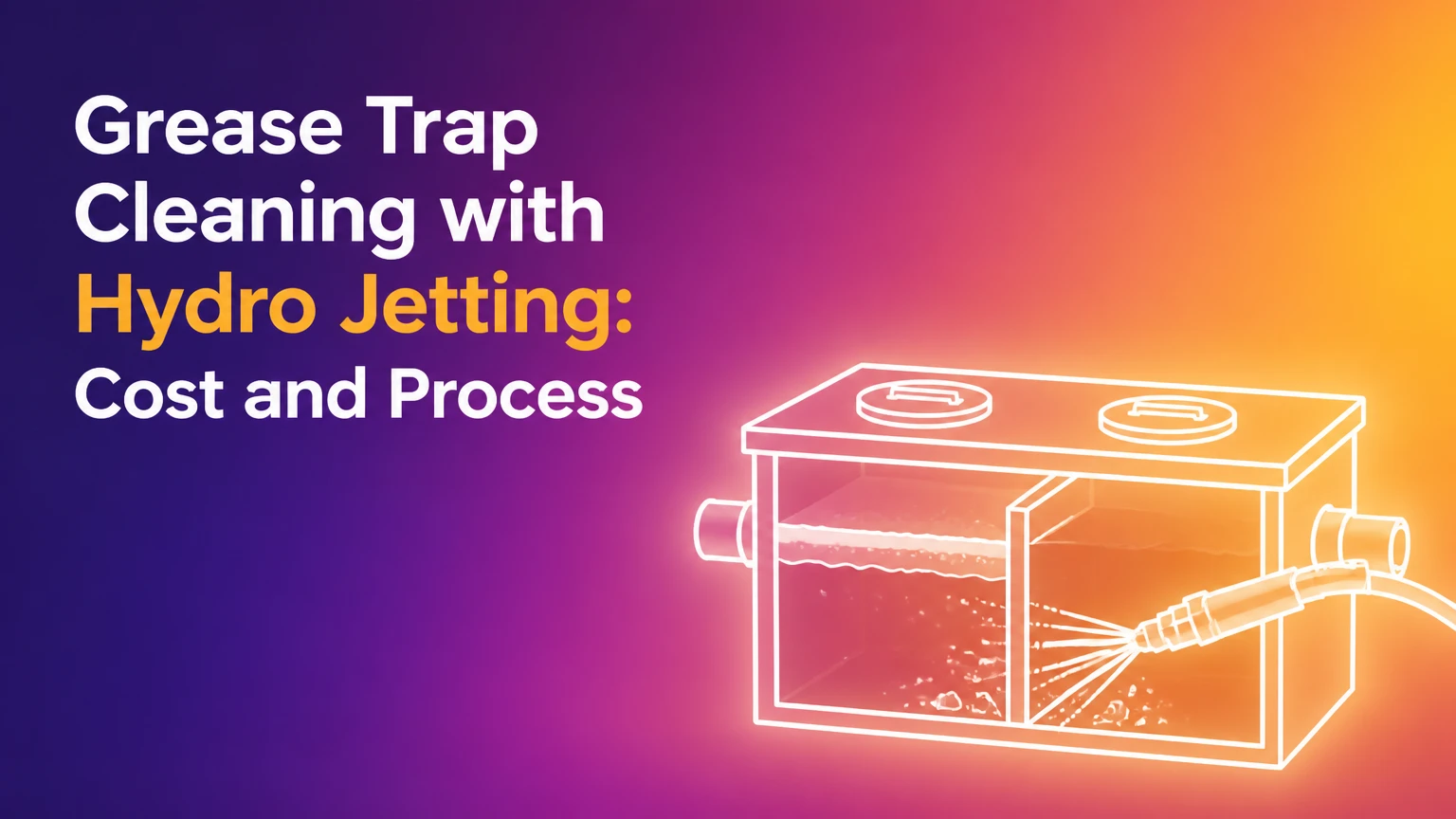
Grease trap cleaning with hydro jetting combines complete interceptor pumping with high-pressure water cleaning of grease-coated pipes, baffles, and tank surfaces. Vacuum extraction removes FOG and solids; controlled jetting clears the connected drain lines that pumping alone cannot clean. The correct pressure, nozzle, access point, and disposal method determine the result.
Key Facts at a Glance
- Grease trap pumping removes liquid, floating FOG, and settled solids from the interceptor; hydro jetting cleans connected pipe walls and selected internal surfaces.
- Commercial jetting commonly uses approximately 1,500-4,000 PSI and 4-25 GPM, but the pipe material and nozzle position determine the safe setting.
- A typical combined service takes 1.5-3.5 hours for an accessible restaurant interceptor with ordinary accumulation.
- The widely cited 25% cleaning rule is not a universal law; local wastewater authorities may set different limits, frequencies, records, and disposal requirements.
- Hydro jetting cannot repair collapsed baffles, cracked tanks, failed joints, or undersized grease interceptors.
- A compliant service should produce waste documentation, inspection findings, and a flow-test result, not merely an invoice marked pumped.
What Does Grease Trap Cleaning With Hydro Jetting Include?
Grease trap cleaning with hydro jetting is a two-part maintenance service for a grease interceptor and its connected drainage network. A vacuum truck or vacuum pump removes the interceptor contents, while a jetting unit sends controlled water through the inlet and outlet lines to cut and transport accumulated grease.
A grease trap separates fats, oils, and grease from wastewater by slowing flow. Heavier food solids settle, lighter FOG rises, and comparatively clearer wastewater exits through the outlet. As the floating and settled layers grow, the effective liquid volume decreases and the outlet becomes more vulnerable to restriction.
Pumping alone restores space inside the tank but does not reliably remove a hardened grease film from downstream piping. Jetting alone is also incomplete because it can dislodge material without removing the waste from the interceptor. The combination works when the technician vacuums displaced debris instead of pushing it toward the municipal sewer.
What Is the Difference Between a Trap and an Interceptor?
A small grease trap usually sits under a sink or inside a floor recess and often has a capacity of roughly 20-100 gallons. A grease interceptor is larger, commonly installed outdoors underground, and may hold 500-2,000 gallons or more.
Terminology varies by jurisdiction and manufacturer. Capacity, access, baffle design, flow rate, and installation location matter more than the label used on a work order.
| System type | Typical capacity | Common location | Typical access | Main service issue |
|---|---|---|---|---|
| Under-sink grease trap | 20-50 gallons | Below preparation sink | Small lid or service opening | Frequent solids and odor buildup |
| Floor-recessed trap | 50-100 gallons | Kitchen floor | Removable cover | Manual handling and poor ventilation |
| Outdoor interceptor | 500-1,500 gallons | Buried outside building | Two manholes | Long inlet and outlet lines |
| Industrial interceptor | 2,000-10,000+ gallons | Plant or institutional site | Large access covers | High flow, heavy solids, complex disposal |
How Does the Hydro Jetting Process Work?
A professional service starts with inspection and primary evacuation, then applies jetting to the lines and trap surfaces that require cleaning. The technician chooses pressure, flow, nozzle, hose diameter, and access direction according to pipe material, grease thickness, line length, and the condition of baffles.
The water does the cutting, scouring, and transport. The vacuum system does the containment and removal. A flow test then confirms whether the drainage system carries water through the interceptor without immediate restriction.
What Happens During a Professional Cleaning?
- Prepare the work area. The crew identifies covers, protects kitchen surfaces, controls pedestrian access, and positions vacuum and jetting equipment. Indoor work requires ventilation and a plan for wastewater spills.
- Inspect the interceptor and connected lines. The technician records liquid level, floating FOG depth, settled solids, baffle condition, cover seals, and visible cracks. A camera inspection is appropriate when the line is repeatedly blocked, inaccessible, or suspected of structural damage.
- Remove the bulk contents. Vacuum extraction removes the floating grease layer, liquid, and bottom sediment. The crew should avoid leaving a thick sludge layer beneath the suction hose.
- Jet the inlet and outlet piping. The operator selects a nozzle that cuts or scours rather than blindly maximizing pressure. Jetting usually proceeds from an accessible downstream or upstream cleanout so dislodged grease can be directed toward controlled recovery.
- Clean internal surfaces and baffles. Where the design permits, technicians wash tank walls, scrape attached solids, and vacuum loosened material. Baffles should be cleaned without bending, cracking, or removing them from their designed position.
- Vacuum the displaced waste again. A second extraction prevents loosened FOG and solids from remaining in the trap or entering the public sewer.
- Test flow and document the work. The crew runs representative kitchen flow, checks the outlet, reinstalls gaskets and covers, and records the pumped volume, destination, date, observations, and defects.
The success checkpoint is sustained flow with no visible backup, a clean outlet path, and an interceptor whose baffles and covers remain intact. A fast drain immediately after service is not enough proof if grease has merely moved farther down the line.
Which Equipment and Settings Are Used?
Commercial hydro jetting equipment varies by access and pipe size. Pressure is only one specification: gallons per minute controls flushing and transport, while nozzle design determines how water contacts the pipe wall.
| Equipment or setting | Typical specification | Best application | Important limitation |
|---|---|---|---|
| Portable electric or gas jetter | 1,500-3,000 PSI, 4-8 GPM | Small indoor kitchen lines | Limited hose reach and waste handling |
| Trailer or truck jetter | 3,000-4,000 PSI, 15-25 GPM | Outdoor interceptors and long laterals | Requires vehicle access and trained operation |
| Hot-water jetter | 160-180°F, lower pressure often possible | Thick animal-fat or waxy grease | Heat does not remove solids or repair pipe defects |
| Penetrating nozzle | Forward spray pattern, model-specific pressure | Initial blockage opening | Can damage weak pipe or redirect debris |
| Scouring nozzle | Rear-facing jets, 4-25 GPM system range | Wall cleaning and return flushing | Needs sufficient flow for debris transport |
| Root-cutting nozzle | Specialized rotating or forward cutters | Confirmed root intrusion | Requires structural assessment before use |
Hot water can soften some grease deposits, but “instant melting” is an unsafe assumption. Melted FOG may cool downstream, adhere to a larger sewer, and create a more expensive obstruction. The technician must recover the removed material.
How Much Pressure Is Safe?
Safe pressure depends on pipe material, age, joints, lining, access, and nozzle distance. New commercial PVC, cast iron, clay, vitrified clay, and Orangeburg pipe do not carry identical risk profiles, so a fixed 4,000 PSI setting is not a universal prescription.
A camera inspection is especially valuable for repeated blockages, older clay or Orangeburg lines, bellied pipe, exposed joints, and any system with unexplained water loss. The operator should begin conservatively, confirm nozzle movement, and increase settings only when the line and equipment justify it.
A practitioner rule is simple: use the lowest pressure and highest practical flow that clears the deposit. Pressure without flow can punch a narrow channel through grease while leaving the surrounding wall coated.
How Much Does Combined Cleaning Cost?
Typical commercial pricing for pumping plus hydro jetting ranges from about $300-$900 for a small accessible trap, $700-$2,000 for a medium outdoor interceptor, and $1,500-$4,000 or more for large industrial systems. Regional labor rates, emergency timing, disposal fees, line length, and access can move the final price substantially.
The Bangladeshi taka figures sometimes displayed in search summaries are location-specific estimates, not global prices. A contractor should quote in the local currency and identify whether tax, transport, water, disposal, camera inspection, and after-hours labor are included.
| Interceptor or job scope | Pumping only, typical USD | Pumping plus jetting, typical USD | Typical duration |
|---|---|---|---|
| 20-100 gallon indoor trap | $150-$400 | $300-$900 | 1-2 hours |
| 500-1,500 gallon outdoor interceptor | $400-$1,200 | $700-$2,000 | 2-4 hours |
| 2,000+ gallon industrial interceptor | $900-$2,500 | $1,500-$4,000+ | 3-8 hours |
| Emergency night or weekend callout | $500-$1,500 | $900-$3,500+ | 2-6 hours |
A low quote may exclude disposal or cover only pumping. Ask whether the price includes both interceptor evacuation and connected-line jetting, the estimated gallons removed, travel, camera work, traffic control, and a written service record.
What Determines the Final Price?
The main cost drivers are interceptor volume, accumulation thickness, access difficulty, line distance, pipe diameter, disposal classification, and service timing. A buried interceptor with flooded covers and a 100-foot outlet line requires more setup than an accessible indoor trap.
Camera inspection adds a separate cost in many markets, often approximately $150-$500. It can reduce wasted jetting on a collapsed or disconnected line, particularly when a restaurant has repeated backups after otherwise thorough cleanings.
How Often Should a Grease Trap Be Cleaned?
A grease trap should be cleaned before FOG and settled solids occupy the local authority’s allowed percentage of working capacity. Many programs use a 25% benchmark for the combined floating grease and settled solids layers, but the threshold is not a universal municipal rule and may not apply identically to every jurisdiction.
Operators should follow the permit, sewer-use ordinance, interceptor manufacturer instructions, and wastewater authority inspection requirements. A restaurant producing fried food may require service every 30-60 days, while a low-volume café may manage on a 60-90 day schedule after measured performance confirms that interval.
| Kitchen profile | Typical starting interval | Monitoring trigger | Suitable jetting approach |
|---|---|---|---|
| Café with limited frying | 60-90 days | Layer depth and odor | Annual line cleaning if buildup is confirmed |
| Full-service restaurant | 30-60 days | 25% capacity or local rule | Jet inlet and outlet when wall scaling appears |
| Fast-food kitchen | 30-45 days | High daily FOG load | Combine pumping with scheduled lateral cleaning |
| Food-production facility | 14-60 days | Flow, solids, production load | Quarterly assessment, more often if measured buildup rises |
The correct interval comes from records, not habit. Measure layer thickness, note daily covers, compare backup frequency, and shorten the interval when accumulation reaches the permitted limit before the next visit.
Is Hydro Jetting Better Than Snaking or Chemicals?
Hydro jetting is usually the strongest choice for grease-coated commercial lines because it removes more of the wall deposit than an auger. Snaking is faster for a localized obstruction, while biological products may support source control but cannot substitute for pumping, inspection, or physical removal.
| Method | Primary action | Typical result | Best use | Main risk |
|---|---|---|---|---|
| Hydro jetting | Water scours pipe walls | Broad deposit removal | Recurrent grease scaling | Damage to weak or defective pipe |
| Mechanical auger | Cuts a narrow passage | Temporary flow restoration | Localized soft blockage | Leaves grease on surrounding walls |
| Enzyme or biological product | Biodegrades selected organics slowly | Maintenance support | Controlled source reduction | Cannot remove settled solids |
| Caustic or acidic chemical | Reacts with deposits | Variable short-term opening | Generally unsuitable for FOG systems | Burns, corrosion, and downstream discharge |
| Pumping only | Extracts interceptor contents | Restores tank capacity | Routine trap maintenance | Does not clean laterals |
Chemical drain openers should not be treated as grease trap maintenance. They can injure staff, degrade components, interfere with wastewater treatment, and move FOG into public infrastructure. Biological dosing also requires authority approval because products differ in composition and discharge rules.
Hydro jetting is not automatically better when the pipe is cracked, collapsed, severely offset, or unsupported. In those cases, inspection and repair come before aggressive cleaning.
What Problems Can Occur After Service?
Persistent odor, immediate slow drainage, or renewed backup after hydro jetting usually indicates an unaddressed system condition rather than a normal cleaning result. Possible causes include a missing gasket, dry fixture trap, grease moved to a downstream restriction, collapsed baffle, blocked outlet, or damaged lateral.
Why Does the Kitchen Still Smell After Cleaning?
A clean interceptor can still smell if the cover gasket leaks sewer gas, the vent is blocked, a dry P-trap allows gas into the room, or residual grease remains in a separate floor drain. Inspect gaskets, vents, fixture traps, and nearby drain bodies instead of repeatedly pumping the same interceptor.
Why Is Water Slow Immediately After Jetting?
A dislodged grease mass may have traveled to a bend, belly, or downstream connection and become lodged there. The technician should perform another flow test, inspect the line with a camera, and flush from the correct access point rather than adding chemicals.
What Does Immediate Backup Indicate?
Immediate backup can indicate a blocked outlet, collapsed baffle, full downstream sewer, pipe failure, or an interceptor installed without adequate flow capacity. Opening the lid and confirming tank levels does not prove that the outlet line is clear.
Which Mistakes Increase Cost and Risk?
Several common practices create repeat failures even when the contractor owns adequate equipment.
- Jetting without condition assessment: High pressure can worsen a cracked clay, Orangeburg, or brittle jointed line. Camera inspection is warranted when age, symptoms, or previous repairs suggest structural weakness.
- Pumping without wall cleaning: The tank looks empty, but grease remains on baffles, floors, and laterals. Working volume then declines faster than the service record suggests.
- Maximizing PSI instead of matching flow: Excessive pressure can separate joints, damage fittings, or drive debris into a branch. Nozzle selection and transport flow matter as much as the gauge reading.
- Discharging removed FOG into a floor drain: Grease belongs in the vacuum system and an approved disposal chain. It should never be washed into the building sewer.
- Using boiling water as prevention: Hot water can liquefy grease near the fixture while allowing it to solidify farther downstream. Scraping and source capture are more reliable.
- Ignoring the outlet and baffles: A clean tank with a failed baffle still produces poor separation and rapid downstream contamination.
An expert rule of thumb is to judge the service by the outlet, records, and flow test, not by the appearance of the liquid removed from the top. A second practical rule is to photograph measured layers and defects before closing the interceptor.
What Should Restaurants Do Between Cleanings?
Restaurants reduce grease loading by scraping plates, collecting fryer oil, using correctly sized drain screens, and keeping food solids out of sinks. Staff should not rely on hot water, bleach, detergent, or enzyme dosing to replace physical source control.
A preventive program should record cleaning date, interceptor size, estimated gallons pumped, layer measurements, odors, backup events, and observed defects. Compare those records with menu changes, production volume, and fryer use because a new high-FOG menu can invalidate an old service interval.
Managers should also verify that the interceptor matches the kitchen’s hydraulic load. An undersized or poorly baffled unit may require frequent cleaning despite excellent staff practices; jetting treats the symptom but cannot correct inadequate design.
How Should a Contractor Document the Work?
A useful service record identifies the property, interceptor location, capacity, service date, waste volume, equipment used, defects observed, and final flow result. The record should also identify the licensed hauler or disposal facility when local rules require chain-of-custody information.
Ask for the following before approving an invoice:
- Pumped gallons or a documented volume estimate.
- Whether both inlet and outlet lines were jetted.
- Pressure and flow settings used, if recorded.
- Camera findings and photographs where inspection occurred.
- Baffle, gasket, cover, and structural observations.
- Waste manifest, disposal destination, or hauling reference.
- Recommended next interval based on measured accumulation.
Documentation supports compliance and reveals trends. It also distinguishes a complete maintenance visit from a basic pump-out.
When Is Hydro Jetting the Wrong Service?
Hydro jetting is the wrong first service when inspection indicates a collapsed pipe, open excavation, disconnected line, failed interceptor baffle, severe root intrusion, or a tank that cannot safely retain water. Jetting also cannot correct undersizing, poor slope, missing venting, or a municipal sewer obstruction outside the property boundary.
A qualified technician should isolate the defect, explain the repair or replacement option, and state whether cleaning can proceed safely. For an emergency backup, containment and sanitary protection come first; pressure cleaning should not begin until the flow path and pipe condition are understood.
Frequently Asked Questions
Can a grease trap be hydro jetted without pumping?
A grease trap should normally be pumped before and after jetting. Jetting an occupied interceptor can stir FOG and solids, reduce visibility, overload the outlet, and send displaced waste downstream. Vacuum extraction provides containment, while jetting supplies the wall-cleaning action.
Does hydro jetting remove all grease permanently?
Hydro jetting removes existing deposits from accessible surfaces, but it does not prevent new FOG from entering the system. Fryer oil, food scraps, poor baffle performance, undersizing, and infrequent pumping can recreate buildup within weeks. Source control and measured service intervals determine longevity.
Can hydro jetting damage PVC or cast-iron pipes?
Hydro jetting can damage any pipe when pressure, nozzle type, hose position, or operating technique is inappropriate. PVC joints, aged cast iron, brittle clay, Orangeburg, liners, and repaired sections require condition-based settings. Inspection is particularly important for old or repeatedly failing lines.
How long does a commercial grease trap cleaning take?
A typical accessible combined service takes 1.5-3.5 hours, including setup, pumping, jetting, vacuum recovery, and flow testing. Large industrial interceptors, long laterals, restricted access, heavy solids, and disposal logistics can extend the job to 3-8 hours.
Are grease-digesting enzymes a replacement for hydro jetting?
Enzymes are not a replacement for pumping or hydro jetting because they do not reliably remove settled solids, hardened wall scale, or structural obstructions. Some authorities permit biological maintenance products, but operators should verify the product, dosage, and discharge rules before use.
What is the best way to compare contractor quotes?
Compare scope rather than the headline price. Confirm interceptor pumping, inlet and outlet jetting, waste disposal, flow testing, camera inspection, emergency fees, documentation, and defect reporting. A cheaper pump-only quote is not equivalent to a combined cleaning service.
The Bottom Line
Grease trap cleaning with hydro jetting is most effective when vacuum extraction removes the interceptor contents and controlled water jetting cleans the connected pipework. Select pressure and nozzle configuration from pipe condition, not a maximum PSI number, and verify the result with a flow test. Maintain records, follow the local wastewater authority’s actual rule, and treat repeated backups as possible evidence of structural or design failure.