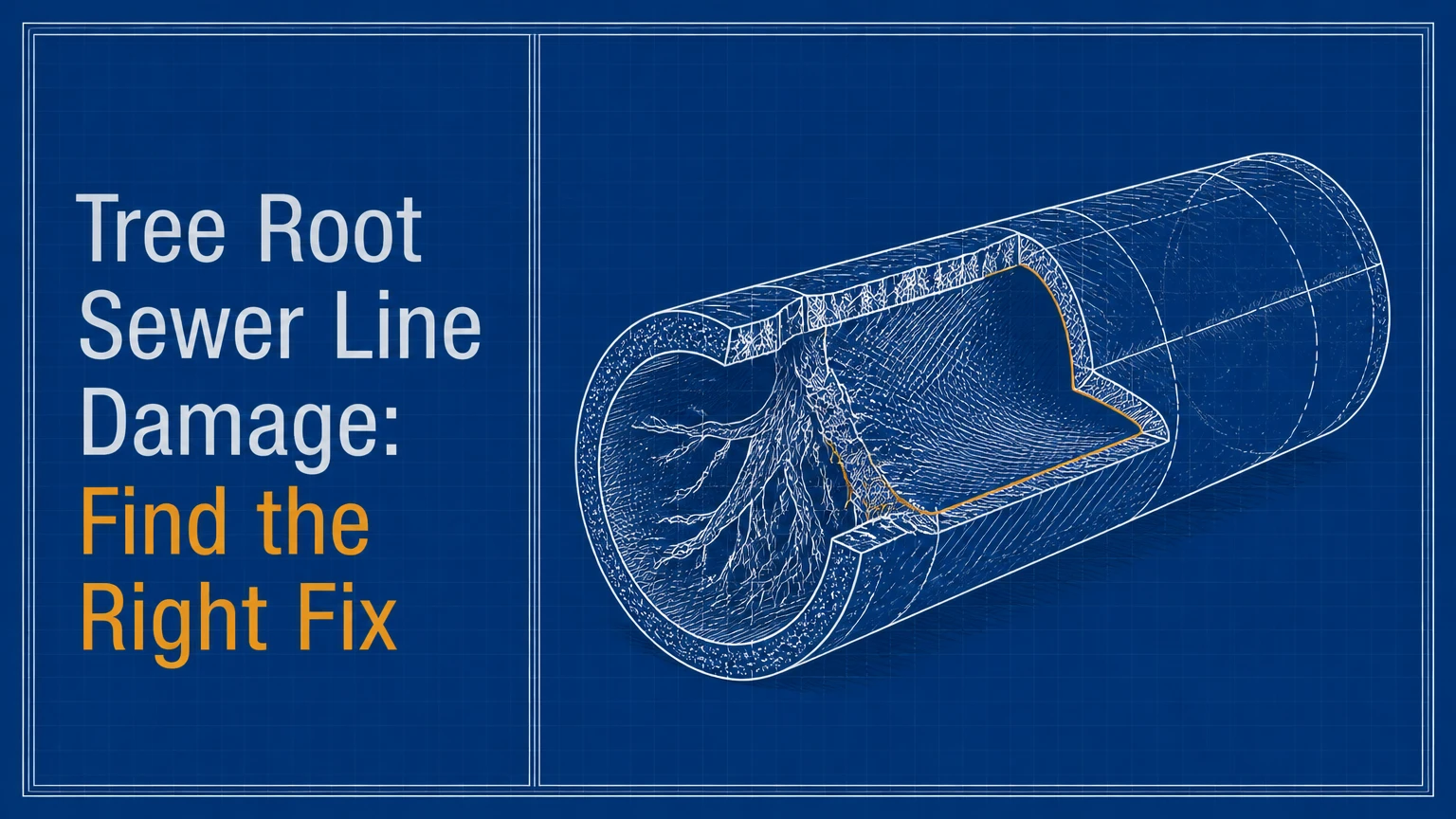
Tree root sewer line damage occurs when roots enter a defective underground sewer pipe through an open joint, crack, failed seal, or connection, then form a blockage that can worsen leakage and structural failure. A camera inspection determines whether cleaning is enough or whether the lateral needs lining, replacement, or excavation.
Key facts at a glance
Tree roots usually enter sewer pipes through existing defects, not through an intact pipe wall.
Multiple slow fixtures, toilet gurgling, and repeated main-line backups indicate a possible lateral obstruction.
Mechanical cutting restores flow temporarily, but it does not repair the entry defect.
CCTV inspection should precede permanent repair because roots can resemble grease, collapsed pipe, offsets, or a belly.
CIPP lining requires a pipe with usable shape; a collapsed or severely deformed section may require replacement.
Typical residential costs range from about $175-$500 for camera inspection to $4,000-$20,000 or more for major replacement.
What Is Tree Root Sewer Line Damage?
Tree root sewer line damage is a failure pattern involving biological intrusion and plumbing defects. Roots follow available moisture around a buried pipe, enter through a separated joint or crack, and grow inside the wastewater passage. The resulting root mat catches paper, grease, and solids, causing repeated blockage and sometimes allowing sewage to leak into surrounding soil.
The condition is common in older clay, concrete, cast-iron, and Orangeburg sewer laterals because these systems contain joints, corrosion, deformation, or material deterioration. Modern PVC and HDPE reduce the risk because their smooth walls and gasketed or fusion-welded connections provide fewer entry points, although defective connections, damaged fittings, and construction errors can still admit roots.
Tree proximity alone does not prove pipe damage. A mature tree can grow near a sound sewer without causing a blockage, while a smaller tree can exploit a failed joint close to a foundation. The pipe defect is the immediate entry condition; the tree is the biological source of continued growth.
How Do Roots Enter and Block a Sewer Pipe?
Tree roots enter a sewer line through an existing opening, then expand inside the pipe as the intrusion captures wastewater and debris. Moisture gradients can attract roots to a leaking or poorly sealed line, but roots generally cannot force their way through an intact, properly joined sewer pipe.
The Root-Intrusion Sequence
- A pipe defect develops. Joint separation, cracked clay, corrosion, a displaced connection, or a failed seal creates an opening.
- Moisture escapes into the soil. Leaking wastewater or vapor increases moisture near the defect. Roots respond to water and favorable soil conditions, a process associated with hydrotropism.
- Fine feeder roots enter. Small roots pass through a joint gap or crack. Initial entry may leave drainage apparently normal.
- The intrusion branches. Water, oxygen, and organic material inside the pipe support a fibrous mass.
- Solids accumulate. Toilet paper, grease, hair, and other waste catch on the roots, reducing the effective pipe diameter.
- The defect worsens. Excavated soil, leakage, joint movement, corrosion, or repeated cleaning can leave the pipe structurally weaker.
A common misconception is that root expansion alone exerts enough pressure to crush every sewer pipe. In practice, many collapses result from the combined effects of defective joints, soil movement, corrosion, brittle materials, hydraulic erosion, and an existing deformation. Root growth can obstruct and destabilize a line, but a camera report should identify the actual structural cause.
What Does the Camera Need to Show?
A useful sewer camera report identifies the clock position of the intrusion, distance from the access point, approximate depth, pipe material, defect type, and whether the camera reached the public connection. The recording should show the entire accessible run, not only the blockage.
Ask the contractor to classify findings such as root intrusion, fracture, offset joint, belly, collapse, infiltration, or encrustation. Those terms lead to different repairs. A root mass at a sound-looking joint may need cleaning and monitoring, while a collapsed section cannot be permanently solved with an auger.
Which Pipes Are Most Vulnerable?
Clay and Orangeburg laterals generally present higher root-intrusion risk than intact PVC or fused HDPE because they rely on joints or have age-related deterioration. Material age, installation quality, soil movement, and joint condition matter more than the tree species alone.
| Pipe material | Typical service context | Root-entry vulnerability | Common failure |
|---|---|---|---|
| Vitrified clay | Homes built before about 1970 | High at joints and cracks | Fracture, offset, separated bell |
| Cast iron | Older interior and exterior laterals | Medium to high after corrosion | Rust scale, joint failure, pinholes |
| Orangeburg fiber pipe | Mid-century installations | Very high after aging | Flattening, delamination, collapse |
| PVC or ABS | Modern residential replacement | Low when correctly joined | Damaged fitting, bad joint, deformation |
| HDPE | Fused trenchless replacement | Very low at fused seams | Service connection or installation defect |
Published service-life figures are approximate rather than guarantees. The American Society of Civil Engineers and local utilities evaluate pipe condition by inspection and failure history, not by age alone. A 60-year-old clay line can remain functional, while a newer line can fail after poor bedding or a damaged connection.
What Symptoms Point to Root Intrusion?
Repeated drainage problems affecting several fixtures are stronger evidence of a main-line obstruction than one slow sink. Root intrusion becomes more likely when a plumber repeatedly clears the same lateral and CCTV shows roots at a joint or crack.
Warning Signs to Track
- Toilets gurgle when a washing machine discharges.
- Basement floor drains rise during showers or laundry cycles.
- Several fixtures drain slowly at the same time.
- A main-line auger restores flow but the blockage returns within weeks or months.
- A toilet bubbles when another fixture is used.
- A lawn strip over the lateral grows unusually thick or green.
- Soil becomes soft, depressed, or washed out along the pipe route.
- Sewage odor appears near a cleanout or in a basement.
- Rodents or insects appear near a leaking sewer connection.
Green grass is only supporting evidence. Irrigation leaks, fertilizer, shallow soil, and natural drainage can create the same pattern. Likewise, a sinkhole may indicate a leaking sewer, a failed storm drain, poor backfill, or another underground void, so excavation should follow locating and inspection rather than visual assumptions.
What Should You Do During an Active Backup?
Stop using all water and arrange an urgent main-line assessment when sewage is backing up indoors. Do not flush toilets, run a washing machine, or test drains repeatedly because additional discharge can force contaminated water onto floors and into wall cavities.
- Keep people and pets away from sewage.
- Stop water use throughout the property.
- Locate the building sewer cleanout if it is safely accessible.
- Call the municipality if the problem may be in the public main or public-side lateral.
- Arrange a licensed plumber for controlled clearing and CCTV inspection.
- Photograph damage and preserve invoices for an insurance or responsibility inquiry.
- Disinfect affected surfaces according to local public-health guidance.
Do not casually remove a cleanout cap. A line full of sewage can release pressurized wastewater when the cap is loosened, and contaminated discharge can spread across the yard. If a plumber instructs you to open it, stand to the side, use protective equipment, and stop if the cap resists.
How Is Root Intrusion Diagnosed?
Professional diagnosis normally combines controlled mechanical clearing, CCTV inspection, and pipe cleaning. The sequence matters because a camera cannot assess the pipe behind a dense blockage, while cleaning without video can remove evidence needed to select a permanent repair.
Step 1: Restore a Temporary Flow Path
A cable machine or root-cutting auger can open a passage through the obstruction. The operator should work from an appropriate cleanout and confirm that wastewater flows freely before withdrawing the cable.
Success checkpoint: fixtures discharge without immediate backup.
Limitation: the auger cuts the root mass but leaves the cracked joint or open connection in place.
Step 2: Run a CCTV Survey
The camera should document the complete lateral from the building toward the public sewer or septic tank. A locator transmitter can mark the camera head at key defects, allowing the contractor to estimate depth and avoid unnecessary excavation.
Success checkpoint: the recording shows the entry defect and downstream endpoint.
Common mistake: accepting a short video that begins after the blockage and does not establish the condition of the remaining pipe.
Step 3: Clean the Pipe
Hydro jetting uses a high-pressure pump and specialized nozzle to scour roots, grease, and deposits from the pipe. Typical residential equipment may operate around 3,000-4,000 psi, but pressure must match pipe material and condition; maximum pressure is not automatically safer or better.
Success checkpoint: post-cleaning video shows an open bore and visible joint condition.
Common mistake: jetting an unstable, severely collapsed, or fragile line without reviewing the pre-cleaning video.
Step 4: Grade the Structural Defect
The contractor should determine whether the pipe remains round, aligned, and structurally capable of receiving a liner. A belly, major offset, missing section, or collapse changes the repair plan even if cleaning restores flow.
Which Repair Method Fits the Damage?
CIPP lining is usually appropriate for a clean, continuous, reasonably shaped pipe with cracks or open joints; pipe bursting suits replacement where the route and surrounding utilities permit; excavation remains necessary for collapse, severe grade problems, or complex connections.
| Method | Typical residential cost | Typical duration | Structural requirement | Landscape impact |
|---|---|---|---|---|
| Cable root cutting | $200-$700 | 1-3 hours | Open enough for cable access | Minimal |
| Hydro jetting | $350-$1,000 | 2-4 hours | Pipe must tolerate cleaning | Minimal |
| CIPP lining | $80-$250 per linear foot | 1-2 days | Usable circular geometry | Low |
| Pipe bursting | $3,500-$20,000 | 1-3 days | Suitable route and launch pits | Low to moderate |
| Open excavation | $4,000-$20,000+ | 2-7 days | Works with collapse and offsets | High |
| Foaming root treatment | $150-$500 per application | 1-2 hours | Maintenance after clearing | Minimal |
CIPP Lining
Cured-in-place pipe lining inserts resin-saturated felt or fiberglass into the host pipe, inflates it against the wall, and cures it with heat, steam, or ultraviolet light. The cured liner creates a jointless passage that closes many existing entry defects without removing the old pipe.
CIPP is not suitable for every root-damaged line. A collapsed section, severe belly, major offset, missing pipe, or inaccessible lateral may prevent installation. The liner also reduces internal diameter slightly, although the smoother surface can preserve or improve hydraulic performance when the original pipe is only moderately encrusted.
Pipe Bursting
Pipe bursting fractures the old pipe and pulls a new HDPE or similar pipe through the established route. The method can replace a structurally failed line while limiting surface disruption, but it requires launch and reception pits, adequate soil conditions, and verified utility clearance.
Pipe bursting does not automatically solve every connection problem. Side connections, shared laterals, shallow utilities, easement restrictions, and unstable ground can require additional excavation. Utility locating through the applicable 811 system is a prerequisite in the United States, and local permits may impose separate requirements.
Open Excavation
Traditional excavation removes the defective section and exposes the pipe, bedding, connections, and surrounding soil for direct correction. It is often the most predictable option for a collapse, severe grade defect, complex junction, or line beneath a structure where trenchless access is impossible.
The visible repair price may exclude driveway replacement, concrete cutting, tree-root removal, shoring, traffic control, soil export, permits, and landscaping. Request a written restoration scope before comparing bids.
Chemical Root Treatment
Foaming root-control products can suppress regrowth after mechanical cleaning, but they do not rebuild a cracked joint or stabilize a collapsing pipe. Product legality, application instructions, septic compatibility, and municipal wastewater rules vary, so use only a labeled product and a qualified professional where required.
Consumer acid or caustic drain cleaners are a poor choice. They are designed for organic clogs at fixtures, can create burn hazards, and do not reliably coat an extensive root mass in a partially blocked main line.
How Much Does Root-Damaged Sewer Repair Cost?
Typical residential costs run from $175-$500 for a camera inspection, $350-$1,000 for hydro jetting, $80-$250 per foot for CIPP lining, and $4,000-$20,000 or more for replacement. Local labor rates, pipe depth, access, permits, restoration, and public-side responsibility can move the final price substantially.
| Cost driver | Typical range or condition | Why it changes price |
|---|---|---|
| Camera inspection | $175-$500 | Access, recording, locating, report |
| Pipe depth | 4-6 feet versus 10-12+ feet | Shoring, labor, spoil handling |
| Surface | Grass versus reinforced concrete | Restoration and cutting equipment |
| Lining length | 40-100 linear feet | Resin, setup, reinstatement |
| Utility complexity | 811-clear route versus congested easement | Pits, hand digging, risk controls |
| Restoration | $500-$10,000+ | Sod, asphalt, concrete, walls, plantings |
Angi and HomeAdvisor publish broad national plumbing cost ranges, but those figures are not guaranteed local quotes. A reliable estimate separates diagnosis, emergency clearing, cleaning, permanent repair, permits, utility locating, reconnection of branch lines, and surface restoration.
Who Is Responsible for the Sewer Lateral?
Responsibility depends on the exact defect location and local code. Homeowners commonly maintain the private building sewer from the house to the public connection, while a municipality may own or maintain the public main and, in some jurisdictions, part of the lateral.
Ask the utility for its lateral-ownership map before authorizing excavation. A camera report should record the distance from the cleanout and, when possible, the location relative to the property line or public right of way.
Septic properties follow a different arrangement. Roots may affect the building sewer, septic tank inlet, distribution box, or drainfield, and a root problem near the tank does not prove that the municipal sewer is involved. Septic inspection and local environmental rules may apply.
Can You Prevent Future Root Intrusion?
You can reduce recurrence by repairing the pipe defect, choosing properly joined replacement material, and monitoring lines with known root entry. Removing a nearby tree alone may not solve the problem because existing roots can remain active and the defective pipe still permits infiltration.
Practical prevention measures include:
- Replace separated clay joints or line a structurally suitable lateral.
- Keep large trees away from future sewer routes when planting.
- Use a qualified arborist before removing mature trees near foundations or utilities.
- Install a root barrier only where local arborists and utility rules support it.
- Schedule periodic cleaning when CCTV shows minor, stable intrusion.
- Keep grease, wipes, paper towels, and bulky materials out of drains.
- Obtain a sewer camera inspection before buying an older property with mature trees.
A root barrier is not a substitute for pipe repair. Barriers can redirect roots, damage other utilities, or fail when installed too shallowly, while a sealed liner or correctly installed replacement addresses the entry path itself.
Common Mistakes That Make the Problem Worse
Mistake 1: Repeating Cable Cleaning Without CCTV
Repeated snaking can maintain flow but creates an expensive cycle when the pipe defect remains unmeasured. After a second recurrence, request video rather than authorizing another identical clearing.
Mistake 2: Assuming Tree Removal Repairs the Pipe
Tree removal may reduce future root activity, but it does not close a separated joint, replace missing pipe, or restore soil around a leaking line. Existing roots can decay and leave pathways for water and soil movement.
Mistake 3: Using Maximum Jetting Pressure
High-pressure water can damage fragile clay, deteriorated cast iron, or already compromised joints. The operator should select nozzle type, pressure, flow, and cleaning direction based on the pipe material and CCTV evidence.
Mistake 4: Accepting a Liner Without a Post-Repair Camera
A post-installation video verifies liner continuity, service reinstatements, wrinkles, open ends, and remaining defects. Without it, the property owner cannot easily confirm that the proposed structural work was completed correctly.
Mistake 5: Comparing Only the Lowest Bid
A $6,000 excavation quote can exceed a $10,000 trenchless quote after concrete, asphalt, fencing, tree protection, and landscaping are added. Compare the complete installed scope, warranty, restoration, permits, and access plan.
Which Strategy Fits Your Situation?
Older Home With Clay or Cast Iron
Choose inspection first, followed by cleaning and a structural repair if the video shows recurring joint intrusion. CIPP can preserve a landscaped yard when the host pipe remains round, while localized excavation may be better for one accessible defect.
Limited Budget and an Active Blockage
Restore flow safely, obtain CCTV, and ask whether professional cleaning plus labeled root suppression can provide a documented maintenance interval. This approach defers replacement, but it should be treated as management, not a permanent structural solution.
Rental Property or Long-Term Ownership
Prioritize a repair that removes recurring service calls. A properly selected liner or fused HDPE replacement usually offers a stronger maintenance profile than annual cutting, provided the camera confirms that the chosen method fits the pipe.
Sewer Beneath a Driveway or Mature Landscape
Obtain both trenchless and excavation proposals with restoration included. Trenchless work may reduce surface damage, but pits, access limitations, service connections, or a collapsed section can narrow its advantage.
What Should a Contractor Include in the Proposal?
A defensible proposal names the pipe material, measured length, access points, defect locations, proposed method, expected duration, and restoration obligations. It should also state whether the price includes CCTV before and after work, permits, utility locating, cleanouts, branch reconnections, traffic control, and disposal.
Request these records:
- Original CCTV recording and written defect map.
- Locator marks or depth measurements for excavation.
- Itemized cleaning and repair costs.
- Product and resin information for CIPP.
- New-pipe material and joint or fusion specifications.
- Warranty exclusions, especially recurring blockages and owner damage.
- Permit and public-connection responsibilities.
- Completion video and restoration photographs.
Contractors cannot guarantee that a tree will never affect an underground utility again. They can describe which entry defect was repaired and which portions of the lateral were inspected.
FAQ
Can tree roots break through an intact PVC sewer pipe?
Roots rarely penetrate an intact PVC wall. Root intrusion usually enters through a failed gasket, damaged fitting, construction defect, or separated connection. PVC remains vulnerable if bedding shifts, a joint is assembled incorrectly, or excavation damages the pipe before backfilling.
How often should a root-damaged sewer line be cleaned?
There is no universal interval. A line that regrows roots within three months may need quarterly monitoring, while a lightly affected line may remain open for a year or longer. Use recurrence history and post-cleaning CCTV rather than a fixed annual schedule.
Should I replace a tree near my sewer line?
Tree removal should not be the first response to a suspected sewer problem. Confirm the pipe defect, then consult an arborist and the utility owner. Removing the tree does not repair the lateral, and mature trees may create structural or ecological risks when removed improperly.
Does homeowners insurance cover root damage to sewer pipes?
Many policies exclude gradual deterioration, roots, and maintenance-related sewer-line failure, although resulting interior water damage or optional service-line coverage may be treated differently. Read the policy language and notify the insurer before destructive work when an active loss may be covered.
Is a sewer-line camera inspection worth paying for?
A camera inspection is usually worthwhile before permanent repair because it distinguishes roots from grease, collapse, bellies, offsets, and municipal-side problems. The recording can prevent unnecessary excavation and gives the owner evidence for comparing lining, bursting, and replacement proposals.
The Bottom Line
Tree root sewer line damage begins with a pipe defect and becomes a hydraulic and structural problem when roots trap wastewater solids inside the lateral. Stop water use during a backup, clear the immediate obstruction safely, and obtain full-length CCTV before selecting a repair. Cleaning and chemical suppression can manage recurrence, but only lining or replacement closes the underlying entry path. Proper diagnosis is the difference between a temporary opening and a durable sewer repair.