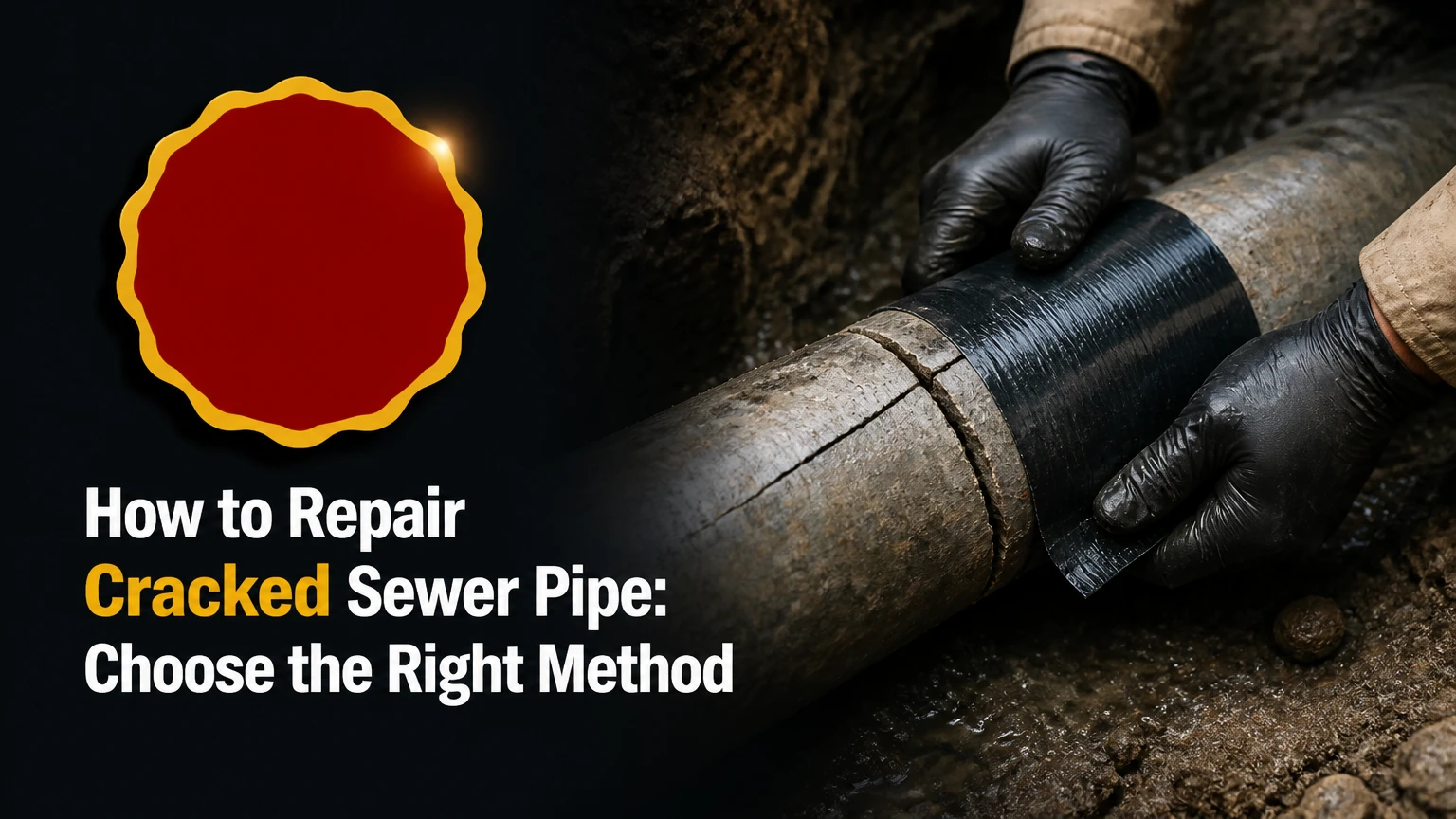
To repair a cracked sewer pipe, first confirm the crack with a sewer camera, clear the line, and determine whether the pipe remains round and properly sloped. A localized crack may need a sectional patch, while long cracks usually need CIPP lining, severe deformation may require pipe bursting, and collapse or poor grade often requires open-trench replacement.
Key Facts at a Glance
A sewer camera inspection should identify the crack’s location, length, pipe material, diameter, and structural condition before repair.
CIPP lining repairs many cracks without removing the existing pipe, but it cannot reliably correct a collapsed section or a sewer belly.
Sectional patches typically repair one localized defect and do not protect the remaining aging sewer lateral.
Pipe bursting replaces the old line and can preserve or increase diameter, but it requires suitable access pits and utility locating.
Open-trench replacement is usually the most direct solution for collapse, severe offset, failed slope, or inaccessible trenchless work.
Typical residential repair pricing ranges from about $1,500 for a localized patch to more than $20,000 for difficult excavation and restoration.
How to Repair Cracked Sewer Pipe Safely
A cracked sewer pipe is repaired through a diagnosis, preparation, rehabilitation or replacement, and verification sequence. The work usually takes several hours for a point repair, one day for a straightforward liner, one to two days for pipe bursting, or three to seven days for excavation, excluding major concrete or landscape restoration.
The determining factor is structural condition, not the visible size of the crack alone. A narrow crack in a round clay pipe may be suitable for lining, whereas a wide joint separation with soil entering the pipe can signal loss of bedding and require excavation.
Before approving the repair
Collect these items from the contractor before work begins:
- A continuous camera recording with distance markings
- The pipe material, inside diameter, and approximate depth
- A diagram showing the house connection, cleanouts, laterals, and municipal or septic endpoint
- The crack location relative to buildings, driveways, trees, utilities, and property boundaries
- A written repair method, access plan, restoration allowance, warranty, and post-repair inspection plan
A camera image alone is insufficient. A lens can pass through a damaged area while missing a belly, offset joint, disconnected lateral, or second defect farther downstream.
Can a homeowner repair a buried sewer pipe?
A homeowner can inspect an accessible cleanout, document symptoms, and arrange a camera inspection, but buried sewer pipe rehabilitation is usually professional work. Excavation can expose workers to trench collapse, contaminated wastewater, electrical services, gas lines, and unstable soil.
Do not pour epoxy, concrete patch compound, or chemical drain cleaner into a sewer lateral. Consumer drain products do not create a structural pipe liner, and corrosive chemicals can damage old metal, harm workers during opening, and contaminate soil or groundwater. A homeowner should use a qualified plumber or trenchless contractor for pipe cutting, resin installation, excavation, and connection to the municipal sewer.
What Must Be Confirmed Before Repair?
A professional sewer diagnosis should confirm defect type, pipe geometry, material, depth, access, and flow direction. The repair method should be selected only after the inspection identifies whether the defect is isolated, continuous, displaced, collapsed, or associated with incorrect grade.
What does a sewer camera inspection reveal?
A push camera or tractor camera can locate cracks, open joints, root intrusion, corrosion, deposits, fractures, offsets, holes, and collapsed sections. The operator should record the distance from the access point and identify clock positions, such as a crack at the 6 o’clock position.
A proper inspection also checks:
- Whether the camera reaches the public main or septic tank
- Whether the pipe holds standing water because of a sag
- Whether branch connections enter the line
- Whether roots are entering through one joint or multiple defects
- Whether the camera can pass through the entire damaged section
- Whether groundwater or soil is visibly entering the pipe
The National Association of Sewer Service Companies, or NASSCO, uses condition-assessment terminology that separates cracks, fractures, holes, roots, deposits, and structural deformation. Asking for standardized defect descriptions makes competing estimates easier to compare.
Which findings change the repair decision?
| Inspection finding | Structural meaning | Common repair direction | Immediate concern |
|---|---|---|---|
| One 2-6 inch crack in a round pipe | Localized wall failure | Sectional patch, typically $1,500-$3,500 | Root or soil entry |
| Cracks over 10-100 feet with a round profile | Distributed leakage and weakening | CIPP liner, typically $80-$250 per foot | Cleaning and resin bond |
| Fully collapsed or flattened section | Passage and structural continuity lost | Excavation or pipe bursting | Sewage backup |
| Standing water over 2-10 feet | Sewer grade has sagged | Excavation and grade correction | Recurring blockage |
| Root entry at 1-4 joints | Open joints or fractures | Patch, liner, or replacement | Root recurrence |
| Offset joint of 1-3 inches | Sections no longer align | Excavation or engineered rehabilitation | Liner installation failure |
The figures in this table are typical residential planning ranges, not guaranteed prices or engineering thresholds. Soil, access, diameter, local labor, permits, and surface restoration can change the estimate substantially.
Which Repair Method Fits the Damage?
The best repair method depends on whether the existing pipe can act as a stable host, whether the sewer retains adequate slope, and whether access pits can be created. CIPP lining is usually efficient for long cracks in a round pipe, while patching suits isolated defects and replacement suits collapse, severe offset, or failed grade.
| Method | Suitable defect | Typical time | Typical residential cost |
|---|---|---|---|
| Sectional point repair | One crack, open joint, or root entry | 3-6 hours | $1,500-$3,500 |
| CIPP lining | Multiple cracks in a round, passable pipe | 1-2 days | $80-$250 per foot |
| Pipe bursting | Severe fractures or replacement with same or larger diameter | 1-3 days | $60-$200 per foot |
| Sliplining | Straight, accessible run with oversized host pipe | 1-3 days | $75-$225 per foot |
| Open-trench replacement | Collapse, offset, belly, or failed bedding | 3-7 days | $50-$150 per foot, plus restoration |
When does CIPP lining work?
Cured-in-place pipe lining works when the host sewer is sufficiently open, round, clean, and structurally stable for a resin-coated liner to pass through and cure against the wall. CIPP is a strong option for long cracks under landscaping, driveways, or finished floors because the contractor can often work through existing access points.
The process normally includes camera inspection, root cutting or hydro-jetting, measurement, liner wet-out, insertion or inversion, curing, lateral reinstatement, and final camera verification. Ambient-cure epoxy may take several hours; hot-water, steam, or ultraviolet systems use different curing equipment and schedules.
CIPP reduces the internal diameter because the liner occupies space. The often-quoted 5%-10% reduction is not universal. Actual reduction depends on liner thickness, host diameter, wrinkles, design loading, and manufacturer specifications. A properly designed liner generally maintains residential drainage capacity, but a small pipe with heavy solids flow deserves hydraulic review.
CIPP is not suitable for a collapsed pipe, a severe belly, an inaccessible obstruction, or a line whose shape prevents full liner contact. The liner follows the existing alignment. It does not raise a sagged section or restore soil beneath a failed pipe.
Is pipe bursting better than pipe lining?
Pipe bursting is better than lining when the old sewer must be replaced, the existing diameter needs upgrading, or deformation prevents a liner from installing. Pipe lining is usually better when the host pipe remains open and the property owner wants to avoid pits, vibration, and ground displacement.
A bursting head fractures or splits the host pipe while pulling a new high-density polyethylene pipe through the same corridor. The method commonly requires an insertion pit and a receiving pit, although access arrangements vary by equipment and site layout.
Pipe bursting needs a clear path. Gas, water, electric, telecommunications, foundation footings, tree roots, and adjacent utilities must be located before the pulling force is applied. Bends, shallow cover, unstable soil, and limited pit space can make bursting unsuitable.
Pipe bursting can preserve the original diameter or install a larger replacement. That advantage disappears when the new line must pass through a narrow easement or a congested utility corridor.
When is a sectional patch enough?
A sectional patch is enough when a camera confirms one or a small number of localized defects and the rest of the sewer has sound walls, acceptable grade, and no widespread corrosion. An inflatable packer positions resin-impregnated fiberglass over the defect, then holds it against the pipe until the resin cures.
Point repair has a low surface impact and a relatively short service visit. It is useful for one cracked clay joint, one root entry point, or a small fracture discovered during a home inspection.
The limitation is coverage. A two-foot patch does not repair a weakened line ten feet away, and it does not stop roots entering through additional joints. Contractors should camera the entire lateral before recommending a localized repair.
When is open-trench replacement mandatory?
Open-trench replacement is usually required when the sewer has collapsed, lost its grade, separated significantly, or cannot provide a stable host for trenchless work. Excavation exposes the pipe, removes failed bedding, installs approved replacement pipe, and allows the crew to restore the designed slope directly.
A replacement may use PVC, ABS, ductile iron, or another locally approved material, depending on location and code. The installer should use proper bedding, joint assembly, cleanout access, inspection, and controlled backfill. Trench safety rules apply even on private residential property.
Open excavation damages the surface above the pipe, but surface damage is not the same as repair cost. A 20-foot excavation beneath a driveway may require concrete removal, base reconstruction, reinforcement, and paving. Those restoration items can exceed the pipe material cost.
How Is a Cracked Sewer Pipe Repaired Without Digging?
Trenchless sewer repair uses existing cleanouts or small access pits to rehabilitate or replace underground pipe with limited surface disturbance. The contractor still performs substantial preparation, and “trenchless” does not mean that no holes, cutting, traffic control, or restoration will occur.
The CIPP lining sequence
- Inspect the complete line. Record the crack, pipe diameter, length, laterals, and endpoint.
- Clean the host pipe. Use a cable, root cutter, or controlled hydro-jetting to remove deposits and roots.
- Measure and design the liner. The liner thickness must match diameter, groundwater loads, soil conditions, and structural requirements.
- Wet out the liner. Saturate the textile tube with the specified resin under controlled conditions.
- Install and position the liner. Pull or invert the liner through the damaged section, then inflate it against the host wall.
- Cure the resin. Use ambient air, hot water, steam, or ultraviolet light according to the resin system.
- Reopen branch lines. A robotic cutter restores laterals covered by the liner.
- Inspect and test. Complete a camera pass and, where required, conduct a leakage, air, or flow test.
The success checkpoint is a continuous liner with no major wrinkles, open laterals, blocked outlet, or uncured section. A final video should be supplied to the property owner.
What can go wrong during installation?
Hydro-jetting pressure must match pipe condition. A 4,000-psi setting may be appropriate for some robust lines but can worsen a fragile clay, badly corroded cast-iron, or already fractured pipe. The operator should select nozzle pressure, flow, and stand-off distance after inspecting the host.
Resin also requires controlled handling. Temperature, resin ratio, wet-out thickness, cure time, and groundwater influence the result. A liner that looks smooth on camera can still have a bonding or cure problem if installation records are absent.
What Changes for Clay, Cast Iron, PVC, and Concrete?
Pipe material changes the likely failure pattern and the acceptable repair method. Clay commonly fails at joints and fractures, cast iron may corrode or channel at the invert, PVC often fails at joints or from impact, and concrete can crack, shift, or admit roots through joints.
| Pipe material | Common residential age range | Typical failure pattern | Frequent repair choice |
|---|---|---|---|
| Vitrified clay | 40-100+ years | Open joints, cracks, roots | Patch, CIPP, or replacement |
| Cast iron | 50-100 years | Corrosion, pinholes, channeling | CIPP or open replacement |
| PVC or ABS | 20-60 years | Joint separation, crushing, puncture | Section replacement or patch |
| Concrete | 50-100+ years | Cracks, displaced joints, infiltration | CIPP, bursting, or excavation |
How should root intrusion be handled?
Root intrusion should be treated as evidence of an opening, not as the entire defect. Root cutting can restore flow temporarily, but roots commonly return if the joint, fracture, or connection remains open.
A contractor should remove the roots, camera the surrounding pipe, and seal or replace every confirmed entry point. CIPP can seal multiple root-entry defects when the pipe remains suitable for lining. A sectional patch can address one entry point when the remaining line is sound.
Copper sulfate and foaming root treatments may reduce regrowth in some systems, but they do not rebuild the pipe wall. Follow local wastewater rules and product labels because treatment chemicals can affect septic systems and downstream biology.
What if the pipe is under a driveway or concrete slab?
A sewer pipe under a driveway or slab often favors CIPP or pipe bursting, provided the pipe has suitable geometry and access. Avoiding demolition can reduce restoration work, but trenchless pricing should still include cleanouts, pits, traffic control, lateral reconnections, and permit fees.
A slab installation may require indoor access through a basement floor or exterior excavation at both ends. If the pipe has a belly or collapsed section beneath the slab, excavation may be unavoidable because neither a liner nor a replacement pulled through the old alignment corrects failed elevation.
What Does Cracked Sewer Pipe Repair Cost?
Residential cracked sewer pipe repair typically costs $1,500-$3,500 for a localized patch, $80-$250 per foot for CIPP lining, $60-$200 per foot for pipe bursting, or $50-$150 per foot for excavation before substantial restoration. Local labor, depth, access, diameter, permits, and surface replacement determine the final estimate.
| Cost component | Typical range | Main price driver |
|---|---|---|
| Camera inspection | $150-$600 | Length, access, recording, locator work |
| Hydro-jetting and root removal | $400-$1,500 | Deposits, roots, pipe fragility |
| Sectional patch | $1,500-$3,500 | Number and length of defects |
| CIPP lining | $80-$250 per foot | Diameter, liner design, access |
| Pipe bursting | $60-$200 per foot | Pits, depth, utilities, replacement diameter |
| Surface restoration | $500-$15,000+ | Asphalt, concrete, landscaping, flooring |
These are typical United States planning ranges for residential work, not a universal price list. A short repair can carry a high minimum mobilization charge, while a longer line may receive a lower per-foot rate.
Ask whether the estimate includes inspection, cleaning, bypass pumping, traffic control, permits, lateral reinstatement, excavation, bedding, backfill, disposal, taxes, and restoration. Comparing only the pipe-repair line item can make open excavation appear cheaper than it becomes after a driveway or mature tree bed is rebuilt.
How long will the repair take?
A camera inspection commonly takes one to two hours, a point patch about three to six hours, CIPP one to two days, pipe bursting one to three days, and open-trench replacement three to seven days before extensive restoration. Cure windows and municipal inspection requirements can extend the schedule.
| Repair situation | Field work | Household restriction |
|---|---|---|
| Single sectional patch | 3-6 hours | Avoid sewer use during curing |
| 40-foot CIPP liner | 1-2 days | No discharge for roughly 8-24 hours |
| 60-foot pipe burst | 1-3 days | Limited access around two pits |
| 20-foot excavation | 3-7 days | Area closed until safe backfill |
| Driveway restoration | 1-5 additional days | Vehicle access may remain restricted |
Contractors should provide a written sewer-use restriction. Flushing during liner curing can displace the liner, contaminate resin, or create a defective lateral connection.
Which Method Fits Your Property?
Property conditions often matter more than the owner’s preferred technology. A manicured lawn favors low-surface-impact work only when the pipe condition supports it; a severely damaged historic sewer may require excavation despite the restoration cost.
- Home beneath a lawn or driveway: Request a CIPP and bursting assessment, then compare the complete restoration-inclusive price.
- Older cast-iron lateral with widespread corrosion: Consider full-length CIPP if the pipe remains round and cleanable; use excavation where the invert has channeled or collapsed.
- One defect found during a home sale: Use a full camera inspection before accepting a patch recommendation. A single visible crack may coexist with multiple hidden failures.
- Sewer line under a basement slab: Trenchless repair can reduce indoor demolition, but a belly still requires grade correction.
- Private line to a septic tank: Confirm tank inlet depth, cleanout access, and septic-system restrictions before lining or bursting.
- Rental property with recurring backups: Repair the structural cause instead of repeatedly paying for drain cleaning, especially when roots or displaced joints are documented.
What should the contractor prove?
Request the following deliverables:
- Before-and-after camera recordings
- Measured repair length and pipe diameter
- Liner manufacturer, resin type, cure method, and design thickness
- Confirmation that laterals were reinstated
- Utility-locate documentation for bursting or excavation
- Permit numbers and inspection results where applicable
- Written warranty terms, exclusions, and maintenance requirements
A warranty without installation records is difficult to evaluate. Ask whether the warranty covers material, workmanship, leakage, lateral openings, and access-related failures separately.
Common Mistakes and How to Fix Them
Lining a collapsed pipe
A liner cannot restore a sewer’s original shape when the host has flattened or dropped out of alignment. The recovery is a spot excavation, pipe bursting, or engineered replacement after the collapse is exposed and measured.
Treating a blockage instead of the crack
Snaking restores flow but does not seal an open joint or prevent groundwater and roots from entering. Require a camera after clearing the blockage, particularly when backups recur within weeks.
Skipping the full-line inspection
A contractor may quote a patch from one camera view while another defect remains downstream. Inspect from the house cleanout to the municipal main or septic tank, and inspect from the opposite direction when a blockage prevents passage.
Ignoring a sewer belly
A liner conforms to a sagged host pipe and leaves low-grade drainage in place. Excavation and proper bedding are needed to correct pitch, although a qualified engineer may identify a specialized alternative for unusual access conditions.
Missing branch connections
CIPP covers lateral openings until a cutter reinstates them. An unopened lateral can cause a new backup even when the main liner is structurally sound.
Digging without utility verification
Private utility lines may not appear on public locate records. Use the required utility-locate service and identify private electric, irrigation, gas, water, and communication lines before excavation or bursting.
FAQ
Can a cracked sewer pipe cause sewage in the yard?
Yes. A fractured or separated sewer pipe can release wastewater into soil, produce wet or unusually green areas, create sewage odors, and attract insects. Surface evidence is not always visible because leaking wastewater may travel through gravel or groundwater. Stop unnecessary water use and arrange an inspection, especially when sewage enters a basement or living area.
Will homeowners insurance pay for a cracked sewer pipe?
Homeowners insurance often excludes wear, corrosion, roots, and neglected maintenance, but policies differ on sudden accidental damage and resulting interior losses. Sewer backup endorsements may cover some water damage without covering the failed pipe itself. Ask the insurer for written coverage terms before authorizing non-emergency replacement.
Can a sewer crack be sealed from inside the house?
A sewer crack can sometimes be repaired through an indoor cleanout or basement access point using a sectional patch or CIPP liner. Indoor access does not make the work a household DIY project because the contractor still needs inspection, cleaning, resin control, cure management, and final verification.
How long does a sewer liner last?
A properly designed and installed CIPP liner is commonly assigned a service-life expectation of several decades, and some manufacturers or contractors cite 50 years or more. Actual performance depends on resin chemistry, installation quality, groundwater, loading, abrasion, and later maintenance. A warranty period is not the same as a guaranteed service life.
Is pipe lining safe for old clay sewer lines?
Pipe lining can work well in old clay lines when the pipe remains open, reasonably round, cleanable, and adequately aligned. Fragile sections, severe offsets, collapsed areas, and large voids may prevent safe installation. The contractor should document the full camera inspection and explain why the liner can pass through every defect.
Should a cracked sewer pipe be repaired or replaced?
Repair a cracked sewer pipe when the damage is localized or the host remains structurally suitable for lining. Replace the affected section when the sewer is collapsed, severely offset, badly corroded, incorrectly sloped, or unsupported by failed bedding. The final decision should follow the camera findings, not the surface location or the cheapest initial quote.
The Bottom Line
The reliable way to determine how to repair cracked sewer pipe is to inspect the entire line, classify the defect, and compare a complete repair price with restoration costs. Use a sectional patch for an isolated defect, CIPP for a long crack in a stable pipe, pipe bursting for trenchless replacement, and open excavation for collapse, failed slope, or severe displacement. Insist on before-and-after video, written specifications, utility verification, lateral reinstatement, and a post-repair flow check.