To repair sewer pipe underground, first confirm the defect with a cleanout-accessed CCTV inspection, then clean and measure the line before selecting CIPP lining, pipe bursting, spot repair, slip lining, or open-cut replacement. A typical residential repair takes several hours to five days, and the correct method depends primarily on pipe slope, collapse, access, depth, and surface restoration.
Key Facts at a Glance
A CCTV inspection identifies the defect, its distance from the access point, pipe material, and whether the line has a belly or complete collapse.
CIPP lining rehabilitates an intact host pipe but does not correct sagging grade, missing sections, or severe deformation.
Pipe bursting replaces the old line with HDPE through entry and exit pits and can maintain or increase diameter when site conditions permit.
Open-cut replacement is usually required for a severely bellied, disconnected, inaccessible, or fully collapsed sewer.
US property owners should contact 811 before excavation, but 811 markings may not identify every privately installed utility.
A repair is incomplete until post-work CCTV confirms a continuous, open line and all lateral connections are reinstated.
What Does Underground Sewer Pipe Repair Involve?
Underground sewer pipe repair restores the watertight structure and hydraulic grade of a buried wastewater pipe between a building and a municipal main, septic tank, or private treatment system. The work may rehabilitate the existing pipe internally or remove and replace it through excavation.
A residential sewer lateral commonly carries wastewater by gravity. The pipe needs continuous fall toward its discharge point, although the exact slope depends on pipe diameter, local plumbing code, cleanout location, and connection design. A frequently used planning figure is 1/4 inch per foot for smaller drainage piping, but a contractor should verify the applicable International Plumbing Code, Uniform Plumbing Code, or local amendment rather than assume one slope applies everywhere.
A sewer problem is not always a broken pipe. A recurring backup may result from grease, wipes, roots, scale, a blocked municipal main, or a failed backwater valve. Repairing the buried line before confirming the cause can turn a cleaning job into an unnecessary excavation.
Which Symptoms Suggest Structural Damage?
Recurring backups, sewage odors, unexplained wet spots, sinkholes, foundation-adjacent settlement, and roots that return soon after cutting suggest structural sewer damage. One isolated slow drain more often indicates a localized blockage, although a camera is the reliable way to distinguish blockage from fracture.
Watch for these patterns:
- Multiple fixtures back up together, especially at the lowest level.
- Toilets gurgle when a washing machine or bathtub discharges.
- A drain cleaning cable repeatedly stops at the same measured distance.
- Grass grows unusually fast over the lateral because wastewater or nutrient-rich water escapes.
- Groundwater enters the pipe during wet weather, or sewage escapes into surrounding soil.
- A camera shows an offset joint, crack, hole, root mass, deformation, or soil visible through the pipe.
How Do Professionals Repair a Buried Sewer Line?
Professionals repair a buried sewer line through diagnosis, utility coordination, cleaning, controlled installation, and independent verification. The practical sequence normally takes one working day for a short trenchless liner and two to five days for excavation, replacement, inspection, and surface restoration.
Step 1: Control the Immediate Sewer Risk
Stop using fixtures if sewage is backing up into the building, and keep people and pets away from contaminated water. A plumber should determine whether the obstruction is on the private lateral or in the public main before anyone excavates.
Do not pour chemical drain cleaner into a backed-up sewer. Caustic chemicals can injure workers, damage seals, and remain in standing wastewater. Emergency pumping may be necessary when the building cannot stop producing wastewater.
Success checkpoint: The building has no active discharge, and the cleanout or lowest fixture is safe to inspect.
Common mistake: Treating a municipal-main surcharge as a private pipe failure. Call the sewer authority when neighboring properties report the same backup.
Step 2: Locate the Cleanout and Record Ownership
Find the building cleanout, exterior cleanout, septic access, or municipal connection. Record the distance between access points, property boundaries, easements, driveways, decks, retaining walls, and known utility corridors.
Responsibility differs by jurisdiction. Many municipalities maintain the public main and sometimes part of the lateral, while the property owner maintains the private connection. The deed, sewer-use ordinance, utility service agreement, and local public works department determine the actual boundary.
Success checkpoint: The inspection route and responsible parties are documented before a repair quote is accepted.
Common mistake: Assuming the property owner owns every foot of pipe to the street. A public easement or municipal lateral policy may change the repair obligation.
Step 3: Obtain a Full CCTV Inspection
A contractor should run a self-leveling CCTV camera through an accessible cleanout after removing enough blockage to see the pipe wall. The report should identify pipe material, diameter, direction, defect type, clock position, distance from the camera, depth estimate, connections, water level, and a video file.
NASSCO’s Pipeline Assessment Certification Program, or PACP, provides standardized defect terminology for many inspected sewer assets. PACP coding does not replace engineering judgment, but consistent terms make competing proposals easier to compare.
Ask for footage before and after cleaning. A camera that passes through roots without showing the pipe wall may prove only that the camera moved, not that the line is structurally sound.
Success checkpoint: The report shows the entire repair segment, including the upstream and downstream ends.
Common mistake: Accepting a verbal statement such as “the pipe is bad” without the defect location and recorded video.
Step 4: Confirm Grade, Utilities, and Permits
Confirm whether the sewer has adequate fall, a belly, reverse grade, offset joints, or a disconnected section. A laser level, sonde tracking, survey, or excavated verification point can improve depth and grade estimates, because CCTV distance alone does not establish elevation.
In the United States, contact 811 before digging. The service generally marks participating public utilities, but private electric lines, irrigation, low-voltage wiring, septic components, and owner-installed gas lines may require a private locator. Obtain excavation, right-of-way, plumbing, traffic-control, and sewer permits when local authorities require them.
OSHA treats trenching as a high-hazard activity, and workers may need protective systems such as sloping, shoring, or a trench shield. A five-foot depth is a common threshold for protective-system requirements, subject to soil and site conditions; a competent person must evaluate the excavation.
Success checkpoint: Utility markings, permits, access rights, and trench-safety controls appear in the written work plan.
Common mistake: Starting a “small” excavation without utility locating. A short trench can still strike a buried gas or electrical service.
Step 5: Clean the Pipe and Remove Obstructions
Clean the sewer with hydro-jetting, root-cutting equipment, descaling tools, or a combination suited to the pipe material. Jetting pressures vary by nozzle, flow, hose size, distance, and pipe condition, so a blanket claim such as “4,000 PSI is safe” is unreliable.
Fragile clay, heavily corroded cast iron, and badly cracked vitrified pipe can suffer additional damage from aggressive cleaning. The contractor should select pressure and nozzle configuration after reviewing the CCTV footage. Roots must be cut far enough to expose the defect and permit a liner or sleeve to fit.
Success checkpoint: The camera sees a clean, round passage, and the contractor confirms that liner, bursting head, or replacement equipment can pass.
Common mistake: Lining over grease, roots, tuberculation, or loose scale. Contamination and protrusions can prevent bonding or create wrinkles.
Step 6: Choose and Install the Repair
The selected repair must match the defect rather than the contractor’s preferred equipment. CIPP lining suits many cracked or leaking lines with usable geometry; pipe bursting suits replacement where pits and soil displacement are acceptable; open-cut work remains the dependable option for grade failure.
CIPP Lining
Cured-in-place pipe lining uses a resin-saturated felt or fiberglass tube inserted into the host pipe and cured with hot water, steam, or ultraviolet light. ASTM F1216 covers many inversion and curing practices. The finished liner forms a continuous sleeve, but its design thickness should be calculated from diameter, groundwater, soil loads, ovality, and structural requirements.
A liner commonly reduces internal diameter by several percent, although the actual reduction depends on design and installation. Smooth liner surfaces can reduce friction, but a smaller pipe does not automatically deliver greater capacity in every partially filled gravity sewer. Designers must check hydraulic performance, not rely on a general velocity claim.
CIPP cannot correct a belly, reverse slope, missing pipe, severe collapse, or a lateral connection that the installer cannot reinstate. Branch connections covered by the liner require robotic cutting or another approved reinstatement method.
Pipe Bursting
Pipe bursting pulls a bursting head through the existing alignment while installing a new HDPE pipe. The method typically uses entry and receiving pits, hydraulic pulling equipment, and a designed product pipe. ASTM F1962 addresses static bursting and splitting applications for thermoplastic pipe.
Pipe bursting can preserve the existing diameter or install a larger pipe, but the surrounding soil must accommodate displaced fragments and expansion. Nearby water services, gas lines, foundations, fragile paving, and shallow utilities may limit feasibility. The old pipe must also provide a route for the cable or pilot system, unless the contractor uses a related replacement technique.
Spot Repair and Sectional Sleeves
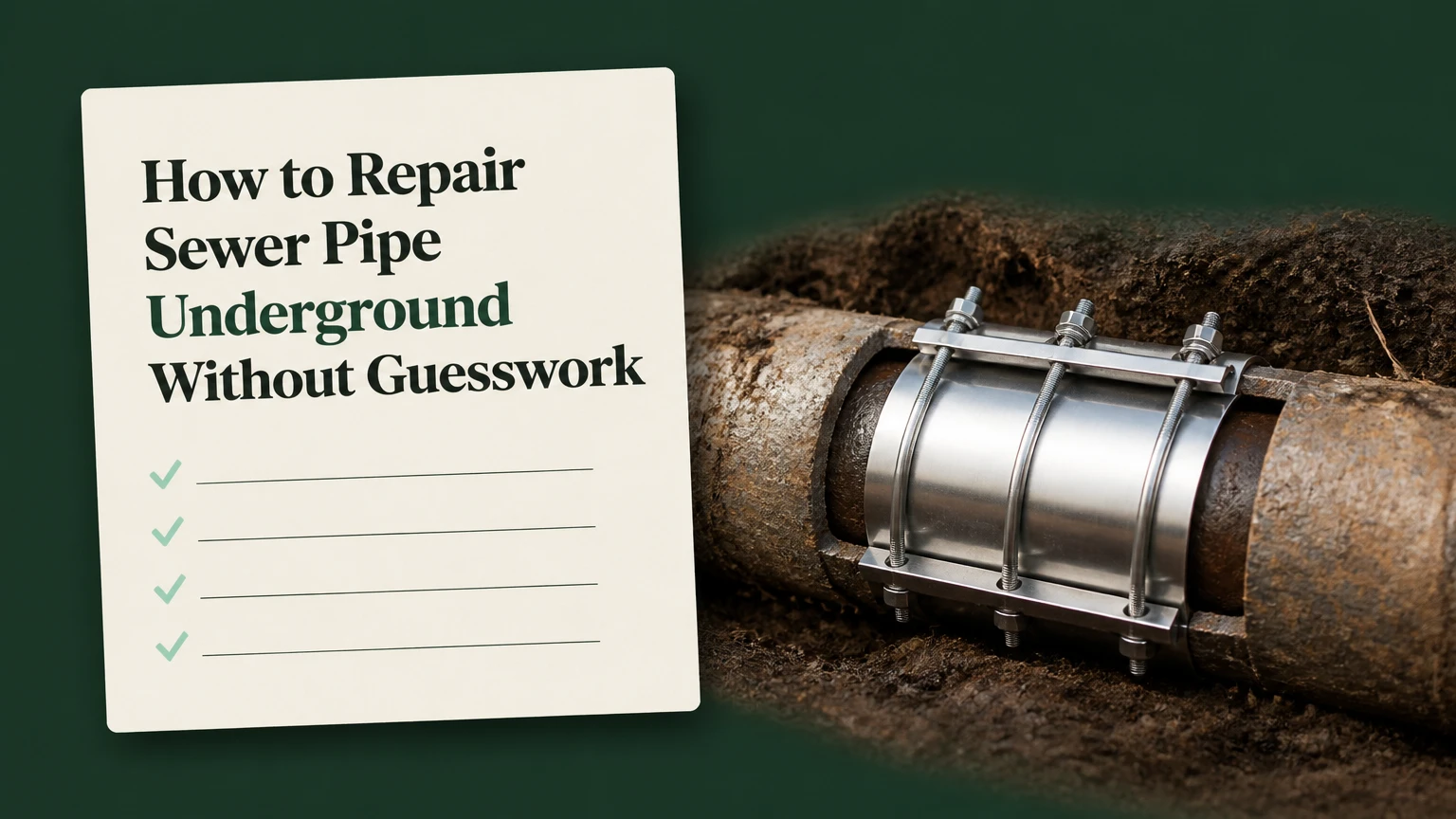
A sectional repair seals one isolated crack, joint, hole, or short root entry with a fiberglass patch, resin sleeve, or mechanical stainless-steel sleeve. A camera-guided packer holds the repair against the pipe wall while the resin cures or the sleeve locks into place.
Spot repair is efficient when the remaining line has sound structure. It is poor value when several defects occur throughout an old clay or cast-iron lateral, because untreated defects remain vulnerable.
Slip Lining
Slip lining inserts a smaller carrier pipe inside the host pipe and fills the annular gap with grout. The method provides a new continuous pipe but sacrifices internal diameter and may require larger access pits than CIPP.
Slip lining is most practical on straight, accessible alignments with enough host-pipe diameter to preserve required flow. It is less suitable for small residential laterals where the diameter reduction would restrict capacity.
Step 7: Verify the Finished Pipe
Run post-repair CCTV after curing, installation, or backfill preparation. The inspection should confirm a continuous opening, smooth transitions, sealed joints, correct lateral reinstatements, absence of wrinkles or folds, and no remaining debris.
Testing varies with the method, pipe diameter, local code, and contract. New gravity sewers may receive air or water leakage testing, while a private lateral may be accepted through CCTV and flow testing. “Pressure tested” does not mean the test was appropriate unless the report identifies the method, duration, test section, and result.
Success checkpoint: Wastewater flows freely, the camera passes the repaired length, and every branch connection is open.
Common mistake: Backfilling before inspection. A concealed wrinkle, displaced coupling, or missed lateral becomes expensive to locate later.
Step 8: Restore the Site and Close the Permit
Open-cut work requires approved bedding, controlled haunching, suitable backfill, compaction, and surface restoration. PVC or ABS pipe should rest on a stable, specified bedding layer, and installers must protect the designed slope during placement and backfill.
Restore lawns, concrete, asphalt, pavers, landscaping, and fencing according to the written proposal. Obtain the final municipal inspection or permit closeout when required, and retain the CCTV footage, test results, invoice, liner warranty, pipe material, and repair location.
Success checkpoint: The permit is closed, the surface is restored to the contracted standard, and the records identify the repaired alignment.
Common mistake: Comparing excavation prices without adding concrete replacement, traffic control, dewatering, landscaping, disposal, and compaction costs.
Which Underground Sewer Repair Method Fits the Defect?
The best underground sewer repair method is CIPP for a structurally continuous pipe with cracks or leaks, pipe bursting for a replaceable alignment with multiple structural failures, spot repair for one isolated defect, and open-cut replacement for grade loss or complete collapse. Method selection should follow the CCTV findings and grade survey.
| Method | Typical residential cost | Typical duration | Suitable defect | Main limitation |
|---|---|---|---|---|
| Sectional sleeve | $1,500-$3,800 total | 2-4 hours | One 2-4 foot crack or joint | Untreated defects remain |
| CIPP lining | $80-$250 per foot; $4,000-$15,000 total | 4-8 hours | Cracks, leaks, recurring roots | Cannot restore lost grade |
| Pipe bursting | $60-$200 per foot; $3,500-$20,000 total | 1-2 days | Multiple failures or replacement | Needs pits and utility clearance |
| Slip lining | $80-$250 per foot; $4,000-$25,000 total | 1-2 days | Straight, oversized host pipe | Reduces inside diameter |
| Open-cut replacement | $50-$250 per foot before restoration; $3,000-$13,000 typical base total | 2-5 days | Collapse, belly, disconnection | Excavation and restoration |
These are typical US planning ranges, not fixed bids. Depth, soil, groundwater, pipe diameter, access, permit fees, bypass pumping, traffic control, disposal, and surface replacement can move the final price substantially.
Is Trenchless Sewer Repair Better Than Digging?
Trenchless sewer repair is better when the pipe has a usable alignment and the property owner values limited surface disturbance; open-cut replacement is better when the line has a belly, severe offset, inaccessible sections, or inadequate grade. Trenchless work reduces excavation but does not remove the need for inspection, access pits, cleaning, or permits.
| Decision factor | CIPP lining | Pipe bursting | Open-cut replacement | Spot repair |
|---|---|---|---|---|
| Surface openings | Two cleanouts or small access points | Entry and receiving pits | Continuous trench | Two small access points |
| Grade correction | No | Usually no | Yes | No |
| Diameter change | Slight reduction | Same or larger possible | Designed new diameter | Localized sleeve reduction |
| Surface restoration | Low | Low to moderate | Moderate to high | Low |
| Typical work window | Same day | One to two days | Two to five days | Same day |
| Best pipe condition | Cracked but continuous | Structurally failed but traceable | Collapsed, bellied, disconnected | Mostly sound with one defect |
A practitioner rule of thumb is simple: a smooth liner inside a sagging pipe still holds wastewater in the sag. Trenchless technology changes pipe structure, not the elevation of a settled section.
How Much Does Sewer Pipe Repair Cost?
Underground sewer pipe repair commonly costs $1,500-$25,000 for a residential project, with sectional repairs at the low end and deep replacement under concrete, roads, or landscaping at the high end. Per-foot rates alone are misleading because mobilization, access, permits, restoration, and bypass work may dominate short jobs.
| Cost driver | Typical added range | Why it changes the quote |
|---|---|---|
| CCTV inspection | $200-$800 | Requires locating, cleaning, and recording |
| Hydro-jetting and root cutting | $300-$1,500 | Depends on length, roots, scale, and access |
| Concrete or driveway restoration | $2,000-$10,000+ | Saw cutting, disposal, base repair, and new slab |
| Deep excavation or shoring | $1,000-$8,000+ | Soil, depth, groundwater, and worker protection |
| Bypass pumping | $500-$5,000+ | Needed when wastewater must flow during work |
| Permit and right-of-way controls | $100-$2,500+ | Local inspection, traffic, and public-area requirements |
Request an itemized quote that names the repair length, diameter, material, access points, cleaning method, resin or replacement pipe, lateral reinstatement, testing, restoration allowance, warranty, and exclusions. Two contractors can quote the same per-foot rate while offering very different total scopes.
Can a Homeowner Repair a Sewer Pipe Underground?
A homeowner can diagnose symptoms, locate cleanouts, photograph access conditions, and request CCTV inspections, but full underground sewer repair is usually unsafe and technically unsuitable for DIY work. Excavation adds cave-in, utility-strike, contamination, and structural risks, while trenchless methods require specialized equipment and installation controls.
Reasonable homeowner tasks include:
- Stop water use during a backup.
- Check whether neighbors have the same problem.
- Locate and protect cleanouts.
- Collect prior drain-cleaning invoices and plumbing records.
- Obtain two or three written, camera-supported proposals.
- Confirm insurance, licensing, permits, and warranty terms.
Do not enter a trench, operate a bursting rig, handle sewage without appropriate protection, or assume a rental camera can determine grade and structural capacity. A licensed plumber, utility locator, excavator, or civil engineer should handle the repair scope according to local requirements.
What Should a Sewer Repair Bid Include?
A defensible sewer repair bid identifies the exact defect, repair limits, installation method, restoration scope, and acceptance test. A proposal that says “repair main line” without a camera map or measurable endpoints does not define the contractor’s obligation.
Check for these details:
- CCTV video before cleaning and after installation.
- Pipe diameter, material, approximate depth, and repair length.
- Defect locations measured from a named cleanout.
- Grade findings, including bellies and reverse slope.
- Utility locating and permit responsibility.
- Cleaning, root cutting, descaling, and disposal.
- Lateral connection reinstatement.
- Bypass pumping or occupant water-use restrictions.
- Bedding, compaction, shoring, dewatering, and restoration.
- Test method, warranty duration, exclusions, and permit closeout.
An expert inspection should also note groundwater infiltration and soil visible through a defect. Those findings affect liner design and can reveal a contamination or erosion risk that a simple blockage report misses.
What Problems Can Occur After Repair?
Post-repair backups usually result from a missed lateral, liner wrinkle, residual debris, an untreated upstream defect, or a separate blockage rather than from normal operation. A new backup requires a prompt CCTV inspection instead of repeated chemical treatments or assumptions about workmanship.
| Post-repair symptom | Likely cause | First diagnostic action | Typical correction |
|---|---|---|---|
| Backup within hours | Missed lateral or liner obstruction | CCTV from cleanout | Robotic cutting or obstruction removal |
| New slow drain after weeks | Debris, root recurrence, or separate defect | Flow test and camera | Cleaning, spot repair, or revised scope |
| Yard pooling near pit | Damaged water line, poor drainage, or leak | Shut water meter and inspect pit | Utility repair or drainage correction |
| Sewage odor indoors | Open cleanout, failed coupling, or vent issue | Smoke or dye test | Seal fitting, replace coupling, or repair vent |
| Settlement over trench | Poor compaction or ongoing leak | Surface and CCTV inspection | Recompact, excavate, or correct leak |
A sewer liner does not stop roots from entering through an untreated branch, a downstream connection, or a section beyond the repair limits. Root-control products may slow recurrence in some systems, but they do not restore missing pipe wall or correct a displaced joint.
What Are the Most Common Repair Mistakes?
The most expensive sewer repair mistakes are choosing a method before measuring the defect, lining a pipe with failed grade, skipping lateral reinstatement, and excluding restoration from the comparison. Each mistake creates a repair that may appear complete while the hydraulic or structural problem remains.
- Repairing a blockage as a structural failure: Require a camera after cleaning.
- Lining a belly: Confirm elevation and water-retention depth before approving CIPP.
- Using aggressive jetting on fragile pipe: Match pressure, flow, and nozzle to pipe condition.
- Ignoring private utilities: Use 811 plus a private locator where records are incomplete.
- Closing branch connections: Mark every lateral before lining and inspect each opening afterward.
- Backfilling without compaction control: Settlement can break couplings or reverse the repaired grade.
- Accepting a warranty without exclusions: Ask whether roots, unrelated pipe sections, and lateral connections are covered.
One counterintuitive point matters: the cheapest excavation quote may be the most expensive finished project when it excludes a driveway, retaining wall, mature tree, or public sidewalk. Compare completed scope, not the trench price alone.
How Do You Repair a Sewer Under Concrete or a Driveway?
A sewer under concrete or a driveway may be repaired with CIPP or pipe bursting when the line has adequate alignment, access, and structural geometry. Open-cut replacement remains necessary when grade must change or the pipe has collapsed, but the contractor may limit demolition to targeted pits rather than remove the entire surface.
CIPP generally minimizes surface disturbance because crews work through cleanouts or small access excavations. Pipe bursting also limits excavation, although entry and receiving pits can affect nearby slabs and utilities. Before approving either method, verify that the host pipe is continuous enough for the equipment and that lateral connections can be found and reopened.
Include saw cutting, concrete thickness, base reconstruction, load timing, curing time, and color or finish matching in the bid. A driveway may be structurally usable before the new concrete reaches its specified strength, so follow the installer’s reopening instructions.
How Long Does Underground Sewer Repair Take?
A sectional sewer repair often takes 2-4 hours, CIPP lining commonly takes 4-8 hours, pipe bursting usually takes 1-2 days, and open-cut replacement commonly takes 2-5 days before complex restoration. Inspection, permit approval, rain, groundwater, utility conflicts, curing, concrete replacement, and municipal scheduling can extend the calendar.
| Project condition | Inspection and preparation | Installation | Restoration or closeout |
|---|---|---|---|
| One isolated joint | 1-3 hours | 2-4 hours | Same day |
| 30-60 foot CIPP liner | 2-5 hours | 4-8 hours | Same day to 2 days |
| 30-60 foot pipe burst | 4-8 hours | 1 day | 1-2 days |
| Deep open-cut replacement | 1 day | 1-3 days | 1-5 days |
Ask when wastewater use can resume, when the surface can support vehicles, and when the final CCTV will be delivered. A job is operationally complete only when the building can discharge safely and the documented inspection passes.
FAQ
Can Sewer Roots Be Permanently Repaired?
Root intrusion can be permanently excluded from a repaired section when a continuous liner or properly joined replacement pipe seals the entry path. Root cutting alone is temporary because roots can regrow through cracks and displaced joints. CIPP, spot sleeves, or open-cut replacement must address the structural opening, while nearby trees may continue affecting untreated pipe.
Is Pipe Lining Stronger Than PVC Replacement?
A properly designed CIPP liner can provide structural rehabilitation, but strength depends on liner thickness, resin cure, host-pipe condition, groundwater, soil loads, and design calculations. New PVC provides predictable material properties and new joints, while CIPP avoids continuous excavation. Neither option is automatically stronger for every diameter, depth, or defect.
Who Pays for a Sewer Lateral Repair?
The property owner often pays for the private lateral, while the municipality usually maintains the public main, but the boundary varies by city, easement, and sewer ordinance. Contact public works before authorizing work near the street. Home insurance may cover sudden accidental damage in some policies, but wear, roots, and maintenance exclusions are common.
Can a Sewer Pipe Be Repaired Without Digging?
A sewer pipe can often be repaired without a continuous trench through CIPP lining, sectional sleeves, or pipe bursting. “Trenchless” does not mean zero excavation: crews may need cleanout access, entry pits, receiving pits, or excavation to expose a connection. Severe collapse, missing pipe, and failed grade can eliminate trenchless options.
Should You Repair or Replace an Old Clay Sewer Line?
Repair an old clay sewer line when defects are isolated and the remaining alignment and grade are sound. Replace it when joints are repeatedly displaced, roots occur throughout the run, sections are crushed, or the line has a belly. A full CCTV inspection and grade assessment are more useful than age alone because old pipe condition varies by soil and installation quality.
What Happens if a Sewer Repair Fails?
If a sewer repair fails, stop unnecessary water use and request post-repair CCTV tied to the original defect measurements. The contractor should identify whether the problem is a missed lateral, wrinkle, open coupling, residual debris, new blockage, or unrelated pipe section. Use the written scope and warranty to determine whether correction is included.
The Bottom Line
How to repair sewer pipe underground depends on the defect confirmed by CCTV and the pipe’s elevation, not on the apparent convenience of a preferred method. Use spot repair for one isolated breach, CIPP for a continuous but damaged host pipe, pipe bursting for suitable full-line replacement, and open-cut excavation when collapse, disconnection, or bad slope requires new geometry. Require utility locating, permits, cleaning, lateral reinstatement, post-repair CCTV, testing, and documented restoration before treating the sewer as repaired.