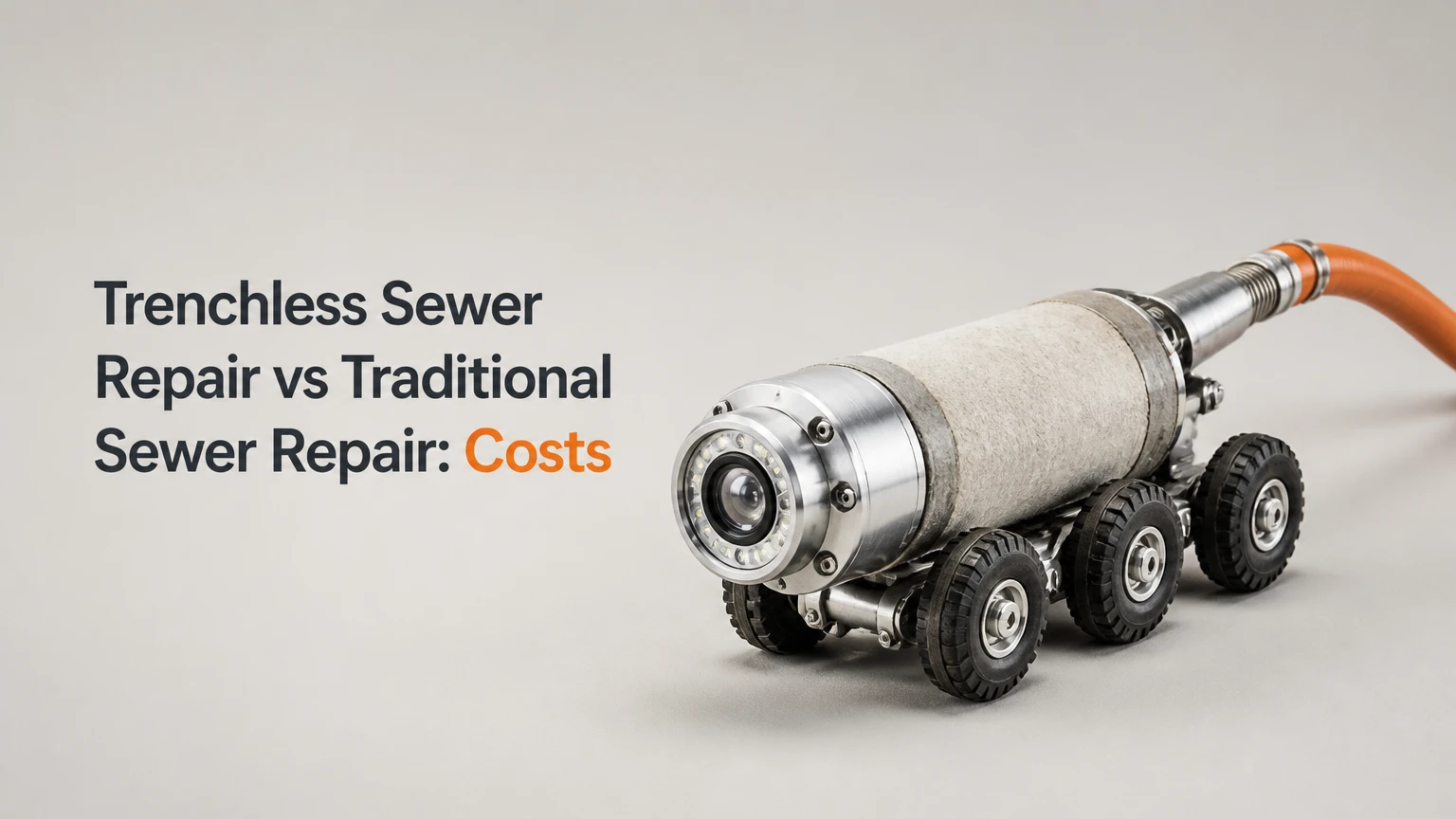
Trenchless sewer repair usually costs more for pipe work but less after restoration, while traditional sewer repair remains the better choice for collapsed, misaligned, or improperly sloped lines. The correct decision depends on the camera findings, pipe diameter, access points, surface restoration, permitting, and whether the existing pipe can support a liner or bursting operation.
Key Facts at a Glance
Traditional sewer replacement exposes the entire pipe, allowing crews to correct grade, alignment, and complete collapse.
Trenchless sewer repair typically uses one or two access pits instead of a continuous trench.
Typical residential project totals range from about $5,000-$23,000 or more for open excavation and $6,000-$12,000 for trenchless work, but local conditions can reverse the comparison.
CIPP lining needs a reasonably continuous host pipe and does not remove a belly or correct an uphill section.
Pipe bursting replaces the old pipe but needs a suitable route, adequate depth, and verified utility clearance.
A sewer camera inspection, cleaning record, written scope, and final video should precede and document either method.
What Is the Difference Between Trenchless and Traditional Repair?
Traditional sewer repair digs down to the buried line, removes defective pipe, installs new pipe, and restores the excavated surface. Trenchless sewer repair reaches the line through small pits or existing cleanouts, then either creates a liner inside the host pipe or breaks the host pipe apart while pulling in a replacement.
The distinction is therefore about access and construction method, not whether the work is permanent. Traditional open-cut replacement installs a new pipe outside the old one. Cured-in-place pipe lining, or CIPP, creates a resin-based pipe within the existing line, while pipe bursting installs a new HDPE pipe along the old route.
The word “repair” can also obscure an important difference. CIPP is rehabilitation when the host pipe remains structurally useful; pipe bursting is closer to replacement because the old pipe is displaced or fractured. A small excavation for one isolated defect is a spot repair, not a full traditional replacement.
Which Method Is Better for Your Sewer Line?
Trenchless repair is usually better when a property has costly landscaping, pavement, mature trees, or limited access and the sewer line retains a continuous path. Traditional excavation is better when the pipe has collapsed, lost its slope, shifted at its joints, or requires a diameter or route change.
No method wins every category. The best choice follows the defect:
| Sewer condition or property factor | Usually preferred method | Reason | Main qualification |
|---|---|---|---|
| Root intrusion in a continuous clay line | CIPP lining | Seals joints and cracks after root removal | Existing grade must remain acceptable |
| Complete pipe collapse | Open-cut replacement | Crews can remove debris and rebuild the route | Pipe bursting may work only if a passable bore path remains |
| Isolated 2-5-foot crack | Spot excavation | Limits labor and restoration | Camera must confirm the defect is isolated |
| Belly or reverse slope | Open-cut replacement | Regrades bedding and pipe | Lining follows the defective profile |
| Sewer under a concrete driveway | CIPP or bursting | Reduces surface demolition | Access pits and utility locating remain necessary |
| Undersized or restricted pipe | Open-cut replacement or bursting | Allows capacity correction | CIPP reduces internal diameter slightly |
| Line under a mature tree | Trenchless method | Avoids extensive root and landscape disturbance | Roots may still affect access pits |
| Severely offset joints | Open-cut replacement | Restores alignment directly | Specialized lining may not bridge the offset |
Quick verdict by property type
- Mature landscaping or expensive hardscape: Prefer trenchless when the camera shows a continuous, adequately sloped line.
- Older home with broken clay or Orangeburg pipe: Compare CIPP with bursting, but use excavation if sections have collapsed or shifted.
- Budget-focused homeowner with one isolated defect: Request a spot-repair price before considering a full-length method.
- Line beneath a public road or sidewalk: Trenchless may reduce traffic control and pavement restoration, subject to municipal approval.
- Line with repeated backups and standing water: Do not approve lining until the cause of the standing water is addressed.
How Traditional Sewer Repair Works
Traditional sewer replacement typically follows seven stages: locate the line, excavate, remove the defective pipe, prepare bedding, install new pipe, test the installation, and restore the surface. Residential excavation depths often fall around 4-12 feet, although local topography, frost depth, utilities, and municipal connections can change that range.
Crews first inspect the line with a camera and mark the route. Excavators then remove asphalt, concrete, soil, and the failed pipe. New PVC or ABS pipe is placed on graded sand or gravel bedding, connected with approved fittings, tested, and backfilled in compacted lifts.
Open trenches create safety and logistics obligations. OSHA’s excavation standard, 29 CFR Part 1926 Subpart P, addresses protective systems, access, and cave-in hazards; workers should not enter an unprotected trench simply because the project is residential. Utility locating through 811 or the applicable local service is required before digging, including for a supposedly small spot repair.
Traditional replacement offers the clearest physical correction. Crews can remove a belly, rebuild a damaged connection, change the pipe diameter, improve slope, and address unstable soil. The trade-off is the restoration bill, which can exceed the pipe installation cost when the route crosses a driveway, retaining wall, finished basement, or mature garden.
What Happens During Trenchless Sewer Repair?
Trenchless sewer repair starts with a camera inspection and mechanical cleaning, followed by access preparation, lining or bursting, reconnection of branch lines, and a final video inspection. The most important success factor is not speed; it is matching the technology to the host pipe’s structural condition and geometry.
For CIPP, technicians clean roots, grease, mineral scale, and debris with mechanical tools and hydro-jetting. A resin-saturated felt or fiberglass tube is inserted, inverted or pulled into position, expanded against the host pipe, and cured with ambient air, hot water, steam, or ultraviolet equipment. Robotic cutters reopen service laterals covered by the liner.
For pipe bursting, a bursting head travels through the old route while a new HDPE pipe follows behind it. The head fractures or displaces the old pipe, but the operation can damage nearby utilities or heave shallow ground if the route, depth, or replacement diameter is unsuitable.
A competent project includes a pre-work video, cleaning documentation, product and resin information, lateral locations, curing records where applicable, and a final video. “Trenchless” does not mean “no excavation.” Most residential installations need one or two pits, commonly about 3 feet by 3 feet, although depth and connection points vary.
Which Trenchless Method Fits the Damage?
CIPP lining is suited to cracks, leaking joints, corrosion, and root intrusion in a pipe that still provides a continuous structural pathway. Pipe bursting suits replacement where the old route is usable and the new pipe can maintain capacity. Sliplining and epoxy coating solve narrower problems and should not be presented as interchangeable options.
| Trenchless method | Typical use | Host-pipe requirement | Main limitation |
|---|---|---|---|
| CIPP lining | Cracks, leaking joints, corrosion, roots | Continuous pathway with sufficient shape | Cannot correct grade or major collapse |
| Pipe bursting | Full-length replacement along an existing route | Passable route and verified utility clearance | May reduce or increase ground stress and requires pits |
| Sliplining | Long straight segments with structural support | Larger host pipe with usable entry and exit | Reduces diameter through the inserted carrier pipe |
| Epoxy coating | Pinholes, corrosion, small leaks | Clean, reasonably stable interior | Not a substitute for structural replacement |
| Localized liner | Short isolated defect | Defect accessible and measurable | Does not address defects elsewhere |
CIPP can bridge many cracks, but a liner does not transform poor hydraulics into good hydraulics. If the original pipe dips, wastewater and solids can still collect in the lined depression. A smooth surface may reduce friction while leaving the underlying grade failure intact.
Pipe bursting can preserve or sometimes increase the nominal flow area, depending on the old and new diameters, but “same route” does not guarantee the same installation quality. A contractor must verify easements, utility crossings, lateral connections, soil conditions, and municipal requirements before selecting bursting.
Which Costs Less, Trenchless or Traditional Repair?
Traditional sewer repair often has the lower direct construction price, while trenchless sewer repair often has the lower total installed cost when surface restoration is expensive. Typical residential open-cut totals run approximately $5,000-$23,000 or more, and trenchless projects commonly fall near $6,000-$12,000, but length, depth, access, and local labor can move either figure substantially.
Common planning ranges are:
| Cost component | Traditional open cut | Trenchless lining or bursting | Cost driver |
|---|---|---|---|
| Pipe work before restoration | $3,000-$8,000 | $6,000-$12,000 | Length, depth, material, equipment |
| Typical unit pricing | $50-$250 per linear foot | $80-$250 per linear foot | Mobilization and pipe diameter |
| Lawn restoration | $500-$3,000 | $0-$1,000 | Sod, irrigation, planting season |
| Driveway or concrete restoration | $2,000-$15,000+ | $0-$3,000 | Slab thickness, pavement type |
| Public-road traffic control | $1,000-$10,000+ | $500-$5,000+ | Permit and jurisdiction |
| Typical project duration | 3-7 business days | 1-2 business days | Weather, curing, inspection |
Advertised per-foot pricing is incomplete because many contractors apply minimum charges. A 20-foot line may cost nearly as much as a longer line when camera inspection, cleaning, equipment transport, pits, permits, and reconnections are fixed costs.
A fair estimate should separate pipe work from restoration. It should also identify whether the price includes hydro-jetting, traffic control, utility locating, permits, lateral reconnection, testing, cleanup, landscaping, concrete, taxes, and a contingency for unrecorded conditions.
When is traditional repair cheaper?
Traditional repair is often cheaper when the defect is short, shallow, and beneath inexpensive ground. A single cracked section beneath a lawn may justify a 2-5-foot spot excavation, especially when the rest of a modern PVC line is sound.
Traditional work may also be cheaper where a trenchless contractor must mobilize specialized equipment for a short line, where access pits are difficult, or where the host pipe fails the structural requirements for lining. The cheapest invoice is not the cheapest solution if the selected method leaves a belly or requires a second repair.
How Long Does Each Method Take?
A typical trenchless sewer project takes 1-2 business days after scheduling and permitting, while a traditional replacement commonly takes 3-7 business days. Service interruption may last only several hours for trenchless work, but excavation can keep a driveway, yard, or bathroom unavailable longer.
The calendar estimate should distinguish field labor from total project time. Municipal inspections, resin production, curing conditions, utility conflicts, rain, frozen soil, concrete delivery, and landscape availability can extend either schedule.
| Project stage | Traditional typical duration | Trenchless typical duration | Completion checkpoint |
|---|---|---|---|
| Camera inspection and marking | 1-3 hours | 1-3 hours | Route and defects documented |
| Cleaning and preparation | 2-6 hours | 2-6 hours | Roots, scale, and debris removed |
| Excavation or access pits | 1-3 days | 3-8 hours | Pipe route safely exposed |
| Repair installation | 4-16 hours | 4-10 hours | New pipe or liner installed |
| Testing and final camera | 2-6 hours | 1-4 hours | Flow and connections verified |
| Surface restoration | 1-5 days | 0-2 days | Ground or pavement usable |
A fast trenchless installation is not automatically a better installation. CIPP requires controlled placement and curing, while bursting requires careful monitoring of pulling force and surface movement. The final video and flow test matter more than finishing in one day.
How Long Do the Repairs Last?
Both methods can provide several decades of service when correctly designed and installed, but a universal 50-100-year guarantee is not technically appropriate for every project. Product design life, installation quality, host-pipe condition, soil movement, hydraulic loading, and warranty terms determine the practical result.
New PVC or HDPE has no existing pipe wall to depend on, but joints, fittings, bedding, and later soil movement still affect performance. CIPP creates a jointless structural lining, yet resin wet-out, curing, wrinkles, delamination, thickness, and lateral cuts influence its result.
Ask for the manufacturer’s product data, the specified liner thickness, resin type, curing method, and written warranty. A warranty may cover material defects for a defined period without covering recurring blockages caused by a belly, grease, misuse, or a separate downstream defect.
When Is Trenchless Repair Inappropriate?
Trenchless repair is inappropriate when the sewer lacks a continuous passable route, has a severe belly, needs regrading, requires a different alignment, or cannot provide safe access and utility clearance. Open-cut replacement is usually the more reliable choice when the camera shows pancaked pipe, major displacement, sinkhole formation, or unstable bedding.
The following findings deserve particular caution:
- Complete collapse: A liner cannot travel through a blocked void, and a bursting head may not follow the intended route.
- Severe offset joints: A rigid obstruction can prevent liner passage and create an incomplete installation.
- Standing water from a belly: Lining can preserve the depression and recurring solids accumulation.
- Insufficient internal diameter: A liner reduces the bore by its wall thickness; a restricted line may need excavation or bursting.
- Unknown lateral connections: Missing a branch can leave a bathroom or kitchen unable to discharge.
- Cross-bored utilities: Pipe bursting can intersect gas, electric, or water lines without accurate utility records and locating.
A non-obvious risk is the misleading “smooth pipe” result. A lined pipe may look clean on the final camera while retaining a low point that continues collecting wastewater. The repair succeeded structurally but failed hydraulically.
What Are the Most Common Repair Mistakes?
The most expensive mistakes occur before installation: skipping the camera, accepting a per-foot price without restoration, and choosing lining before confirming slope and structural continuity. Cleaning, lateral mapping, utility locating, and final inspection are core quality controls, not optional extras.
Mistake 1: Lining without confirming grade
A camera should identify the location and severity of bellies, reverse slopes, and standing water. If grade is defective, excavation may be needed to rebuild the bedding and establish continuous fall.
Mistake 2: Treating hydro-jetting as the repair
Hydro-jetting removes roots, grease, and scale, but it does not restore missing pipe, correct a displaced joint, or rebuild a collapsed section. Temporary improvement after cleaning is diagnostic evidence, not proof that the pipe is repaired.
Mistake 3: Failing to reopen laterals
A CIPP liner can cover branch connections. The contractor should map laterals before installation and use a robotic cutter afterward, followed by a camera check from the relevant fixtures or cleanouts.
Mistake 4: Ignoring pipe diameter
A liner’s wall occupies part of the original bore, and sliplining places a smaller carrier pipe inside the host. Request before-and-after internal diameter and hydraulic-capacity calculations for restricted lines.
Mistake 5: Assuming access pits eliminate utility risk
Small pits still require utility locating. Pipe bursting needs an additional route review because the replacement operation exerts force through surrounding soil and can encounter nearby services.
Mistake 6: Comparing warranties instead of scopes
A 50-year material statement does not equal a 50-year workmanship warranty. Compare exclusions, lateral coverage, restoration responsibility, and the remedy if the liner wrinkles, delaminates, or fails inspection.
What Should a Written Sewer Estimate Include?
A written sewer estimate should identify the defect, repair length, pipe diameter, access locations, materials, restoration scope, testing, warranty, and exclusions. Two estimates cannot be compared accurately when one includes concrete replacement and lateral reconnection while the other covers only pipe installation.
Use this checklist before signing:
- Pre-repair camera video with footage timestamp and defect distances
- Pipe material, diameter, length, depth, and route
- Chosen method and the reason it fits the camera findings
- Cleaning method, curing method, resin or replacement-pipe specification
- Number and dimensions of access pits
- Branch-lateral reconnection and testing procedure
- 811 utility locating, permits, inspection, and traffic control
- Concrete, asphalt, soil, sod, irrigation, and planting restoration
- Written warranty, exclusions, payment stages, and change-order process
- Final camera video, flow test, photographs, and closeout documentation
A reputable contractor should explain why an alternative was rejected. If a proposal recommends CIPP but does not address a visible belly, ask for a written hydraulic explanation before proceeding.
Which Should You Choose?
Choose trenchless for valuable landscaping
A homeowner with a mature oak, irrigation system, paver patio, or decorative retaining wall should prioritize trenchless repair when the host pipe remains continuous and properly graded. Avoiding full excavation can reduce restoration work and shorten the period of property disruption.
Trenchless is not automatically appropriate beneath a tree. Access pits can still sever roots, and pipe bursting can affect surrounding soil. The route, depth, and root protection plan should appear in the estimate.
Choose traditional replacement for collapse or bad slope
A century-old clay line with shattered sections, offset joints, and standing water usually needs open-cut replacement. Excavation allows crews to remove unstable pipe, rebuild bedding, correct alignment, and verify the connection physically.
A liner installed over a structurally failed or improperly graded line may postpone excavation rather than eliminate it. The lower initial disruption can become a second project.
Choose spot repair for one isolated defect
Spot repair fits a line that is mostly sound, with one accessible crack, separated joint, or root opening. A camera should demonstrate that the defect is isolated and that upstream and downstream segments do not contain additional failures.
The practical rule is simple: do not buy a full-length solution for a verified short defect without receiving a spot-repair alternative. Conversely, do not accept spot repair when the camera shows repeated defects along the route.
Choose pipe bursting for replacement under hardscape
Pipe bursting can be effective where the owner wants a new pipe along an established route beneath a driveway, sidewalk, or road. The contractor must confirm the new pipe diameter, pulling path, depth, service connections, soil behavior, and nearby utilities.
Bursting is replacement without a continuous trench, not a universal cure. It cannot safely proceed through every collapsed or obstructed line, and shallow installations may experience ground heaving.
What Changes Under Streets or Shared Property?
Sewer work beneath public streets, sidewalks, or neighboring parcels adds permits, easements, traffic control, and ownership questions to the technical decision. Trenchless methods can reduce pavement removal, but they do not remove the need for municipal approval or legal access.
A private lateral may cross a public right-of-way before reaching the municipal main. The homeowner should confirm who owns each segment, who pays for defects in that segment, and whether the city requires a licensed contractor, inspection, bond, traffic plan, or specific pipe material.
Shared laterals create a separate coordination problem. Camera footage should identify where each property connects, and the written agreement should state how costs, access, future maintenance, and restoration are divided.
The Bottom Line
Trenchless sewer repair is usually the better property-preservation choice for a continuous, correctly graded sewer line beneath expensive surfaces, while traditional excavation is the better engineering choice for collapse, severe displacement, bellies, or route correction. Compare total installed cost, not the pipe-only price, and require camera evidence before choosing either method.
The phrase “trenchless sewer repair vs traditional sewer repair” describes a decision that cannot be resolved by price alone. A complete inspection, defect-specific method selection, documented lateral reconnection, utility review, final video, and clear restoration scope produce a more dependable result than a fast quote or a broad lifespan promise.
Frequently Asked Questions
Is trenchless sewer repair worth the extra upfront cost?
Trenchless sewer repair can justify a higher pipe-work price when excavation would damage a driveway, mature tree, retaining wall, or finished landscape. It is less attractive for a short, shallow, isolated defect or a collapsed line that still requires excavation. Compare total installed cost, including restoration and permits.
Can trenchless repair fix a completely collapsed sewer pipe?
Most trenchless methods cannot pass through a completely collapsed or severely offset pipe. Pipe bursting may work where a recognizable route remains, but a blocked path often requires a small excavation to create access or a full open-cut replacement. Camera footage should establish passability before approval.
Does sewer lining fix roots permanently?
CIPP lining can seal the joints and cracks that allow roots to enter, reducing future intrusion through those repaired defects. It cannot prevent roots from entering an unrepaired downstream section, a service connection, or a new crack caused by movement. Cleaning and final lateral inspection remain necessary.
Does a sewer liner reduce pipe capacity?
A sewer liner reduces the internal diameter by the liner wall thickness, while sliplining reduces it by the carrier pipe size and annular space. A smooth liner can reduce friction, but restricted or undersized lines still need a capacity review before installation. Ask for the finished inside diameter.
Who pays for sewer-line repair under a sidewalk?
Responsibility depends on local ownership rules, easements, and the point where the private lateral connects to the municipal sewer. Some municipalities assign the homeowner responsibility to the main; others maintain public portions. Confirm the boundary with the sewer authority before accepting a contractor’s scope.
How can a homeowner compare sewer contractors?
A homeowner should compare camera evidence, defect mapping, method justification, pipe specifications, restoration, testing, warranty exclusions, and final documentation. The lowest quote may omit lateral reconnection, permits, concrete replacement, or downstream defects. Obtain comparable written scopes rather than comparing totals alone.