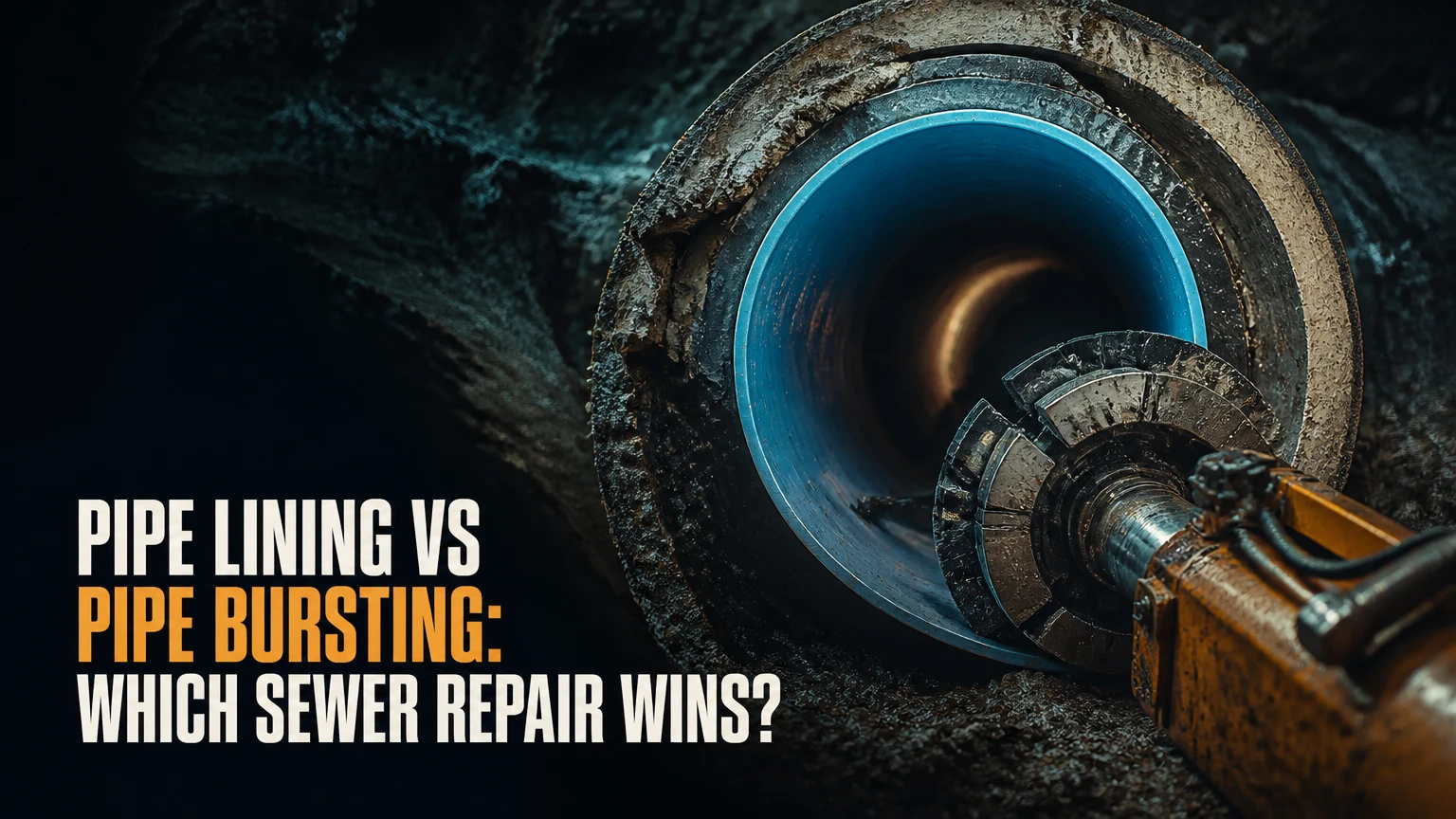
Pipe lining repairs a damaged sewer by installing a resin-cured sleeve inside the existing pipe, while pipe bursting destroys the old pipe and pulls a new one through its route. Pipe lining usually wins for cracked, leaking, root-invaded lines with usable alignment; pipe bursting wins when the pipe has collapsed, needs upsizing, or lacks enough structure for a liner.
Key Facts at a Glance
- Pipe lining is rehabilitation: CIPP creates a structural or nonstructural pipe inside the host pipe after resin curing.
- Pipe bursting is replacement: A bursting head fractures or splits the existing pipe while installing a new HDPE or fusible pipe.
- Lining preserves alignment and usually needs fewer access excavations, but it cannot pass through every collapse, severe offset, or obstructed section.
- Bursting can replace a severely damaged line and increase diameter, but it requires insertion and reception pits and sufficient space around the existing route.
- Typical residential costs range from $4,000-$12,000 for lining and $5,000-$18,000 for bursting, before unusual access, utility, permit, or restoration costs.
- A camera inspection, accurate utility locating, and grade assessment should precede either method. A trenchless label does not remove the need for engineering judgment.
What Are Pipe Lining and Pipe Bursting?
Pipe lining and pipe bursting solve different infrastructure problems. Cured-in-place pipe lining, commonly called CIPP, rehabilitates the existing route by forming a new pipe within the old one; pipe bursting replaces the old pipe by breaking or splitting it and installing a continuous replacement.
The distinction matters because the two methods impose different requirements on the host pipe, soil, access points, and alignment. A liner needs a passage through the damaged line and enough clearance for installation, whereas a bursting head needs room to displace fragments and soil. Neither process automatically corrects poor slope.
Pipe lining can be structural when the liner thickness and resin system are designed for the anticipated loads. Spray-applied epoxy, by contrast, may provide corrosion protection or leak sealing without creating a fully structural replacement. A contractor should identify the system, design classification, resin, thickness, and curing method instead of using “lining” as a generic promise.
Pipe bursting commonly uses high-density polyethylene (HDPE), molecularly oriented PVC, or another approved fusible pipe. The replacement pipe is pulled behind a static or pneumatic bursting head, then connected at access pits. The new pipe does not depend on the old pipe for structural strength.
How Does Each Method Work?
Pipe lining typically follows six controlled stages: CCTV inspection, cleaning, liner design and wet-out, insertion or inversion, curing, and lateral reinstatement. Pipe bursting follows a different sequence: pit excavation, cable or rod installation, bursting-head attachment, hydraulic or pneumatic pulling, new-pipe installation, and connection.
Pipe lining process
- Inspect and map the line. A high-definition CCTV survey identifies cracks, roots, joint gaps, offsets, intrusions, belly locations, diameter changes, and every active lateral.
- Clean the host pipe. Hydro-jetting, root cutting, descaling, or mechanical scraping removes deposits that could prevent passage or create a defect in the finished liner.
- Design and saturate the liner. The installer calculates liner length, diameter, resin quantity, wall thickness, and curing requirements, then impregnates felt or fiberglass with resin.
- Install the liner. A pull-in-place system is drawn into position, or an inversion system is turned inside out using air or water pressure.
- Cure the resin. Ambient air, hot water, steam, or ultraviolet light hardens the liner. Cure temperature and duration depend on resin chemistry and system design.
- Reopen connections. A robotic cutter restores lateral openings that the sleeve covered during installation.
- Verify the result. A post-installation CCTV inspection should confirm a continuous bore, open laterals, sealed ends, and no folds that impair flow.
A liner installation can finish in one working day for a straightforward residential run, but cleaning, water bypass, access, curing, and reinstatement determine the actual schedule. The strongest quality indicator is not speed. It is documented preparation and verification.
Pipe bursting process
- Excavate insertion and reception pits. The pits expose the pipe route at both ends and provide room for the bursting rig and new-pipe connections.
- Verify utilities and route conditions. Utility maps alone are insufficient at crossings; vacuum potholing may be required to confirm depth and location.
- Thread the pulling system. A steel cable or rod assembly travels through the existing pipe.
- Attach the bursting head and replacement pipe. The head must match the host material, diameter, soil conditions, and proposed upsizing.
- Pull the head through the route. Static bursting uses hydraulic force; pneumatic bursting adds impact energy. The head fractures brittle pipe or splits and displaces more ductile materials.
- Install the new pipe continuously. HDPE is commonly fused into a long string before pulling, reducing the number of underground joints.
- Connect and test the line. The crew completes pit connections, checks grade and flow, inspects the pipe, and restores the access areas.
Bursting is not a no-excavation method. It is a reduced-excavation replacement method. Two small pits can still become larger when the crew encounters deep pipe, unstable soil, unknown utilities, oversized equipment, or difficult connections.
Which Specifications Change the Decision?
The most important specifications are host-pipe condition, alignment, diameter, depth, lateral layout, soil behavior, and required capacity. Cost and schedule matter, but they should follow the engineering fit rather than determine the method by themselves.
| Decision factor | Pipe lining, typical residential condition | Pipe bursting, typical residential condition |
|---|---|---|
| Basic action | Resin sleeve forms pipe inside host | Bursting head replaces host with new pipe |
| Typical access | One cleanout or two small access points | Insertion pit plus reception pit |
| Typical cost | $125-$250 per linear foot | $150-$300 per linear foot |
| Typical total price | $4,000-$12,000 | $5,000-$18,000 |
| Typical duration | 4-8 hours to 1 day | 1-2 days |
| Common replacement material | Felt or fiberglass CIPP | HDPE or fusible PVC |
| Internal diameter effect | Usually reduces diameter by about 2-5 millimeters for many small liners | Maintains or increases diameter when soil and utilities permit |
| Alignment tolerance | Handles moderate bends and changing geometry | Requires a practical pulling route with limited sharp deflection |
| Collapsed host pipe | Often unsuitable if equipment cannot pass | Often suitable if the route and soil allow head passage |
| Upsizing capability | No meaningful upsizing | Commonly increases one nominal pipe size, subject to design |
| Main structural dependency | Depends on system design and installation conditions | New pipe is structurally independent of the old pipe |
| Main external risk | Resin, moisture, wrinkles, or missed laterals | Utility strikes, soil heave, vibration, or stuck equipment |
These figures are typical contractor ranges, not universal prices. Diameter, depth, length, groundwater, traffic control, bypass pumping, permit requirements, resin system, and surface restoration can move the quote substantially.
How Much Do Pipe Lining and Pipe Bursting Cost?
Pipe lining usually costs less when a cleanout provides access and the line needs no excavation, while pipe bursting may cost more because pits, utility verification, pipe fusion, and connection work add labor. A fair comparison uses the complete project price, not only the advertised price per foot.
| Cost component | Pipe lining | Pipe bursting | Common price effect |
|---|---|---|---|
| CCTV inspection and locating | $250-$800 | $250-$1,000 | Required before method selection |
| Cleaning or preparation | $500-$2,500 | $300-$1,500 | Roots and scale increase labor |
| Access work | $0-$2,500 | $2,000-$8,000 | Bursting generally needs two pits |
| Installation | $125-$250 per foot | $150-$300 per foot | Diameter and length drive pricing |
| Lateral reconnection | $150-$600 each | $300-$1,200 each | Bursting may require exposed connections |
| Bypass pumping | $500-$3,000 | $500-$4,000 | Depends on flow and duration |
| Surface restoration | $0-$3,000 | $1,000-$8,000 | Concrete, asphalt, and landscaping vary |
| Typical residential total | $4,000-$12,000 | $5,000-$18,000 | Access and restoration create the spread |
Pipe lining becomes less attractive when the host requires extensive excavation to create access or when multiple laterals need difficult robotic reinstatement. Pipe bursting becomes more competitive when the old pipe is unusable, the replacement route is short and straight, or upsizing prevents a second project later.
A low quote can omit essential work. Ask whether the price includes cleaning, water control, lateral opening, post-installation CCTV, permits, engineering, warranty terms, and restoration.
Which Method Handles Structural Damage Better?
Pipe bursting handles total collapse, missing sections, and severely compromised pipe structure better because the new pipe does not need the old pipe to remain continuous. Pipe lining is usually better for cracks, open joints, root intrusion, corrosion, and leaks when a camera and installation equipment can traverse the host line.
| Camera finding | Preferred method | Reason | Important limitation |
|---|---|---|---|
| Hairline cracks and leaking joints | Pipe lining | Seals defects without replacing the route | Cleaning and curing must be controlled |
| Repeated root intrusion | Pipe lining | Seals entry paths and creates a smoother interior | Roots outside the pipe may remain in soil |
| Moderate corrosion or tuberculation | Pipe lining | Adds a corrosion-resistant interior surface | Diameter and structural design must be checked |
| Short missing section | Bursting or spot excavation | A continuous replacement bypasses the gap | Access and nearby utilities determine feasibility |
| Completely collapsed pipe | Pipe bursting or open cut | Bursting does not require an intact passage | Severe blockage may require excavation |
| Severe offset joint | Bursting or localized excavation | A liner may wrinkle or fail to seat | Bursting head also needs a workable route |
| Bellied or reverse-sloped pipe | Open-cut correction, sometimes bursting | Trenchless methods follow the existing grade | Replacement cannot reliably remove a deep sag |
| Undersized line | Pipe bursting | Replacement can increase nominal diameter | Soil heave and utility clearance must be assessed |
A sewer belly deserves special caution. Lining follows the existing geometry, so wastewater can continue pooling in the low section. Bursting may replace the pipe but does not guarantee a corrected grade unless the design, depth, and soil movement permit meaningful grade adjustment. For a severe belly, controlled open-cut repair is often the more honest recommendation.
Can Pipe Bursting Increase Capacity?
Pipe bursting can increase pipe capacity by installing a larger replacement pipe, but upsizing is limited by soil displacement, cover depth, adjacent utilities, easements, and connection geometry. Pipe lining cannot increase the original nominal diameter and reduces the internal diameter slightly, although its smooth surface can reduce friction.
For example, replacing a 4-inch line with a 6-inch line can materially increase theoretical cross-sectional area, but the result is not automatic. The bursting head must expand the existing bore, the surrounding soil must accept displacement, and the larger pipe must connect to downstream infrastructure without creating a bottleneck.
A smoother CIPP surface may preserve useful hydraulic performance despite a small diameter reduction. Designers should compare actual internal diameters, slope, roughness, expected flow, and downstream constraints rather than assuming every larger pipe provides usable capacity.
How Do Bends and Access Change the Choice?
Pipe lining generally tolerates bends, diameter transitions, and branching layouts better than pipe bursting because the flexible liner conforms to the host route. Pipe bursting needs a pulling path with limited sharp turns, adequate pit alignment, and enough room for the bursting head to move without damaging nearby infrastructure.
| Site condition | Lining response | Bursting response | Practical choice |
|---|---|---|---|
| Straight 50-foot lateral | Efficient installation | Efficient installation with two pits | Compare total price |
| One gradual bend | Often manageable | May be feasible with specialized equipment | Confirm manufacturer limits |
| Sharp 45-degree elbow | Sectional liner may work | Usually difficult or infeasible | Lining or open cut |
| Multiple branch laterals | Requires robotic cutting | Requires exposed or reconstructed connections | Price each lateral |
| Line under a slab | Minimal surface disturbance | Pits may be outside slab | Choose from access and route |
| Line beneath driveway | Usually avoids removal | Pit placement may affect driveway | Lining often reduces restoration |
| Dense utility corridor | Fewer excavation points | Head expansion creates underground risk | Favor lining if host is passable |
| Deep municipal main | Requires specialized equipment | May need substantial pits and traffic control | Engineer both options |
Pipe lining is not automatically “zero excavation.” A buried cleanout may need excavation, and an inaccessible or damaged cleanout may require a new access point. Similarly, pipe bursting does not always require large open trenches, but its pits can encounter foundations, utilities, groundwater, or unstable soil.
Which Variations Matter?
CIPP, pull-in-place liners, UV-cured systems, spray-applied coatings, static bursting, pneumatic bursting, and pipe splitting serve different conditions. The method name alone does not establish structural performance; the installer must specify the material system and intended use.
| Variation | Typical use | Main requirement | Main limitation |
|---|---|---|---|
| Inverted CIPP | Long sewer runs with continuous access | Clean, passable host pipe | Requires reliable pressure and cure control |
| Pull-in-place liner | Straight sections or localized repairs | Access at both ends or a suitable pull route | Less adaptable to complex geometry |
| UV-cured fiberglass CIPP | Fast, controlled structural rehabilitation | Correct light train and resin system | Equipment and diameter limits vary |
| Spray-applied epoxy or polyurea | Corrosion control and leak sealing | Prepared, relatively stable substrate | Often not a full structural replacement |
| Static pipe bursting | Controlled replacement and upsizing | Strong hydraulic rig and suitable soil | Requires significant pulling force |
| Pneumatic pipe bursting | Brittle clay or cast-iron pipe | Vibration-tolerant surroundings | Impact can affect nearby structures |
| Pipe splitting | Ductile plastic or metal lines | Compatible cutting head and route | Crossing utilities remain a major risk |
A practitioner should be wary of calling every internal coating a CIPP replacement. A thin spray coating can protect a surface while leaving a structurally deficient host pipe in place. The proposal should state whether the finished system is structural, semi-structural, or protective.
How Long Does Each Repair Last?
A properly designed and installed CIPP system commonly carries a manufacturer or contractor design life of 50 years or more, while fused HDPE replacement is often assigned a 50-100 year service-life expectation under suitable conditions. These are design-life claims, not guarantees for every installation.
Service life depends on resin chemistry, wall thickness, temperature, groundwater, chemical exposure, installation quality, traffic loading, and maintenance. A liner installed over grease, standing water, or protruding roots can fail earlier than a correctly prepared system. HDPE has excellent joint continuity when fusion is performed and documented correctly, but poor connections or external damage can still create defects.
Ask for the written warranty and its exclusions. The warranty should identify the installed product, coverage period, lateral obligations, cleaning assumptions, and whether the contractor guarantees flow, watertightness, structural performance, or only workmanship.
What Can Go Wrong?
Pipe lining failures commonly involve poor cleaning, wrinkles, incomplete cure, resin delamination, excessive water infiltration, or missed lateral connections. Pipe bursting failures more often involve utility strikes, ground heave, excessive vibration, head refusal, cable failure, or insufficient space for the replacement pipe.
Lining failure controls
- Wrinkles or folds: Confirm liner sizing, inversion pressure, and host geometry before curing. A hardened fold may require robotic grinding or replacement.
- Delamination: Control groundwater and verify surface preparation. Removing a failed liner is difficult and can require specialized cutting or excavation.
- Blocked lateral: Map every connection before installation and use post-cure CCTV to locate and reopen it.
- Incomplete cure: Require cure records, temperature monitoring, or UV documentation appropriate to the system.
- Reduced flow: Compare finished diameter with the original and remove excess resin or protrusions before acceptance.
Bursting failure controls
- Utility strike: Mark utilities, review records, and pothole crossings where the expanding head could contact another line.
- Ground heave: Evaluate cover, soil type, groundwater, and upsizing ratio. There is no universal “three feet per inch” safety rule that applies to every site.
- Stuck head: Identify concrete encasement, abandoned services, deep fittings, and inaccessible sections before pulling.
- Vibration damage: Use static bursting near fragile structures or utilities when the route and material allow it.
- Connection mismatch: Confirm outside diameter, inside diameter, material, service fittings, and downstream capacity before ordering the replacement pipe.
The most preventable error is choosing the method from symptoms alone. “Roots” may suggest lining, but an offset joint, collapsed segment, or belly behind the roots can change the recommendation completely.
Which Method Fits Your Situation?
The best choice depends on the defect, not on whether a contractor markets one technology. Pipe lining suits a passable, reasonably aligned host pipe; pipe bursting suits a route that needs replacement, structural independence, or additional capacity.
Home with mature landscaping
Choose pipe lining when the sewer has cracks, roots, leaking joints, or corrosion and the camera confirms a continuous passage. The method can reduce surface disruption because the crew may work through an existing cleanout, although lateral reinstatement and access work still affect the final price.
Choose bursting when the line has collapsed or when the existing diameter cannot support planned occupancy. Protect mature trees and hardscape by comparing pit locations, utility clearance, and restoration costs rather than assuming both methods have equal surface impact.
Sewer beneath a slab or finished floor
Pipe lining often reduces risk when the line bends beneath a building and remains passable. Pipe bursting may work for a straight route with pits outside the slab, but the contractor must assess pulling loads, soil movement, foundation proximity, and connection locations.
Neither method should be sold as a guarantee against structural movement. A geotechnical or structural review may be appropriate when the pipe is shallow, the slab is sensitive, or the proposed replacement requires substantial upsizing.
Commercial or municipal line
CIPP is frequently attractive for long, aligned sewer segments where traffic control and excavation would be expensive. Bursting becomes attractive when capacity expansion, severe structural failure, or replacement of obsolete pipe material justifies access pits and utility coordination.
Municipal projects may also require bypass pumping, NASSCO-style condition coding, public right-of-way permits, pre- and post-installation CCTV, traffic plans, and documented materials testing. Residential pricing should not be transferred to these projects.
Line with a belly or failed grade
Use open-cut correction when the defect is a severe sag, reverse slope, or unstable bedding condition. Lining preserves the problem, and bursting may replace the pipe without correcting grade unless the project has enough depth and design control to alter the route.
This is the clearest case where “trenchless” is not automatically the best outcome. A smaller excavation that fixes the cause can outperform a no-dig repair that leaves recurring standing water.
What Should a Professional Quote Include?
A reliable proposal identifies the actual defect, proposed system, access plan, restoration responsibilities, and acceptance tests. A quote that says only “trenchless sewer repair” does not provide enough information to compare lining with bursting.
Require these items:
- Pre-installation CCTV video with the address, date, direction, and defect locations.
- Pipe diameter, material, length, depth, slope findings, and lateral count.
- For lining, liner material, resin type, design thickness, cure method, pressure or temperature records, and lateral reinstatement price.
- For bursting, pit dimensions, replacement material, outside diameter, fusion method, proposed upsizing, pulling direction, and utility-verification plan.
- Water bypass, permits, traffic control, dewatering, disposal, and surface restoration.
- Post-installation CCTV, flow testing where applicable, and written warranty terms.
- A stated contingency process for collapse, obstruction, groundwater, inaccessible laterals, or utility conflict.
A strong contractor explains why the rejected method is unsuitable. That explanation is often more valuable than a generic promise of a “permanent” repair.
When Is Open-Cut Repair Better?
Open-cut excavation is better when the line has a severe belly, inaccessible route, major grade failure, unstable soil, unverified utility congestion, or a defect that trenchless equipment cannot safely traverse. Open cut also makes sense when a small, exposed repair is cheaper than mobilizing specialized equipment for a short isolated failure.
Traditional excavation provides direct access to bedding, grade, joints, connections, and surrounding soil. Its disadvantages are equally direct: excavation, restoration, traffic disruption, and the possibility of damaging landscaping or hardscape. The correct comparison is total risk and lifecycle cost, not trenchless versus excavation as a slogan.
The Bottom Line
Pipe lining is the better choice for a passable sewer with cracks, roots, leaking joints, corrosion, or moderate structural deterioration, especially when bends, laterals, landscaping, or finished surfaces make excavation disruptive. Pipe bursting is the better choice for a collapsed or undersized line that needs a structurally independent replacement and has a suitable, verifiable route for pits and pulling.
For pipe lining vs pipe bursting, start with CCTV, cleaning, utility locating, and a grade assessment. Reject any recommendation that ignores a belly, omits lateral reconnection, hides access-pit costs, or promises a universal lifespan without naming the installed system.
Frequently Asked Questions
Is pipe lining stronger than the original sewer pipe?
A structural CIPP liner can provide a new load-bearing conduit, but strength depends on resin, thickness, host conditions, groundwater, and design calculations. A spray-applied coating may only protect the interior surface. Request the liner classification, design thickness, product documentation, and warranty instead of assuming every lining product has the same structural capacity.
Can pipe lining be installed through a completely collapsed pipe?
Pipe lining usually cannot be installed through a collapse that blocks the liner or prevents cleaning equipment from passing. A contractor may excavate the collapsed section, use a sectional repair, or switch to pipe bursting or open-cut replacement. CCTV should identify whether the obstruction is a collapse, severe offset, root mass, or removable deposit.
Does pipe bursting damage nearby utilities?
Pipe bursting can damage nearby gas, water, electrical, telecommunications, or private utility lines if their locations and depths are unknown. Utility records, field locating, and vacuum potholing at significant crossings reduce the risk. Static bursting may reduce vibration compared with pneumatic equipment, but it does not eliminate the head’s physical expansion.
Can either method repair a sewer with poor slope?
Neither method reliably repairs a severe sewer belly by itself. Lining follows the existing sag, and bursting may install a replacement along nearly the same grade. Open-cut excavation is often required to correct bedding and elevation, although a carefully designed bursting project may make limited grade changes where depth and soil conditions allow.
Does a CIPP liner reduce sewer capacity?
CIPP usually reduces the internal diameter by a small amount, commonly about 2-5 millimeters in many residential applications, but the cured liner also creates a smoother surface. Actual capacity depends on finished diameter, slope, roughness, inflow, and downstream restrictions. A hydraulic calculation is more reliable than comparing nominal pipe sizes alone.
How can a homeowner compare two trenchless bids?
Compare the documented defect, access assumptions, pipe measurements, lateral count, materials, curing or fusion records, utility plan, bypass pumping, restoration, post-work CCTV, and warranty. Obtain at least two bids based on the same inspection data. The lowest price is not comparable if one proposal excludes pits, reconnections, permits, or surface restoration.