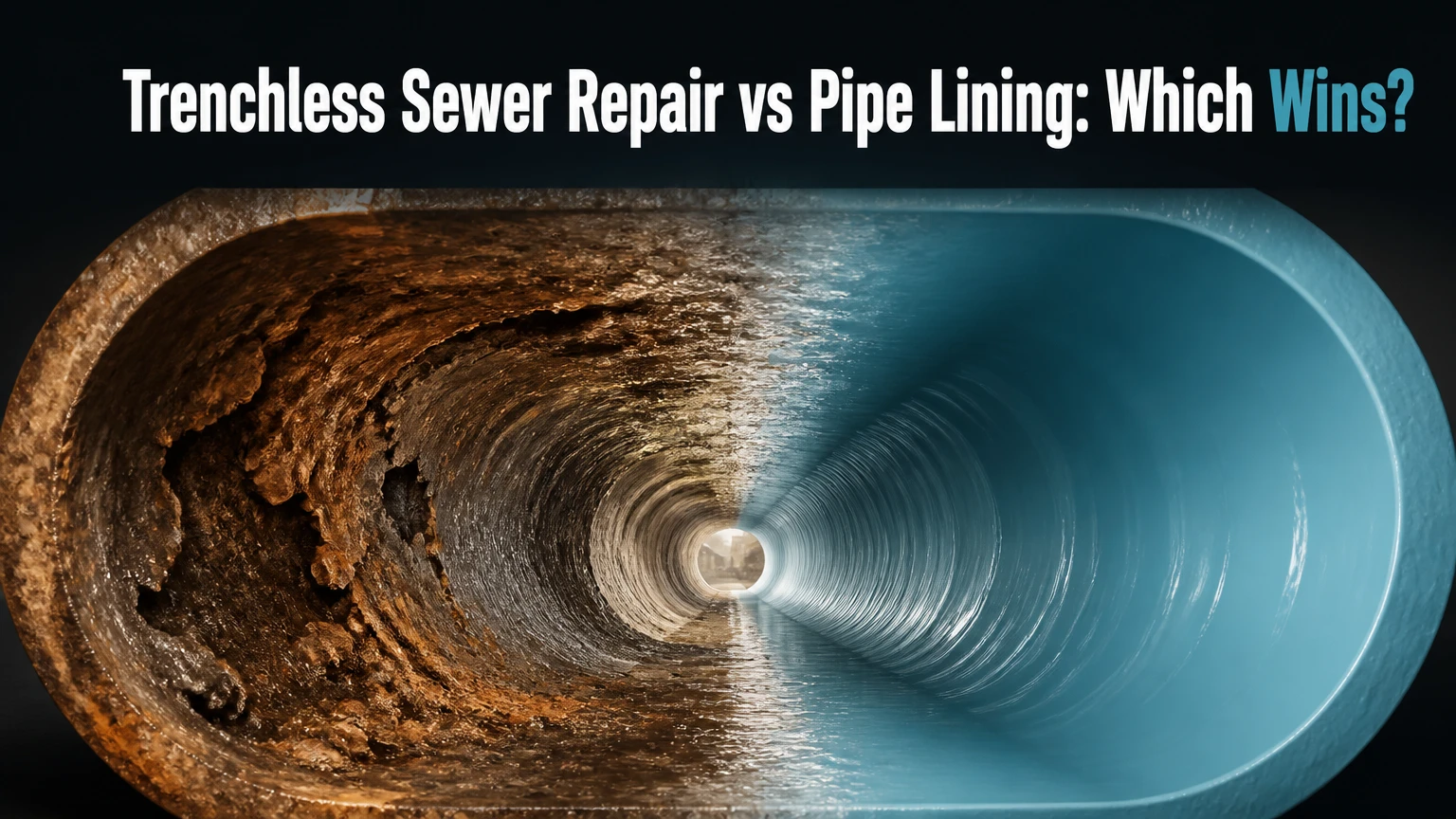
Trenchless sewer repair is the broad category of no-dig rehabilitation and replacement methods, while pipe lining is one specific method within that category. Pipe lining usually repairs a structurally adequate host pipe by curing an epoxy-saturated sleeve inside it; pipe bursting replaces the old line and can increase its diameter. The right choice depends primarily on pipe condition, geometry, access, and site restoration costs.
Key Facts at a Glance
- Pipe lining is trenchless, but trenchless sewer repair also includes pipe bursting, slip lining, and spray coating.
- CIPP lining needs a continuous host pipe with enough shape and strength to support installation.
- Pipe bursting can replace a severely damaged line and may increase capacity, but it commonly requires two access pits.
- A deep belly or backpitch remains a drainage defect after lining because the liner follows the existing grade.
- Typical residential CIPP projects cost about $4,000-$15,000, while pipe bursting commonly costs about $3,500-$20,000.
- A camera inspection, cleaning record, cure report, and final camera video should support any professional trenchless installation.
What Do the Terms Mean?
Trenchless sewer repair describes work completed without excavating a continuous trench along the entire sewer route. Contractors use existing cleanouts or limited entry and exit pits to insert rehabilitation equipment, replace the line, or install a new pipe through the old alignment.
Pipe lining, also called pipe relining or cured-in-place pipe, creates a new pipe inside the existing pipe. A felt, textile, or fiberglass tube receives thermosetting resin, enters the host pipe, expands against its walls, and hardens into a seamless sleeve.
The comparison is therefore not between two equal methods. The comparison is between a category and one treatment option inside that category. In practical bids, the more useful comparison is usually CIPP lining versus pipe bursting, or both trenchless options versus excavation.
| Term | Engineering meaning | Typical residential use | Main limitation |
|---|---|---|---|
| Trenchless sewer repair | No-continuous-trench rehabilitation or replacement | Sewer laterals beneath landscaping, paving, or slabs | Method still depends on pipe condition and access |
| CIPP lining | Resin-cured sleeve installed inside a host pipe | Cracks, corrosion, roots, leaking joints | Cannot correct severe collapse or poor grade |
| Pipe bursting | Old pipe is fractured while a new pipe is pulled through | Replacement and diameter increases | Needs pits and a suitable alignment |
| Spray coating | Thin resin or polyurea applied to the inner surface | Small lines, stacks, complex fittings | Usually unsuitable for major voids or missing walls |
| Slip lining | Smaller rigid pipe inserted into a larger host | Large mains and selected straight runs | Reduces internal diameter and requires annular grout |
How Does CIPP Lining Work?
CIPP lining repairs a sewer by placing a resin-saturated sleeve inside a cleaned host pipe, expanding the sleeve to the pipe wall, and curing the resin into a rigid inner pipe. A standard installation includes inspection, cleaning, wet-out, insertion, inflation, curing, lateral reconnection, and final verification.
The Installation Sequence
- Inspect the sewer with a camera. A high-definition CCTV inspection identifies roots, cracks, offset joints, corrosion, voids, sags, and collapse. The operator should record pipe diameter, length, material, connection locations, and defect positions.
- Clean the host pipe. Hydro-jetting removes grease, sediment, roots, and loose debris. Chain cutters or mechanical tools may remove hardened scale, especially in cast-iron pipe. Cleaning must expose a stable surface rather than merely open a narrow passage.
- Confirm the lining design. The contractor selects sleeve thickness, resin system, cure method, and installation length. The design should account for groundwater, external loading, operating temperature, and the host pipe’s remaining structural support.
- Saturate the sleeve. The resin is mixed and distributed through the liner. Vacuum impregnation helps achieve consistent wet-out, while uneven resin distribution can create weak or uncured areas.
- Insert and expand the liner. Installers either invert the sleeve with air or pull it into position before inflating a calibration bladder. The sleeve must contact the host wall without folds that restrict flow.
- Cure the resin. Ambient cure may take several hours. Steam or hot-water systems commonly cure in roughly 1-3 hours, while UV systems can cure selected liners in approximately 10-20 minutes. Actual timing depends on resin, diameter, wall thickness, temperature, and manufacturer requirements.
- Reopen lateral connections. A robotic cutter restores branch connections from bathrooms, kitchens, or other fixtures. Missed laterals can cause immediate backups even when the main liner itself is sound.
- Run a final camera inspection. The finished pipe should be checked for wrinkles, resin obstructions, open laterals, gaps, blisters, and incomplete cure.
What Must Be True Before Lining?
The host pipe does not need to be perfect, but it must provide a viable route and enough support for installation. A liner can bridge some cracks, leaking joints, and localized defects, yet it cannot recreate missing alignment or remove a deep low spot.
A professional assessment should answer five questions:
- Is the pipe open enough for the liner and calibration equipment?
- Does the pipe retain a continuous route between access points?
- Are offsets within the liner manufacturer’s permitted range?
- Is the pipe grade acceptable, with no damaging belly or backpitch?
- Can every lateral connection be located and reopened?
Trenchless Sewer Repair vs Pipe Lining: Which Criteria Decide?
The practical winner changes with the defect. CIPP lining usually wins when the pipe remains continuous and the main goal is sealing roots, cracks, or corrosion beneath expensive surfaces; pipe bursting wins when the line has collapsed, needs upsizing, or lacks enough host structure for a liner.
| Decision criterion | CIPP pipe lining | Pipe bursting | Conventional excavation |
|---|---|---|---|
| Primary action | Installs a cured sleeve inside host pipe | Fractures old pipe and pulls new HDPE pipe | Removes and replaces soil and pipe |
| Typical access | Existing cleanout or 1 entry pit | Usually 2 pits | Continuous trench |
| Diameter effect | Reduces diameter by roughly 1/4 inch, depending on design | Maintains or increases diameter | Maintains or increases diameter |
| Best defect profile | Cracks, roots, corrosion, leaking joints | Collapse, severe breaks, replacement, upsizing | Extreme collapse, bad grade, inaccessible route |
| Typical duration | About 1-2 days | About 1-2 days | About 3-5 days, with longer restoration |
| Typical residential price | $4,000-$15,000 | $3,500-$20,000 | $5,000-$50,000 or more with restoration |
| Surface disruption | Minimal | Limited, concentrated at pits | Extensive along the route |
| Common failure condition | Deep belly or unstable host pipe | Sharp bends or unlocated utilities | High restoration labor and site disturbance |
Which Method Causes Less Property Damage?
CIPP lining generally causes less surface disruption because installers can often use an existing cleanout or one small excavation. Pipe bursting also avoids a continuous trench, but its entry and exit pits can be larger and may affect driveways, sidewalks, plantings, or utility corridors.
The least disruptive method is not automatically the least expensive. A short, shallow sewer under an open lawn may be cheaper to excavate, while a line beneath a reinforced driveway or finished basement can make limited-access work financially preferable.
Winner: CIPP lining for minimal surface disturbance, provided the host pipe is suitable.
Which Method Handles Collapse and Structural Failure?
Pipe bursting or excavation handles major structural failure better than CIPP lining. Pipe bursting uses a bursting head to split or displace the old pipe while pulling a new HDPE pipe through the alignment, so it does not require the old pipe to remain an intact cylinder.
Lining depends on the existing route. A pipe that is fully pancaked, badly missing, or blocked by a large displacement may not accept a sleeve. A partially collapsed section can sometimes be opened or repaired locally first, but that decision requires camera evidence and a method-specific design.
Winner: Pipe bursting for a collapsed or structurally unsound line, unless the route cannot accommodate the bursting equipment.
Which Method Preserves or Increases Capacity?
Pipe bursting is the stronger capacity option because contractors can pull a larger replacement pipe through a suitable corridor. A four-inch line may be replaced with a six-inch line when soil conditions, utility clearances, municipal requirements, and connection geometry permit.
CIPP lining slightly reduces the internal diameter. The smooth epoxy surface can improve flow compared with rough, scaled cast iron, so a smaller finished diameter does not always create a practical performance problem. However, a lining proposal should compare original diameter, finished diameter, slope, fixture load, and expected peak flow.
Winner: Pipe bursting for upsizing; CIPP lining for restoring flow in a rough but adequately sized pipe.
How Long Do the Repairs Last?
Both properly designed and installed CIPP liners and HDPE burst pipes are commonly presented with service-life expectations of 50 years or more, but longevity depends on resin quality, installation control, loading, soil movement, and maintenance. A warranty is not a substitute for a documented design and inspection.
The host pipe’s age does not determine lining life by itself. A century-old cast-iron line can receive a durable liner if cleaning and structural design are appropriate, while a newer installation can fail if it has poor grade, recurring settlement, or an uncorrected belly.
Winner: Neither method universally wins on lifespan. Installation quality and defect suitability matter more than the label.
What Does Each Method Cost?
Typical residential CIPP lining costs range from $80-$250 per linear foot, with total projects often around $4,000-$15,000. Pipe bursting commonly ranges from $60-$200 per linear foot, with total projects around $3,500-$20,000. These are planning ranges, not quotes, because access, depth, diameter, permits, cleaning, pits, and restoration can change the total substantially.
| Cost component | CIPP lining | Pipe bursting | Excavation |
|---|---|---|---|
| Typical linear-foot range | $80-$250 | $60-$200 | $50-$250 before restoration |
| Typical total residential range | $4,000-$15,000 | $3,500-$20,000 | $5,000-$50,000+ |
| Cleaning and preparation | $500-$2,500 typical | $500-$2,500 typical | Included in excavation scope |
| Access work | $0-$5,000 typical | $2,000-$8,000 typical for pits | Continuous trench labor |
| Surface restoration | Limited, often $0-$5,000 | Pit restoration, often $1,000-$8,000 | Driveway, concrete, soil, and landscaping may add $10,000-$30,000 |
| Usual work period | 1-2 days | 1-2 days | 3-5 days before extended restoration |
What Changes the Price?
Pipe diameter and length affect material and equipment requirements, but site conditions often control the final price. A deep line under concrete can cost more than a longer line beneath accessible soil because excavation, shoring, disposal, and restoration become larger parts of the estimate.
Ask each contractor to separate these line items:
- Camera inspection and written defect map
- Root cutting, hydro-jetting, or descaling
- Liner thickness, resin type, and cure method
- Pipe-bursting pit dimensions and restoration
- Lateral reconnection charges
- Permits, traffic control, and utility locating
- Final CCTV inspection and warranty terms
A low bid that excludes lateral cutting or restoration is not directly comparable with a complete bid.
What Other Trenchless Methods Exist?
CIPP lining and pipe bursting are not the only no-dig methods. Spray coating can suit small, irregular, or vertical lines, while slip lining is more common in larger straight mains where a reduced diameter remains hydraulically acceptable.
| Method | Typical pipe setting | Access requirement | Defect it addresses | Main constraint |
|---|---|---|---|---|
| CIPP lining | Four-inch to large sewer runs | Cleanout or limited pits | Roots, cracks, corrosion, leaking joints | Needs a usable host route |
| Spray or brush coating | 1.5-3-inch lines and stacks | Localized access | Pinholes, corrosion, minor leaks | Thin coating is not a replacement pipe for large voids |
| Slip lining | Large commercial or municipal mains | Entry and receiving access | Long straight rehabilitation runs | Smaller carrier pipe reduces capacity |
| Pipe bursting | Residential laterals and mains | Entry and exit pits | Replacement, collapse, upsizing | Sharp bends and utility conflicts |
| Excavation | Any accessible route | Continuous trench | Grade correction, total replacement | Major surface restoration |
Spray systems deserve careful specification review. Product chemistry, minimum wall thickness, surface preparation, pressure rating, and structural classification vary considerably, so “epoxy coating” alone does not establish equivalent performance to a structural CIPP liner.
Which Properties Make a Line a Good Candidate?
A sewer is a strong CIPP candidate when camera footage shows a continuous route with cracks, root intrusion, corrosion, open joints, or small localized defects, and when the line has enough diameter after cleaning. A sewer is a strong bursting candidate when replacement or upsizing is required and the alignment has accessible ends with manageable bends.
Common Scenarios
| Property condition | Preferred method | Reason | Important qualification |
|---|---|---|---|
| Roots beneath a mature tree | CIPP lining | Seals joints and cracks without removing paving or landscaping | Correct grade and remove roots first |
| Cast iron with heavy internal scale | CIPP lining after descaling | Smooths corrosion pits and reduces roughness | Verify remaining wall and cleaning quality |
| Fully collapsed clay pipe | Pipe bursting or excavation | New pipe does not depend on the failed host | Confirm utility clearances and soil movement |
| Four-inch line needing higher capacity | Pipe bursting | Can install a larger HDPE pipe | Municipal approval and geometry may limit upsizing |
| Deep belly beneath a slab | Excavation or engineered correction | Restores grade rather than preserving the dip | Lining alone does not drain standing water |
| Vertical building stack with many fittings | Spray or brush coating | Navigates small diameters and complex connections | Confirm structural rating and cure controls |
| Short, shallow line in open soil | Excavation may be economical | Restoration is limited and access is simple | Compare complete installed prices |
When Is Excavation Better?
Excavation is often the better engineering choice when the sewer has a persistent belly, incorrect slope, major grade change, inaccessible cleanouts, or a connection that cannot be reliably reinstated. Open excavation also makes sense when the line is shallow, short, and located in an area with inexpensive restoration.
Trenchless methods reduce surface disturbance, but they do not change the sewer’s grade. A new pipe installed along the same failed alignment can reproduce the same drainage defect unless the project changes the elevation or route.
What Can Go Wrong?
The most common trenchless failures result from unsuitable pipe selection, incomplete cleaning, poor curing control, missed lateral connections, or an uncorrected grade problem. A contractor should diagnose the defect before recommending a method, because equipment capability cannot compensate for an incompatible sewer geometry.
Cleaning Failure
Grease, roots, rust scale, and debris can prevent resin from bonding to the host wall. Residue may cause blistering, wrinkling, delamination, or a reduced internal diameter. The project record should identify the cleaning method and include pre-installation camera footage.
Incomplete Cure
A liner that fails to reach its required temperature, UV exposure, or cure time may remain weak or chemically unfinished. Ask for the resin manufacturer, cure method, temperature records where applicable, and installer quality-control documentation.
Lining a Belly
A liner follows the existing pipe profile. If the host pipe has a deep sag, the finished liner still retains a low point where solids and water can accumulate. Repeated blockages after a visually smooth lining often trace back to grade rather than liner strength.
Missed Laterals
Robotic reinstatement must reopen every active branch connection. A missed bathroom or kitchen lateral can produce a backup immediately after the main line is repaired, creating the false impression that the liner failed.
Utility Cross-Bores
Pipe bursting and other guided underground work can encounter gas, water, electrical, or communication utilities. Utility locating, route mapping, and careful launch-pit planning are safety requirements, not optional administrative steps.
Persistent Odor or Immediate Backup
A styrene odor can occur for approximately 24-48 hours with some thermal resin systems, especially when ventilation is limited. Persistent odor requires contractor review. An immediate backup requires a prompt camera inspection for an unreinstated lateral, wrinkle, obstruction, or displaced connection.
How Should You Compare Contractor Proposals?
Compare proposals by documented scope rather than by the word “trenchless.” Two bids can use the same method while offering different liner thicknesses, cure controls, lateral work, warranties, and restoration responsibilities.
Use this checklist before approving work:
- Request the complete pre-repair CCTV video.
- Mark the proposed start and end points on a site plan.
- Confirm pipe material, diameter, length, and number of laterals.
- Ask why lining, bursting, or excavation fits the observed defect.
- Require the liner design thickness or replacement pipe specification.
- Confirm cleaning, root removal, and groundwater-control procedures.
- Identify the cure method and quality-control records supplied.
- Ask whether lateral reinstatement is included in the price.
- Require a final CCTV video after curing or replacement.
- Read warranty exclusions for settlement, roots, grade, and access.
A credible proposal should explain why a method is unsuitable as well as why it is suitable. Refusal to provide camera footage, vague “lifetime” claims, or a price that excludes known lateral work warrants a second opinion.
Which Should You Choose?
Home With Mature Landscaping
Choose CIPP lining when roots, cracks, or leaking joints occur beneath established trees, patios, or a finished driveway, provided the sewer has acceptable grade and a continuous host pipe. Lining limits excavation and creates a jointless interior that removes many future root-entry paths.
Pipe bursting may still be preferable if the old line is badly distorted or if the property owner wants a larger diameter. The two access pits can disturb less area than a continuous trench, but they remain real excavation and require utility planning.
Old, Collapsed Clay or Orangeburg Sewer
Choose pipe bursting or excavation when the camera shows a full collapse, severe deformation, or missing host sections. CIPP lining needs a route through which the sleeve can travel and a structure against which it can expand.
Pipe bursting is attractive when a new HDPE line can follow the existing route. Excavation becomes more compelling when the alignment has sharp bends, a grade problem, or utility conflicts.
Commercial Building or High-Rise Stack
Consider spray or brush coating for small-diameter vertical stacks with corrosion and many fittings, but verify that the product is rated for the actual pressure, temperature, and structural demand. CIPP can work in selected building drains, although access and lateral geometry may complicate installation.
A building manager should require occupant protection, ventilation planning, fixture shutdown times, and a written reconnection schedule. Sewer work inside an occupied structure has operational risks that a residential bid may not address.
Property Owner Seeking More Capacity
Choose pipe bursting when the existing sewer is undersized and the route can accept a larger pipe. CIPP lining is a rehabilitation method, not a reliable upsizing method, and its sleeve occupies some internal space.
Capacity analysis should include downstream pipe size, municipal connection limits, slope, fixture demand, and backwater conditions. Enlarging a private lateral does not solve a restricted public main.
FAQ
Can pipe lining fix tree-root damage permanently?
CIPP lining can seal cracks and joints that allow roots to enter, so it can provide a durable root-control repair when the host pipe remains continuous and properly graded. Roots must be removed before installation, and the final camera inspection should verify that every active lateral has been reopened.
Does pipe lining reduce sewer flow?
Pipe lining reduces the internal diameter by the liner wall thickness, often around 1/4 inch in residential applications, although the exact value depends on design. The smooth cured surface can reduce friction compared with heavily scaled cast iron, so hydraulic performance must be evaluated using the finished diameter and pipe slope.
Is pipe bursting safe near gas and water lines?
Pipe bursting can be safe near other utilities when the route is accurately mapped, clearances are evaluated, and the contractor uses appropriate locating and excavation procedures. Unmapped or poorly located utilities increase risk because the bursting head and expanding replacement pipe exert forces in the surrounding soil.
Do I need a permit for trenchless sewer repair?
Permit requirements vary by municipality, pipe location, connection point, depth, and whether work affects a public right-of-way. A homeowner should ask the contractor who obtains permits, schedules inspections, coordinates utility locating, and handles restoration obligations before work begins.
Can a lined sewer be cleaned with a drain snake?
A lined sewer can usually receive routine cleaning, but aggressive equipment, cutting heads, pressure settings, and inspection practices should match the liner manufacturer’s guidance. Preventive maintenance should address grease and root sources without damaging lateral connections or the cured inner surface.
Should I sell a home with a lined sewer?
A lined sewer can support a home sale when the work is documented with permits, invoices, warranty terms, pre-repair and post-repair CCTV, and the installer’s specifications. Disclosure obligations vary by jurisdiction, so the owner should retain the records and provide accurate information to the buyer.
The Bottom Line
Trenchless sewer repair vs pipe lining is not a true method-versus-method comparison because pipe lining is one form of trenchless repair. Choose CIPP lining for a continuous, serviceable pipe with roots, cracks, corrosion, or leaking joints beneath costly surfaces. Choose pipe bursting for collapse, replacement, or upsizing when the route and utility conditions permit. Choose excavation when the sewer has a deep belly, major grade defect, inaccessible geometry, or a short shallow route where restoration is inexpensive. The camera inspection and complete project scope should determine the method, not the sales label.