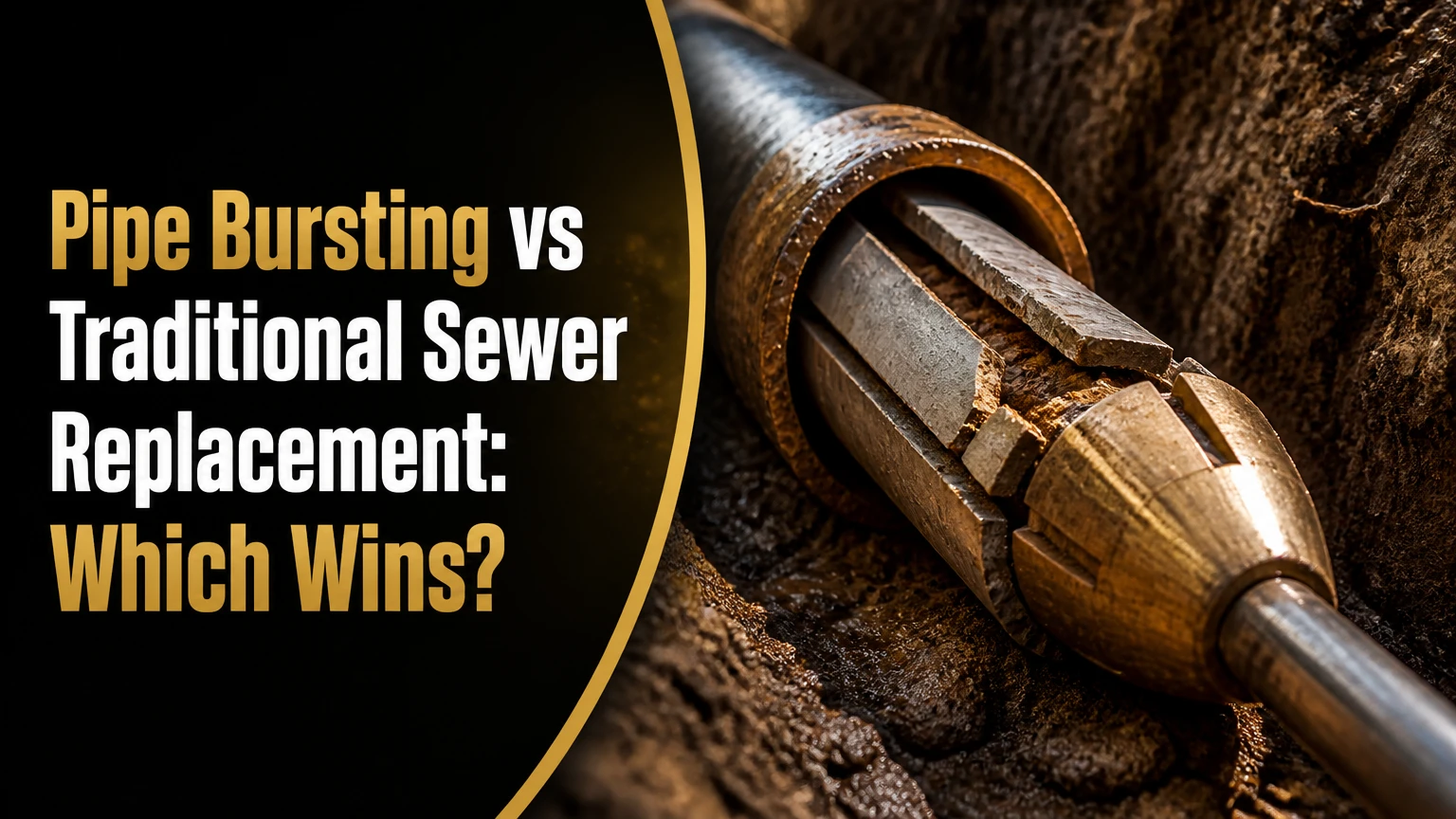
Pipe bursting is usually the better choice when a sewer line is structurally replaceable, access pits can be placed safely, and surface restoration is expensive. Traditional sewer replacement is usually better when the pipe has a severe belly, complete collapse, poor grade, difficult soil, or conflicts that require direct excavation and correction.
Key Facts at a Glance
- Pipe bursting typically uses an insertion pit and a reception pit, while open-cut replacement exposes the full pipe alignment.
- Typical residential pipe-bursting projects cost about $6,000-$15,000 before unusual utility, access, or permit complications.
- Traditional excavation may cost $4,000-$13,000 for basic work, but pavement, traffic control, and landscaping can raise the total to $12,000-$25,000 or more.
- Pipe bursting can often increase the replacement diameter, but the achievable increase depends on soil, existing utilities, pipe design, and pulling force.
- Pipe bursting follows the existing alignment and generally cannot correct a deep low spot or improper slope.
- Open-cut replacement usually takes longer because crews must excavate, shore, install bedding, backfill in controlled lifts, compact soil, and restore surfaces.
What Is the Difference Between Pipe Bursting and Open-Cut Replacement?
Pipe bursting replaces a sewer pipe underground by fracturing or splitting the existing host pipe and pulling a new pipe into its path. Traditional sewer replacement exposes the line in a continuous trench, removes the old pipe, prepares the trench base, installs new pipe, and restores the surface.
The practical difference is not simply “trenchless versus traditional.” Pipe bursting shifts cost into specialized equipment, engineering, utility locating, and high-strength replacement pipe. Open-cut construction shifts cost into excavation, shoring, soil handling, disposal, backfill, pavement replacement, and landscaping.
| Decision factor | Pipe bursting | Traditional open-cut replacement |
|---|---|---|
| Surface excavation | Usually 2 pits, plus lateral access | Continuous trench over the alignment |
| Typical residential duration | 1-2 business days, site dependent | 3-7 business days, site dependent |
| Typical direct cost | $60-$225 per linear foot | $50-$250 per linear foot |
| Typical residential total | $6,000-$15,000 | $4,000-$25,000 after restoration |
| Grade correction | Usually unavailable | Full control of elevation and slope |
| Common replacement pipe | Heat-fused HDPE | PVC, ductile iron, or other code-approved pipe |
| Upsizing | Often possible within engineering limits | Broadly possible with sufficient trench width |
| Main construction risk | Utility conflict or excessive pull force | Trench collapse, settlement, and restoration defects |
The lowest installation rate does not identify the lowest project cost. A trench through a lawn may favor excavation, while the same trench beneath a driveway, sidewalk, retaining wall, or mature tree may favor pipe bursting after all restoration expenses are included.
How Does Each Sewer Replacement Method Work?
Pipe bursting and open-cut replacement follow different construction sequences, but both require a camera inspection, utility investigation, proper pipe sizing, lateral planning, testing, and final documentation. The installation method cannot compensate for an incorrect diagnosis or an incomplete scope of work.
How does pipe bursting work?
A pipe-bursting crew sends a cable or rod train through the existing line, connects it to a bursting head, and pulls the head through the host pipe while attaching the new pipe behind it. The head fractures or splits the old pipe and displaces fragments into the surrounding soil.
A typical sequence includes:
- CCTV inspection: The contractor records pipe material, diameter, alignment, blockages, breaks, sags, lateral connections, and access points.
- Cleaning: Hydro-jetting removes roots, grease, sediment, and loose deposits that could obstruct the bursting head.
- Utility locating: The crew uses records, electronic locating, and, where needed, vacuum excavation to expose crossing utilities.
- Pit construction: Crews excavate insertion and reception pits sized for the equipment, pipe bend radius, depth, and soil conditions.
- Pipe fusion: HDPE sections are butt-fused into a continuous pipe string, with fusion parameters recorded for quality control.
- Bursting pull: A static, pneumatic, or hydraulic system draws the head and replacement pipe through the alignment.
- Lateral reconnection: Branch connections are excavated or opened with robotic cutting equipment, then connected using approved fittings.
- Testing and inspection: The finished line receives CCTV inspection and applicable leakage, pressure, vacuum, or mandrel testing.
A bursting pull can take roughly 1-4 hours for a straightforward 100-foot run, but total project time includes setup, pits, fusion, lateral work, inspections, and restoration.
How does traditional sewer replacement work?
Traditional replacement removes the pipe from an open trench. Excavators expose the line, crews stabilize the excavation, workers remove the old pipe, and installers rebuild the pipe zone with suitable bedding and controlled backfill.
The usual sequence is:
- Clear asphalt, concrete, soil, plants, or other surface materials.
- Excavate to the pipe invert while maintaining safe access.
- Install trench boxes, shoring, or approved sloped walls when required.
- Remove and dispose of the old pipe and unsuitable soil.
- Prepare aggregate bedding and establish the designed line and grade.
- Install new pipe and make watertight joints.
- Connect laterals and inspect accessible joints.
- Backfill in specified lifts and compact each lift.
- Rebuild pavement, concrete, lawns, irrigation, and other disturbed assets.
The Occupational Safety and Health Administration states, “Each employee in an excavation shall be protected from cave-ins,” under 29 CFR 1926.652. Trench safety is therefore a design and production requirement, not an optional add-on to the estimate.
Which Pipe-Bursting System Fits the Existing Pipe?
Static, pneumatic, and hydraulic expansion systems are the main pipe-bursting categories. The correct system depends on host-pipe material, diameter, length, soil, nearby utilities, allowable vibration, and the replacement pipe’s tensile limits.
| Bursting system | Typical host pipe | Primary force | Important limitation |
|---|---|---|---|
| Static rod or cable | PVC, ductile iron, steel, clay | Continuous hydraulic pull | Requires careful force control |
| Pneumatic bursting | Clay, concrete, brittle cast iron | Reciprocating air hammer | Produces more vibration and soil shock |
| Hydraulic expansion head | Selected short or controlled runs | Repeated radial expansion | Requires compatible geometry and access |
| Pipe splitting | Steel, ductile iron, some plastics | Cutting blades and pulling force | May need greater clearance than expected |
Static systems are often preferred near sensitive structures because they apply continuous force rather than repeated impact. Pneumatic systems can advance quickly through brittle materials, although vibration and ground movement need assessment near foundations, shallow utilities, and fragile structures.
The pipe manufacturer’s installation data should govern allowable pulling force, minimum bend radius, and suitability for the ground conditions. A contractor should not increase pulling tension simply because the bursting head has stopped moving.
Is Pipe Bursting Cheaper Than Traditional Replacement?
Pipe bursting is cheaper when avoided restoration costs exceed the premium for specialized equipment and HDPE installation. Traditional replacement is often cheaper when the line is shallow, located in an open lawn, and accessible without major pavement, tree, foundation, traffic, or utility work.
Published consumer cost guides and contractor estimates vary substantially by region. Typical figures for residential work are useful for screening, not for selecting a contractor or predicting a final invoice.
| Cost component | Pipe bursting, typical | Open-cut replacement, typical |
|---|---|---|
| Installation rate | $60-$225 per linear foot | $50-$250 per linear foot |
| Equipment and setup | $1,500-$5,000 | $500-$3,000 |
| Access or excavation | 2 localized pits | Full trench length |
| Surface restoration | $500-$4,000 | $2,000-$15,000 or more |
| Residential project total | $6,000-$15,000 | $4,000-$25,000 or more |
| Major cost escalators | Utilities, rock, extra pits | Deep trench, pavement, traffic, soil disposal |
A 100-foot sewer under a lawn may not justify trenchless equipment if excavation and restoration are simple. A 100-foot sewer beneath a $15,000 driveway can produce the opposite result, because a narrow pit repair may cost less than removing and replacing the entire driveway.
Cost estimates should identify whether they include permits, engineering, traffic control, utility potholing, lateral reconnections, excavation spoil disposal, testing, cleanouts, taxes, and final restoration. Missing items often explain why two apparently similar bids differ by thousands of dollars.
How Long Does Each Method Take?
A straightforward pipe-bursting replacement commonly takes 1-2 business days, while traditional open-cut replacement commonly takes 3-7 business days. Depth, pipe length, number of laterals, weather, permits, utility conflicts, trench conditions, and restoration requirements can extend either schedule.
| Project condition | Pipe bursting effect | Open-cut effect |
|---|---|---|
| 50-100 feet, one lateral | Often 1-2 days | Often 3-5 days |
| 150-300 feet, several laterals | More pits and reconnections | Longer trench and restoration |
| Street or sidewalk crossing | Traffic control may still apply | Pavement closure and replacement |
| Rock or dense fill | Cutting and rescue risk increases | Excavation and disposal cost increases |
| Deep installation | Larger pits and lifting requirements | Shoring and groundwater controls increase |
| Winter or wet weather | Fusion and access conditions matter | Excavation, bedding, and curing slow down |
The actual bursting pull is usually the shortest phase. Pits, lateral connections, utility verification, and post-installation testing determine whether the advertised one-day installation becomes a two-day project.
Can Pipe Bursting Fix a Sewer Belly or Complete Collapse?
Pipe bursting generally cannot correct a deep sewer belly because the new pipe follows the host pipe’s existing line and grade. Traditional excavation is the safer choice when CCTV shows a sustained low spot, reverse slope, severe displacement, or a collapsed segment that prevents controlled passage of the bursting assembly.
Pipe bursting may still be possible through some localized breaks or partial collapses after cleaning and preparation. A contractor must prove that the rod, cable, or pilot assembly can pass through the entire run without excessive force.
| CCTV finding | Pipe bursting suitability | Better response |
|---|---|---|
| Cracked clay with stable alignment | Usually suitable | Pipe bursting or lining review |
| Root-filled but open pipe | Often suitable after cleaning | Bursting or cured-in-place lining |
| Local offset joint | Site specific | Repair, ream, or excavate |
| Deep recurring belly | Poor candidate | Open-cut grade correction |
| Completely pancaked pipe | Usually poor candidate | Open-cut excavation |
| Unknown route or missing access | Incomplete evaluation | Locate and expose before pricing |
A new pipe installed into a sag remains a sag. That counterintuitive outcome is one of the most common reasons a low trenchless bid fails to solve recurring backups.
Which Method Protects Driveways, Trees, and Foundations?
Pipe bursting usually protects surface assets better because the project needs localized pits instead of a trench across the full alignment. Traditional excavation can still be the better engineering choice when direct visibility is needed around a foundation, an unstable retaining wall, or a dense network of utilities.
Pipe bursting is attractive beneath expensive hardscape because the contractor may avoid removing and replacing the entire surface. The method does not eliminate all excavation: pits, lateral connections, cleanouts, and utility exposures still require ground disturbance.
What site conditions favor pipe bursting?
Pipe bursting is a strong candidate when the sewer route is reasonably straight, the host pipe has a passable alignment, and the surrounding soil can accept displaced pipe fragments. The method is particularly valuable beneath:
- Concrete driveways and sidewalks
- Mature landscaping and tree-root zones
- Patios, pool decks, and outdoor structures
- Parking lots where closure time affects revenue
- Roads where pavement restoration requires permits and traffic control
What site conditions favor open-cut replacement?
Open-cut replacement is usually preferable when the pipe route is shallow and exposed lawn restoration is inexpensive. Excavation also wins when crews must change grade, relocate the alignment, remove contaminated soil, expose multiple utilities, or rebuild several connected structures.
Rock, very dense fill, expansive clay, and shallow utilities can restrict bursting. A burst head displaces soil outward, so nearby gas, water, electrical, telecommunication, or stormwater lines require accurate horizontal and vertical clearance checks.
Which Replacement Pipe Material Lasts Longer?
Neither method has a universal longevity winner because service life depends on material, installation, joints, soil chemistry, loading, manufacturing quality, and maintenance. Properly specified HDPE and PVC systems can each provide decades of service, while poor bedding, defective joints, or settlement can shorten either system’s life.
Pipe bursting commonly uses heat-fused HDPE, which creates a continuous pipe string without standard bell-and-spigot joints along the installed run. Traditional replacement may use PVC, ductile iron, vitrified clay, or another material required by the owner, code, loading, or utility standard.
| Material | Common application | Joint or connection characteristic | Key design consideration |
|---|---|---|---|
| HDPE | Trenchless sewer replacement | Heat-fused, continuous joints | Pull force and bend radius |
| PVC | Open-cut gravity sewer | Gasketed or solvent-welded joints | Bedding, alignment, and loading |
| Ductile iron | High-load or force-main work | Mechanical or push-on joints | Corrosion protection and restraint |
| Vitrified clay | Existing gravity sewer | Bell-and-spigot sections | Brittle behavior during bursting |
| Cast iron | Existing building or service lines | Hub, no-hub, or mechanical joints | Corrosion, weight, and removal |
Fused HDPE reduces the number of potential infiltration points, but fusion quality still matters. Crews should document bead formation, heating time, alignment, cooling, and traceability rather than treating “seamless” as a substitute for inspection.
What Can Go Wrong With Pipe Bursting or Excavation?
Pipe bursting most often fails through unverified utilities, inadequate access, unsuitable soil, excessive pulling force, or a host pipe condition that prevents the tooling from advancing. Open-cut replacement most often fails through trench instability, poor bedding, inadequate compaction, incorrect slope, or incomplete restoration.
| Failure mode | Likely consequence | Preventive control |
|---|---|---|
| Unlocated crossing utility | Water, gas, or electric damage | Records, electronic locating, potholing |
| Bursting head obstruction | Stalled pull or rescue excavation | CCTV, pre-reaming, planned rescue pit |
| Excessive pull tension | Pipe deformation or damage | Manufacturer force limits and monitoring |
| Sharp host fragments | Scoring of replacement pipe | Suitable pipe specification and ground review |
| Unstable trench wall | Injury, collapse, or delay | OSHA-compliant protective system |
| Poor trench bedding | Settlement or recurring belly | Approved aggregate and elevation checks |
| Unreconnected lateral | Backup or unauthorized discharge | Lateral map and final CCTV |
| Incomplete surface restoration | Settlement, drainage, or disputes | Written restoration specification |
A contractor should record pulling force during a burst. A stalled head is a diagnostic event, not an invitation to increase hydraulic pressure indefinitely.
Which Method Should You Choose?
Homeowners with valuable surface improvements and a passable, correctly graded sewer line should usually investigate pipe bursting first. Owners with a collapsed or badly sloped line should usually prioritize open-cut reconstruction, even when excavation causes more visible property damage.
Home with a paved driveway
Pipe bursting often has the lower total cost when a driveway would otherwise require saw-cutting, base reconstruction, reinforcement replacement, and full-width paving. Confirm that the sewer route has adequate clearance from water and gas services before approving the method.
Home with an open lawn
Traditional replacement may be the better value when the line is shallow, the run is short, and lawn restoration costs only a few hundred dollars. Open excavation also gives the crew direct control over grade and bedding.
Commercial property with parking constraints
Pipe bursting can reduce closure duration when the existing alignment is suitable and the owner values continued vehicle access. The bid must still include traffic control, business-hour restrictions, lateral service management, and emergency bypass planning.
Municipal street or public right-of-way
Pipe bursting can reduce pavement removal and traffic disruption, but public projects require design review, utility coordination, permits, easements, testing, and specifications for the replacement pipe. Open-cut work may be preferable when a broader utility reconstruction project already requires the street to be opened.
Sewer beneath a foundation or structural slab
Neither method should be selected from a sales description alone. A structural engineer, utility designer, or experienced trenchless contractor should evaluate settlement risk, access, pipe depth, building loads, and whether a localized tunnel or open excavation offers better control.
What Should a Sewer Replacement Quote Include?
A reliable quote identifies the diagnosed defect, replacement limits, pipe material and diameter, access strategy, lateral treatment, testing, restoration, exclusions, and warranty. Homeowners should reject comparisons based only on a single linear-foot price.
Use this checklist when comparing proposals:
- Attach the CCTV report and identify the exact starting and ending manholes or cleanouts.
- State the existing pipe material, nominal diameter, depth, and approximate length.
- Specify the new pipe material, dimension ratio or pressure class where applicable, and connection method.
- List every lateral, cleanout, access pit, traffic-control area, and utility exposure.
- State whether permits, engineering, locating, potholing, bypass pumping, and disposal are included.
- Describe testing, final CCTV, acceptance criteria, and documentation.
- Define restoration for asphalt, concrete, irrigation, fencing, planting, and soil settlement.
- Identify allowances for rock, groundwater, contaminated soil, unknown utilities, and extra excavation.
- State who pays if the bursting head becomes obstructed or the method proves unsuitable.
- Compare warranty terms for pipe material, fusion, workmanship, and surface restoration separately.
The strongest bid is not always the cheapest. It is the bid that assigns risk clearly enough for the homeowner to compare equivalent scopes.
Are There Alternatives to Both Replacement Methods?
Cured-in-place pipe lining, sliplining, and localized spot repair can avoid a full replacement when the existing host pipe retains sufficient shape and alignment. These alternatives do not provide the same structural correction as open-cut replacement or the same diameter flexibility as pipe bursting.
| Alternative | Best condition | Typical limitation | Surface disruption |
|---|---|---|---|
| Cured-in-place pipe lining | Continuous host pipe with cracks or roots | Reduces internal diameter and needs sound alignment | Low, usually access points |
| Sliplining | Straight, accessible host pipe | Smaller finished diameter and insertion constraints | Low to moderate |
| Spot repair | One or two localized defects | Does not solve widespread deterioration | Local excavation |
| Open-cut repair | Grade, collapse, or route correction | Highest surface disturbance | High |
| Pipe bursting | Replaceable host with suitable soil | Utility and heave-zone constraints | Low to moderate |
Cured-in-place lining is not interchangeable with pipe bursting. Lining installs a resin-saturated tube inside the old pipe, while bursting removes the host pipe’s functional role and installs a new carrier pipe with potential upsizing.
The Bottom Line
Pipe bursting vs traditional sewer replacement is a choice between minimizing surface disruption and maximizing control over the underground geometry. Choose pipe bursting for a structurally passable, properly graded line beneath costly improvements; choose traditional excavation for severe sags, complete collapse, difficult ground, uncertain routing, or projects that require direct grade and utility correction.
The decision should follow CCTV evidence, utility potholing, depth and soil information, lateral mapping, and a quote that includes restoration. A contractor who cannot explain those inputs has not yet established that either method is appropriate.
Frequently Asked Questions
Can pipe bursting increase sewer pipe size?
Pipe bursting can increase the replacement diameter when the soil, host-pipe route, nearby utilities, bursting equipment, and replacement pipe can tolerate the required displacement. A 4-inch line may sometimes be replaced with a 6-inch line, but the increase is not automatic and must be engineered rather than promised as a standard percentage.
Does pipe bursting damage nearby utility lines?
Pipe bursting can damage nearby water, gas, electrical, telecommunications, or stormwater lines if the expanding head or displaced soil enters their clearance zone. Utility records, electronic locating, and vacuum-excavated potholes at crossings reduce the risk, but no trenchless method eliminates the need for site-specific utility verification.
Does pipe bursting work through a completely collapsed sewer?
A completely collapsed sewer is often a poor pipe-bursting candidate because the cable, rods, or pilot assembly may not pass through the obstruction. Some contractors can excavate a new access point or pre-ream a damaged section, but open-cut replacement usually provides more reliable access when the line is pancaked or filled with soil.
How are sewer laterals reconnected after pipe bursting?
Crews locate each lateral before or during installation, then excavate the connection or use a robotic cutter to reopen it from inside the new pipe. The lateral receives an approved saddle, branch fitting, or other connection, and final CCTV should confirm that the opening is unobstructed and watertight.
Is HDPE better than PVC for a sewer replacement?
HDPE is often advantageous for pipe bursting because heat fusion creates a flexible, continuous pipe string that can withstand installation pulling forces. PVC may be an excellent open-cut material when bedding, grade, loading, and joint installation are controlled. The better material depends on the method, design, local code, soil, and operating conditions.
Can pipe bursting be used under a house or concrete slab?
Pipe bursting may be used beneath a house or slab when access pits, utility clearances, soil conditions, and structural risks are acceptable. The method still creates ground movement and requires lateral or cleanout access. A site-specific engineer or qualified trenchless contractor should assess settlement and foundation effects before work begins.