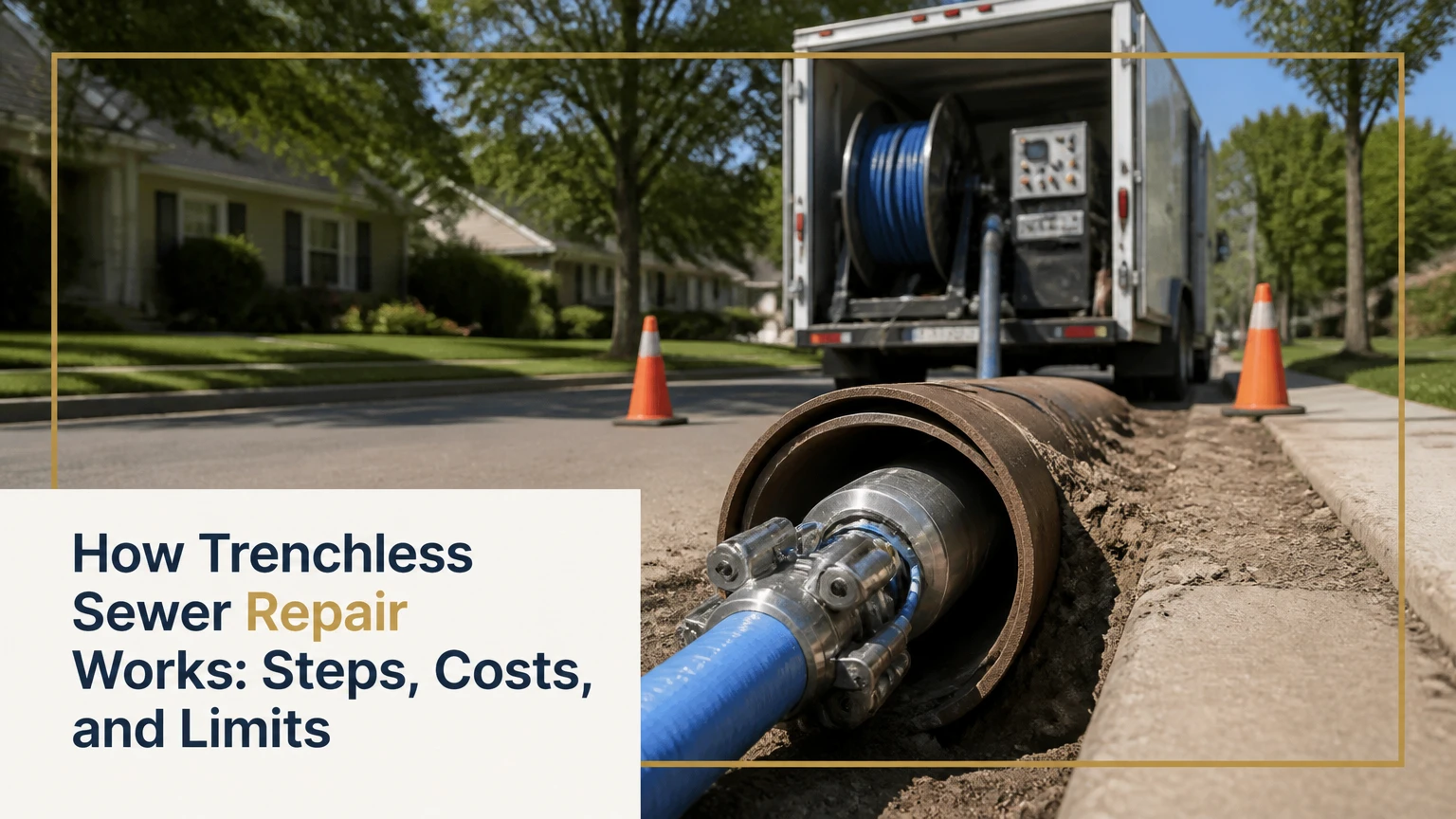
Trenchless sewer repair rehabilitates or replaces underground wastewater pipe through cleanouts, existing manholes, or small access pits instead of exposing the entire line in a continuous trench. Contractors first inspect and clean the host pipe, then install a liner, replacement pipe, or internal coating and verify the finished sewer with CCTV and appropriate tests.
Key Facts at a Glance
- Trenchless sewer repair is a method family, not one product; CIPP lining and pipe bursting solve different pipe failures.
- A CCTV inspection must identify cracks, roots, separated joints, sags, collapses, pipe diameter, and every lateral connection before design.
- CIPP creates a new pipe inside the existing pipe, while pipe bursting breaks the old pipe and pulls a new pipe through its alignment.
- Trenchless work usually needs two access points or existing manholes, although some lateral lining projects use one access point.
- Typical residential pricing is approximately $60-$250 per linear foot, with total projects often falling near $4,000-$15,000.
- A liner follows the existing grade; it does not correct a settled “belly” unless the defective section is excavated and reconstructed.
What Is Trenchless Sewer Repair?
Trenchless sewer repair is underground pipe rehabilitation or replacement that limits excavation to access points rather than digging continuously from the building to the municipal connection. The installed system uses the old pipe as a pathway for a structural liner, a spray-applied coating, or a replacement pipe.
“No-dig” does not mean zero digging. A contractor may need a launch pit, receiving pit, cleanout excavation, manhole access, or a small excavation to expose a damaged connection. The practical advantage is that a driveway, mature tree, finished floor, or road usually remains intact.
The method is appropriate only when the host pipe can be accessed and prepared. Pipe diameter, alignment, groundwater, soil conditions, pipe collapse, and lateral connections determine whether a trenchless design is technically feasible.
What Does the Host Pipe Do?
The host pipe is the existing sewer line that guides equipment or contains the new lining system. With CIPP, the host pipe provides access and temporary containment while the cured liner becomes the new water-carrying structure. With pipe bursting, the host pipe is fractured and displaced, so the new HDPE or fusible PVC pipe becomes the replacement conduit.
The host pipe does not automatically provide structural support. A competent design specifies liner thickness, resin properties, groundwater assumptions, live-load conditions, and expected ovality. NASSCO’s Pipe Assessment and Certification Program, commonly called PACP, provides a standardized approach for coding many defects seen during sewer CCTV inspection, but PACP coding is not itself a repair design.
How Trenchless Sewer Repair Works, Step by Step
A typical trenchless sewer project follows seven stages: inspection, engineering selection, cleaning, access and flow control, installation, lateral reinstatement, and quality verification. A small residential lateral may finish in one to two working days, while difficult access, large diameters, permits, bypass pumping, or multiple laterals can extend the schedule.
1. Inspect and Map the Sewer
The contractor sends a self-propelled or push CCTV camera through a cleanout or manhole and records the line from one access point to another. The inspection identifies pipe material, internal diameter, length, direction, cracks, roots, grease, corrosion, displaced joints, open joints, sags, and collapse.
The camera operator should mark lateral connections by distance and clock position. A pre-repair video without a reliable location reference can leave a lined branch buried behind the new liner.
A useful inspection report includes a video file, an annotated plan, defect distances, pipe diameter, access locations, and the municipal connection point. If the camera cannot pass the entire run, the contractor should explain whether the obstruction requires cleaning, spot excavation, or a different repair method.
2. Select the Installation Method
The contractor matches the method to the defect rather than selling one universal solution. CIPP commonly treats leaking joints, cracks, corrosion, and root intrusion; pipe bursting replaces a severely damaged or undersized line; slip lining installs a smaller carrier pipe; spray coating addresses corrosion and small leaks in compatible geometry.
The design must also account for the sewer’s hydraulic role. A smaller slip-lined pipe can reduce capacity, while a properly sized replacement installed by bursting may maintain or increase diameter. A liner usually preserves more of the original internal diameter than slip lining, but its thickness still reduces the opening by a measurable amount.
3. Clean and Prepare the Host Pipe
Hydro-jetting removes grease, sludge, loose deposits, and many root masses with pressurized water. Mechanical cutters, chain flails, scrapers, or specialized descaling heads remove hardened scale and intruding roots that water alone cannot reliably detach.
A contractor may use water pressures from roughly 2,000-4,000 psi, but nozzle selection, flow rate, pipe material, defect condition, and operator control matter more than a headline pressure number. High pressure can damage fragile clay, deteriorated cast iron, or compromised joints.
The pipe must be clean enough for accurate sizing and, where specified, reliable liner contact. A second CCTV inspection after cleaning confirms that the installation path is open and reveals defects hidden beneath deposits.
4. Control Wastewater and Prepare Access
Active wastewater may need temporary bypass pumping, flow diversion, or timed installation during low-use periods. Commercial buildings, apartment properties, hospitals, and restaurants often require a written flow-management plan because one toilet flush can introduce water into an uncured liner.
Access preparation depends on the system. CIPP may use cleanouts or manholes, whereas pipe bursting generally needs a launch pit and a receiving pit unless existing manholes provide suitable alignment and pulling access. Contractors should locate gas, water, electrical, telecommunications, and other buried utilities before bursting.
Utility conflict is a serious pipe-bursting risk. A bursting head displaces soil and can damage a nearby utility even when the sewer itself is correctly mapped.
5. Install and Cure the New Pipe
For CIPP, a resin-saturated felt or fiberglass tube is pulled into the host pipe or inverted using air or water pressure. The liner is pressed against the host-pipe wall, then cured with ambient conditions, heated water, steam, or ultraviolet light, depending on the product and design.
Curing time ranges from several hours to longer periods depending on resin chemistry, liner thickness, temperature, moisture, and curing technology. UV systems can be fast in suitable straight runs, while steam or hot-water systems require controlled heating and cooling.
Pipe bursting uses a cable, rod, or hydraulic pulling system to draw a tapered bursting head through the old pipe. The head fractures brittle material or displaces the existing pipe while pulling a new HDPE pipe into the resulting annulus. The method can replace an undersized sewer, but soil movement and nearby utilities must be assessed.
6. Reopen Every Lateral Connection
A CIPP liner initially covers branch connections entering the main sewer. After curing, a remotely controlled robotic cutter reopens each lateral at the recorded position and clock orientation.
This step is easy to underestimate. A missed branch can cause backup in a bathroom or kitchen even though the main line appears open. The contractor should compare the pre-installation lateral map with the post-installation CCTV footage and document each reinstated connection.
A lateral connection may need a separate repair if it is badly offset, collapsed, or inaccessible from the main line. Mainline lining does not automatically repair the entire lateral extending beneath private property.
7. Inspect, Test, and Restore Service
The final CCTV run checks for wrinkles, folds, lifted edges, incomplete lateral cuts, open joints, debris, voids, and visible sags. The contractor may also perform air, vacuum, water, leakage, or hydrostatic testing according to the product specification, contract, pipe type, and governing authority.
A universal “3-5 psi” acceptance rule is misleading. Testing pressure and duration vary by standard and application, and a residential gravity sewer may not use the same test protocol as a municipal pressure pipeline. Ask for the actual acceptance criteria in writing before installation.
Service resumes only after the liner has reached its specified cure and the contractor confirms that bypass equipment can be removed. Obtain the final video, test results, product data, warranty terms, and a marked-up sewer map.
Which Trenchless Method Fits the Defect?
CIPP lining is usually the leading option for a structurally damaged sewer beneath expensive surfaces, while pipe bursting is stronger when diameter must increase or the original pipe has widespread failure. Slip lining and spray-applied coatings have narrower applications and require more specific geometric and structural conditions.
| Method | New material | Typical access | Best-fit defect or goal |
|---|---|---|---|
| CIPP lining | Resin-saturated felt or fiberglass | 1-2 access points | Cracks, leaking joints, corrosion, root entry |
| Pipe bursting | HDPE or fusible PVC | 2 pits or manholes | Fractured, undersized, or broadly failed pipe |
| Slip lining | PVC or HDPE carrier pipe | 2 access points | Straight alignment with capacity allowance |
| Spray coating | Epoxy, polyurea, or cementitious material | 1-2 access points | Corrosion, pinholes, and compatible interior surfaces |
CIPP Lining
CIPP is a structural tube formed inside the existing sewer. Resin selection, liner thickness, cure method, groundwater, and design loading determine whether the finished liner is independent of the host pipe or relies partly on host-pipe support.
CIPP is not always “epoxy.” Polyester, vinyl ester, epoxy, felt, and fiberglass systems differ in chemistry and performance. A homeowner should request the product name, resin type, design thickness, cure record, and warranty rather than accepting a generic claim about epoxy.
Pipe Bursting
Pipe bursting is a replacement technique, not an internal coating. The bursting head breaks or displaces the old line, and a new pipe follows behind it. Pipe bursting can preserve or enlarge diameter, but it requires adequate pulling force, a compatible alignment, sufficient soil conditions, and careful utility clearance.
Pipe bursting is a poor choice where the route passes close to unlocated gas services, under sensitive foundations, or through an obstruction that the head cannot pass. A targeted excavation may still be necessary.
Slip Lining and Spray Coating
Slip lining pushes or pulls a smaller pipe inside the existing host pipe, leaving an annular gap that may require grout. The method is comparatively straightforward on straight, accessible runs, but the reduced diameter can affect gravity flow and lateral reconnection.
Spray-applied coatings place a thin protective layer against the interior wall. Coatings can control corrosion and seal small defects, but they are not a universal replacement for a missing pipe wall, severe deformation, active groundwater infiltration, or a major grade defect.
How Much Does Trenchless Sewer Repair Cost?
Typical residential trenchless sewer repair costs approximately $60-$250 per linear foot, with many 40-100-foot projects totaling about $4,000-$15,000 before unusual access, permitting, or restoration costs. Local labor rates and the selected method create wide variation, so a camera-based proposal is more reliable than a national average.
| Cost component | Typical residential range | Main price driver |
|---|---|---|
| CCTV inspection | $175-$350 | Access, video length, reporting requirements |
| CIPP or replacement work | $60-$250 per linear foot | Diameter, material, access, design |
| Typical 40-100-foot project | $4,000-$15,000 | Defect severity and installation method |
| Permit or inspection fees | $400-$1,000 | Municipality and project classification |
| Spot excavation | $1,000-$5,000 or more | Depth, surface, utility conflicts |
These are typical planning figures, not guaranteed bids. A deep line beneath a reinforced concrete driveway can cost more than a shallow line beneath a lawn even when both contain the same number of linear feet.
The estimate should identify cleaning, access pits, bypass pumping, lateral cuts, permits, testing, traffic control, disposal, surface restoration, and taxes. Excluding lateral reinstatement or post-repair inspection can make a low bid appear cheaper than a complete proposal.
How Long Does the Process Take?
Most uncomplicated residential installations take one to two working days after inspection and preparation, while difficult commercial or municipal projects can require several days or longer. CIPP cure time, multiple laterals, restricted access, bypass pumping, and permit inspections usually control the schedule.
| Project condition | Typical field duration | Likely schedule issue |
|---|---|---|
| Single residential CIPP run | 1-2 working days | Cure and lateral reinstatement |
| Pipe bursting with two pits | 1-3 working days | Excavation, utility locating, reconnection |
| Commercial line with bypass | 2-5 working days | Continuous flow management |
| Municipal mainline segment | Several days to weeks | Traffic control, large diameter, testing |
The property may need restricted water use during installation. Contractors should state when toilets, showers, laundry, and commercial fixtures can return to normal operation.
Is Trenchless Better Than Excavation?
Trenchless repair is usually better when surface restoration is expensive and the sewer has a suitable alignment, grade, and access route. Conventional excavation is better when the pipe has a severe belly, a complete collapse, an inaccessible lateral, a connection defect, or a utility and foundation risk that makes trenchless installation unsuitable.
| Decision factor | Trenchless repair | Open excavation |
|---|---|---|
| Surface disruption | Small pits or cleanout work | Continuous trench and restoration |
| Grade correction | Usually cannot correct a belly | Can reset pipe elevation |
| Diameter increase | Pipe bursting can increase size | New pipe can be selected freely |
| Inspection access | Requires suitable endpoints | Direct exposure at every section |
| Initial unit price | Often higher per foot | Often lower pipe-installation price |
| Restoration cost | Usually lower | Lawn, concrete, paving, and landscaping costs |
Trenchless work can reduce total project cost when replacing a driveway, retaining wall, mature tree, or interior floor would be expensive. It is not automatically cheaper because specialized equipment, resin, engineering, testing, and access work can raise the initial construction price.
The most important counterintuitive rule is simple: avoiding excavation does not compensate for preserving a defective grade. A smooth liner inside a sagging sewer still holds standing water and can continue to collect solids.
What Can Trenchless Sewer Repair Not Fix?
Trenchless systems generally cannot correct a structural belly, severe misalignment, inaccessible lateral, or fully collapsed section that equipment cannot traverse. These conditions may require spot excavation, a hybrid repair, or full conventional replacement.
Structural Sags and Bellies
A belly is a section where the sewer has settled below its intended grade. Lining or bursting commonly follows the existing path, so the standing-water zone remains. A contractor should measure the defect with CCTV and, where necessary, use survey information or a level analysis before recommending lining.
Complete Collapse
A liner cannot pass through a solidly collapsed pipe. Pipe bursting may pass through some fractured obstructions, but concrete, rock, a crushed section, or an incompatible transition can stop the bursting head. A small targeted excavation often resolves the obstruction and allows the remainder of the project to stay trenchless.
Damaged Laterals and Bad Connections
A mainline liner does not guarantee a sound lateral connection. Offset joints, broken wyes, illegal cross-connections, and lateral sags may need point repairs or separate lateral lining.
What Causes Trenchless Repairs to Fail?
Trenchless failures most often follow incomplete cleaning, poor design, inadequate curing control, missed laterals, unplanned wastewater flow, or an unsuitable host-pipe condition. The installation process is specialized, but the diagnosis determines whether the technology can succeed.
- Incomplete descaling: Residual cast-iron scale can prevent liner contact and reduce the effective internal diameter.
- Wrinkled or folded liner: Excess liner length, poor inversion control, bends, or obstruction can create a restriction that needs robotic cutting or point repair.
- Under-cured resin: Incorrect resin quantities, temperature, cure time, or UV exposure can leave the liner below its specified strength.
- Unreinstated lateral: A missed branch connection can cause a localized backup despite an open main line.
- Uncontrolled wastewater: Flow entering an uncured liner can wash resin, disturb placement, or contaminate the work area.
- Unmapped utilities: Pipe bursting without utility locating can damage gas, water, electrical, or communications infrastructure.
A practitioner rule of thumb is to distrust a proposal that includes no post-cleaning CCTV, no lateral map, and no written cure or testing record. Those documents are inexpensive compared with repairing a hidden installation defect.
What Should Homeowners Ask Before Hiring a Contractor?
Homeowners should request a complete pre-repair video, a written method selection, a line drawing with lateral locations, and a post-repair video before authorizing trenchless work. The proposal should also identify who pays for access pits, permits, bypass pumping, failed testing, and surface restoration.
Ask these questions:
- What exact defect appears on the CCTV, and where is it measured from?
- Does the pipe have a belly, collapse, severe offset, or inaccessible connection?
- Which method is proposed, and why is it suitable for this pipe material?
- What liner thickness, resin, replacement-pipe diameter, or coating product will be used?
- How will toilets, sinks, and commercial discharge be managed during installation?
- How will every lateral be located and reopened?
- Which testing standard and acceptance criteria apply?
- Will the contractor provide pre- and post-repair CCTV footage?
- What does the warranty cover, and does it cover installation defects?
- Which permits and utility-locating services are included?
A “50-year warranty” should be read carefully. Warranty duration is not the same as a guaranteed service life, and exclusions may cover roots, ground movement, unauthorized alterations, or defects outside the rehabilitated segment.
The Bottom Line
Trenchless sewer repair works by using existing access points to clean, line, coat, or replace an underground sewer without exposing the entire route. CCTV diagnosis, accurate lateral mapping, proper preparation, controlled installation, and documented final testing determine success more than the no-dig label.
Choose CIPP when the line has repairable structural defects and surface disruption matters. Choose pipe bursting when the sewer needs replacement or upsizing and surrounding utilities permit displacement. Choose excavation when grade, collapse, access, or connection defects make an internal solution technically incomplete. The right answer to how trenchless sewer repair works is therefore both mechanical and diagnostic: the installation method must match the failure mode.
Frequently Asked Questions
Does trenchless sewer repair work on clay, cast iron, and Orangeburg pipe?
Yes, trenchless methods can work on clay, cast iron, and some Orangeburg lines, but condition and geometry control feasibility. CIPP often rehabilitates cracked clay or corroded cast iron after cleaning, while severely deformed Orangeburg may require replacement. A camera inspection must confirm diameter, alignment, collapse, and cleanout access before selection.
Can tree roots grow through a new sewer liner?
Roots generally cannot penetrate an intact, properly cured liner, but they can enter through an unreinstated lateral, an open end, a failed connection, or a damaged installation. Root cutting before installation is still necessary because roots and soil deposits can prevent proper liner contact and hide defects.
Will trenchless repair reduce the sewer pipe diameter?
CIPP reduces the internal diameter by the liner’s wall thickness, often by a relatively small amount in residential lines. Slip lining can reduce capacity more substantially because it inserts a separate carrier pipe. Pipe bursting can preserve the existing diameter or install a larger pipe when the alignment and soil conditions allow it.
Can a sewer be lined under a house foundation?
A sewer beneath a foundation can sometimes be lined through suitable cleanouts or exterior access points, avoiding foundation excavation. The contractor must verify that the camera and installation equipment can reach the entire run, that laterals can be reopened, and that no belly or complete collapse requires direct excavation.
Is pipe bursting safe near a gas line?
Pipe bursting can be safe near a gas line only after qualified utility locating, exposure or confirmation of clearance where required, and an assessment of soil movement and pulling forces. A utility map alone may be insufficient. The contractor should document the utility-clearance plan before the bursting head enters the ground.
How long does a cured sewer liner last?
A properly designed and installed structural liner may have a design life measured in decades, and manufacturers commonly provide long warranties for qualifying systems. Actual performance depends on resin, thickness, cure quality, groundwater, loading, cleaning practices, and installation conditions. A warranty does not prove that every liner will last 50 or 100 years.