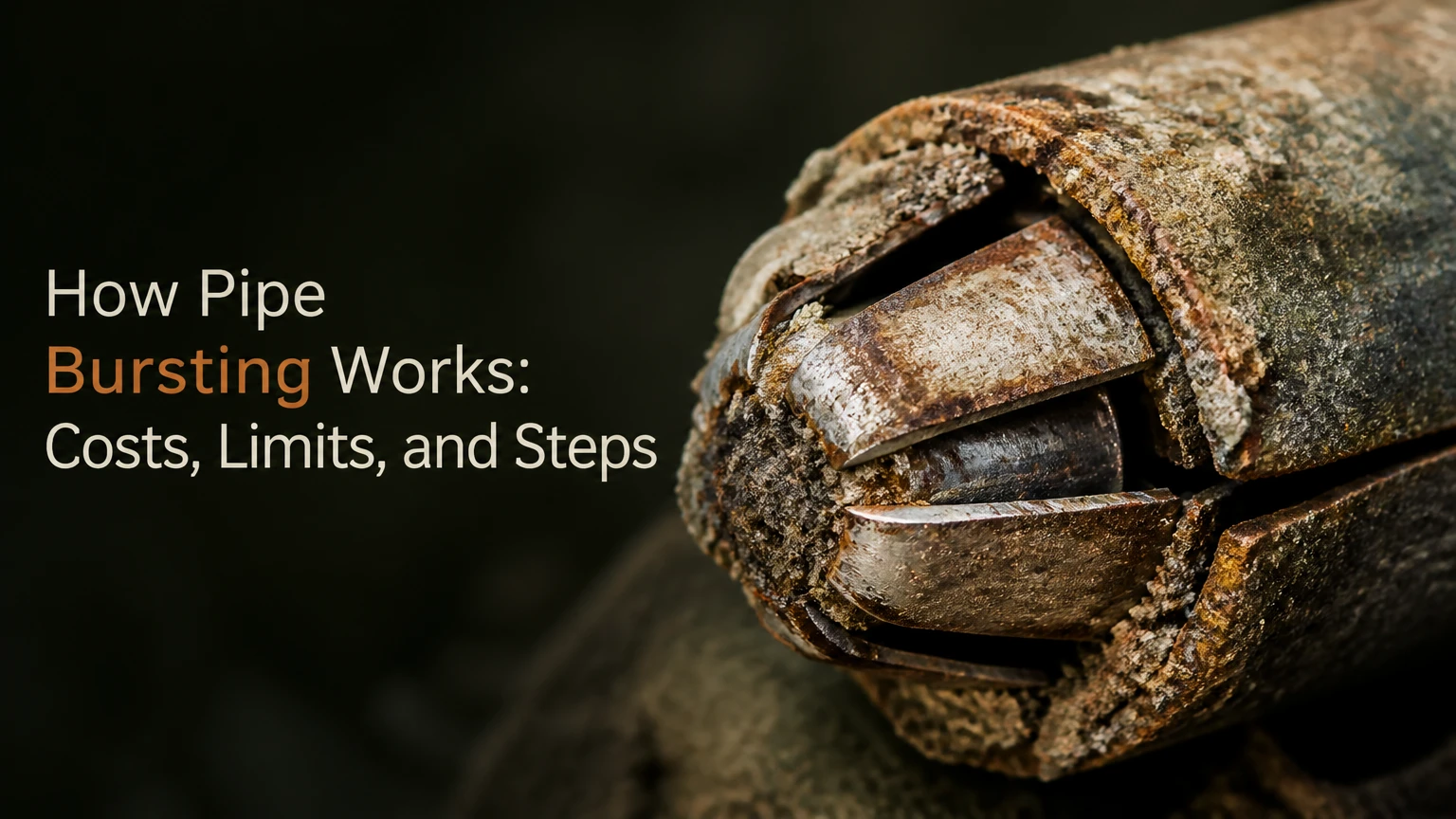
Pipe bursting replaces a buried pipeline from inside its existing route by pulling or pushing an expanding head through the old pipe, fracturing or splitting the host pipe, and drawing a new pipe into the space immediately behind it. The method uses small launch and receiving pits instead of a continuous trench, but it cannot correct every grade defect or overcome every obstruction.
Key Facts
Pipe bursting breaks or splits the existing host pipe while installing a new pipe along the same alignment.
A bursting head converts pulling force into outward radial force against the host pipe and surrounding soil.
Static bursting produces little ground vibration; pneumatic bursting uses repeated impacts and requires more careful vibration assessment.
Butt-fused high-density polyethylene, or HDPE, is a common replacement pipe because its flexible, jointless string tolerates pulling loads.
Typical planning values are 300-400 feet per pull, 2-3 feet of cover, and 10%-25% upsizing, although soil, depth, diameter, and utilities control the actual design.
A pre-installation CCTV inspection, utility survey, lateral plan, and pull-force calculation determine whether pipe bursting is suitable.
What Is Pipe Bursting?
Pipe bursting is a trenchless pipe replacement method, not a coating or repair process. A conical or expandable tool travels through the existing pipe, breaks the host material outward, and pulls a replacement pipe behind it. The old fragments remain in the surrounding soil rather than being removed through a continuous excavation.
Pipe bursting normally follows the existing right-of-way. Contractors excavate an insertion pit and a receiving pit, then use rods, a cable, or a hydraulic puller to move the bursting assembly through the host pipe. Depending on the equipment, the tool may fracture brittle pipe, split ductile pipe with cutting blades, or expand in controlled stages.
The replacement pipe is commonly HDPE, although trenchless-grade PVC and other products may be specified. HDPE sections are heat-fused into a continuous string, so the installed line has fewer potential leak paths than a replacement assembled from many mechanical joints.
Pipe Bursting Versus Pipe Splitting
Pipe bursting fractures a brittle host pipe with an expanding head. Pipe splitting uses a cutting blade or knife to separate a ductile host pipe, such as steel or certain plastic pipes, before the replacement pipe follows the cut. Contractors often use “pipe bursting” as the broader category, but the cutting action matters when selecting equipment.
How Pipe Bursting Works Underground
Pipe bursting works by transferring a machine’s longitudinal pulling force through a bursting head into radial pressure against the host pipe. The head’s larger rear section exceeds the host pipe’s internal opening, so the old pipe fractures or splits while soil moves outward and the attached replacement pipe occupies the newly formed path.
The process is continuous rather than a sequence of isolated repairs. A steel cable or interlocking rod string reaches through the host pipe, connects to the nose of the bursting head, and transfers force from the hydraulic or pneumatic equipment. The new pipe connects to the head with a pulling swivel, pulling eye, or manufacturer-approved adapter.
The host pipe’s response depends on material and condition. Vitrified clay, asbestos cement, and some cast iron tend to fracture into pieces. Ductile steel, ductile iron, and some plastic pipes usually split, deform, or require a dedicated cutting assembly. Soil density controls how much room is available for fragments and the replacement pipe.
What Happens to the Old Pipe?
Old pipe fragments are displaced into the soil around the alignment. They do not normally travel ahead as a large plug because the head creates a path while the tool advances, but hard encasements, collapsed sections, service connections, and heavy repairs can stop the assembly.
The displaced soil creates temporary clearance around the replacement pipe. In cohesive or heavily compacted ground, that clearance may be limited, which increases pulling force and the risk of surface heave. A larger replacement diameter increases the required radial displacement.
What Happens Before the Pull?
Before pipe bursting begins, the contractor verifies the host pipe’s route, condition, depth, connections, and surrounding utilities. CCTV inspection alone does not locate every outside obstruction, so the design normally combines internal inspection with records research, electromagnetic locating, potholing, or a formal subsurface utility engineering survey.
A typical pre-construction sequence includes:
- Inspect the host pipe with CCTV. Record cracks, deformation, collapses, intruding laterals, previous repairs, and changes in diameter.
- Trace laterals and utility crossings. Mark sewer laterals, water services, gas lines, electrical ducts, telecom conduits, foundations, and buried structures.
- Design bypass pumping when needed. Active sewer flows may require pumps, hoses, standby power, monitoring, and contingency storage.
- Confirm permits and access. Public right-of-way work may require traffic control, restoration bonds, environmental controls, and utility coordination.
- Calculate the pull. The engineer considers pipe diameter, soil, depth, upsizing, bend radius, pulling tension, and allowable pipe stress.
- Excavate and shore the pits. The pit layout must accommodate the rig, rod or cable alignment, pipe string, fusion equipment, and worker protection.
A pipe bursting plan that omits lateral locations is incomplete. The new pipe can pass the main alignment successfully while an unrecorded lateral becomes disconnected, crushed, or buried in the displaced soil.
What Are the Steps in Pipe Bursting?
A standard pipe bursting installation has eight field stages, from inspection through testing. A residential sewer replacement may take one to two working days after access is prepared, while a municipal project commonly takes three to ten working days because of bypassing, traffic control, reconnections, and phased testing.
Step 1: Prepare the Launch and Receiving Pits
Excavate a launch or insertion pit where the replacement pipe enters the ground and a receiving pit where the bursting assembly and pulling equipment are positioned or recovered. Exact dimensions vary with pipe diameter, rig geometry, depth, soil, and shoring requirements.
The pits must provide a straight, properly aligned entry path. A poor entry angle can increase bending, friction, and stress at the replacement pipe connection.
Step 2: Fuse and Stage the Replacement Pipe
Butt-fuse HDPE sections on the surface into one continuous string. Fusion technicians control heater temperature, bead formation, alignment, cooling time, and joint records according to the pipe manufacturer’s procedure and project specification.
The pipe string needs sufficient staging space and protection from sharp rocks, traffic, mud, and excessive bending. Fusion does not make a pipe immune to pulling damage; the pipe’s allowable tensile load and minimum bend radius still govern the installation.
Step 3: Install the Rods or Cable
Push a rod string or pull a high-strength cable through the host pipe from the equipment side to the opposite pit. Attach the cable or rods to the bursting head, then connect the replacement pipe to the rear of the head.
The connection must transfer force without damaging the pipe wall. A swivel can reduce torsion when the assembly rotates, especially in pneumatic systems.
Step 4: Pull the Bursting Head
The hydraulic rig applies steady force, or a pneumatic head advances through repeated impacts. The head breaks or splits the host pipe and enlarges the path as the replacement pipe follows directly behind it.
Operators monitor hydraulic pressure, rod movement, pulling tension, head progress, and nearby ground conditions. A sudden pressure increase indicates rising resistance, but pressure alone does not identify the obstruction.
Step 5: Control Soil Displacement
Keep the pull speed, head size, and upsizing ratio within the design assumptions. Excessive expansion in dense soil can lift pavement, distort shallow utilities, or transfer force to a foundation.
Lubrication may reduce friction in some soil conditions, but bentonite use requires engineering approval because uncontrolled fluid migration can affect nearby utilities, groundwater, or unstable ground.
Step 6: Reconnect Laterals and End Connections
Expose each service connection, cut an opening in the new pipe, and install a saddle, electrofusion fitting, or approved mechanical connection. Mainline ends connect to manholes, fittings, valves, or existing pipe with products suitable for the material and pressure class.
Lateral reconnection is often the most labor-intensive part of a short residential project. A successful mainline pull does not automatically restore every service.
Step 7: Test and Inspect the New Line
Pressure-test a water main according to the applicable owner specification, disinfect it where potable-water rules require, and perform leakage checks. Gravity sewers generally receive acceptance testing such as low-pressure air testing, infiltration or exfiltration testing, mandrel testing where specified, and CCTV inspection.
Testing requirements vary by owner, pipe type, and jurisdiction. The contractor should document test results rather than relying on a visual claim that the pipe is intact.
Step 8: Backfill and Restore the Surface
Remove equipment, complete end treatments, backfill the pits in controlled lifts, compact the soil, and restore pavement, concrete, landscaping, or other surfaces. Final restoration can extend the project beyond the active bursting operation.
Which Host Pipes Can Be Burst?
Host-pipe material, wall thickness, structural condition, and outside restraints determine whether a pipe can be fractured or split. Brittle materials are usually easier to fracture, while ductile materials require cutting tools and greater attention to tensile resistance and surrounding utilities.
| Host pipe | Typical bursting behavior | Common replacement | Primary concern |
|---|---|---|---|
| Vitrified clay | Fractures into pieces | HDPE | Service connections and offset joints |
| Cast iron | May fracture or split | HDPE | Wall thickness, corrosion, and nearby utilities |
| Asbestos cement | Fractures, subject to regulations | HDPE | Licensed handling and exposure controls |
| PVC | Splits or expands, depending on product | HDPE or PVC | Plastic deformation and diameter compatibility |
| Steel | Requires pipe splitting or cutting | HDPE or steel | High tensile resistance and welds |
| Reinforced concrete | Often unsuitable for standard bursting | HDPE or larger carrier pipe | Reinforcement, encasement, and head damage |
| Ductile iron | Usually requires specialized splitting | HDPE | Thick wall and high cutting force |
A contractor should not approve a method from CCTV footage alone. Material records, test pits, wall thickness, outside encasements, and utility clearances can change the equipment selection.
Which Bursting System Fits the Job?
Static hydraulic bursting is usually preferred near vibration-sensitive structures, while pneumatic bursting is effective for many brittle host pipes when impact effects are acceptable. Hydraulic expansion systems suit selected large-diameter or highly confined installations, but the rig and tooling requirements are more specialized.
| System | Force method | Suitable host conditions | Main limitation |
|---|---|---|---|
| Static rod pull | Continuous hydraulic force | Clay, cast iron, PVC, steel with splitting tools | High reaction forces and limited access |
| Static cable pull | Continuous winch or hydraulic tension | Shorter runs and selected brittle pipes | Cable alignment and tension limits |
| Pneumatic bursting | Repeated air-powered impacts | Clay, cast iron, concrete, asbestos cement | Vibration and impact near structures |
| Hydraulic expansion | Segmented radial expansion | Large diameter or dense soil | Specialized tooling and slower cycles |
| Pipe splitting | Blade cuts ductile host pipe | Steel, ductile iron, selected plastic | Cutting resistance and utility risk |
The “best” system is a site decision, not a universal equipment ranking. Soil stiffness, cover, pipe material, nearby structures, pipe diameter, and required upsizing matter more than nominal machine power.
Why Choose Static Bursting?
Static bursting applies force without the repeated shock of a pneumatic hammer. That characteristic reduces vibration risk near masonry foundations, fragile utility ducts, historic structures, and sensitive equipment, although static equipment can still displace soil and transmit substantial pulling force.
When Is Pneumatic Bursting Appropriate?
Pneumatic bursting suits brittle host pipes when the project can tolerate ground vibration and the replacement pipe can accept the installation loads. The operator must assess nearby utilities, buried slabs, foundations, and shallow surfaces before selecting an impact-based system.
Can Pipe Bursting Upsize a Line?
Pipe bursting can upsize a pipeline when the surrounding soil can accept the additional displacement and the pits, head, replacement pipe, and connections are designed for the larger diameter. Typical planning increases are approximately 10%-25%; larger increases require project-specific geotechnical and structural analysis.
For example, replacing a 4-inch sewer with a 6-inch pipe represents a 50% increase in nominal diameter, not a routine 10%-25% upsizing. The increase may require more radial force, greater pit dimensions, utility relocation, or open-cut work at constrained sections.
Capacity does not rise in direct proportion to diameter. For a full circular gravity pipe under comparable conditions, the hydraulic capacity relationship is strongly influenced by diameter, slope, roughness, and flow depth. An engineer should verify the actual design rather than promise a capacity gain from diameter alone.
Typical Planning Limits
The following values are field-planning ranges, not universal limits. Manufacturer data, owner specifications, geotechnical conditions, and local regulations control the final design.
| Parameter | Typical range | What controls the value |
|---|---|---|
| Single residential or municipal pull | 300-400 linear feet | Diameter, bends, soil, and access |
| Specialized long pull | More than 1,000 feet | Rig capacity, alignment, pipe string, and engineering |
| Common upsizing | 10%-25% | Soil compressibility and utility clearance |
| Typical cover target | 2-3 feet minimum | Surface sensitivity, diameter, and soil |
| HDPE design-life planning | 50-100 years | Resin, temperature, pressure, and design standard |
| Residential active work | 1-2 working days | Lateral count, bypass, and restoration |
Cover depth is not a safe universal minimum. A shallow host line may be burst successfully in one soil and cause heave in another, while a deep line can still threaten a nearby utility through lateral ground displacement.
What Does Pipe Bursting Cost?
Pipe bursting commonly costs about $60-$200 per linear foot for residential sewer laterals and $130-$350 or more per linear foot for municipal or commercial mainlines. A typical residential project may total $3,500-$20,000, while a municipal installation may total $40,000-$150,000 or more after bypassing, traffic control, design, and restoration.
| Project type | Typical unit cost | Typical total | Typical duration |
|---|---|---|---|
| Residential sewer lateral | $60-$200 per foot | $3,500-$20,000 | 1-2 working days |
| Commercial service line | $90-$250 per foot | $10,000-$40,000 | 1-4 working days |
| Municipal gravity main | $130-$350+ per foot | $40,000-$150,000+ | 3-10 working days |
| Large industrial line | $200-$500+ per foot | $100,000-$500,000+ | 1-4 weeks |
Cost comparisons must include the whole work area. Pipe bursting may have a higher direct installation price than shallow open-cut excavation, yet avoidable costs for driveway demolition, pavement replacement, mature-tree removal, traffic control, and landscaping can make trenchless replacement less expensive overall.
The largest cost variables are pipe diameter, length, depth, access, bypass pumping, lateral count, host-pipe material, utility congestion, soil, permits, and surface restoration. A contractor who provides only a price per foot has not fully described the project cost.
How Does Pipe Bursting Compare With Alternatives?
Pipe bursting provides a new structural pipe and can increase diameter, whereas CIPP lining leaves the host pipe in place and open-cut replacement removes the old pipe through excavation. Pipe bursting is strongest when surface disruption matters and the existing alignment is acceptable.
| Method | Structural result | Typical excavation | Upsizing ability | Best-fit condition |
|---|---|---|---|---|
| Pipe bursting | New pipe replaces host | Two or more pits | Often 10%-25% | Sound alignment, buried access constraints |
| CIPP lining | Liner forms pipe inside host | Access pits or manholes | Usually reduces inside diameter | Continuous host path and limited collapse |
| Open-cut replacement | Old pipe removed and new pipe installed | Continuous trench | Flexible | Grade correction, major obstruction, shallow work |
| Sliplining | New pipe inserted inside host | Access pits | Usually reduces diameter | Straight host with adequate clearance |
| Horizontal directional drilling | New bore created separately | Entry and exit pits | New alignment possible | New route or crossing without host pipe |
When Is CIPP Lining Better?
CIPP lining is often better when the host pipe has a continuous path, the diameter loss is acceptable, and avoiding pipe-fragment displacement is important. CIPP does not create the same capacity opportunity as upsizing, and severe collapse or grade defects may prevent proper liner installation.
When Is Open-Cut Replacement Better?
Open-cut replacement is better when the line needs a new grade, a severe belly must be removed, the route contains an immovable obstruction, or the existing alignment is wrong. Excavation costs more at the surface, but it provides direct access for correcting bedding, elevation, fittings, and utility conflicts.
What Can Go Wrong?
Pipe bursting cannot reliably correct a sag, belly, or incorrect grade because the bursting assembly generally follows the existing alignment. The method also becomes unsuitable when an obstruction, encasement, rock ledge, severe collapse, or utility conflict prevents the head from advancing safely.
The most important risks are:
- Surface heave: Excessive radial displacement lifts pavement, slabs, or landscaping.
- Utility damage: A crossing or parallel utility may be crushed, distorted, or exposed to vibration.
- Replacement-pipe overstress: Excessive pulling tension can stretch, neck, or damage HDPE.
- Head refusal: Concrete encasement, repair clamps, rock, and reinforced sections can stop the tool.
- Lateral loss: Unlocated service connections may be severed or buried.
- Alignment transfer: The new pipe inherits problematic bends, sags, and elevation errors.
- Environmental release: Drilling fluid or groundwater can move through permeable soil.
An expert field rule is to treat a sudden pressure spike as a diagnostic event, not permission to increase the machine setting. Stop, compare pressure with head movement, inspect the pits and surface, and determine whether the resistance comes from soil, pipe material, a fitting, or an outside obstruction.
Failure Modes and Recovery
| Observed problem | Likely cause | Appropriate response |
|---|---|---|
| Head stalls with no progress | Encasement, rock, clamp, or reinforced pipe | Stop pulling and expose the obstruction through a rescue pit |
| Pavement begins lifting | Shallow cover or excessive expansion | Reduce head size, change method, or open-cut the section |
| HDPE shows excessive stretch | Pull force or friction exceeds design | Stop, inspect pipe, recalculate load, and replace damaged material |
| Adjacent service loses pressure | Utility displacement or puncture | Stop work, isolate the utility, and follow emergency repair procedures |
| Lateral cannot be located | Incomplete records or CCTV mapping | Use tracing, potholing, and controlled excavation before reconnection |
| New sewer fails grade testing | Host belly transferred to replacement | Open-cut and correct the defective segment |
Is Pipe Bursting Safe Near Utilities and Foundations?
Pipe bursting can be used near utilities and foundations only after the project evaluates ground displacement, vibration, clearance, depth, and utility condition. Static systems reduce impact vibration, but they do not eliminate radial soil movement or the possibility of damage to a crossing utility.
Utility locating should include records review and field verification. Vacuum potholing at planned crossings provides better information than relying on paint marks or outdated maps, particularly in older urban corridors where abandoned and undocumented lines are common.
Foundations deserve separate assessment. A shallow footing immediately beside the host alignment may receive force through the soil even when the bursting head never touches the structure. Pneumatic equipment adds a vibration source, so static rod bursting or open-cut excavation may be preferable in sensitive locations.
Is Pipe Bursting Suitable for a Residential Sewer?
Pipe bursting is often suitable for a residential sewer lateral that runs beneath a driveway, patio, finished basement, mature landscaping, or other expensive surface. The line should have a traceable route, manageable bends, adequate cover, accessible pits, and no uncorrectable belly or major obstruction.
Homeowners should request the following before accepting a proposal:
- A dated CCTV video showing the full line.
- The host-pipe material, diameter, depth, and length.
- A written plan for every lateral and cleanout.
- Utility locating and responsibility for unknown services.
- The replacement-pipe material, SDR or pressure class, and fusion method.
- The testing procedure and restoration scope.
- A contingency price or process for an obstruction and rescue pit.
- Contractor insurance and applicable trenchless installation experience.
A low price can conceal excluded reconnections, bypass pumping, permits, concrete restoration, or excavation caused by an obstruction. Compare complete scopes rather than unit prices alone.
Expert Rules That Improve Installation Quality
CCTV is a design input, not a pass-fail certificate. A camera can show a collapse but cannot reliably reveal an external concrete encasement, undocumented utility, or soil condition. Combine internal inspection with locating and targeted excavation.
Pipe pull force is not the same as machine capacity. A powerful rig can damage a smaller replacement pipe if the allowable tensile load, connection strength, or bend radius is exceeded. Load cells, pressure records, and movement observations provide better control than gauge pressure alone.
The cheapest surface restoration is planned before excavation. Pit placement near existing cleanouts, manholes, and property edges can reduce concrete cuts, bypass length, and reinstatement work. Poor staging can erase the economic benefit of trenchless construction.
Frequently Asked Questions
Does pipe bursting remove the old pipe?
Pipe bursting usually leaves the old pipe fragments in the surrounding soil instead of removing them to the surface. The bursting head fractures or splits the host pipe and displaces the pieces outward. If contaminated material, heavy encasement, or regulatory conditions require removal, contractors may need localized excavation or a different replacement method.
How long does a pipe-bursting installation last?
A fused HDPE replacement pipe is commonly designed for a service life of 50-100 years when the resin, temperature, pressure, installation, and operating conditions meet the design assumptions. Design life is not a guarantee for every site. Poor bedding, excessive pulling damage, chemical exposure, or faulty connections can shorten performance.
Can pipe bursting be used under a driveway?
Pipe bursting can pass beneath a driveway with two localized pits, reducing the need to remove a continuous strip of concrete or asphalt. The contractor still may need to cut a section of driveway for the pits, lateral connections, or an obstruction. Surface heave risk depends on cover, soil, head size, and utility location.
Does pipe bursting fix tree-root damage?
Pipe bursting replaces the damaged host pipe with a new pipe that has fused or otherwise sealed joints, which can reduce future root entry. The method does not remove every root outside the alignment, and roots can still enter through a defective lateral, end connection, cleanout, or service fitting.
Can pipe bursting follow a curved sewer line?
Pipe bursting can negotiate some gradual changes in direction, but the allowable curvature depends on the bursting head, rod or cable system, replacement pipe flexibility, diameter, and soil resistance. Tight bends, sharp offsets, and abrupt grade changes may cause excessive friction or prevent the assembly from passing safely.
The Bottom Line
How pipe bursting works is straightforward in principle: a bursting or splitting head travels through the existing pipe, converts pulling or impact force into radial expansion, breaks the host pipe, and installs a replacement pipe behind it. The method offers structural replacement with limited excavation, but its success depends on verified utilities, suitable soil, manageable alignment, controlled pull force, and a replacement pipe designed for the installation loads.
Pipe bursting is a strong choice when surface disruption and capacity preservation matter. CIPP lining may fit a continuous host pipe where diameter reduction is acceptable, while open-cut replacement remains the better answer for grade correction, severe obstructions, or major alignment changes. A complete CCTV survey, utility investigation, engineering design, testing plan, and restoration scope should determine the method before equipment reaches the site.