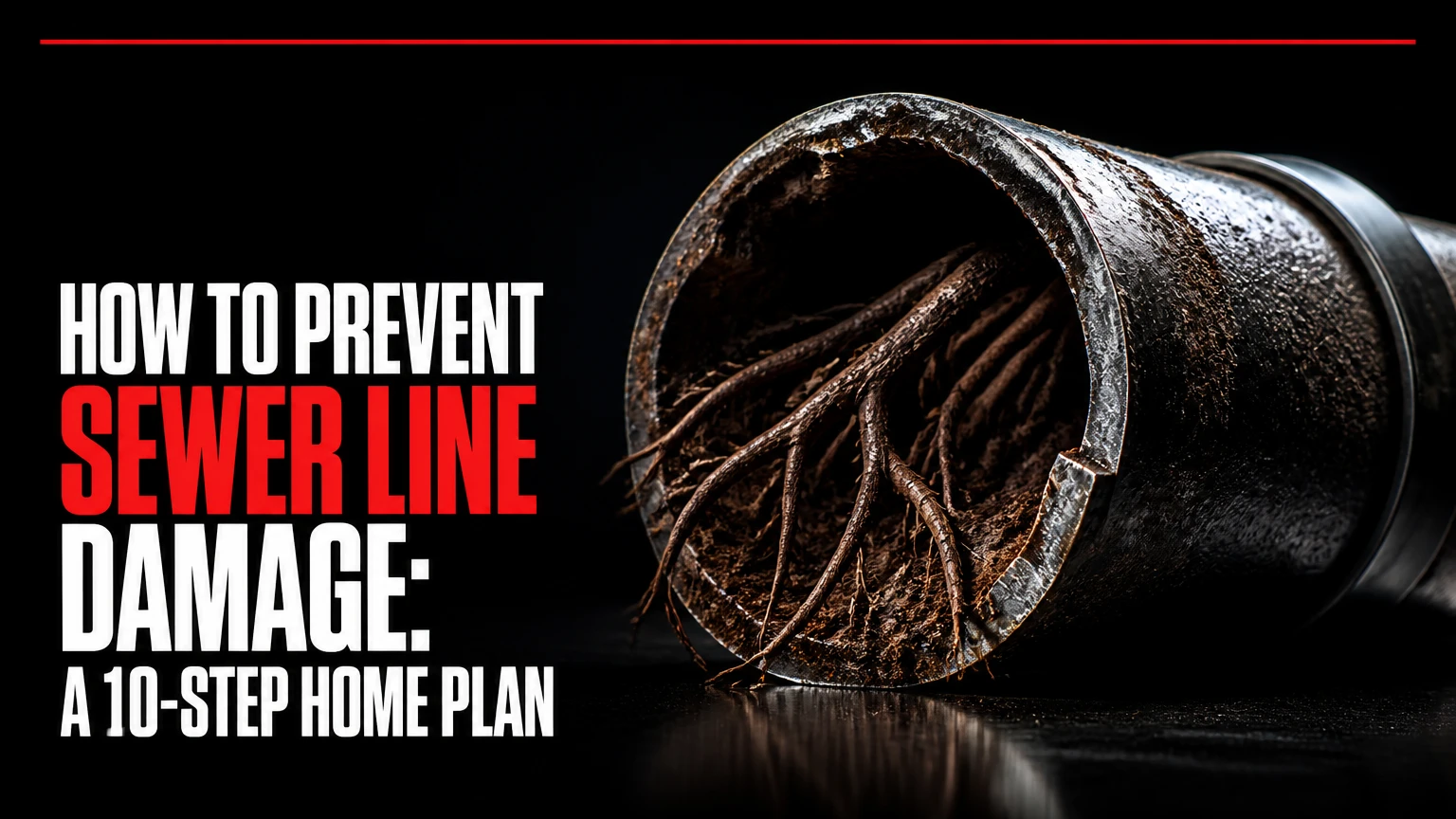
To prevent sewer line damage, keep tree roots and heavy loads away from the buried lateral, prevent grease and non-dispersible waste from entering the main drain, maintain correct drainage, and inspect older or symptomatic pipes with a camera. The most effective plan combines daily disposal habits, property protection, and risk-based professional maintenance.
Key Facts at a Glance
Sewer laterals commonly connect a building to a municipal main or private septic tank, but ownership and maintenance responsibility vary by local code.
Tree roots usually enter through joints, cracks, or deteriorated seals; cutting roots alone does not restore a damaged pipe.
EPA guidance commonly summarizes safe toilet flushing as the “3 Ps”: pee, poop, and toilet paper.
A camera inspection identifies roots, cracks, offsets, bellies, corrosion, and collapse more reliably than repeated drain cleaning.
A typical residential sewer camera inspection costs about $150-$400, while repair pricing varies greatly by depth, length, access, and restoration.
Pipe lining can seal a structurally suitable host pipe, but a collapsed, severely deformed, or inaccessible pipe may require excavation or replacement.
What Sewer Line Damage Means
Sewer line damage is physical or functional failure in the buried pipe carrying wastewater from a building to a public sewer main, septic tank, or private treatment system. Damage includes cracks, open joints, root intrusion, corrosion, deformation, bellies, blockages, punctures, and complete collapse.
A sewer backup is the visible consequence, not the complete diagnosis. A blockage can occur inside an otherwise sound pipe, while a damaged pipe can leak into surrounding soil without producing an indoor backup. The distinction matters because snaking or jetting may restore flow temporarily without correcting a structural defect.
Responsibility also changes by location. Many municipalities maintain the public main but assign the property owner responsibility for the private lateral, sometimes including the portion beneath a sidewalk or roadway. Check the local sewer ordinance, easement documents, and utility department before arranging excavation.
How the Main Sewer Works
The household drainage system sends wastewater through fixture branches into a building drain, then into the underground building sewer or private lateral. Gravity moves the wastewater toward the municipal main or septic tank, so the pipe needs continuous support, adequate slope, and an unobstructed internal path.
A quarter-inch-per-foot slope is a common design rule for certain 3- and 4-inch drainage pipes under plumbing codes, but it is not a universal requirement for every sewer lateral. Larger diameters, local codes, engineered systems, terrain, and approved alternative slopes can change the design. A camera and elevation survey are more reliable than assuming a nominal slope.
The main failure points are predictable:
- Roots exploit joints and openings.
- Soil settlement creates offsets or low spots.
- Vehicles and construction loads compress poorly supported soil.
- Grease and sediment reduce the passage area.
- Corrosion thins metal pipe walls.
- Freezing, poor bedding, or ground movement cracks rigid pipe.
- Aging plastic or bituminous fiber pipe deforms and loses capacity.
How to Prevent Sewer Line Damage
The strongest prevention program has ten actions. Start with location and risk assessment, then control what enters the system, protect the buried route, and investigate symptoms before a blockage becomes a sanitary emergency.
Step 1: Locate the Cleanout and Sewer Route
Find the exterior cleanout, basement access, or crawl-space cleanout before an emergency occurs. Residential cleanouts often have a capped 3- or 4-inch riser, although some properties have multiple access points or concealed cleanouts.
Obtain utility records and use the local one-call service before digging. Public utility marking usually does not reveal every privately installed line, so a private utility locator may be necessary for additions, fences, pools, drainage work, or tree planting.
Record the route, cleanout positions, approximate depth, pipe material, and direction to the street or septic tank. Treat the route as a no-excavation and no-deep-root zone until a professional confirms its location.
Checkpoint: You can identify the cleanout and explain where the private lateral leaves the property.
Common mistake: Guessing the sewer path from the street without confirming the building connection.
Step 2: Control Tree and Shrub Placement
Keep new trees well away from the sewer alignment. A 10-foot separation is a practical minimum for many small plantings, while aggressive, moisture-seeking species such as willow, poplar, cottonwood, elm, and some maples deserve substantially more distance, often 20-30 feet or the mature root-zone recommendation from a qualified arborist.
Distance is not a guarantee. Roots can travel beyond the canopy, and old clay joints or cracked cast iron attract roots even when a tree is not directly above the pipe. Do not remove a mature tree solely because it is near a line without checking tree stability, local rules, and the pipe condition.
Root barriers can redirect roots when installed correctly, but a barrier that stops at the pipe depth or leaves gaps can simply move the problem. Barrier design should account for mature root depth, utility depth, soil type, and species.
Checkpoint: New planting plans show the sewer route, mature canopy, and expected root spread.
Common mistake: Planting a fast-growing tree ten feet away and assuming the young trunk’s current size represents future risk.
Step 3: Keep Grease and Solids Out
Collect fats, oils, and grease in a container and place the cooled material in household waste according to local disposal rules. Wipe greasy cookware with paper before washing it, because repeated small deposits can combine with detergent residue, sediment, and wipes inside a lateral.
Flush only human waste and toilet paper. The U.S. Environmental Protection Agency’s consumer guidance uses the phrase “Only flush the 3 Ps,” meaning pee, poop, and toilet paper. “Flushable” wipes may pass a toilet but remain intact long enough to snag at roots, offsets, rough corrosion, or narrow sections.
Do not flush paper towels, tissues in large quantities, diapers, cotton products, dental floss, feminine hygiene products, cat litter, or household chemicals. A garbage disposal also does not eliminate sewer risk, because ground food waste still contributes solids and grease.
Checkpoint: Every bathroom has a wastebasket, and kitchen grease has a defined disposal container.
Common mistake: Treating a product’s flushable label as proof that it is safe for every sewer system.
Step 4: Avoid Caustic Mainline Drain Openers
Do not use repeated caustic drain openers to maintain a sewer lateral. Sodium hydroxide and related products may create heat, damage vulnerable materials, injure workers during later opening, and fail to remove roots, collapsed pipe, or a displaced joint.
A plunger or small branch-line auger may be reasonable for an isolated sink or toilet obstruction. Multiple affected fixtures require a different response, because the obstruction may be downstream in the building drain or private lateral.
If a chemical product has already entered a blocked line, tell the plumber before anyone opens the cleanout. Chemical exposure changes the safety procedure.
Checkpoint: The product label and local plumbing guidance, rather than a recurring backup, determine whether a cleaner is appropriate.
Common mistake: Using stronger chemicals after the first dose fails, increasing hazard without addressing the cause.
Step 5: Protect the Burial Zone From Heavy Loads
Keep vehicles, dumpsters, compactors, loaded trailers, and construction equipment off areas containing shallow or poorly supported sewer pipe. A lawn can hide a lateral only a short distance below grade, particularly after landscaping changes or erosion.
Heavy loads are most dangerous where the soil is saturated, recently excavated, poorly compacted, or frozen. Temporary access mats distribute surface load but do not make every buried line safe. Ask a civil contractor or utility professional to assess depth and bedding before allowing repeated heavy traffic.
During construction, protect cleanout caps from burial and damage. Never pour concrete over an access point without installing an approved extension or relocation plan.
Checkpoint: A site plan identifies the sewer corridor before driveway, patio, retaining-wall, or pool work begins.
Common mistake: Protecting the pipe from tree roots while allowing a loaded dump truck to cross the same route.
Step 6: Manage Water and Soil Movement
Direct roof downspouts and sump discharge according to local rules, away from areas where concentrated water can erode or saturate the sewer trench. Excess water can wash fines from poorly compacted soil, weaken bedding, or expose shallow pipe.
Do not connect a sump pump, roof drain, foundation drain, or storm leader to the sanitary lateral unless local regulations specifically permit it. Inflow can overload the municipal system, septic tank, or private line and may violate separation requirements.
After major flooding, excavation, earthquakes, drought-related soil movement, or nearby utility work, inspect for settlement and new drainage symptoms. A sunken trench or recurring wet area deserves investigation even if fixtures still drain normally.
Step 7: Maintain the Correct Service Schedule
No universal biennial camera schedule fits every home. A newer PVC line with no symptoms and stable soil may need inspection only during a property transaction or after a significant event, while a 70-year-old clay or cast-iron lateral beneath mature trees deserves more frequent review.
Use the following risk-based schedule:
| Property condition | Camera timing | Additional action |
|---|---|---|
| New PVC or ABS, no symptoms | Every 5-10 years or before sale | Keep route and repair records |
| Clay lateral with mature trees | Every 1-3 years | Inspect joints and root regrowth |
| Cast iron older than 50 years | Every 2-5 years | Check corrosion and bottom-wall loss |
| Orangeburg or visibly deformed pipe | Promptly | Obtain replacement or lining assessment |
| Any recurring backup | Immediately | Scope after flow is restored |
| Recent excavation or ground movement | Within 3-12 months | Check offsets, settlement, and cracks |
A camera inspection should include the entire private lateral where possible, not merely the first few feet from a cleanout. Request a video, distance markings, observed defects, pipe material, and a written recommendation.
Step 8: Monitor Early Warning Signs
A gurgling toilet, bubbling fixture, or backup when another appliance runs can indicate a partial mainline restriction. Water rising in a shower when a toilet flushes usually points downstream of those fixtures, rather than to a single toilet trap.
Unusually lush grass, a persistent wet patch, subsidence, sewage odor outdoors, or repeated insect activity can indicate leakage, although irrigation leaks, broken water lines, and poor grading can create similar evidence. Confirm the cause with a camera, dye test, smoke test, or leak investigation rather than treating the landscape symptom alone.
Call a sewer professional promptly when multiple fixtures are affected, sewage enters the building, a cleanout overflows, or a backup returns after cleaning. Stop using water until the cause is assessed.
Checkpoint: You distinguish an isolated fixture clog from a downstream mainline problem.
Common mistake: Repeatedly plunging one toilet while laundry discharge continues to fill a restricted lateral.
Step 9: Verify Repairs and Prevent Recurrence
After root cutting, augering, or hydro jetting, obtain a post-service camera inspection when the contractor recommends it or when the pipe is old. Cleaning proves that flow improved; it does not prove that cracks, offsets, corrosion, or a belly are gone.
Ask whether the work addressed a blockage, a root intrusion, a leak, or a structural defect. Keep invoices, photographs, videos, permits, and measured repair locations. These records help future contractors avoid unnecessary excavation and can support a property sale or insurance claim.
A backwater valve may reduce the risk of sewage entering a building during a public main surcharge, but it does not prevent private lateral cracks or blockages. The valve requires access and periodic maintenance, and local authorities may regulate installation.
Step 10: Reassess During Property Changes
Order a dedicated sewer scope before buying an older home, adding a bathroom, finishing a basement, or building an accessory dwelling. A general home inspection may not include a full lateral camera inspection, and a clean test at one fixture does not prove the buried line is sound.
Confirm available capacity before adding fixtures to a marginal or septic-connected system. New plumbing can increase discharge volume, expose an existing belly, or overload a septic tank even when the pipe itself remains intact.
Which Pipe Materials Need the Most Protection?
Pipe material changes the dominant risk, but age, installation quality, soil, joints, and maintenance often matter more than the label alone.
| Pipe material | Common installation period | Main failure mode | Practical prevention |
|---|---|---|---|
| PVC or ABS | 1970s-present | Cracks, poor joints, settlement damage | Protect bedding and avoid heavy loads |
| Cast iron | Pre-1970s, still used commercially | Rust, tuberculation, bottom-wall corrosion | Camera inspection and corrosion assessment |
| Clay terra cotta | Early-mid 20th century | Root intrusion, brittle breaks, open joints | Tree control and joint-focused inspection |
| Orangeburg bituminous fiber | 1940s-1970s | Flattening, swelling, delamination, collapse | Confirm condition and plan replacement |
| Concrete | Older municipal and private systems | Cracks, joint movement, chemical attack | Inspect joints and structural integrity |
PVC and ABS resist internal corrosion and have relatively smooth walls, but neither material is immune to impact, poor bedding, thermal movement, or separated joints. Cast iron can remain serviceable for decades, yet internal rust can reduce the effective diameter before an owner sees external leakage.
Clay is chemically durable but rigid and joint-dependent. Orangeburg is a special concern because the bituminous fiber wall can soften, deform, and flatten under soil load; cleaning cannot restore its original shape.
Service-life numbers are planning estimates, not expiration dates. A carefully installed PVC line may last more than 100 years, cast iron often lasts roughly 50-75 years, clay commonly lasts 50-60 years, and Orangeburg frequently reaches failure within 30-50 years. A camera report should control the decision.
Which Prevention Method Fits the Pipe?
The correct method depends on whether the pipe has a removable obstruction, recurring root growth, or structural failure. Cleaning restores capacity, root treatment slows regrowth, lining seals a suitable host pipe, and replacement removes an unsuitable or collapsed host.
| Method | Typical use | Typical cost | Main limitation |
|---|---|---|---|
| Mechanical augering | Local blockage or light roots | $150-$500 | Often temporary for roots |
| Hydro jetting | Grease, scale, and heavy deposits | $350-$900 | Can harm fragile or collapsed pipe |
| Root foaming | Recurring early root intrusion | $150-$300 per treatment | Does not repair cracks or open joints |
| CIPP lining | Cracked but reasonably continuous pipe | $4,000-$12,000 total | Needs a suitable, clean host pipe |
| Pipe bursting | Replacement with accessible endpoints | $6,000-$20,000 typical | Requires pits and suitable alignment |
| Open-trench replacement | Collapse, severe deformation, or poor access | $5,000-$15,000 or more | Requires excavation and restoration |
Hydro jetting can use pressures approaching 4,000 psi at the pump, but nozzle pressure, flow, distance, and pipe condition determine actual force at the wall. A contractor should inspect brittle clay, Orangeburg, badly corroded cast iron, and collapsed sections before jetting.
Root-killing foam can reduce regrowth in some lines, but “kills roots without harming the tree” is not a universal promise. Follow the product label, local wastewater rules, and professional advice, especially near septic tanks or groundwater. Chemical treatment is maintenance, not a structural repair.
Cured-in-place pipe lining creates a resin-reinforced pipe inside the old line and removes many joints that permit roots. It does not reliably correct a completely collapsed section, severe sag, major diameter loss, or a line that cannot be cleaned and calibrated.
Pipe bursting installs a new pipe while displacing or breaking the old one, often through two excavation pits. Sharp bends, inaccessible endpoints, congested utilities, and fragile nearby structures can make open excavation the safer option.
What Is a Sewer Belly?
A sewer belly is a sag where wastewater and solids collect because the pipe no longer maintains its designed elevation. Minor, short sags may be monitored when they cause no symptoms, but a recurring blockage, standing water across a long section, or contaminated soil can justify correction.
Jetting does not remove a belly. Lining may follow the existing sag rather than regrade it, so a contractor must explain whether lining addresses leakage only or also restores hydraulic performance. Replacement is the method that corrects grade, but it requires excavation or an engineered alternative.
Typical Costs, Timeframes, and Service Life
Typical U.S. residential prices vary by region, access, depth, labor availability, permits, pipe diameter, and restoration. The ranges below are planning figures, not quotes.
| Service or repair | Typical price | Typical duration | What changes the price |
|---|---|---|---|
| Camera inspection | $150-$400 | 1-2 hours | Access, length, locating, report |
| Root cutting or augering | $150-$600 | 1-3 hours | Root density and cleanout access |
| Hydro jetting | $350-$900 | 2-4 hours | Pipe size, deposits, inspection needs |
| Root-control treatment | $150-$300 | About 1 hour | Product and repeat frequency |
| CIPP lining | $125-$250 per foot | 1-2 days | Diameter, bends, cleaning, access |
| Open-trench replacement | $50-$150 per foot plus restoration | 3-5 days | Depth, pavement, utilities, landscaping |
Get a written scope that separates diagnosis, cleaning, repair, permits, traffic control, disposal, and restoration. A low cleaning price can become expensive if it postpones a necessary structural repair, while a high replacement proposal may be unnecessary when a sound host pipe can be lined.
Common Mistakes and How to Fix Them
- Planting over the sewer route: Move future plantings before roots establish. Have an arborist evaluate existing trees rather than cutting them reflexively.
- Assuming a cleanout means easy access: Confirm that the cap opens, the riser is intact, and the opening is large enough for inspection equipment.
- Treating repeated clogs as normal: Request a camera after recurring service, especially when the same location blocks repeatedly.
- Jetting an unverified old pipe: Inspect first when clay, Orangeburg, severe corrosion, or deformation is possible.
- Ignoring legal responsibility: Check municipal rules before repairing the portion of the lateral under a public right-of-way.
- Skipping post-repair documentation: Save the final camera video and defect measurements with the property records.
A practitioner rule is simple: recurrence is diagnostic information. If the same line blocks again within weeks or months, the underlying cause deserves investigation instead of another identical cleaning.
Special Situations That Change the Plan
Older Homes
Homes built before the 1970s deserve a pipe-material assessment, particularly when original clay, cast iron, or Orangeburg may remain. A sewer scope before purchase can reveal roots, offsets, corrosion, and deformation that a routine plumbing test will miss.
Properties With Septic Systems
A septic lateral may connect to a tank or distribution component rather than a municipal main. Do not apply municipal sewer chemicals, flushing assumptions, or maintenance intervals without checking the septic designer’s instructions and local health regulations.
Roots can affect the building sewer, tank inlet, outlet, and drainfield. Protect the entire wastewater route, not only the pipe between the house and the property line.
Cold Climates
Bury sewer pipes below the local frost requirement during construction and prevent surface water from saturating shallow sections. Freeze-related damage is more likely where pipe depth, bedding, grade, or drainage is already deficient.
Commercial Properties
Restaurants and food-service buildings need correctly sized grease interceptors, documented pumping, and maintenance that follows local plumbing rules. Hydro jetting every 12-24 months may be appropriate for some commercial laterals, but the interval should follow observed loading and inspection results rather than a generic calendar.
FAQ
Does homeowners insurance cover sewer line damage?
Homeowners insurance often excludes gradual wear, root intrusion, corrosion, and poor maintenance, while some policies offer a service-line endorsement for specified failures. Coverage depends on the policy, cause, location, exclusions, deductible, and local responsibility rules. Photograph damage and ask the insurer before authorizing non-emergency excavation.
Can tree roots damage a PVC sewer line?
Tree roots can enter PVC sewer lines when a joint separates, a gasket fails, or the pipe cracks from settlement or impact. Roots do not normally penetrate an intact, properly joined PVC wall. Root cutting removes the obstruction, but recurring growth indicates a joint or structural condition that should be inspected.
How often should a sewer line be cleaned?
A healthy, well-installed residential sewer line does not need routine cleaning on a universal schedule. Clean only when inspection or symptoms justify it, then address the cause. Older clay or cast iron lines with documented root growth may need annual or multi-year maintenance, while newer PVC may need no scheduled cleaning.
Is hydro jetting safe for old cast-iron pipes?
Hydro jetting can be safe for serviceable cast iron when a qualified contractor selects suitable pressure, flow, and nozzle settings after inspection. It can expose weak corrosion or damage severely deteriorated pipe. A camera inspection before and after jetting provides the evidence needed to distinguish cleaning from structural failure.
Can a sewer backwater valve prevent pipe damage?
A backwater valve can reduce sewage entry into a building during a downstream surcharge, but it cannot prevent roots, cracks, corrosion, bellies, or collapse in the private lateral. The valve must remain accessible, operate freely, and receive periodic maintenance. Local plumbing authorities may require a specific installation design.
Should a sewer scope be part of a home inspection?
A dedicated sewer scope is prudent for older homes, properties with mature trees, recurring drainage symptoms, additions, or uncertain pipe materials. A standard home inspection generally cannot assess the buried lateral’s full interior. Request the video and defect location, not merely a verbal statement that the line is clear.
The Bottom Line
The most reliable way to prevent sewer line damage is to combine route protection, careful waste disposal, tree management, water-control measures, and evidence-based inspection. Keep heavy loads and deep-rooted plants away from the lateral, flush only appropriate material, investigate recurring symptoms, and choose cleaning, lining, or replacement according to the verified pipe condition. A camera-led maintenance plan prevents more damage than repeated guesswork.