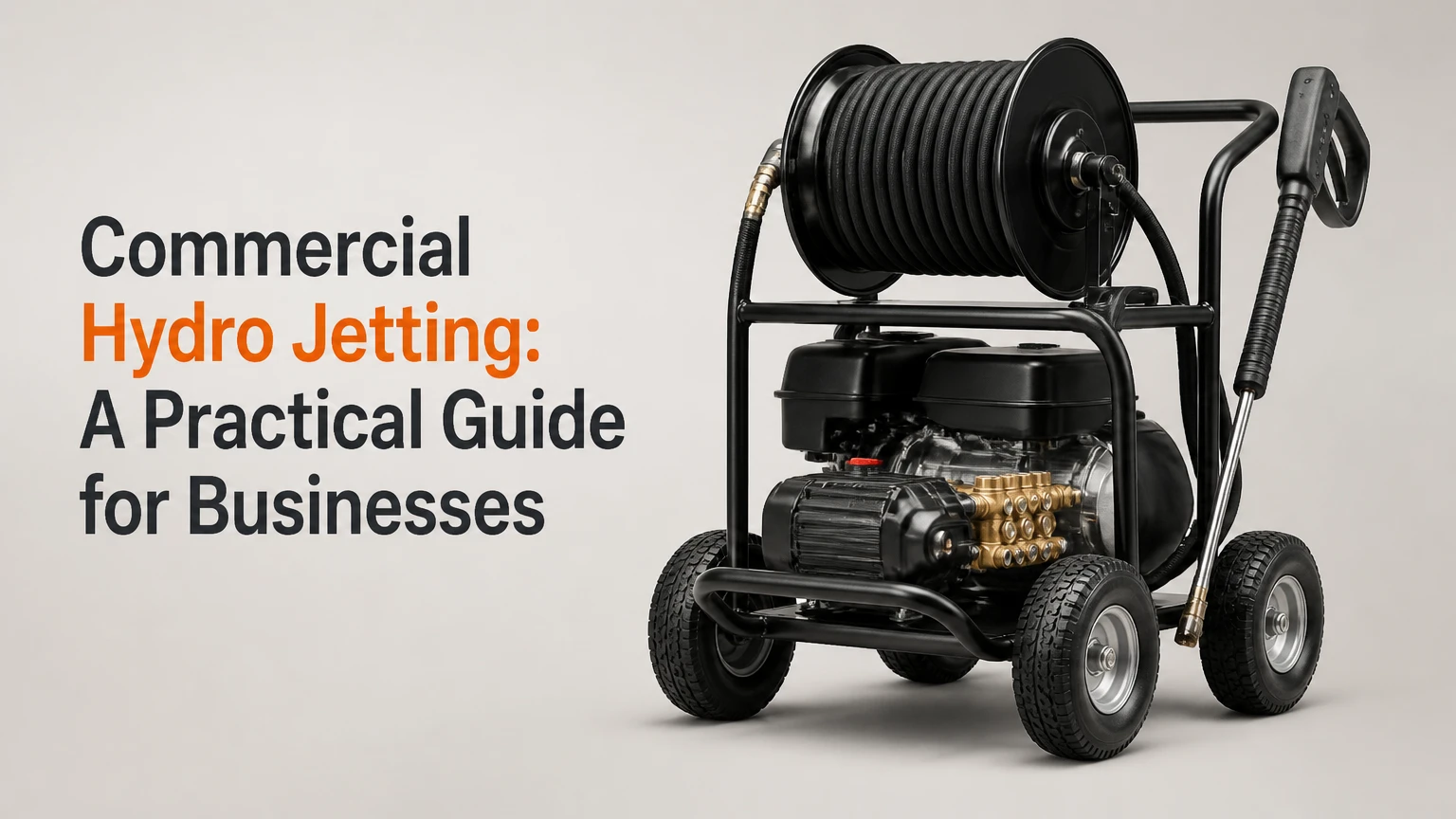
Commercial hydro jetting is a professional drain and sewer cleaning method that pumps high-pressure, high-volume water through a specialized nozzle to remove grease, scale, roots, sludge, and debris from commercial pipelines. Unlike a cable machine, which usually opens a passage through a blockage, hydro jetting cleans the pipe wall and restores usable flow capacity when the pipe remains structurally sound.
Commercial Hydro Jetting at a Glance
- Commercial hydro jetting commonly uses 2,000-4,000 PSI and 8-25 GPM, although the correct setting depends on pipe size, material, and condition.
- A sewer camera inspection should precede pressure cleaning when the pipe’s structural condition is unknown.
- Portable jetters typically serve 1.5-4 inch branch lines, while trailer and combination units handle larger mains.
- Typical commercial pricing ranges from $350-$800 per hour or $600-$1,500 per primary line run before difficult access, disposal, or emergency premiums.
- Hydro jetting removes grease and scale from pipe walls; it cannot repair a collapse, replace missing pipe, or permanently stop root intrusion.
- Restaurants, hotels, apartment buildings, warehouses, and industrial plants require different nozzles, flow rates, access plans, and maintenance intervals.
What Is Commercial Hydro Jetting?
Commercial hydro jetting is water-jet pipeline cleaning for buildings and sites with larger, longer, or more heavily contaminated drainage systems than typical residential plumbing. A positive-displacement pump sends water through a reinforced hose and engineered nozzle, where forward jets attack obstructions and rear jets propel the hose while washing the pipe circumference.
Commercial systems address kitchen grease, soap residue, mineral scale, sand, sediment, paper, wipes, sludge, and fine roots. The method applies to interior branch drains, grease-waste lines, building sewers, storm drains, process piping, and some industrial channels.
Hydro jetting is a cleaning procedure, not a structural repair. A pipe that has collapsed, separated at a joint, lost its bottom, or contains severe corrosion may need excavation, lining, or replacement after cleaning.
Why Businesses Use Water Jetting
Commercial drainage systems receive higher contaminant loads and experience longer operating hours. A restaurant may send fats, oils, and grease into a shared waste line every day, while an apartment trunk line can accumulate wipes, hair, sediment, and mineral deposits from dozens of units.
A cable can restore flow quickly during an emergency. Hydro jetting usually provides a deeper cleaning because the water reaches deposits that a rotating cutter may leave attached to the wall. The result is often a longer interval before grease or scale reduces the opening again, but the interval depends on usage and pipe condition rather than a guaranteed one-to-three-year cycle.
How Does Commercial Hydro Jetting Work?
Commercial hydro jetting combines pump pressure, water volume, hose movement, and nozzle geometry. Pressure helps break or cut deposits, while flow carries loosened material through the line; a high-PSI, low-flow setup can fail to transport the debris it dislodges.
A gas or diesel engine drives a pump that supplies water from a tank, hydrant, or approved connection. The pump sends water through a high-pressure hose to a nozzle selected for the obstruction and pipe geometry. Rear-facing jets create thrust and scour the pipe wall, while specialized forward jets can penetrate dense grease or root masses.
Nozzle angle changes performance. Rear jets at approximately 15-45 degrees can provide different combinations of traction and wall coverage, while rotary nozzles distribute impact around a larger circumference. Operators must match the nozzle’s orifice, pressure, flow, and hose diameter to the pump and pipe.
Pressure and Flow Have Different Jobs
Pressure is the force available at the nozzle; flow rate is the volume of water moving through the pipe. Pressure helps fracture scale and cut through obstructions, while GPM provides the carrying force that moves loosened material downstream.
A practical commercial range is 2,000-4,000 PSI and 8-25 GPM. Large storm or sanitary mains may require substantially higher volume, but increasing pressure alone is not a substitute for adequate flow. Pump performance also falls when the hose is excessively long, the nozzle is mismatched, or the water supply starves the inlet.
Waterjetting creates serious injection, laceration, slip, and debris hazards. The Water Jetting Association’s safety rule is direct: “Never point a waterjet at yourself or anyone else.” Commercial crews should use suitable face and hearing protection, barriers, controlled access, dead-man controls, and documented lockout procedures.
What Happens During a Commercial Jetting Service?
A professional commercial cleaning normally follows five stages: inspection, setup, cleaning, recovery, and verification. A standard line run often takes 1.5-4 hours, although long mains, difficult access, traffic control, grease disposal, and multiple passes can extend the workday.
Step 1: Inspect the Line
The technician locates a suitable cleanout and runs a sewer camera when access and pipe condition permit. The inspection identifies the blockage, pipe diameter, material, offsets, roots, open joints, belly sections, corrosion, and collapse risk.
The camera record also establishes a before-condition for property owners and facility managers. If a line is already broken, pressure cleaning may expose the defect rather than cause it.
Step 2: Establish Access and Containment
The crew protects floors, walls, fixtures, electrical equipment, and occupied areas before connecting the jetter. Technicians assess water supply, hose routing, ventilation, runoff, downstream access, odor control, and the destination of removed solids.
Cleaning from a downstream access point toward the blockage often gives debris a path away from the machine. The exact direction depends on pipe geometry, available cleanouts, flow conditions, and the contractor’s operating plan, so “always jet upstream” is too absolute to be a safe universal rule.
Step 3: Select the Nozzle and Clean the Pipe
The operator chooses a nozzle for grease, roots, scale, sludge, or general flushing, then advances the hose under controlled pressure. A slow, measured retrieval usually cleans more thoroughly than rapidly pulling the nozzle through the line.
The operator monitors pump pressure, hose behavior, water level, downstream flow, and building fixtures. A sudden change can indicate a blocked nozzle, a disconnected hose, a damaged pipe, or a flooded downstream section.
Step 4: Extract Waste and Rinse the System
Grease cakes, rocks, wipes, and sludge may need removal with a wet vacuum or combination sewer-cleaning truck. Large facilities should not assume that dislodged material will safely pass into a municipal sewer, especially when the line connects to a grease interceptor or a restricted downstream main.
Recovered waste may require lawful transport and disposal. Local sewer authorities, environmental agencies, and facility permits can determine whether discharge, containment, manifesting, or pretreatment controls apply.
Step 5: Verify the Result
A post-cleaning camera inspection confirms whether the deposit was removed and whether roots, scale shelves, offsets, or structural defects remain. The owner should receive video or still images, the cleaned distance, pipe size, observed defects, nozzle type, operating settings, and recommendations.
A line is not “fixed” merely because water flows again. Verification distinguishes restored passage from a temporary hole through a remaining obstruction.
Which Commercial Jetting Equipment Fits the Job?
Equipment selection depends on line diameter, length, access, obstruction type, water availability, and waste volume. A small machine may clean a kitchen branch effectively but lack the flow, hose length, or tank capacity required for a long building sewer.
| Equipment configuration | Typical line size and reach | Typical output | Best-fit facilities |
|---|---|---|---|
| Portable electric cart jetter | 1.5-3 inches, 50-100 feet | 1,500-2,500 PSI, 3-8 GPM | Offices, interior sinks, short branch drains |
| Portable gas cart jetter | 2-4 inches, 100-150 feet | 2,000-3,000 PSI, 6-12 GPM | Commercial kitchens, retail units, floor drains |
| Trailer-mounted jetter | 4-12 inches, 300-500 feet | 3,000-4,000 PSI, 15-25 GPM | Hotels, shopping centers, apartment complexes |
| Truck-mounted sewer jetter | 8-24 inches, 500+ feet | 2,500-4,000+ PSI, 25-100 GPM | Long building sewers, storm systems, municipal mains |
| Combination jet-vac truck | 8-72 inches, site-dependent | High-flow jetting plus vacuum recovery | Industrial sludge, catch basins, large public infrastructure |
Which Nozzle Should a Contractor Use?
General flushing nozzles suit loose sediment and routine rinsing, while penetrator nozzles help open dense grease or soft blockages. Root-cutting and rotary nozzles require greater care because concentrated impact can damage weak pipe walls, exposed joints, or deteriorated liners.
| Obstruction | Suitable nozzle approach | Typical operating concern | Verification target |
|---|---|---|---|
| Soft grease | Penetrating or Warthog-style rotary nozzle | Avoid pushing a grease plug downstream | Clear wall circumference and free flow |
| Mineral scale | Rotary descaling nozzle | Confirm pipe wall thickness first | Reduced scale without exposed reinforcement |
| Fine roots | Root-cutting nozzle or controlled rotary head | Roots may indicate defective joints | No active root curtain on post-camera video |
| Sand and sludge | High-flow flushing nozzle | Prevent downstream sediment accumulation | Solids removed or vacuumed |
| Wipes and rags | Opening pass, then extraction | Jetting can fragment material | No downstream restriction or rag mass |
What Specifications Matter Most?
Commercial hydro jetting performance cannot be judged by PSI alone. The contractor should specify nozzle pressure, usable GPM at the nozzle, hose diameter and length, water-tank capacity, access distance, pipe diameter, and waste-recovery method.
| Job condition | Typical pressure | Typical flow | Main selection factor |
|---|---|---|---|
| 2-4 inch kitchen branch | 2,000-3,000 PSI | 6-12 GPM | Compact hose and grease nozzle |
| 4-8 inch building sewer | 2,500-3,500 PSI | 12-20 GPM | Carrying flow and cleanout access |
| 8-24 inch storm or sanitary line | 2,500-4,000 PSI | 20-50 GPM | High-volume flushing and recovery |
| Heavy industrial sludge | 2,000-4,000+ PSI | 18-50+ GPM | Vacuum support and disposal logistics |
These values are typical planning ranges, not universal settings. A responsible operator reduces pressure or changes nozzle geometry when camera evidence shows thin cast iron, fractured vitrified clay, Orangeburg pipe, brittle fittings, or a compromised liner.
How Much Does Commercial Hydro Jetting Cost?
Commercial hydro jetting typically costs $350-$800 per hour or $600-$1,500 for a primary line run, excluding unusually difficult access, disposal, traffic control, and emergency scheduling. After-hours failures during active business operations can raise total charges to approximately $1,200-$2,500 or more in high-cost markets.
| Service scenario | Typical price range | Typical duration | Cost drivers |
|---|---|---|---|
| Short interior branch | $350-$750 | 1-2 hours | Access, setup, floor protection |
| Restaurant main or grease line | $600-$1,500 | 1.5-4 hours | FOG load, cleanout access, waste handling |
| Apartment or hotel building sewer | $900-$2,000 | 2-5 hours | Length, tenant coordination, camera records |
| Storm drain or long commercial main | $1,500-$4,000+ | 4-8 hours | Truck size, traffic control, vacuum recovery |
| Emergency after-hours response | $1,200-$2,500+ | 2-6 hours | Labor premium, urgency, containment |
A low quote may omit camera inspection, setup, water, disposal, difficult-access fees, or a second cleaning pass. Request a written scope that identifies the line, access point, included footage, operating assumptions, post-camera verification, and charges for recovered waste.
Is Hydro Jetting Better Than Snaking?
Hydro jetting is usually better for recurring grease, scale, sludge, and wall buildup, while mechanical cabling is often better for a rapid opening when access is limited or the pipe condition is uncertain. The correct choice depends on whether the immediate objective is temporary flow restoration or full internal cleaning.
| Decision criterion | Hydro jetting | Mechanical cabling | Practical winner |
|---|---|---|---|
| Grease removal | Washes wall deposits across the circumference | Opens a channel through grease | Hydro jetting |
| Initial response cost | Typically $600-$1,500 per line | Often lower for short calls | Cabling |
| Structural uncertainty | Requires inspection and controlled settings | Can also snag or damage weak pipe | Camera first |
| Root treatment | Cuts and flushes roots, without repairing entry point | Cuts a narrow path through roots | Hydro jetting |
| Water requirement | 8-25+ GPM is common | Minimal water demand | Cabling |
| Recurring buildup | Better suited to preventive cleaning | Often produces shorter relief | Hydro jetting |
| Collapsed pipe | Cannot restore missing structure | Cannot restore missing structure | Repair or replacement |
Cabling remains useful for a blocked toilet branch, a short line with no jetting access, or an urgent opening before a scheduled camera inspection. Hydro jetting is a poor substitute for excavation when the camera shows collapse, severe deformation, a disconnected joint, or a failing pipe bottom.
Is Commercial Hydro Jetting Safe for Old Pipes?
Commercial hydro jetting can be safe for older pipes when a camera inspection confirms adequate structural integrity and the operator matches pressure, flow, nozzle, and direction to the material. Hydro jetting is unsafe as a blind procedure in a pipe with collapse, major corrosion, fragile Orangeburg, open joints, or an unverified buried route.
Common materials require different judgment:
- PVC: Usually tolerates routine commercial cleaning, but fittings, solvent joints, and older thin-wall sections still require appropriate settings.
- Cast iron: Scale can conceal corrosion. Aggressive cleaning may reveal holes that were already present.
- Vitrified clay: Sound sections can be cleaned, but cracked joints and displaced segments need repair planning.
- Orangeburg: Highly vulnerable to deformation and failure; camera evidence should precede any pressure cleaning.
- Concrete: Large lines may tolerate high-volume cleaning, but exposed aggregate and failed joints require inspection.
- Lined pipe: The liner manufacturer’s pressure and nozzle limits control the procedure.
The counterintuitive risk is that successful cleaning can expose a pre-existing defect. Property owners should treat the post-camera report as a condition assessment, not merely proof of cleanliness.
How Often Should a Business Schedule Jetting?
Restaurants commonly schedule commercial hydro jetting quarterly, every six months, or at an interval established by blockage history and grease loading. Apartment buildings often inspect and clean main trunks annually, while industrial facilities should base intervals on production residue, sampling, flow loss, and maintenance records.
| Facility type | Starting maintenance interval | Main contaminant | Adjustment trigger |
|---|---|---|---|
| High-volume restaurant | Every 3 months | Fats, oils, grease | Backup before 90 days |
| Moderate restaurant | Every 6 months | Grease and food solids | Slow drains or interceptor overflow |
| Apartment complex | Every 12 months | Wipes, hair, sediment | Repeated stack complaints |
| Hotel or hospital | Every 6-12 months | Linen fibers, soap, organic waste | Occupancy and fixture load |
| Manufacturing site | Monthly to annually | Scale, sludge, process residue | Production cycle and flow readings |
Biological additives may help manage some grease deposits, but they do not replace interceptor maintenance, source control, proper disposal, or mechanical cleaning. A schedule based only on calendar time wastes money when the line is clean and reacts too late when loading changes.
What Are the Main Failure Modes?
Commercial jetting failures usually result from poor inspection, wrong nozzle selection, inadequate debris recovery, or uncontrolled pressure. The most expensive mistake is treating a structural defect as a routine clog.
- Blind jetting into an unknown line: Stop and camera-inspect when the hose meets unusual resistance or pressure changes abruptly.
- Using high pressure with insufficient flow: Match pump output to nozzle orifices and confirm that the water tank can supply the required GPM.
- Pulling a trapped hose with a vehicle: Shut down the pump, isolate the area, and recover the hose manually or with controlled low-pressure pulses.
- Sending grease downstream: Establish downstream containment or vacuum recovery before breaking a large grease plug.
- Choosing a root nozzle for fragile pipe: Use a less aggressive rotary or flushing method after confirming wall condition.
- Ignoring a post-cleaning camera: Reinspect the line, because restored flow does not prove full deposit removal or structural safety.
Pump cavitation can appear as unstable pressure, vibration, or abnormal noise. Operators should inspect inlet filters, tank valves, water level, supply restrictions, trapped air, and pump valves before continuing.
How Should a Facility Manager Choose a Contractor?
A commercial contractor should provide a defined cleaning scope, appropriate equipment, documented safety controls, and condition evidence before and after the work. A company that quotes only a PSI figure without stating GPM, nozzle type, access assumptions, and recovery procedures has not supplied enough information for a sound comparison.
Ask for these details:
- Which line will be cleaned, and what are its diameter, material, length, and access points?
- Is pre-cleaning and post-cleaning CCTV included?
- What pressure and nozzle flow will the operator use?
- How will grease, sludge, rocks, wipes, and contaminated water be contained?
- Does the price include water, setup, travel, disposal, traffic control, and overtime?
- What happens if the camera finds collapse, roots, open joints, or severe corrosion?
- Are technicians trained in waterjet safety and confined-space procedures?
- Will the owner receive footage, still images, measured distances, and a written report?
For an occupied restaurant, schedule work outside service hours and protect food-contact areas. For a high-rise, confirm hose routing, drain-down control, elevator access, and tenant notification. For an industrial plant, coordinate the cleaning window with process shutdowns, chemical exposure controls, vacuum-truck capacity, and waste classification.
Frequently Asked Questions
Can Hydro Jetting Remove Tree Roots Permanently?
No. Commercial hydro jetting can cut and flush roots from the pipe, but roots return if they enter through cracked joints, separated connections, or defective service laterals. Permanent control requires repairing the entry point, replacing the affected section, or using an appropriate root-management program approved for the site.
Can Hydro Jetting Remove Concrete or Hardened Scale?
Hydro jetting can remove some mineral scale and deposits, but hardened concrete, severe corrosion, and thick industrial crystallization may require specialized descaling, milling, robotic cutting, or pipe replacement. The contractor should camera-inspect first because aggressive cleaning can damage a thin or already perforated pipe.
How Long Does a Commercial Drain Stay Clear?
A commercial drain may remain clear for several months to several years, depending on contaminant load, pipe defects, flow, maintenance, and usage. A high-volume restaurant with recurring FOG may need quarterly cleaning, while a lightly used office sewer may require service only after inspection or a blockage.
Does Hydro Jetting Use More Water Than Snaking?
Yes. Commercial hydro jetting commonly uses 8-25 GPM and may consume hundreds of gallons during a long line cleaning, whereas cabling uses little water. A trailer jetter may carry a 200-600 gallon tank, and facilities with discharge restrictions should plan containment and disposal before work begins.
Can a Pressure Washer Replace a Commercial Jetter?
Usually no. A pressure washer may deliver high PSI but lack the pump durability, hose construction, nozzle geometry, flow rate, water tank, and sewer-access controls required for commercial lines. Improvised equipment can damage pipes, trap hoses, create unsafe recoil, or leave loosened debris in the downstream system.
What Should a Business Do After Hydro Jetting?
Keep the camera report, record the cleaned line and date, correct grease or disposal practices, and monitor flow and backup frequency. Commercial properties should use the result to set a maintenance interval based on actual recurrence, because cleaning removes deposits but does not correct poor drainage design or defective pipe structure.
The Bottom Line
Commercial hydro jetting is the strongest routine cleaning option for sound commercial drains affected by grease, scale, roots, sludge, and sediment. The method combines high pressure with high flow to clean pipe walls rather than merely puncture a blockage, but safe results depend on camera inspection, controlled settings, correct nozzle selection, and responsible waste recovery.
Choose equipment by pipe diameter, distance, obstruction, and access rather than PSI alone. Compare quotes by the complete scope, including inspection, containment, disposal, and verification. When a camera shows collapse or severe deterioration, commercial hydro jetting can reveal the problem, but only repair or replacement can restore the pipeline.