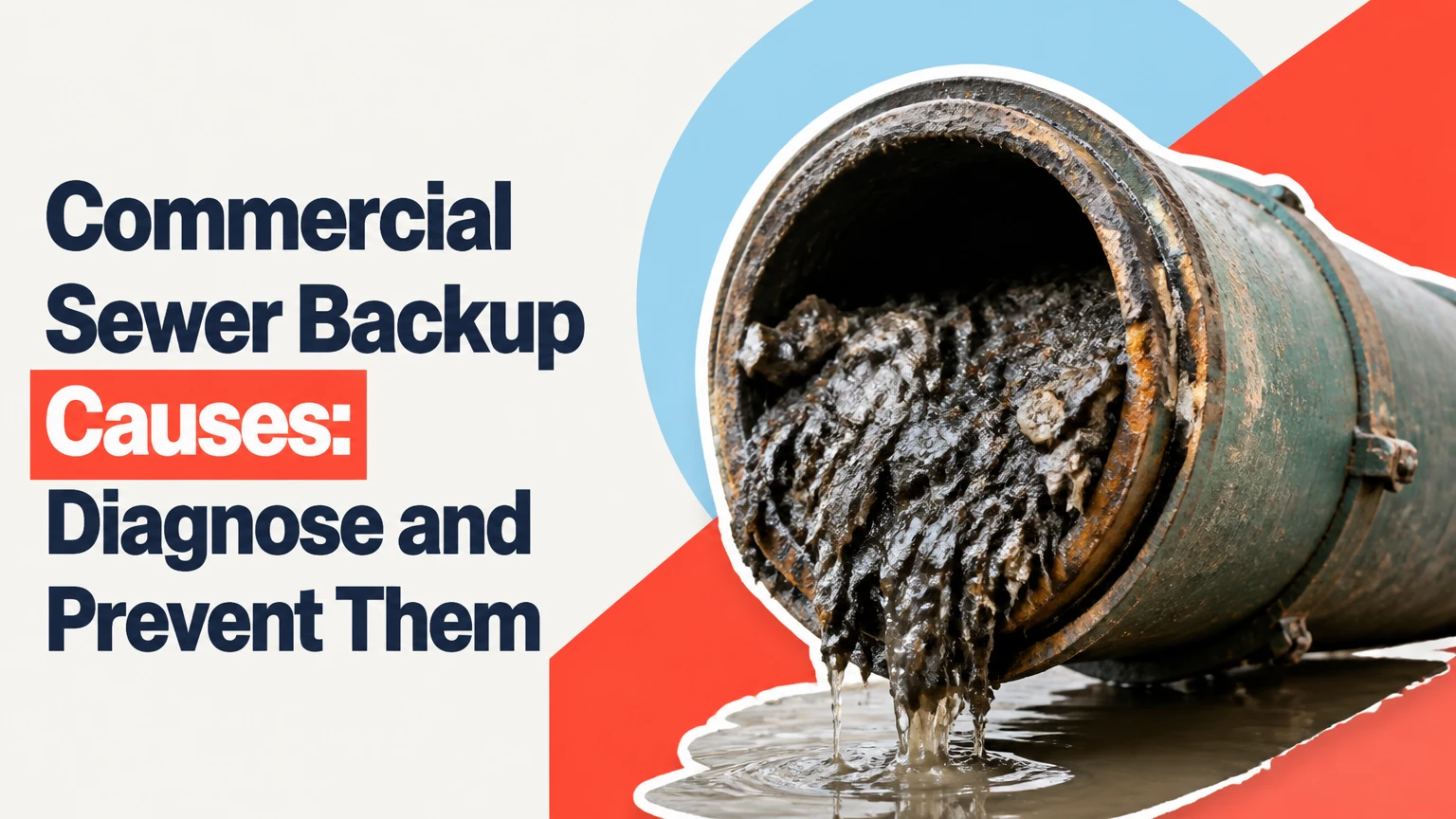
Commercial sewer backup causes usually fall into four groups: grease and solids accumulation, structural pipe failure, foreign-object blockage, and municipal sewer surcharge. A business backup occurs when wastewater cannot reach the public sewer main, fills the building drain system, and exits through a low fixture such as a floor drain, toilet, or sink.
Key Facts at a Glance
- A commercial sewer backup is usually a main-drain or sewer-lateral problem when several fixtures drain slowly or overflow together.
- Restaurants most often face grease-related restrictions, while older properties face roots, corrosion, cracks, and settled pipe sections.
- Heavy rain can surcharge a municipal sewer main and force wastewater toward connected commercial buildings.
- Sewage-contaminated water is generally treated as Category 3 water because it may contain pathogens and cannot be cleaned like a routine plumbing spill.
- A drain snake can restore flow without correcting a collapsed, root-damaged, or bellied pipe.
- CCTV inspection identifies the blockage location and pipe condition before an owner chooses jetting, lining, replacement, or excavation.
What Are the Main Commercial Sewer Backup Causes?
The main commercial sewer backup causes are FOG accumulation, structural deterioration, foreign objects, municipal surcharge, and failed wastewater equipment. Facility use determines the dominant risk: cooking produces grease, public restrooms produce flushable debris, industrial processes produce solids or scale, and low-lying buildings are more exposed to street-main surcharge.
| Cause | Typical facility | Failure mechanism | First diagnostic clue |
|---|---|---|---|
| FOG buildup | Restaurant, commissary kitchen | Cooled grease narrows the lateral | Recurrent kitchen drainage |
| Root intrusion | Older retail or office site | Roots catch solids at joints | Seasonal slow drains |
| Pipe belly | Any settled building lateral | Low section retains solids | Same blockage returns quickly |
| Foreign objects | School, stadium, public office | Paper products or trash form a plug | Restroom-only incidents |
| Municipal surcharge | Basement or low-grade property | City main pressure reverses flow | Neighboring properties affected |
| Lift-station failure | Below-grade commercial space | Pump cannot discharge wastewater | High-level alarm or silent pump |
How does grease block a commercial sewer lateral?
Grease blocks a commercial sewer lateral when liquid FOG cools against underground pipe walls, hardens, and captures food particles until the remaining opening cannot carry peak discharge. Commercial kitchens create unusually high loading because dishwashers, fryers, prep sinks, and floor-wash water send repeated waste pulses into the drainage system.
A grease interceptor reduces FOG entering the public sewer, but it does not remove grease already present in the building drain or private lateral. A restaurant can therefore have a recently pumped interceptor and still experience a downstream blockage. Grease-control rules vary by municipality, so the required pumping interval should come from the local sewer authority rather than a universal monthly or quarterly rule.
Which structural pipe defects cause backups?
Root intrusion, corrosion, cracks, displaced joints, pipe collapse, and a sagging section called a belly can obstruct commercial wastewater. A belly is especially persistent because solids settle at the low point; cleaning may reopen the passage, but gravity continues delivering debris to the same location.
Cast-iron scale reduces internal diameter and can break loose during aggressive cleaning. Clay laterals may crack or separate at joints, while Orangeburg pipe can deform under soil pressure and lose its original round shape. PVC often has a long service life, but poor bedding, joint separation, or construction damage can still create a failure.
Why do public restrooms and industrial drains behave differently?
Public restrooms usually produce paper products, wipes, sanitary items, and other objects that create compact plugs. Industrial drains may carry sand, lint, process solids, mineral scale, oils, or chemicals that require screening, separation, neutralization, or specialized cleaning.
Vandalism adds a separate risk at exposed toilets, roof drains, and unlocked cleanouts. A locking cleanout cap can reduce deliberate access, but it cannot correct a defective lateral or prevent a city-main surcharge.
How Does a Commercial Sewer Backup Develop?
A commercial sewer backup develops when a restriction or downstream surcharge removes the drainage system’s available hydraulic capacity. Wastewater from toilets, sinks, equipment, and floor drains then fills the connected piping and exits at the lowest opening that can release the pressure.
The sequence normally follows five stages:
- Restriction formation: Grease, roots, debris, scale, or a collapsed pipe reduces the passage.
- Flow interruption: New wastewater reaches the restriction faster than wastewater can pass it.
- Surcharge: The building drain and lateral fill, creating a pressurized or partially pressurized condition.
- Pressure equalization: Wastewater moves toward a lower fixture or open cleanout.
- Overflow: Sewage appears at a basement floor drain, toilet, shower, sink, or exterior access point.
Gravity drainage does not mean the system has no pressure. A full pipe can transmit hydraulic head, and a downstream municipal surcharge can push wastewater into private connections even when the building has no internal blockage.
How Can a Facility Locate the Blockage?
A facility can estimate the blockage location by comparing fixture behavior, checking the cleanout carefully, and using a CCTV camera with a sonde locator. Multiple affected fixtures usually indicate a shared branch, main building drain, sewer lateral, or municipal problem rather than several independent fixture clogs.
| Observation | Likely location | Useful confirmation |
|---|---|---|
| One sink drains slowly | Trap or branch line | Trap removal or small-line inspection |
| Two restroom fixtures fail | Restroom branch | Branch-line camera inspection |
| Floor drain and toilets overflow | Main building drain or lateral | Camera from cleanout |
| Cleanout overflows outdoors | Restriction downstream of cleanout | Camera toward street |
| Neighboring buildings back up | Municipal main or surcharge | Utility notification and incident records |
| Basement ejector alarm sounds | Pump, float, or discharge line | Electrical and pump inspection |
A cleanout full of water does not, by itself, prove the city is responsible. The result depends on which side of the cleanout holds water, where the private lateral ends, and local ownership rules. A plumber should document the camera location, footage, depth, defect, and distance from fixed reference points.
What does a sewer camera inspection reveal?
A CCTV inspection can reveal grease depth, root penetration, displaced joints, cracks, collapsed sections, bellies, scale, and the distance to a defect. A locator allows the technician to mark the defect above ground, which helps separate a cleanout repair from excavation under a slab, parking lot, or public roadway.
Camera footage has limits. Heavy water, dense grease, and a completely collapsed pipe can obscure the defect, so cleaning or a second inspection may be necessary. A camera also cannot reliably assess soil stability outside the pipe or determine municipal legal responsibility without property records.
What Should Staff Do During an Active Backup?
Staff should stop all nonessential water use, isolate the affected area, keep people away from sewage, and call a commercial plumber and qualified remediation contractor. Employees should not mop, vacuum, pressure-wash, or handle contaminated materials without appropriate training and personal protective equipment.
- Stop toilets, sinks, dishwashers, laundry, process water, and floor washing.
- Shut off nearby electrical circuits only if personnel can do so without entering wet areas.
- Keep customers and employees away from contaminated rooms.
- Photograph conditions from a safe location and record the time, fixtures, weather, and affected operations.
- Notify the property owner, facility manager, insurer, and sewer utility according to the emergency plan.
- Avoid opening a cleanout in an enclosed area because sewage may discharge suddenly.
- If a lift station is installed, check the alarm and breaker without bypassing safety controls.
- Arrange extraction, cleaning, disinfection, and structural drying through a contractor familiar with sewage losses.
The first objective is volume control, not cosmetic cleanup. Every gallon discharged by the business can increase contamination, damage, and downtime.
Which Commercial Sewer Repairs Work Best?
The best commercial sewer repair depends on the defect, not the cleaning method that produces the fastest temporary flow. Hydro-jetting suits removable grease and debris, CIPP lining suits many cracks and joint defects, and excavation remains necessary for collapse, severe settlement, inaccessible defects, or failed slope.
| Method | Typical cost | Typical duration | Appropriate condition | Main limitation |
|---|---|---|---|---|
| Cable cleaning | $250-$900 | 1-3 hours | Soft plug or limited branch blockage | May leave grease and defects |
| Hydro-jetting | $500-$1,500 | 2-5 hours | Grease, roots, scale, solids | Unsafe in fragile or collapsed pipe |
| CCTV inspection | $350-$1,200 | 1-3 hours | Unknown or recurring blockage | Does not repair the pipe |
| CIPP lining | $150-$300 per foot | 1-2 days | Cracks, joints, moderate root entry | Not suited to major collapse or severe belly |
| Point repair | $2,000-$8,000 | 1-2 days | Localized defect | Multiple defects may cost more |
| Excavation and replacement | $5,000-$20,000+ | 3-7 days | Collapse, bad slope, deep structural failure | Disrupts slabs, paving, and utilities |
Typical U.S. prices vary by access, depth, region, traffic control, permit requirements, pipe diameter, and after-hours response. Restoration, lost revenue, contents replacement, and regulatory work are separate costs.
Is hydro-jetting safe for every commercial pipe?
Hydro-jetting is not safe for every commercial pipe because high-pressure water can worsen a cracked, paper-thin, displaced, or collapsed line. A camera inspection is the safer first step when the building has an unknown pipe history, repeated blockages, Orangeburg, severe cast-iron scaling, or evidence of structural movement.
A practical rule is to inspect before aggressive cleaning when a blockage returns within weeks, when the jetter cannot advance normally, or when water disappears suddenly into a suspected void. Jetting removes material; it does not restore slope, replace missing pipe, or stabilize soil.
Do backwater valves prevent every backup?
Backwater valves can reduce inflow from a surcharged municipal main, but they do not prevent backups caused by internal blockages, improperly connected fixtures, or a failed ejector pump. The valve must be correctly sized, accessible, maintained, and installed where local plumbing rules permit.
A closed valve also traps wastewater generated inside the building. If staff continue using toilets and sinks after the valve closes, internal drainage can back up even though municipal sewage is blocked. Facilities need an inspection schedule, a cleaning procedure, and a clear shutdown trigger.
What Are the Technical Limits and Health Risks?
Commercial drainage capacity depends on pipe diameter, slope, fixture load, venting, occupancy, and local plumbing code. Four- to six-inch private laterals are common, but high-volume or industrial systems may require larger piping; a nominal diameter alone cannot predict backup risk.
| Attribute | Typical value or range | Interpretation |
|---|---|---|
| Private commercial lateral | 4-6 inches | Common small-to-medium building connection |
| Industrial sanitary line | 8 inches or larger | Selected from process and fixture loading |
| Design self-cleansing target | About 2 feet per second | Project-specific hydraulic design value |
| PVC service life | 75-100+ years | Depends on installation and environment |
| Cast-iron service concern | Often 50-75 years | Scale and corrosion can occur sooner |
| Orangeburg concern | Often 30-50 years | Deformation and collapse risk increase with age |
The 2-feet-per-second figure is a design target, not a guarantee that solids remain suspended in every commercial pipe. Low flows, poor slope, grease, and intermittent occupancy can produce deposits even in a correctly sized system.
Sewage exposure can introduce organisms such as E. coli, Salmonella, hepatitis A virus, and Giardia. The Occupational Safety and Health Administration identifies sewage as potentially containing biological hazards, while the Institute of Inspection, Cleaning and Restoration Certification classifies sewage losses as Category 3 water in common restoration practice. Local health departments may impose additional closure or disposal requirements.
How Much Do Commercial Backups Cost?
A commercial backup commonly costs $3,000-$25,000 or more after extraction, disinfection, drying, demolition, replacement, and downtime are included. A simple blockage may cost hundreds of dollars, while contaminated porous materials, food-service closure, inventory loss, and structural damage can multiply the claim.
| Cost component | Typical range | Timeframe |
|---|---|---|
| Emergency diagnosis | $350-$1,200 | 1-3 hours |
| Clearing and cleaning | $250-$1,500 | 1-5 hours |
| Sewage remediation | $3,000-$25,000+ | 2-5 days |
| Interior demolition and rebuild | $2,000-$30,000+ | 3 days-3 weeks |
| Business interruption | $1,000-$50,000+ | 1 day-several weeks |
These are practitioner ranges, not guaranteed quotations. A written estimate should separate plumbing work, biohazard remediation, reconstruction, permits, contents handling, and business interruption.
Commercial property insurance often excludes sewer or drain backup unless the policy includes a specific endorsement. Coverage limits, waiting periods, exclusions, and business-income provisions differ, so the policy and declarations page should be reviewed before an incident.
How Should Businesses Prevent Sewer Backups?
Businesses prevent sewer backups through source control, scheduled inspection, documented cleaning, and rapid response to early warning signs. Prevention works best when maintenance frequency follows actual grease, solids, occupancy, rainfall, and blockage history rather than a generic annual calendar.
| Facility type | Highest-risk material | Recommended control | Review interval |
|---|---|---|---|
| Restaurant | FOG and food solids | Scrape cookware, use strainers, service interceptor | Per shift and by local schedule |
| Office building | Paper products and aging lateral | Restroom education, cleanout access, camera survey | Annual inspection |
| School or stadium | Flushable debris and peak surges | Custodial checks, tamper-resistant fixtures | Daily during occupancy |
| Warehouse | Sediment and stormwater cross-connections | Keep floor drains screened, inspect connections | Quarterly |
| Manufacturing plant | Process solids, oils, chemicals | Separators, screens, neutralization systems | Monthly process review |
| Basement tenant | Municipal surcharge | Backwater protection and pump alarms | Monthly valve and alarm check |
Restaurant operators should maintain grease-trap manifests, invoices, inspection findings, and staff training records. An interceptor pump-out that is not documented creates both operational and regulatory uncertainty.
Property managers should maintain an asset map showing cleanouts, lateral ownership, backwater valves, ejector pumps, shutoffs, and low fixtures. Annual CCTV is particularly valuable for older buildings, properties with repeated backups, and sites undergoing a change in tenant use.
Which warning signs require immediate action?
Gurgling floor drains, bubbling toilets, repeated slow drainage, sewage odor, water rising during rain, and a backup that returns after cleaning require prompt investigation. A single slow sink may be local, but simultaneous symptoms across separate rooms point toward a shared drainage restriction.
Rain-linked incidents deserve special attention. If backups occur during storms and nearby properties report similar problems, the likely mechanism may be municipal surcharge or infiltration and inflow rather than restaurant grease, although both conditions can coexist.
What Common Commercial Mistakes Make Backups Worse?
The most damaging mistakes are continuing water use, repeatedly snaking a recurring blockage, cleaning sewage without containment, and assuming a recently serviced grease interceptor proves the lateral is clear. Each mistake delays diagnosis while adding wastewater, contamination, or documentation problems.
- Treating recurrence as success: A cable opens a passage but does not identify a belly or collapsed pipe. Order CCTV after repeated failures.
- Using corrosive chemical cleaners: Acids and caustics can injure workers, damage fittings, and complicate remediation. Use mechanical diagnosis instead.
- Ignoring cleanout access: Buried or locked cleanouts lengthen emergency response and encourage destructive access.
- Overlooking pumps: A failed float switch or tripped breaker can mimic a sewer blockage in below-grade rooms.
- Mixing stormwater with sanitary drainage: Illegal or defective cross-connections can overload private and public systems during rain.
- Cleaning without records: Missing invoices, photos, camera footage, and utility notifications weaken insurance and responsibility claims.
One counterintuitive field rule matters: a completely dry floor drain does not prove the lateral is healthy. A trap may be evaporated, a blockage may be farther downstream, or the drain may be disconnected from the active system.
Who Is Responsible for a Commercial Sewer Backup?
Responsibility depends on the blockage location, ownership boundary, easements, local sewer ordinance, and evidence collected during the incident. The private building drain and lateral are often the owner’s responsibility, while the public main may belong to a city or utility, but boundaries differ by jurisdiction.
A facility should preserve CCTV footage, technician notes, cleanout photographs, weather records, invoices, and communications with the utility. Ask the sewer authority whether it logged a main blockage, surcharge, sanitary sewer overflow, or nearby complaint at the same time.
A municipal main can be the initiating cause without covering every resulting loss. Property ownership, negligence standards, insurance terms, and local claims procedures determine recovery, so legal or insurance advice may be necessary for significant interruption.
The Bottom Line
Commercial sewer backup causes are usually traceable to FOG, structural defects, foreign objects, municipal surcharge, or failed pumping equipment. The fastest reliable path is to stop water use, isolate the hazard, document conditions, inspect with CCTV, and repair the diagnosed defect rather than repeatedly clearing the symptom.
Hydro-jetting is effective for removable deposits, but it is not a substitute for structural repair. Backwater valves reduce some municipal risks, while grease controls, cleanout access, pump maintenance, and documented inspections reduce the frequency and severity of internal failures. For a business, early diagnosis is usually less expensive than a contaminated shutdown.
Frequently Asked Questions
Can a commercial sewer backup happen without heavy rain?
Yes. A commercial sewer backup can occur during dry weather when grease, roots, collapsed pipe, foreign objects, or a failed lift-station pump blocks private drainage. Rain increases the probability of municipal surcharge, but weather is not required for an internal restriction to fill the lateral and overflow a low fixture.
Why does a sewer backup keep returning after cleaning?
A backup returns after cleaning when the underlying pipe has a belly, root intrusion, displaced joint, severe scale, or partial collapse. Cleaning restores temporary capacity, but the defect continues collecting solids. A CCTV inspection after the line is open usually provides more useful evidence than another blind cable pass.
Can flushable wipes cause a commercial backup?
Yes. Flushable wipes can contribute to commercial sewer backups because their breakdown rate, quantity, and downstream conditions may exceed the system’s ability to move them. Public restrooms also receive paper towels, sanitary products, and trash that are not designed for sewer transport, making signage and waste bins practical controls.
How often should a commercial sewer line receive preventive cleaning?
There is no safe universal interval. A restaurant with recurring FOG may need monthly or quarterly service under local requirements, while an office building with a clean, modern lateral may need annual inspection rather than routine jetting. The best schedule follows camera findings, flow volume, pipe material, incident history, and municipal rules.
Does a floor drain overflow mean the floor drain itself is clogged?
Usually not when toilets, sinks, or other fixtures also show symptoms. A shared main drain or lateral restriction can cause the floor drain to become the lowest overflow point. If only one floor drain is affected, the trap, branch, or local drain may be blocked, and a smaller inspection should begin there.
Does standard business insurance cover sewage damage?
Standard commercial property insurance may not cover sewage backup without a sewer-and-drain endorsement or similar water-backup coverage. Even when coverage exists, limits and business-interruption terms may differ. Facility owners should confirm exclusions, deductibles, sublimits, waiting periods, and documentation requirements with their insurance professional before a loss occurs.