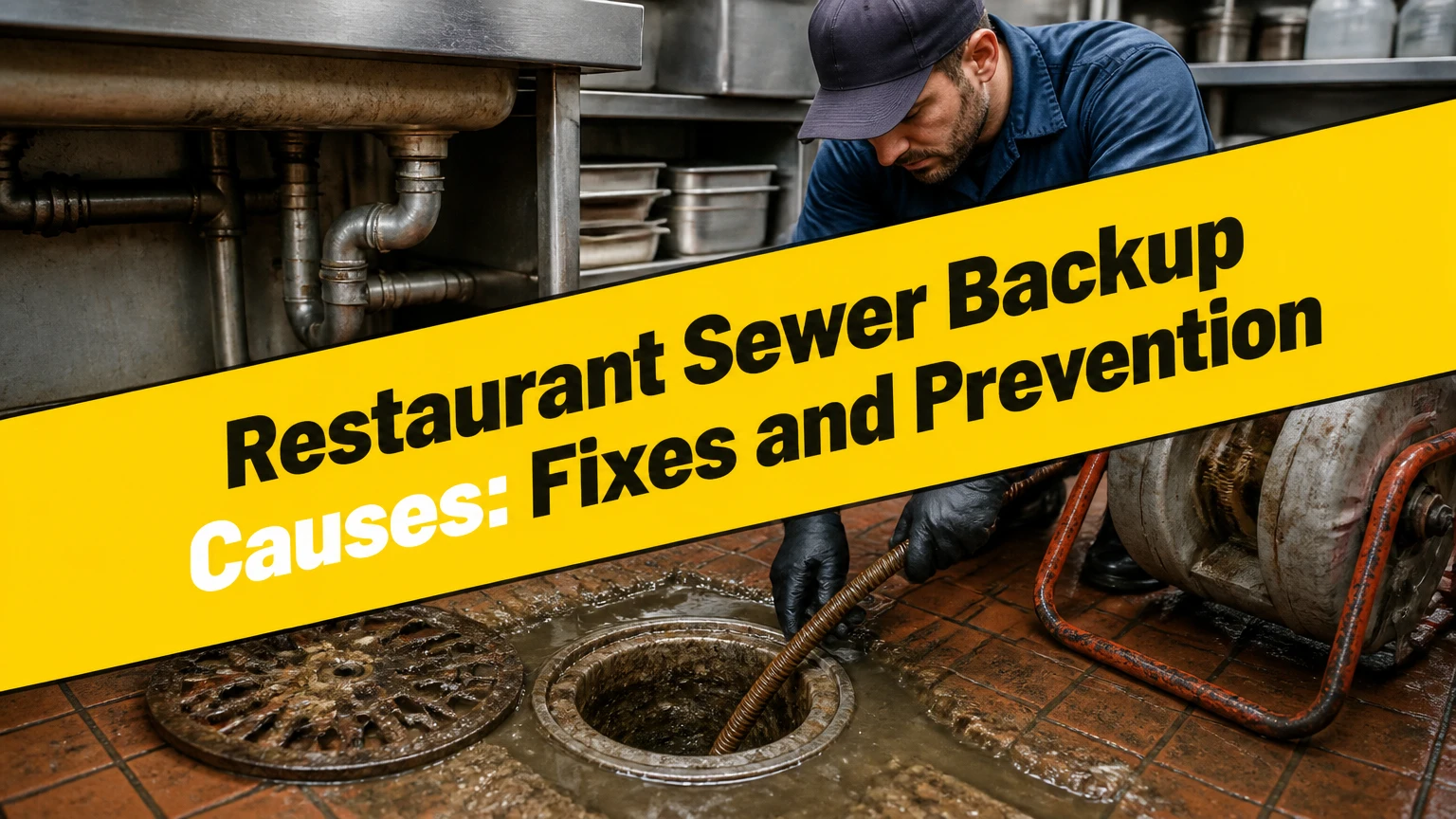
Restaurant sewer backup causes usually fall into four groups: accumulated fats, oils, and grease (FOG), damaged or collapsed private sewer piping, foreign-object blockages, and a surcharge in a municipal or shared sewer main. A backup becomes an immediate health and business emergency when contaminated wastewater reaches food areas, equipment, floors, or customer spaces.
Key Facts at a Glance
- FOG becomes more obstructive as wastewater cools and deposits adhere to pipe walls.
- A full grease interceptor does not prove the interceptor caused the blockage; the outlet line, building drain, or public main may be restricted.
- Multiple fixtures backing up at once usually indicate a downstream building drain, private lateral, shared line, or municipal main problem.
- Chemical drain cleaners rarely remove dense commercial grease and can create corrosive hazards for employees and plumbing.
- A sewage-contaminated food area requires stopping operations, isolating the area, removing exposed food, and following local health-department reopening requirements.
- A backwater valve can reduce reverse flow from a public or shared sewer, but it cannot correct a blocked restaurant drain or replace grease control.
What Causes a Restaurant Sewer Backup?
The most common restaurant sewer backup causes are FOG accumulation, undersized or neglected grease-control equipment, structural pipe damage, foreign objects, and public sewer surcharge. The correct diagnosis depends on where wastewater appears, which fixtures are affected, whether the grease interceptor is full, and whether the exterior cleanout contains standing sewage.
A commercial kitchen sends a different waste profile into its drainage system than a typical office. Fryer oil, dairy fat, meat residue, flour, food scraps, paper products, and high-temperature dishwasher discharge can combine into deposits that narrow a lateral line. A blockage outside the kitchen can then force wastewater through the lowest connected fixture, often a floor drain, floor sink, mop basin, or basement toilet.
| Cause | Typical location | First visible clue | Usual corrective action |
|---|---|---|---|
| FOG deposit | Kitchen branch or private lateral | Slow floor sink, recurring odor | Interceptor service and mechanical line cleaning |
| Root intrusion | Exterior sewer lateral | Seasonal or recurring backup | Root cutting followed by CCTV and pipe repair |
| Pipe belly | Buried horizontal line | Repeated solids accumulation | CCTV, excavation, lining, or replacement |
| Municipal surcharge | Public main or shared line | Several fixtures overflow together | Utility notification and backflow assessment |
| Foreign object | Branch drain or restroom line | Sudden complete stoppage | Cable removal, retrieval, or sectional repair |
How does grease create a blockage?
Grease creates a blockage when FOG cools inside a drain, sticks to the pipe wall, combines with food solids, and progressively reduces the pipe’s usable diameter. The restriction often begins as a soft coating, then becomes a dense deposit that ordinary water flow cannot carry away.
Grease does not need to form a dramatic “fatberg” to cause a restaurant backup. A few millimeters of buildup around a long lateral can reduce hydraulic capacity enough to create trouble during a dishwasher discharge or peak meal-period washing. Calcium and other minerals can harden deposits, while rice, flour, bones, wipes, and scraps provide a framework that traps additional material.
Hot water creates a common diagnostic illusion. It may move liquid grease temporarily, but the grease can redeposit farther downstream when the pipe temperature falls. The result is a larger, less accessible blockage rather than a clean line.
Can a full grease trap still cause a backup?
A full grease trap can cause a backup, but a full trap is only one possible location. The outlet baffle, interceptor outlet pipe, downstream lateral, building drain, or municipal connection may be restricted even when the interceptor appears to be operating normally.
Restaurant operators should inspect the interceptor without entering it. An overflowing inlet compartment suggests upstream flow is arriving faster than the trap can pass it, while a high liquid level with a clear inlet can indicate an outlet restriction. Odor, sludge depth, and grease thickness should be recorded, but visual inspection alone cannot locate a buried blockage.
A universal “quarter-inch rule” is unsafe advice. Some authorities require pumping at 25% of total volume, while others specify a maximum grease-and-solids layer, a calendar interval, or a local performance standard. Follow the permit, plumbing code, and wastewater authority’s written requirement.
How Does a Backup Progress Through Restaurant Plumbing?
A restaurant sewer backup develops when discharge exceeds the restricted pipe’s capacity, pressure pushes wastewater upstream, and the wastewater exits through a lower or more open fixture. The overflow point indicates where pressure found an escape route, not necessarily where the blockage began.
The sequence usually looks like this:
- Kitchen wastewater enters branch drains, floor sinks, or the building drain.
- FOG cools and adheres to pipe walls or interceptor components.
- Food particles and solids lodge in the narrowed passage.
- A high-volume discharge, such as a dishwasher cycle, raises the upstream water level.
- Wastewater seeks the lowest available fixture and reverses into the restaurant.
- Continued use spreads contamination through floors and connected equipment.
A sink that drains slowly before a backup is an early warning. Gurgling toilets, fluctuating floor-drain water levels, sewage odor, and backups that occur only during dishwashing help identify a developing restriction.
Which Plumbing Area Is Blocked?
The affected fixtures provide the fastest initial distinction between a branch clog, building-drain blockage, private lateral failure, and public sewer surcharge. One sink usually indicates a localized branch problem, whereas several low fixtures or every fixture indicate a downstream restriction.
| Affected area | Likely blockage zone | Verification action | Typical urgency |
|---|---|---|---|
| One hand sink | Sink trap or branch line | Remove trap or cable branch | Same shift |
| Kitchen floor sink and prep sinks | Kitchen branch or interceptor outlet | Inspect interceptor and cleanout | Immediate |
| Restrooms only | Restroom branch or shared riser | Isolate restroom fixtures | Immediate |
| Kitchen and restrooms | Building drain or private lateral | Open cleanout and obtain CCTV | Immediate |
| Entire leased food court | Shared sewer or public main | Notify landlord and utility | Immediate |
An exterior cleanout with standing water often indicates a blockage between the cleanout and the public or shared connection. A dry exterior cleanout does not guarantee that the interior plumbing is clear, because the obstruction may sit between the building and cleanout or in a branch that does not drain through that access point.
Why are multiple drains backing up at once?
Multiple restaurant drains back up when a downstream building drain, private lateral, shared sewer, or public main cannot accept normal discharge. The number and position of affected fixtures are more useful than the amount of wastewater when estimating the blockage location.
If a floor drain rises when a restroom toilet flushes, the fixtures probably share a downstream path. If the problem appears only when the dishwasher runs, the kitchen branch or interceptor outlet deserves priority. If neighboring tenants report the same event, a shared or municipal line becomes more likely.
Rainfall strengthens the municipal-surcharge hypothesis, but it does not prove it. A neglected private lateral can fail during a storm because inflow, groundwater, and building discharge increase at the same time.
What Should Staff Do During a Sewer Backup?
Staff should stop all water use, isolate the contaminated area, protect employees from contact, remove exposed food, and call qualified plumbing and remediation professionals. Restaurant personnel should not continue washing dishes, flushing toilets, or applying chemicals to force the line open.
Use this emergency sequence:
- Stop sinks, dishwashers, ice-machine drains, floor washing, and restroom use.
- Shut down affected food preparation and service areas.
- Keep employees and customers away from sewage and wet contaminated surfaces.
- Do not step into standing water if electrical equipment or outlets may be energized.
- Photograph the overflow, affected equipment, cleanout, interceptor, and surrounding surfaces.
- Notify the manager, landlord, insurer, wastewater authority, and health department when required.
- Arrange extraction, cleaning, disinfection, and waste disposal through a qualified contractor.
- Retain disposal manifests, invoices, inspection reports, and temperature records.
- Reopen only after contaminated materials are removed and the applicable authority permits operation.
Food, packaging, single-use items, and porous materials exposed to sewage should be discarded according to local health and waste rules. Do not place contaminated utensils back into service after rinsing them with tap water.
How Do Professionals Diagnose the Failure?
Professionals diagnose a commercial sewer backup by isolating fixtures, inspecting accessible cleanouts, checking the interceptor, clearing the line mechanically, and using a CCTV camera to identify structural defects or residual deposits. Cable or jetting work alone may restore flow without explaining why the failure recurs.
A reliable diagnostic visit should document:
- The fixture where wastewater surfaced.
- Whether the backup followed rain, a dishwasher cycle, or peak service.
- Interceptor liquid, grease, and solids levels.
- Cleanout water levels on both sides of the building.
- Cable footage, jetting distance, and material removed.
- CCTV findings, including roots, cracks, offsets, bellies, and collapsed sections.
- Pipe diameter, material, access points, and approximate age.
CCTV inspection is especially important after a second backup within several months. A camera can distinguish a temporary grease blockage from a broken clay joint, corroded cast-iron line, root intrusion, or sagging pipe that repeatedly collects solids.
What does a CCTV inspection reveal?
A sewer CCTV inspection reveals the obstruction’s location, pipe condition, connection defects, and whether cleaning restored the full internal diameter. The report should identify distance from the access point, clock position of defects, pipe material, and recommended repair method.
Root intrusion usually appears at joints or cracks. A belly appears as a low section where water and solids remain after flow stops. An offset joint shows misalignment, while a collapse presents as a severely narrowed or impassable section. These conditions cannot be permanently corrected by adding more bacterial treatment.
Which Remediation Method Fits the Blockage?
Hydro-jetting is generally the strongest option for extensive grease deposits, cabling is useful for localized obstructions and roots, and biological products are limited to preventive organic residue control. The correct method depends on pipe condition, access, blockage material, and whether the line must be fully scoured.
| Method | Suitable blockage | Typical commercial price | Main limitation |
|---|---|---|---|
| Hand auger | 1-2 inch sink branch | $150-$400 | Limited reach and cleaning power |
| Motorized cable | Object, roots, soft blockage | $300-$1,200 | May punch a passage without cleaning walls |
| Hydro-jetting | FOG coating and deposits | $600-$2,500 | Can damage fragile or defective pipe |
| CCTV inspection | Recurring or unexplained failure | $250-$800 | Diagnoses defects, does not repair them |
| Pipe lining | Cracked accessible lateral | $4,000-$15,000 | Requires suitable pipe geometry and preparation |
| Excavation and replacement | Collapse or severe belly | $8,000-$30,000+ | Disruptive, site-specific construction |
Typical US commercial ranges vary by city, access, pipe diameter, emergency timing, and contamination controls. A low cable price can become expensive if the line requires a second visit, while hydro-jetting a fragile clay or badly corroded cast-iron pipe can worsen the failure.
Biological additives cannot dissolve a collapsed pipe, retrieve a rag, remove roots reliably, or replace pumping an interceptor. They may support routine maintenance when a local authority permits their use, but they should never substitute for source control or mechanical inspection.
How Much Does a Restaurant Sewer Backup Cost?
A restaurant sewer backup typically costs about $300-$2,500 for emergency clearing and inspection, $1,000-$10,000 for professional cleanup, and $4,000-$30,000 or more for lateral repair or replacement. Revenue loss, discarded inventory, tenant obligations, and regulatory closure can exceed the plumbing invoice.
| Cost category | Typical US range | Timeframe | Main cost driver |
|---|---|---|---|
| Emergency drain clearing | $300-$1,500 | 1-4 hours | Access, after-hours labor, blockage depth |
| Jetting and CCTV | $850-$3,300 | 3-8 hours | Pipe size, grease load, camera distance |
| Sewage remediation | $1,000-$10,000 | 1-5 days | Area size, porous materials, drying |
| Private lateral repair | $4,000-$30,000+ | 1-7 days | Excavation, traffic, pipe depth |
| Business interruption | $2,000-$50,000+ | 1-7+ days | Sales volume and closure duration |
These are planning ranges, not quotations. A restaurant with a small localized drain clog may reopen the same day, while a contaminated kitchen with damaged flooring can remain closed for several days. Insurance coverage depends on the policy, the source of water, exclusions, and whether sewer-backup or equipment-breakdown coverage applies.
How Can Restaurants Prevent Sewer Backups?
Restaurants prevent sewer backups by keeping FOG and solids out of drains, maintaining correctly sized grease-control equipment, inspecting private sewer lines, and recording every service event. Prevention works best when staff behavior, equipment capacity, and downstream pipe condition are managed together.
A practical kitchen best-management-practice program includes:
- Scrape plates, pans, and fryer baskets into designated waste containers before rinsing.
- Collect fryer oil for approved recycling rather than pouring it into a sink.
- Use drain screens with openings appropriate to the fixture and clean them each shift.
- Keep mop water, towels, rags, gloves, and packaging out of floor sinks.
- Never flush wipes, paper towels, chemicals, or food waste through restroom fixtures.
- Verify that dishwasher discharge temperatures and flow rates match the plumbing design.
- Maintain interceptor baffles, lids, inlet pipes, outlet pipes, and access covers.
- Record pump dates, measured grease depth, solids depth, waste volume, and manifests.
- Arrange CCTV inspection after recurring blockages or major plumbing alterations.
How often should a restaurant clean its sewer lines?
Many restaurants schedule professional line cleaning every 3-12 months, but the correct interval comes from measured accumulation, menu, flow volume, interceptor performance, and local requirements. A high-volume fryer operation may need quarterly service, while a low-FOG bakery may require less frequent jetting.
| Facility profile | Typical line-service interval | Interceptor service starting point | Monitoring trigger |
|---|---|---|---|
| Fried chicken QSR | 3-6 months | Monthly measurement, frequent pumping | Any recurring floor-sink slowdown |
| Burger and grill restaurant | 3-6 months | Every 1-3 months | Grease layer approaches local limit |
| Full-service mixed menu | 6-9 months | Every 1-3 months | Dishwasher discharge causes gurgling |
| Bakery or café | 6-12 months | Every 3-6 months | Odor, solids, or slow prep sink |
| Shared food court | 3-6 months | Tenant-specific schedule | Neighboring unit reports surcharge |
The schedule should change when measurements show faster accumulation. A fixed calendar is weaker than a documented trend because a restaurant’s menu, operating hours, equipment, and staff practices can change within weeks.
Which Prevention Equipment Matters Most?
A correctly sized grease interceptor, accessible cleanouts, flow-control equipment, and a maintained backwater valve provide the strongest physical controls. No device can compensate for sending oil, solids, or foreign objects into a line that lacks adequate capacity.
Interior grease traps are often compact and close to fixtures, while exterior hydromechanical or gravity interceptors handle larger flows. Sizing depends on fixture volume, discharge rate, retention requirements, local code, and the authority having jurisdiction. Operators should not select capacity from a generic online chart without confirming the governing calculation.
A backwater valve allows normal discharge toward the public sewer and closes when flow reverses. It is useful where a public or shared main can surcharge, but it needs an accessible location, routine inspection, and a maintenance plan. A closed valve can also prevent the restaurant from discharging normally until the downstream condition is resolved.
Common Mistakes That Make Backups Worse
The most damaging operator mistakes are continuing water use, pouring grease or boiling water into drains, applying caustic chemicals, ignoring repeated slowdowns, and assuming a pumped interceptor proves the whole sewer system is clear. Each mistake either spreads contamination, relocates the blockage, or delays structural diagnosis.
Pouring boiling water into a grease line
Boiling water may liquefy surface grease temporarily, but it can transport FOG into a cooler downstream pipe where the material redeposits. It also increases the chance of burns, pipe-joint stress, and a blockage beyond the interceptor.
Using chemical drain cleaners
Caustic drain cleaners create splash and inhalation hazards, can react with other products, and may remain in standing wastewater when a plumber opens the line. Chemical products rarely remove the thick, mineral-bound deposits common in commercial laterals.
Pumping the interceptor without cleaning the outlet
Pumping removes stored grease and solids from the tank, but a grease-coated outlet line remains restricted. The restaurant may regain capacity briefly and then experience another overflow during the next high-flow discharge.
Treating recurring backups as isolated clogs
A second backup is evidence that the cause may be structural, undersized, poorly graded, or operational rather than accidental. Repeating cable service without CCTV can produce a cycle of emergency charges and lost operating days.
Edge Cases Restaurant Operators Often Miss
A restaurant can experience a sewer backup even with a recently serviced interceptor, especially when a private lateral has roots, a belly, a collapse, or a shared-line surcharge. Recent maintenance reduces one risk; it does not certify every connected pipe.
Cold weather can expose marginal systems because lower wastewater temperatures accelerate FOG deposition. Renovations can also create problems when new fixtures increase discharge without upgrading branch size, venting, interceptor capacity, or the private lateral.
Leased premises create responsibility questions. The tenant may control kitchen practices, while the landlord controls buried building drains, and the municipality controls the public main. Document the exact overflow location and notify all potentially responsible parties before authorizing major excavation.
FAQ
Can a restaurant sewer backup contaminate food?
Yes. Sewage can contaminate exposed food, packaging, utensils, floors, equipment wheels, storage areas, and splash zones. Discard exposed food and porous items according to local health rules, isolate the area, and obtain professional cleaning before food production resumes. Rinsing contaminated equipment with clean water does not make it sanitary.
Why does a restaurant drain back up only during heavy rain?
Rain-related backups may result from a surcharged public main, inflow into a defective private lateral, or a private pipe whose limited capacity fails during peak conditions. Ask the utility about nearby incidents, inspect the exterior cleanout, and obtain CCTV footage to separate a municipal event from a private defect.
Can a grease interceptor be too small?
Yes. An undersized interceptor can receive wastewater faster than its design allows, reducing retention time and carrying FOG into the outlet line. Sizing should account for fixture volume, flow rate, menu, operating schedule, local code, and the wastewater authority’s approval requirements.
Does a backwater valve stop every sewer backup?
No. A backwater valve primarily limits reverse flow from a downstream public or shared sewer. It does not clear a kitchen branch clog, stop an overflowing grease interceptor, repair a collapsed lateral, or prevent wastewater generated inside the restaurant from backing up against the closed valve.
Should staff use a floor-drain enzyme treatment?
Only as a permitted maintenance measure and never as an emergency clearing method. Enzyme or bacterial products may reduce some soft organic residue over time, but they cannot remove roots, hard grease deposits, foreign objects, bellies, or collapsed pipe sections. Mechanical cleaning and source control remain the primary measures.
The Bottom Line
Restaurant sewer backup causes are usually traceable to FOG and solids, structural private piping, foreign objects, or a shared and municipal sewer surcharge. Stop water use immediately, protect people and food, identify the affected drainage zone, and use CCTV when the failure recurs or the cause remains uncertain. Prevent future backups through documented grease-control practices, correctly sized equipment, measured service intervals, and structural inspection.
The most useful operational rule is simple: treat the first backup as a diagnosis, not merely a clog to clear. Restaurant sewer backup causes become manageable when operators connect the overflow location, discharge pattern, interceptor records, cleanout evidence, and camera findings into one maintenance decision.