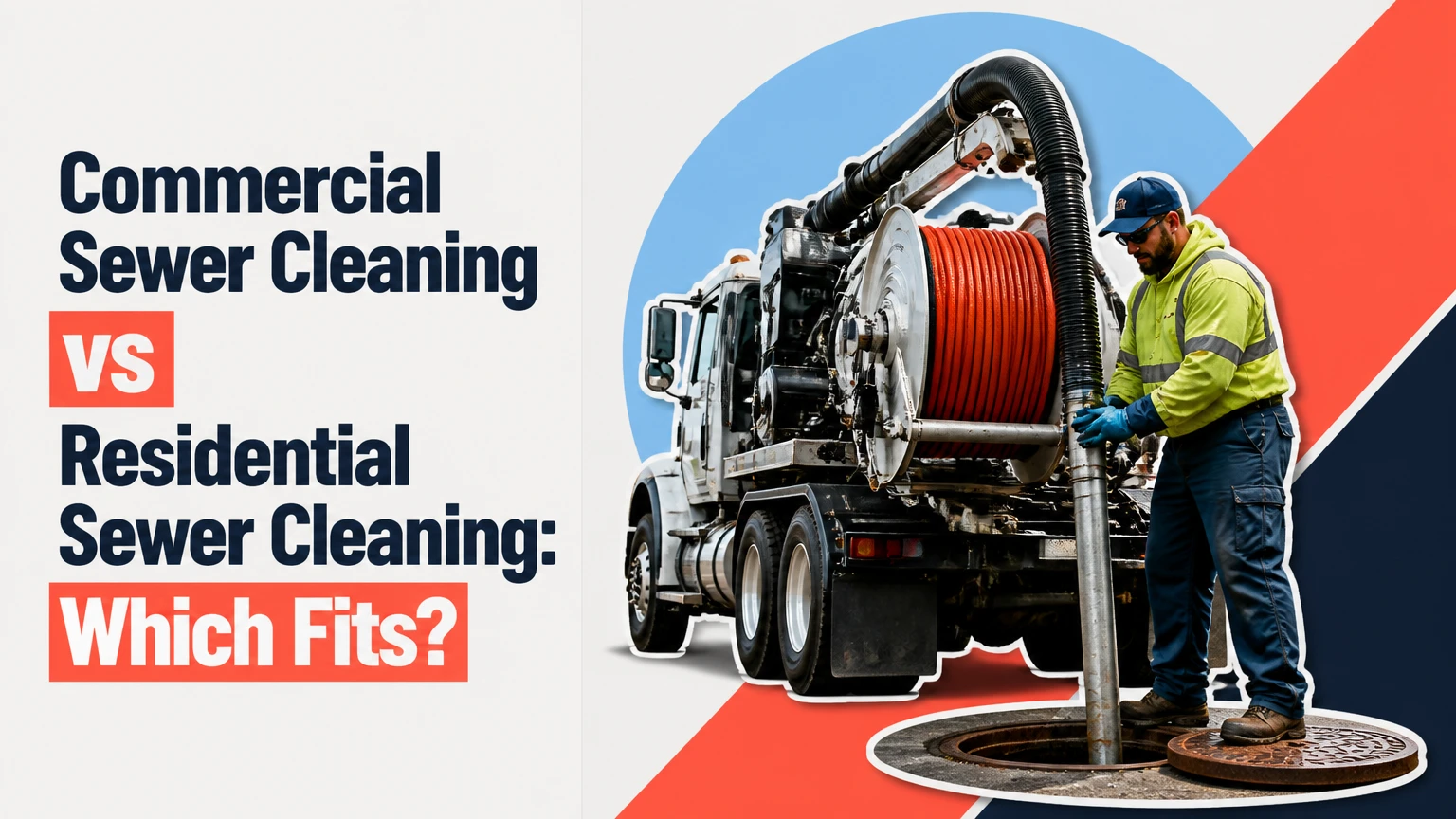
Commercial sewer cleaning handles larger or more heavily used drainage systems, while residential sewer cleaning usually addresses one home’s sewer lateral and localized blockages. The correct service depends less on the property label than on pipe diameter, waste type, access, pipe condition, backup risk, and required operating schedule. A restaurant may need high-flow jetting and grease management; a tree-lined home may need root cutting and camera inspection.
Key Facts at a Glance
- Residential sewer cleaning commonly serves a 4-6 inch private lateral, although actual diameters vary by building design, local code, and connection point.
- Commercial sewer cleaning may involve 3-12 inch lines, shared building mains, grease interceptors, parking-lot drains, or industrial process waste piping.
- A cable machine opens a passage through a blockage; hydro jetting cleans more of the pipe wall when the pipe is structurally sound.
- Typical residential cleaning costs about $200-$600, while commercial work commonly ranges from $600 to several thousand dollars.
- Pipe material and condition determine safe water pressure; a higher PSI rating does not automatically mean a better cleaning result.
- A camera inspection is especially valuable when backups recur, multiple fixtures are affected, or the pipe is old, damaged, or inaccessible.
What Is the Difference Between Commercial and Residential Sewer Cleaning?
The main difference is system duty: residential lines carry intermittent household wastewater, while commercial systems may carry continuous flow, grease, sediment, paper products, and wastewater from many fixtures. Commercial cleaning therefore requires more coordination, waste control, documentation, and sometimes larger equipment, but a small office line may need a process similar to a large home.
| Decision factor | Residential sewer cleaning | Commercial sewer cleaning |
|---|---|---|
| Typical served property | Single-family home or small duplex | Restaurant, office, school, apartment, warehouse |
| Common private-line diameter | 4-6 inches | 3-12 inches, depending on branch or main |
| Waste pattern | Intermittent household wastewater | Continuous occupancy or process discharge |
| Frequent blockage | Roots, wipes, paper, settled debris | FOG, scale, sediment, paper, foreign objects |
| Access | Exterior cleanout, basement, crawlspace | Multiple cleanouts, manholes, interceptor access |
| Operating constraint | Household disruption | Business closure, tenant access, traffic control |
| Typical initial cleaning price | $200-$600 | $600-$4,000 or more |
| Common documentation | Camera findings and invoice | Camera video, jetting report, waste manifest, service log |
The categories overlap. A six-unit apartment building can create more hydraulic demand than a small retail store, and a single-family home with a 100-foot clay lateral can require more specialized work than a modern office branch. Contractors should classify the line by use, condition, access, and consequence of failure.
Residential Sewer Cleaning: System and Waste Profile
Residential sewer cleaning normally targets the private building sewer between the home and the municipal main or septic tank. The line often carries toilet paper, wastewater, soap residue, and household solids, with roots entering through joints or cracks where mature landscaping is present.
A residential blockage may affect one fixture or the entire home. A kitchen drain clog points toward an interior branch, while a basement floor-drain backup, toilet bubbling, and slow fixtures across several rooms suggest a building sewer problem. Cleaning cannot correct a collapsed section, severe belly, missing pipe, or open joint.
Commercial Sewer Cleaning: System and Waste Profile
Commercial sewer cleaning covers more than large pipe diameter. Restaurants produce fats, oils, and grease, often called FOG. Offices may produce ordinary sanitary waste but serve hundreds of occupants. Warehouses and factories may introduce sand, fibers, process solids, or chemicals that require special handling.
Commercial work also includes shared laterals, vertical stacks, loading-area drains, parking-lot catch basins, grease interceptors, and lines crossing public or common areas. A contractor must identify ownership and discharge points before cleaning, because pushing a blockage into a municipal main can transfer the problem rather than solve it.
Which Equipment Fits Each Sewer Line?
The correct equipment is determined by obstruction type, pipe condition, line size, access, and cleaning objective. Cable machines are effective for opening many localized obstructions, whereas hydro jetters remove grease, sludge, and wall deposits more completely when inspection confirms that the pipe can withstand the work.
| Equipment or method | Typical residential use | Typical commercial use | Main limitation |
|---|---|---|---|
| Electric cable machine | 50-100 feet, roots or soft blockage | Branch lines and small sanitary lines | May leave deposits on pipe walls |
| Compact hydro jetter | 1,500-3,000 PSI, 4-12 GPM | Small commercial branches | Limited water volume and hose reach |
| Trailer or truck jetter | Occasional large home lateral | 3,000-8,000 PSI, 10-40+ GPM lines | Requires water, staging, and trained operation |
| Root-cutting nozzle | Tree-root intrusion in 4-6 inch pipe | Large root-affected laterals | Roots return if the defect remains |
| Chain flail or descaling head | Limited use in sound small lines | Cast iron scale and mineral deposits | Can damage weak or badly corroded pipe |
| Vacuum truck | Rare residential need | Sediment, interceptor, sludge, and debris | Higher mobilization and disposal cost |
| Push camera | Most home laterals | Branches and accessible small lines | Limited reach through large or complex networks |
| Crawler camera | Not normally needed | Manholes and larger commercial mains | Requires suitable access and line size |
Snaking Versus Hydro Jetting
Snaking is usually the faster first response for a localized residential obstruction or a small branch line. A rotating cable with an appropriate cutter can punch through roots, paper, or a compact blockage, but it may leave grease films, scale, and debris attached to the pipe wall.
Hydro jetting uses pressurized water to scour deposits and transport loosened material toward an approved discharge point. Typical residential machines may operate around 1,500-3,000 PSI, while commercial rigs often provide greater flow and pressure, but pressure alone is not a quality metric. A fragile clay, cast-iron, or heavily corroded line may require lower pressure, a different nozzle, or repair instead.
Winner: Snaking wins for a simple, accessible residential blockage; hydro jetting wins for recurring grease, sludge, or wall buildup in a verified sound line.
Camera Inspection Before Cleaning
A CCTV inspection identifies roots, cracks, offset joints, bellies, scale, and collapse before aggressive cleaning begins. A camera does not always see every defect because standing water, grease, distance, or a blocked passage can obscure the image, so the inspection should be interpreted alongside flow behavior and pipe access.
Pre-cleaning inspection is not mandatory for every minor sink stoppage. It becomes high-value when a main line backs up, the problem returns within weeks, the pipe predates modern PVC, or hydro jetting could dislodge material around a defect.
How Does Residential Sewer Cleaning Work?
Residential sewer cleaning usually follows four stages: locate access, inspect when warranted, clear the obstruction, and verify drainage. A straightforward cable cleaning may take 1-2.5 hours, while difficult access, root cutting, camera documentation, or jetting can extend the visit.
- Locate the correct cleanout. Technicians usually begin at an exterior yard cleanout, basement access, crawlspace opening, or point near the building drain.
- Identify the affected section. Fixture symptoms and camera footage help distinguish an interior branch clog from a private sewer lateral blockage.
- Select a cable or jetter. Root cutters, retrieval tools, and compact jetters suit different obstructions. Chemical drain openers should not substitute for mechanical diagnosis.
- Restore and test flow. The technician runs fixtures or a controlled volume of water, checks for backup, and documents remaining defects.
A successful cleaning restores sustained flow without forcing water around a hidden obstruction. It does not prove that roots, a belly, or a broken pipe has been permanently corrected.
How Does Commercial Sewer Cleaning Work?
Commercial sewer cleaning begins with site coordination and a line map, then combines inspection, isolation, cleaning, recovery, and documentation. A restaurant main may require overnight jetting and interceptor coordination, while an office branch may need only a scheduled cable cleaning during business hours.
- Plan access and shutdowns. The contractor identifies cleanouts, manholes, tenant areas, restroom closures, water supply, electrical needs, and emergency routes.
- Control exposure and discharge. Barriers, confined-space procedures, personal protective equipment, spill controls, and waste-disposal requirements depend on the site and jurisdiction. OSHA does not impose one universal sewer-cleaning procedure, and EPA requirements vary by discharge and wastewater type.
- Inspect the line. Push cameras suit smaller lines; crawler cameras can inspect larger mains from manholes. Grease depth, scale, roots, and structural defects determine the cleaning method.
- Clean in controlled passes. Jetting may begin with a penetrating nozzle and continue with a flushing nozzle. Operators choose pressure, flow, nozzle angle, and forward speed for the pipe condition.
- Recover displaced material. Vacuum equipment may be needed for heavy sediment, grease, interceptor contents, or debris that should not enter a downstream main.
- Verify and report. A post-cleaning camera, flow test, footage timestamp, location notes, and disposal records provide a defensible maintenance record.
Commercial service is therefore an operational process, not simply residential snaking with a larger machine.
How Much Does Each Service Cost?
Typical residential sewer cleaning costs $200-$600, while commercial cleaning commonly costs $600-$4,000 or more. Local labor rates, access, emergency timing, pipe length, waste disposal, traffic control, camera documentation, and equipment mobilization can move the final price well outside those ranges.
| Work type | Typical price range | Typical duration | Main price driver |
|---|---|---|---|
| Residential cable cleaning | $200-$500 | 1-2 hours | Access and obstruction severity |
| Residential hydro jetting | $350-$600 | 1.5-3 hours | Hose reach, water, camera work |
| Residential root cutting | $250-$700 | 1-3 hours | Root density and line length |
| Small commercial branch cleaning | $400-$1,200 | 2-4 hours | Fixtures, access, occupancy |
| Commercial main-line jetting | $600-$1,400 | 4-8 hours | Diameter, flow, staging |
| Grease-heavy or sediment work | $1,500-$4,000+ | 6-12 hours | Vacuum recovery and disposal |
| Emergency after-hours response | Add 25%-100% typically | Variable | Night, weekend, and shutdown demands |
These are planning ranges, not guaranteed prices. A quote should state whether the price includes camera inspection, additional access openings, water supply, vacuum extraction, disposal, restoration, and a return visit if flow does not hold.
Why Commercial Cleaning Costs More
Commercial prices increase because the contractor may need multiple technicians, larger jetting equipment, additional water, longer hose runs, containment, overnight labor, traffic control, and waste transport. The cost also reflects business interruption: a restaurant may choose a $1,500 overnight service to avoid a full day of lost sales and tenant disruption.
Commercial contracts can lower the per-visit cost when access, scheduling, and line maps are established. A contract is worthwhile only when the interval is based on measured buildup, previous failures, food-service requirements, or facility risk rather than an arbitrary annual promise.
How Often Should Cleaning Occur?
Residential sewer cleaning is usually event-driven, with preventive root treatment or inspection based on history. Commercial cleaning frequency should follow observed deposits, occupancy, FOG production, municipal requirements, and the consequence of a backup, not a universal six-month rule.
| Property situation | Starting interval | Adjustment trigger |
|---|---|---|
| Modern single-family PVC with no history | As needed | Any repeat backup or flow change |
| Home with recurring roots | 12-36 months | Tree growth and camera findings |
| Small office with ordinary sanitary use | 12-24 months or as needed | Occupancy and shared-line symptoms |
| Restaurant with heavy FOG | 3-12 months | Grease depth and blockage history |
| Apartment building shared main | 6-12 months initially | Tenant count and recurrence data |
| Pre-1980 cast-iron commercial system | Inspect first, then 12-60 months | Scale, corrosion, and camera evidence |
A food-service establishment may also need grease-interceptor pumping and records under local plumbing or wastewater rules. Sewer-line jetting does not replace interceptor maintenance, correct kitchen practices, or compliance with a local pretreatment program.
When Is Hydro Jetting Unsafe?
Hydro jetting is unsafe when the pipe is collapsed, severely cracked, disconnected, badly corroded, or unable to contain the water pressure. A camera inspection and experienced pressure selection reduce the risk, but neither can guarantee that an inaccessible or deteriorated section will tolerate cleaning.
A common misconception is that a commercial machine must operate at its maximum rating. Operators should match nozzle thrust and water volume to pipe material, diameter, deposit type, and defect risk. PVC may tolerate different conditions than vitrified clay or thin, graphitized cast iron, and a line with a major belly may retain sediment after jetting.
Hydro jetting is also a poor substitute for excavation or trenchless repair. If roots enter through an open joint, jetting removes the symptom while the opening remains. If a pipe has collapsed, cleaning may create temporary flow but cannot restore its shape or structural support.
Why Do Commercial Clogs Return?
Recurring commercial clogs usually indicate an unresolved source, such as grease production, insufficient interceptor maintenance, scale, sagging pipe, inadequate slope, or a line that is too small for current occupancy. A cable may restore a narrow flow channel while leaving a thick grease coating that captures new solids within days.
Restaurant managers should compare post-cleaning camera footage, grease depth, interceptor pumping records, kitchen practices, and backup dates. A 30-day recurrence after repeated cabling is a strong reason to investigate the entire line and change the maintenance method, rather than repeating the same clearing service.
Commercial FOG Controls
FOG enters sewers through cooking oil, animal fat, sauces, dairy residue, and food particles. Scraping cookware, using sink strainers, maintaining the interceptor, and scheduling line cleaning based on measured accumulation reduce the load, but biological additives cannot reliably compensate for a neglected interceptor or defective pipe.
The downstream risk matters. Jetting grease toward a municipal main without containment can create a second blockage, violate local discharge rules, and increase cleanup costs. Ask the contractor where displaced grease will go before work begins.
What Changes for Apartments and Mixed-Use Buildings?
Apartment and mixed-use properties occupy the middle ground between residential and commercial sewer cleaning. Shared mains can carry high peak flows, multiple tenant waste streams, laundry lint, wipes, and kitchen grease, even when each individual unit has ordinary residential fixtures.
Property managers should map cleanouts, identify line ownership, record affected units, and separate branch-line symptoms from main-line symptoms. A backup affecting several apartments on lower floors requires rapid main-line diagnosis; clearing one unit’s branch may leave the shared obstruction intact.
Mixed-use buildings also need scheduling controls. A ground-floor restaurant can overload a line shared with apartments, so maintenance records should connect the food-service tenant, interceptor, branch connection, and downstream cleanout.
What Does Residential and Commercial Cleaning Not Fix?
Sewer cleaning removes an obstruction or deposit; it does not repair structural failure. A contractor should recommend repair or replacement when camera footage shows collapse, severe deformation, separated joints, extensive cracks, persistent belly conditions, or root entry through a major defect.
| Finding | What cleaning may accomplish | Likely next action |
|---|---|---|
| Soft paper blockage | Restore normal flow | Monitor and correct disposal behavior |
| Moderate root intrusion | Open the line temporarily | Camera follow-up and root-management plan |
| Grease coating in sound pipe | Remove deposits | Interceptor and scheduled jetting program |
| Mineral scale in stable cast iron | Improve internal diameter | Descaling with controlled inspection |
| Standing-water belly | Remove some sediment | Evaluate slope, spot repair, or replacement |
| Collapsed clay or cast iron | Possibly create temporary passage | Excavation or trenchless repair assessment |
| Offset or open joint | Clear current debris | Structural repair and soil-intrusion evaluation |
| Broken cleanout or missing access | Reach may be limited | Install or repair access point |
A line that needs cleaning every few weeks is not necessarily a maintenance success. Repeated service can mask a structural defect and cost more than an early repair investigation.
What Should a Service Quote Include?
A reliable sewer-cleaning quote identifies the line, access point, cleaning method, equipment, inclusions, exclusions, and verification standard. Price alone cannot compare a small cable pass with a documented commercial jetting program.
Check these items before authorizing work:
- Exact line or fixture being cleaned, including approximate length and diameter.
- Whether a pre-cleaning and post-cleaning camera inspection is included.
- Cable type, jetting pressure range, water-flow range, nozzle type, and operator qualification.
- Protection for floors, walls, tenant areas, food-preparation spaces, and public walkways.
- Vacuum recovery, grease-interceptor pumping, transport, and disposal charges.
- Emergency, overnight, permit, traffic-control, and water-supply fees.
- What happens if the line cannot be cleared or immediately re-blocks.
- Whether the report includes video, defect location, pipe material, and recommended repair priority.
One practitioner rule is especially useful: never approve a high-pressure cleaning proposal that cannot explain how the operator will identify a damaged line and control displaced waste.
Which Service Should You Choose?
Homeowner With One Main-Line Backup
Choose residential sewer cleaning with a camera-informed cable or compact jetter when one home is affected and the line is accessible. Request a camera inspection if roots, old pipe, repeated backups, or uncertain ownership are involved.
Restaurant or Commercial Kitchen
Choose commercial jetting and FOG-focused maintenance when grease or recurring kitchen backups are present. Coordinate interceptor pumping, kitchen procedures, off-hours access, waste recovery, and local discharge requirements rather than ordering routine cabling alone.
Office or Retail Manager
Choose a scaled commercial service based on occupancy and line size. A small office may need a push camera and cable machine, while a multi-story building with shared mains may require crawler inspection, high-flow jetting, and a documented maintenance schedule.
Apartment or Facility Manager
Choose a planned inspection and cleaning program for shared lines, with priority based on backup consequences and historical recurrence. Map every cleanout and retain camera footage so future technicians can compare deposits and structural changes.
Troubleshooting Common Symptoms
Multiple fixtures backing up at once usually indicate a building sewer or shared main problem, not several unrelated fixture clogs. Gurgling toilets, low-floor drain backups, and water rising when another fixture runs justify stopping water use and arranging line diagnosis.
A single slow sink usually points to a nearby branch, trap, or fixture issue. A basement backup after heavy rain may involve a private sewer, municipal surcharge, backwater valve, stormwater intrusion, or groundwater problem, so cleaning alone may not address the cause.
Do not pour consumer chemical drain cleaners into a suspected sewer main. They may remain in standing water, injure workers, damage some materials, and complicate safe cable or jetting work without resolving a root intrusion or collapse.
FAQ
Is commercial sewer cleaning always done with a vacuum truck?
No. A small commercial branch may need only a cable machine or compact jetter. Vacuum trucks become appropriate when the job involves heavy sediment, grease interceptors, large manholes, substantial debris, or a need to prevent displaced material from entering a downstream sewer.
Can a homeowner use commercial hydro-jetting equipment?
A homeowner should not operate high-flow commercial jetting equipment without training and a pipe assessment. Incorrect nozzle selection, pressure, hose handling, or wastewater control can injure the operator, damage a weak pipe, or force debris into a municipal main.
Are commercial sewer pipes always larger than residential pipes?
No. Commercial branch lines can be the same 3-4 inch size found in homes, while some residential properties have large private mains. Commercial classification usually reflects use, occupancy, shared infrastructure, access, and operational risk as much as diameter.
How long does a sewer cleaning remain effective?
The result may last months or years, depending on the cause. A sound residential line with one accidental blockage may remain clear for years, while a restaurant line with heavy FOG, or a root-damaged line, may recur within weeks or months without source control or repair.
Should sewer cleaning happen before buying a property?
A sewer scope is sensible before purchasing a property with mature trees, older clay or cast-iron piping, additions, repeated backup history, or uncertain sewer responsibility. The inspection may reveal a repair need that ordinary plumbing tests will not show.
The Bottom Line
Commercial sewer cleaning and residential sewer cleaning use overlapping tools, but they solve different operating problems. Residential work usually prioritizes rapid access, roots, household blockages, and affordable diagnosis; commercial work adds high-volume flow, FOG control, shared-line coordination, waste recovery, documentation, and business-continuity planning.
For a homeowner, begin with the correct cleanout and a camera when recurrence or pipe age raises uncertainty. For a restaurant, connect sewer cleaning to interceptor maintenance and grease prevention. For a property manager, use line maps, camera records, measured deposit levels, and backup history to set the interval. The best choice in commercial sewer cleaning vs residential sewer cleaning is the least aggressive method that safely restores flow and addresses the reason the blockage formed.