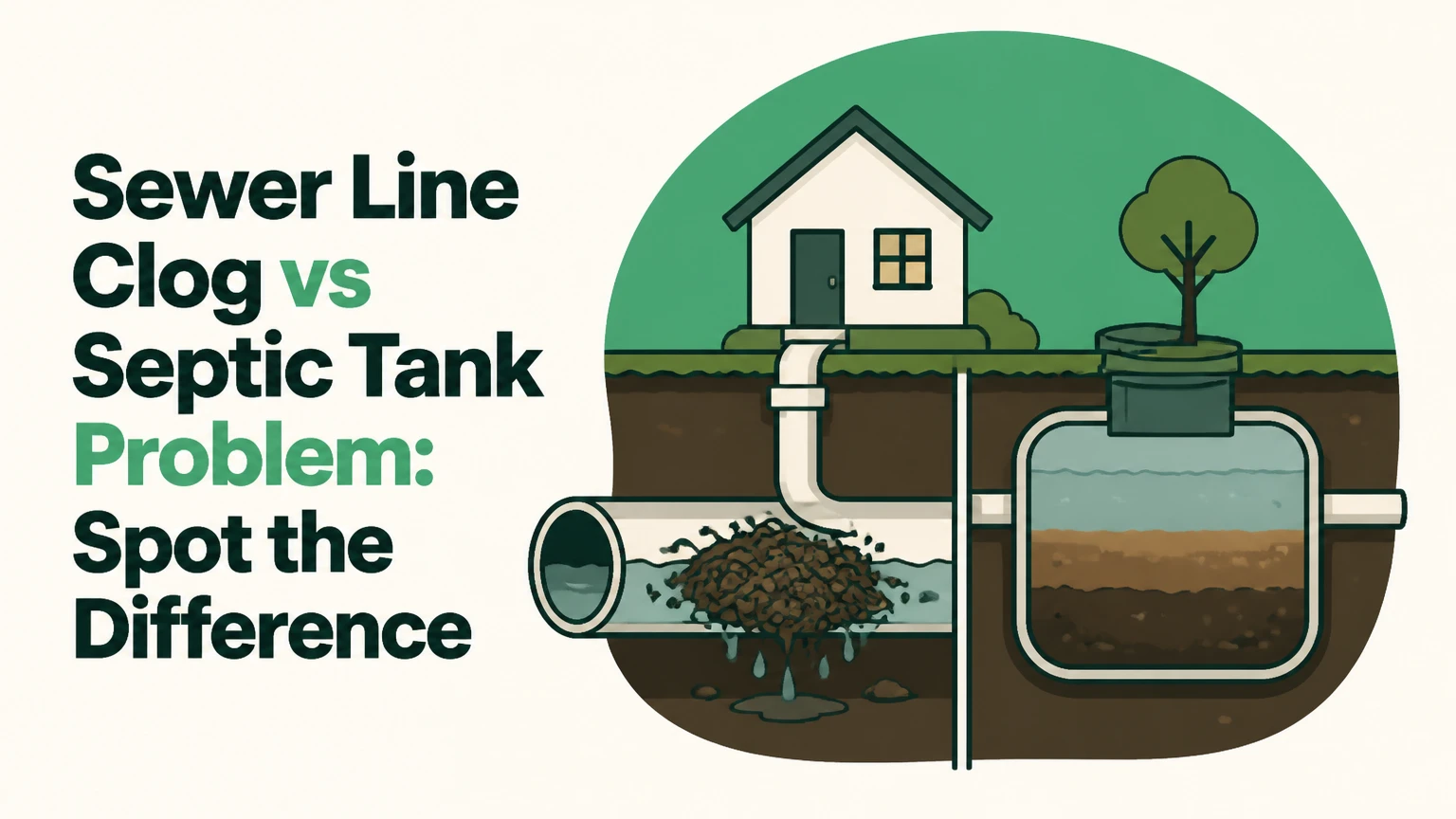
A sewer line clog vs septic tank problem comparison comes down to the failed component: a sewer-line clog restricts a pipe, while a septic problem affects the tank, effluent outlet, pump, or drainfield. Multiple indoor backups can indicate either condition, but sewage in the yard, a high tank level, or a failed pump points more strongly to septic failure.
Key Facts at a Glance
- A home connected to septic can still have a sewer-line clog between the house and the septic tank.
- A municipal sewer connection does not make every backup a city problem; the private lateral often belongs to the property owner.
- Sewage rising from a cleanout indicates a downstream restriction, but it does not identify whether the restriction is in a pipe or septic system.
- A septic tank that needs pumping is different from a drainfield that has lost soil absorption capacity.
- Typical U.S. drain clearing costs range from $200-$800, while drainfield replacement commonly costs $5,000-$20,000 or more.
- Never open a septic tank or enter a confined space; septic gases and oxygen-deficient conditions can kill without warning.
What the Two Problems Actually Mean
A sewer-line clog is a physical obstruction or damaged section within the building drain or private sewer lateral. The affected pipe may run from the home to a municipal sewer main or, for a septic property, from the home to the septic tank. A septic tank problem is a treatment-system failure involving solids, liquid levels, tank structure, outlet filtration, pumps, distribution, or drainfield absorption.
The distinction matters because the same symptom, such as a toilet backing up, can originate in different locations. A septic property has both interior plumbing and a sewer lateral, so “sewer problem” and “septic problem” are not mutually exclusive. A clogged house-to-tank line is a sewer-line clog even though the property does not use a municipal sewer.
The U.S. Environmental Protection Agency describes septic systems as “underground treatment structures.” The tank separates solids and scum, but the drainfield performs the final soil-based treatment and dispersal. Therefore, a full tank, blocked outlet filter, failed lift pump, and saturated drainfield require different diagnoses.
Where does each failure occur?
A sewer-line clog occurs along a pipe route. A septic failure occurs at one or more treatment components after wastewater leaves the house.
| Component | Typical location | Failure pattern | First diagnostic |
|---|---|---|---|
| Branch drain | Inside wall or floor | One fixture drains slowly | Fixture-level auger |
| Building drain | Under the house | Several nearby fixtures back up | Main drain access |
| Private sewer lateral | Yard, house to main or tank | Whole-house backup | Cleanout and camera |
| Septic tank | Buried near house | High liquid, sludge, damaged baffle | Professional tank inspection |
| Effluent pump | Tank or pump chamber | Alarms, no flow to field | Electrical and float test |
| Drainfield | Downstream soil area | Wet ground, odors, sewage surfacing | Hydraulic and soil evaluation |
Why Do Sewer Line Clogs and Septic Problems Back Up?
A sewer-line clog stops or slows gravity flow at a point in the pipe, so wastewater from toilets, sinks, showers, and washing machines accumulates behind the obstruction. Because wastewater seeks the lowest available opening, a basement floor drain, shower, or toilet may overflow before a higher fixture shows any sign.
A septic problem can create the same indoor backup through a different mechanism. A tank with excessive solids may block the outlet filter, a failed pump may prevent effluent from reaching the field, or a saturated drainfield may accept little additional liquid. Continued water use then raises the level through the tank and house lateral.
How a sewer-line clog develops
- Roots, grease, scale, or an object narrows the pipe.
- Reduced velocity allows paper and sediment to settle.
- The restriction becomes intermittent, often after laundry or bathing.
- A complete blockage forces wastewater toward indoor fixtures.
- Repeated clearing may temporarily restore flow without correcting pipe damage.
A camera is important when roots return quickly. Repeated snaking can cut a temporary channel through roots while leaving the underlying joint separation, crack, belly, or collapsed section in place.
How septic failure develops
- Sludge and scum occupy increasing tank volume.
- Solids reach the outlet or clog the effluent filter.
- Solids or poorly treated wastewater enter the drainfield.
- Soil pores and the biological interface become less permeable.
- Liquid rises in the tank, distribution box, or field and may return toward the house.
The common phrase “the septic tank is full” requires interpretation. A septic tank normally contains liquid between pump-outs. The relevant question is whether the tank has excessive sludge, an abnormal liquid level, a blocked outlet, or a downstream field restriction.
Which Symptoms Point to Which Problem?
A sewer-line clog is more likely when multiple indoor fixtures back up suddenly without yard wetness, especially after heavy water use. A septic or drainfield problem becomes more likely when indoor symptoms accompany persistent sewage odor, unusually wet soil, surfacing effluent, a septic alarm, or a recent history of missed pumping.
No single symptom proves the diagnosis. For example, gurgling can result from a pipe restriction, a full septic tank, or a venting defect.
| Symptom | Sewer-line clog likelihood | Septic-system likelihood | Interpretation |
|---|---|---|---|
| One sink drains slowly | High for branch clog | Low | Usually not a tank failure |
| Several fixtures back up | High | High | Failure is downstream of shared fixtures |
| Basement shower fills after flushing | High | Medium to high | Downstream house line or full septic system |
| Rotten-egg odor outdoors | Low | High | Tank, field, gas, or surface sewage issue |
| Sewage surfacing over field | Very low | Very high | Drainfield or distribution failure |
| Backup after every load of laundry | High | High | Flow capacity is inadequate |
| Septic alarm sounds | None on municipal system | Very high | Pump, float, electrical, or high-level fault |
| Problem disappears after a local auger | Medium | Low | Confirms a temporary pipe restriction |
| Roots return within months | Very high | Low | Damaged lateral or root intrusion |
| Water remains at cleanout | High | High | Downstream obstruction, tank, or field restriction |
What does a gurgling toilet mean?
A gurgling toilet usually indicates air displaced by restricted drainage, but the location remains uncertain. If the toilet gurgles when a washing machine discharges, inspect the shared building drain or private lateral first; if the property has septic and the tank is overdue for service, inspect the tank and outlet filter as well.
Does green grass prove septic failure?
Bright green grass over a drainfield is a warning sign, not proof. Extra moisture and nutrients can produce vigorous growth above a functioning field, while a failing field may show no visible change during dry weather, frozen ground, or early-stage restriction. Odor, wetness, surfacing liquid, and professional testing provide stronger evidence.
What Causes a Sewer-Line Clog?
Tree roots are the leading recurring cause in older clay, cast-iron, and fiber conduit laterals because small joints and cracks provide entry points. Grease, paper towels, wipes, hygiene products, scale, and construction debris can also reduce the effective diameter until ordinary wastewater flow carries too little force to clear it.
A pipe belly, incorrect slope, offset joint, or partial collapse creates a structural obstruction rather than a removable plug. Hydro-jetting may clean the inside of a damaged pipe, but it cannot restore grade or reconnect a separated joint.
| Cause | Typical onset | Diagnostic clue | Durable remedy |
|---|---|---|---|
| Tree roots | Months to years | Roots on camera, recurring blockage | Root cutting plus repair or lining |
| Grease and scale | Gradual | Thick deposits on camera | Jetting plus source control |
| Wipes or paper towels | Sudden | Object retrieved during clearing | Removal and disposal changes |
| Pipe belly | Intermittent | Standing water on camera | Spot repair or replacement |
| Offset or cracked joint | Recurrent | Soil intrusion or separated joint | Excavation, lining, or replacement |
| Collapse | Sudden or progressive | Camera cannot pass | Excavation or trenchless repair |
What Causes Septic Tank or Drainfield Failure?
Septic failure commonly follows inadequate pumping, excessive water loading, blocked outlet filtration, damaged baffles, pump failure, or drainfield soil restriction. The tank may remain structurally intact while the drainfield fails, so pumping alone may produce only short-term relief.
The EPA recommends regular inspection and pumping schedules based on household size, wastewater volume, total solids, and tank size rather than one universal interval. A three-to-five-year interval is a common planning range for many homes, but a large household, garbage disposal, small tank, or high water use can shorten it.
| Septic problem | Failed part | Characteristic sign | Typical next action |
|---|---|---|---|
| Excess sludge | Tank solids layer | Pumping overdue, low outlet clearance | Pump and measure layers |
| Blocked effluent filter | Outlet filter | High tank level, clean inlet flow | Remove and clean filter |
| Broken baffle | Inlet or outlet baffle | Solids escape toward field | Inspect and repair baffle |
| Failed pump | Pump chamber | Alarm, no field distribution | Test power, float, and pump |
| Saturated drainfield | Soil absorption area | Wet field, odors, surfacing | Hydraulic evaluation |
| Hydraulic overload | Whole system | Backup after high-use periods | Reduce flow and assess capacity |
| Structural crack | Tank shell or lid | Groundwater infiltration or leakage | Licensed repair or replacement |
Is a full septic tank the same as a failed drainfield?
A full septic tank is not automatically a failed drainfield. Pumping removes accumulated solids and may correct a high liquid level caused by an outlet obstruction, but pumping cannot repair compacted soil, broken distribution piping, inadequate reserve area, or a permanently overloaded field.
A useful field rule is to compare the tank level before and after pumping. If the tank refills rapidly without normal household flow, groundwater infiltration, a broken pipe, or a field-side restriction may exist. A septic professional must interpret that test because conditions vary with soil, rainfall, and system design.
How Can You Diagnose the Failure Safely?
Use a controlled diagnostic sequence: stop adding water, identify the wastewater system, observe the lowest affected fixture or cleanout, and obtain professional inspection when the restriction is downstream or sewage is exposed. Do not dig into a tank or pour chemicals into a suspected septic system.
Step 1: Stop water use
Stop flushing, showering, laundry, dishwashing, and automatic water treatment regeneration. Water conservation limits the volume released into a blocked pipe or overloaded septic system.
Step 2: Confirm municipal sewer or septic
Check the property disclosure, utility bill, septic permit, tank lids, or local records. A private well does not prove septic ownership, and municipal water does not rule out septic; some properties use public water with private wastewater treatment.
Step 3: Check symptom distribution
A single fixture suggests a branch drain. Several fixtures suggest the building drain or downstream lateral. Outdoor wetness, field odor, or an alarm shifts attention toward septic components.
Step 4: Observe the cleanout without opening the tank
A plumber can safely inspect an exterior sewer cleanout using appropriate procedures. Do not leave a cleanout uncapped to “relieve pressure”; an open pipe can release sewage, gases, and contamination. A cleanout full of standing wastewater indicates a downstream restriction but does not distinguish a lateral clog from a septic blockage.
Step 5: Use the right inspection
A sewer camera identifies roots, scale, cracks, bellies, offsets, and collapse. A septic inspection measures sludge and scum, checks baffles and filters, tests pumps, and evaluates the field. Dye, hydraulic loading tests, and soil assessment may be needed for intermittent cases.
Step 6: Contact the correct party
For municipal systems, the utility may inspect the public main at no charge, while the property owner often maintains the private lateral. For septic systems, use a licensed septic service, not only a drain cleaner, when the tank, pump, or field may be involved.
What Fixes Each Problem?
A sewer-line clog normally requires mechanical cable clearing, root cutting, or hydro-jetting, followed by camera inspection when the blockage recurs. A septic problem may require pumping, filter cleaning, baffle repair, pump replacement, distribution repair, or drainfield remediation; the correct treatment depends on the failed component.
| Service | Typical U.S. cost | Typical duration | Suitable for | Not suitable for |
|---|---|---|---|---|
| Main-line cable clearing | $200-$500 | 1-3 hours | Soft blockages, paper, grease | Collapsed or badly damaged pipe |
| Hydro-jetting | $500-$1,200 | 2-5 hours | Grease, scale, some roots | Structural repair |
| Sewer camera inspection | $150-$500 | 1-2 hours | Recurring or uncertain clogs | Septic-field diagnosis alone |
| Septic tank pumping | $300-$700 | 1-3 hours | Sludge accumulation | Failed soil absorption |
| Pump or float repair | $500-$2,000 | 2-8 hours | Alarm and chamber failures | Severely damaged field |
| Lateral spot repair | $1,000-$5,000 | 1-3 days | Local crack or offset | Multiple failures along route |
| Drainfield repair or replacement | $5,000-$20,000+ | Several days to weeks | Soil or field failure | A simple blocked outlet filter |
These are typical planning ranges, not guaranteed bids. Location, access, depth, permitting, traffic control, pipe material, emergency timing, and engineered septic requirements can change the final price substantially.
A common practitioner mistake is approving hydro-jetting before a camera inspection on an old, fragile line. High-pressure water can expose a severe defect and may not be appropriate for a collapsed or badly deteriorated pipe. The limitation is practical: cleaning restores flow, but it does not make a failing pipe structurally sound.
Sewer Line Clog vs Septic Tank Problem: Which Should You Choose?
The owner should choose a sewer-drain contractor when symptoms are confined indoors or a camera shows a pipe restriction. The owner should choose a septic professional when the tank, pump, outlet filter, distribution box, drainfield, or outdoor wastewater signs are involved.
| Situation | First call | Evidence to request | Avoid |
|---|---|---|---|
| Municipal home, sudden whole-house backup | Drain or sewer contractor | Camera location and video | Repeated chemical treatments |
| Municipal home, suspected public-main issue | Sewer utility | Main inspection result | Assuming the city owns the lateral |
| Septic home, overdue pumping | Septic pumper | Sludge depth and baffle condition | Pumping without component inspection |
| Septic alarm or pump failure | Septic electrician or contractor | Pump amperage and float test | Resetting alarm repeatedly |
| Wet drainfield and odors | Licensed septic evaluator | Field assessment and repair design | Driving equipment across field |
| Home purchase | Independent inspector plus specialists | Camera report or septic certification | Relying only on seller statements |
For homeowners with a municipal connection
Start with the lowest fixture and private cleanout, then call the sewer utility if the backup remains after the property lateral is checked. A utility inspection can determine whether the public main is flowing, but ownership boundaries differ by city and may be defined by local ordinance.
For homeowners with septic
Find the tank lids, pump chamber, reserve field, and distribution area from permit records. Keep vehicles, sheds, pools, and deep-rooted trees away from the drainfield, and spread laundry across several days rather than sending many high-volume loads through a marginal system.
For home buyers
Order a sewer camera inspection for a municipal property and a septic inspection for a private system. Ask for pumping receipts, permits, repair records, tank capacity, field age, and the location of any reserve area. A routine home inspection rarely substitutes for either specialist evaluation.
What Should You Do During an Active Backup?
An active sewage backup requires immediate water shutoff, electrical caution, contamination control, and professional assessment. Keep children and pets away, avoid contact with wastewater, and never operate electrical equipment while standing in wet areas.
- Stop all indoor water use.
- Keep people away from contaminated rooms.
- Avoid basement electrical panels, outlets, and appliances exposed to water.
- Close toilet lids and prevent additional flushing.
- Call the sewer utility, plumber, or septic contractor.
- Photograph damage only from a safe location.
- Contact the insurer before discarding major damaged materials.
- Disinfect only after the source is stopped and contaminated materials are removed safely.
Sewage can contain pathogens, sharp debris, and chemical residues. Porous flooring, drywall, insulation, and upholstered materials often require removal rather than surface cleaning.
Mistakes That Make Both Problems Worse
Chemical drain cleaners are a poor response to a main-line or septic backup. They may fail to reach the obstruction, endanger the technician, corrode older piping, and introduce toxic chemicals into a septic treatment system.
“Flushable” wipes remain a common cause of downstream restrictions despite their labeling. Toilet paper is engineered to disperse rapidly in water; wipes and paper towels generally retain much more structural strength.
Do not drive, park, or store heavy materials over a drainfield. Compaction reduces soil infiltration and can damage shallow distribution lines, especially when the ground is wet.
Do not add septic bacteria products as a substitute for pumping or repair. Normal household wastewater already introduces microorganisms, while additives cannot dissolve a collapsed pipe or restore clogged soil pores.
Do not assume an odor proves a septic failure. Sewer gas can enter through a dry trap, broken vent, loose toilet seal, or cracked pipe. Outdoor sewage surfacing and high tank levels provide stronger evidence of septic malfunction.
How Can You Prevent a Recurrence?
Prevent sewer-line clogs by keeping grease, wipes, paper towels, and foreign objects out of drains, while inspecting older laterals when roots or repeated backups occur. Prevent septic failure by controlling water volume, protecting the field, maintaining filters and pumps, and pumping according to measured solids rather than a rigid calendar alone.
| Preventive action | Municipal sewer home | Septic home | Practical interval |
|---|---|---|---|
| Avoid wipes and grease | Required | Required | Every day |
| Inspect older lateral | Strongly recommended with roots | Strongly recommended house to tank | On recurrence or before purchase |
| Camera inspection | Useful for clay or cast iron | Useful for private lateral | Every 2-3 years only if risk warrants |
| Tank pumping | Not applicable | Required when solids approach limits | Often 3-5 years, individualized |
| Effluent filter service | Not applicable | Required if installed | Per manufacturer, commonly annually |
| Field protection | Not applicable | Keep traffic and irrigation controlled | Continuous |
| Water-use balancing | Helpful during restrictions | Important for marginal systems | Daily and during heavy use |
The most useful maintenance record is not merely a pumping receipt. It includes tank measurements, filter condition, baffle inspection, pump performance, distribution observations, and any recommendation for field monitoring.
Edge Cases That Mislead Homeowners
Heavy rain can expose a marginal septic field without creating a new pipe clog. Groundwater may enter cracked laterals or a damaged tank, while saturated soil temporarily removes the field’s ability to accept effluent.
Cold weather can freeze shallow septic lines, pump discharge pipes, or poorly protected plumbing. A frozen section may resemble a clog, but snaking will not correct a frozen or hydraulically overloaded system.
Intermittent backups after large water releases often indicate a partial obstruction or limited treatment capacity. If a line clears overnight but fails after laundry, the remaining restriction still needs diagnosis; temporary drainage is not proof of a successful repair.
Shared laterals and condominium systems complicate responsibility. A blockage affecting several units may lie in a common private line, a municipal main, or an individual branch, so the association documents and local maintenance agreement matter.
Frequently Asked Questions
Can a septic system have a sewer-line clog?
Yes. A septic property usually has a private sewer lateral from the house to the tank. Roots, grease, wipes, bellies, and collapsed sections can obstruct that line even when the septic tank and drainfield are functioning normally.
Will septic tank pumping fix a house backup?
Pumping may fix a backup caused by excessive sludge, a high tank level, or temporary outlet restriction. Pumping will not repair a collapsed house-to-tank line, failed pump, broken baffle, clogged distribution system, or drainfield that has lost absorption capacity.
How long can a sewer-line clog be ignored?
A partial clog can worsen within hours after repeated water use, while a recurring root intrusion may persist for months. Ignoring slow drainage risks sewage contamination, pipe damage, and an emergency overflow at the lowest fixture.
Can a sewer camera inspect a septic system?
A sewer camera can inspect the building drain and private lateral, but it cannot by itself evaluate sludge depth, biological treatment, pump operation, soil absorption, or drainfield capacity. Septic diagnosis requires tank and field assessment in addition to pipe inspection.
Is a rotten-egg smell always dangerous?
A rotten-egg smell may indicate hydrogen sulfide or another sewer-gas issue, and concentrated gases can be hazardous in enclosed spaces. Ventilate only when safe, leave the area if symptoms occur, and never enter a septic tank or confined chamber.
Does a septic tank need pumping every three years?
Many households fall within a three-to-five-year planning range, but pumping frequency depends on tank size, occupancy, wastewater volume, solids accumulation, and garbage-disposal use. Measured sludge and scum levels provide a better schedule than an inflexible date.
The Bottom Line
The fastest way to resolve a sewer line clog vs septic tank problem is to identify the system boundary and the location of the restriction. Indoor-only backups usually justify a building-drain or private-lateral inspection, while outdoor sewage, high tank levels, alarms, and wet drainfield soil require septic evaluation. Stop water use, avoid chemicals, document the symptoms, and match the contractor to the failed component rather than treating every backup as a routine drain clog.