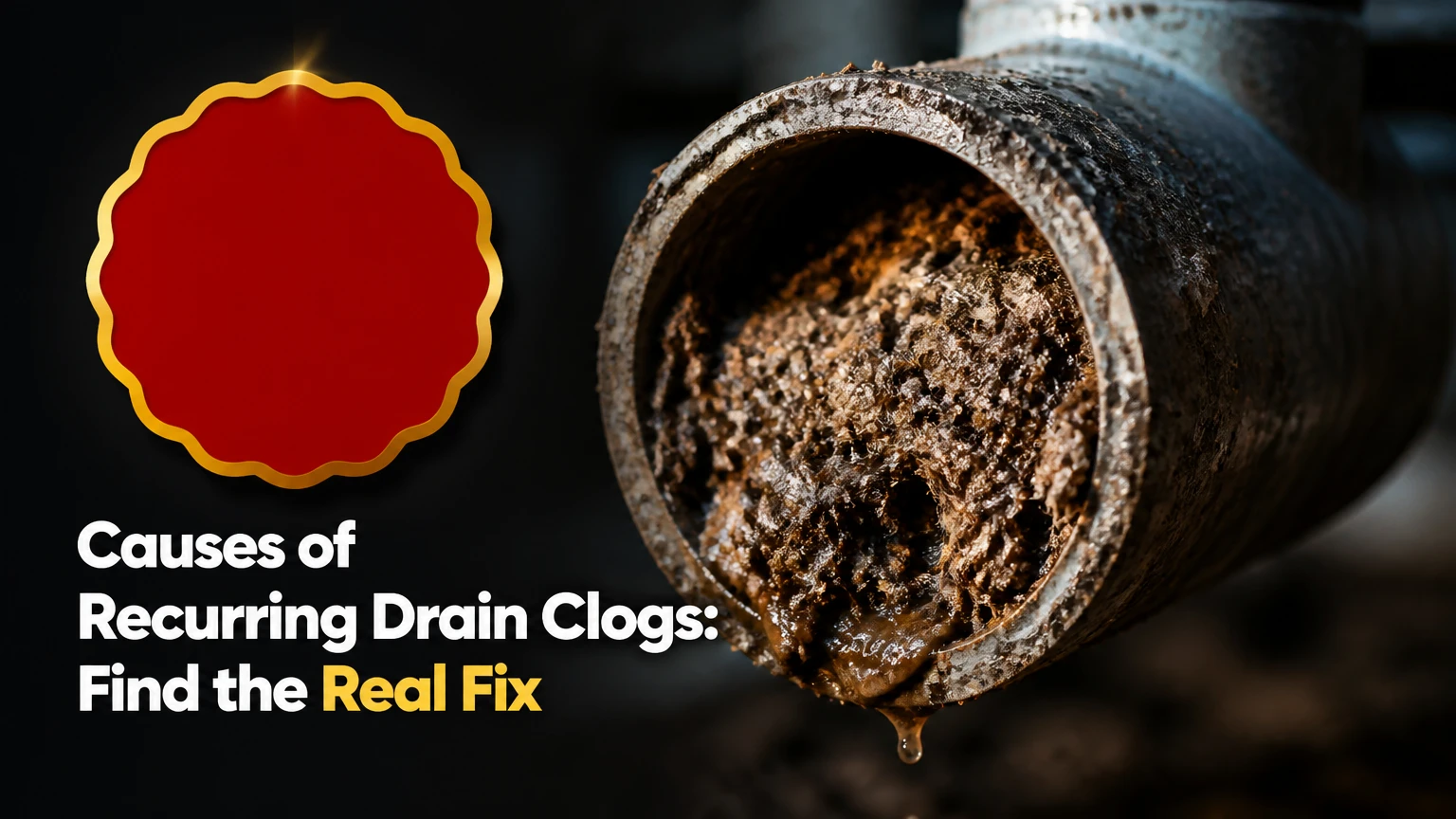
The main causes of recurring drain clogs are incomplete clearing, grease or hair accumulation, foreign objects, tree roots, pipe defects, poor slope, blocked vents, and overloaded septic or sewer systems. A drain may flow after plunging or snaking while residue, roots, scale, or a damaged section remains, allowing another blockage to form.
Key Facts at a Glance
- A clog that returns within 30 days usually indicates remaining debris, a pipe defect, or an incorrectly sized clearing method.
- One affected fixture usually points to a local branch drain; several affected fixtures indicate a building drain, sewer, vent, or septic problem.
- A sewer camera inspection typically costs $150-$400 in the United States and identifies defects that snaking cannot confirm.
- Hydro jetting cleans more of a pipe wall than a cable, but professionals should assess fragile, cracked, or badly corroded pipes first.
- “Flushable” wipes, dental floss, grease, paper towels, and feminine hygiene products can create persistent blockages even when toilets initially flush.
- A drain that backs up more than twice yearly deserves diagnosis rather than repeated chemical treatment or routine plunging.
What Are Causes of Recurring Drain Clogs?
Recurring drain clogs result from a persistent restriction that was opened but not removed, or from a physical defect that continually catches waste. Grease hardens on kitchen-pipe walls, hair binds with soap in showers, roots enter damaged sewer joints, and sagging pipes retain solids. Each new obstruction forms at the same weak point.
A plunger changes pressure and a drain cable may bore through the center of a blockage. Neither method necessarily removes the coating around the pipe, extracts every fragment, corrects an offset joint, or restores the pipe’s original slope. The result is temporary drainage followed by predictable re-accumulation.
The recurrence interval provides useful evidence. A backup within days suggests incomplete removal or a foreign object; recurrence after several months suggests gradual buildup, roots, or a structural defect. Seasonal recurrence after heavy rain points toward infiltration, root growth, a stormwater connection, or a saturated septic system.
How Does a Clog Return After Clearing?
A recurring clog typically follows five stages: material attaches to the pipe wall, the opening narrows, flow stops, a basic clearing method creates a channel, and fresh debris catches on the remaining rough surface. The cycle accelerates because reduced diameter increases turbulence and lowers the pipe’s ability to carry solids.
- Accumulation: Fat, hair, paper, mineral scale, or soap adheres to the interior.
- Restriction: Water still passes, but the reduced opening slows transport.
- Blockage: Solids bridge the remaining opening and stop flow.
- Partial clearing: A plunger or cable restores a narrow passage.
- Reattachment: Residue, roots, or pipe damage catches new material.
- Repeat backup: The restriction reaches the same failure point again.
A retail auger is often effective for a nearby hair plug. It is less effective against a long grease coating, a mainline root mass, or a collapsed pipe. The method must match both the material and the pipe condition.
Why does plunging work briefly?
Plunging works briefly when pressure displaces a blockage without removing its surrounding material. The plunger can move a soft mass farther down the branch line, split it into smaller pieces, or open a temporary channel through grease and paper. Flow returns, but the displaced material remains available to catch additional waste.
A proper plunger seal matters. Cover an adjacent overflow opening, add enough water to cover the cup, and use controlled strokes rather than violent pumping. Stop if multiple fixtures are backing up, because pressure can force contaminated water into another fixture or stress a weak trap connection.
Which Materials Recur Most Often?
The most persistent recurring-clog materials are grease, hair and soap film, wipes, paper products, mineral scale, roots, and small foreign objects. Material type changes the best remedy: a hair trap may respond to manual removal, while hardened grease or root intrusion usually needs professional equipment and verification.
| Material | Common location | Typical recurrence clue | Effective response |
|---|---|---|---|
| Fats, oils, grease | Kitchen branch or shared food line | Backup after cooling periods or heavy cooking | Mechanical removal, approved jetting, grease control |
| Hair and soap scum | Shower, tub, bathroom sink | Slow drainage that worsens over weeks | Strainer, trap cleaning, cable, wall cleaning |
| Wipes and floss | Toilet branch or building drain | Toilet overflow with little warning | Mechanical extraction and disposal correction |
| Mineral scale | Older galvanized or hard-water lines | Grit, flakes, narrowing, low flow | Descaling, replacement, or carefully assessed jetting |
| Tree roots | Buried sewer lateral | Spring or rain-related recurrence | Root cutting followed by structural repair |
| Foreign objects | Toilet, sink trap, laundry drain | Sudden blockage after a specific event | Retrieval, trap removal, or camera confirmation |
Grease does not need to remain liquid to cause trouble. Kitchen fats cool inside a pipe, combine with food particles, and form a layered deposit that narrows the line. Hot water may move the surface temporarily while the bulk of the deposit remains downstream.
Hair behaves differently. Long strands create a mesh that catches toothpaste, skin oils, shaving residue, and soap salts. Bathroom drain screens prevent much of this material from entering the branch line.
The U.S. Environmental Protection Agency’s toilet guidance uses the memorable rule, “Only flush the 3 Ps: pee, poop, and paper.” That rule excludes wipes, even products labeled flushable, because household plumbing transport and wastewater treatment conditions vary.
Which Pipe Defects Cause Repeat Blockages?
Pipe defects cause repeat blockages by creating a lip, low point, rough surface, opening, or reduced diameter where solids collect. Common defects include bellies, offset joints, cracks, root-entry points, corroded cast iron, collapsed sections, and undersized or improperly sloped piping. A camera inspection is usually required to distinguish these conditions.
| Defect | What happens inside the pipe | Typical visible symptom | Usual remedy |
|---|---|---|---|
| Belly or sag | Standing water retains sediment and solids | Repeated mainline backups despite cleaning | Excavation or engineered replacement |
| Offset joint | A pipe edge forms a catch point | Recurring clog at a consistent location | Spot repair, replacement, or relining if suitable |
| Cast-iron scaling | Corrosion reduces diameter and roughens walls | Black flakes, slow flow, repeat toilet blockage | Descaling, lining, or replacement |
| Root intrusion | Roots create a dense physical mesh | Seasonal backups, often in buried lines | Root cutting plus joint repair or replacement |
| Partial collapse | Debris cannot pass a deformed section | Severe, rapid recurrence or standing water | Excavation and replacement |
| Poor slope or undersizing | Solids settle because transport velocity is inadequate | Chronic slow drainage from installation onward | Regrading or pipe replacement |
A pipe belly is a structural low point, not a removable clog. Cleaning can empty the low section, but gravity will refill it with water and eventually sediment. Pipe relining also cannot restore a sagged alignment because a liner follows the existing shape.
Offset joints deserve similar caution. A cable may pass the lip and restore flow, yet toilet paper continues catching on the same edge. Repeated clearing without locating the offset increases labor while leaving the cause intact.
Can tree roots cause recurring sewer backups?
Tree roots can cause recurring sewer backups when roots enter cracks, failed joints, or deteriorated connections in buried drainage pipes. Roots exploit moisture and nutrients, then form a fibrous mass that catches paper and grease. Cutting the roots restores capacity temporarily, but the entry defect remains unless the pipe is repaired.
Root intrusion often affects the sewer lateral between the house and municipal main, especially near mature trees. A camera can show root density, pipe material, joint condition, and distance from an access point. Root-killing chemicals are not a substitute for repairing a cracked or separated joint and may create environmental or plumbing risks.
What Causes Multiple Drains to Clog?
Multiple drains clog simultaneously when the restriction is downstream of several fixtures, in the building drain, sewer lateral, vent system, or septic system. A shower, toilet, and basement floor drain failing together are more significant than three isolated slow drains because they share a common pathway.
| Symptom pattern | Most likely area | Diagnostic clue | Urgency |
|---|---|---|---|
| One shower drains slowly | Shower branch | Hair and soap near trap | Moderate |
| Kitchen sink and dishwasher back up | Kitchen branch | Grease or food residue | Moderate |
| Toilet bubbles when shower runs | Shared branch or building drain | Air displaced through toilet | High |
| Several fixtures back up at once | Building drain or sewer lateral | Water rises in lowest fixture | High |
| Backup follows heavy rain | Sewer infiltration or septic overload | Timing matches rainfall | High |
| Basement drain overflows first | Main drain or lateral | Lowest opening receives wastewater | Immediate |
Blocked vents can mimic a drain clog. A plumbing vent supplies air that helps fixtures drain; leaves, animal nests, ice, or debris can disrupt pressure and produce gurgling, slow flow, or trap siphoning. A vent problem usually does not cause wastewater to rise in several fixtures unless another drainage restriction exists.
A septic system adds another branch of diagnosis. If all household fixtures drain slowly, the tank is overdue for pumping, the outlet filter is blocked, or the soil absorption area is saturated, clearing an indoor pipe will not solve the problem.
Which Clearing Method Fits the Cause?
Snaking suits localized, reachable obstructions; hydro jetting suits extensive wall deposits in structurally sound pipes; camera inspection identifies hidden causes; relining repairs certain cracks and joints; excavation addresses bellies and collapses. The correct sequence is diagnosis, cause-specific clearing, and verification.
| Method | Typical U.S. cost | Typical service time | Best application | Main limitation |
|---|---|---|---|---|
| Plunger or hand auger | $10-$80 DIY | 10-30 minutes | Nearby soft or hair blockage | Cannot inspect or repair pipe |
| Professional snaking | $150-$350 | 1-2 hours | Local obstruction or light roots | Often leaves wall deposits |
| Sewer camera | $150-$400 | 45-90 minutes | Unknown recurring mainline problem | Finds defects but does not clear them |
| Hydro jetting | $350-$800 | 2-4 hours | Grease, scale, and heavy deposits | Unsafe for some failing pipes |
| Trenchless relining | $80-$250 per foot, typical | 1-2 days | Cracks and leaking joints without collapse | Cannot correct a belly |
| Excavation and replacement | $1,500-$5,000 or more | 2-5 days | Collapse, severe offset, or sag | Disrupts floors, landscaping, or access |
Costs vary with access, region, pipe diameter, cleanout location, permitting, and contamination controls. A low initial price can become expensive when repeated service calls address the same untreated defect.
Is hydro jetting better than snaking?
Hydro jetting is better than snaking for removing broad grease, sludge, and scale deposits from a sound pipe, while snaking is better for creating access through a localized obstruction or retrieving a solid object. Hydro jetting is not automatically safer or more durable because pipe condition determines whether high pressure is appropriate.
A cable cuts or pierces a route through the blockage. Jetting uses pressurized water to scour the circumference, but a professional must select nozzle type, pressure, flow, and access direction. Fragile clay, cracked ceramic, severely corroded cast iron, and collapsed pipe may be damaged or fail during jetting.
The practitioner rule is simple: inspect questionable lines before aggressive cleaning. Jetting a visibly defective sewer can turn a contained leak into an excavation project.
When Should You Get a Camera Inspection?
Get a sewer camera inspection when a drain backs up more than twice yearly, returns within 30 days of professional clearing, affects multiple fixtures, or produces roots, heavy scale, or unexplained debris. The camera is especially valuable before hydro jetting, relining, excavation, or buying a property with older buried plumbing.
A useful inspection records the pipe material, diameter, defect location, distance from the camera entry, direction of flow, and condition of joints. Ask for video or still images, not only a verbal statement that the line is “bad.” The distance measurement helps locate a defect beneath a slab, driveway, or landscaped area.
Camera inspection has limits. A camera may pass through a belly without clearly measuring standing water, and a small camera cannot always assess the entire municipal connection. A plumber may need a locator, water-level observation, smoke test, or specialized equipment to confirm the diagnosis.
When Is Cleaning Not the Repair?
Cleaning is not the repair when the pipe has a belly, collapse, severe offset, large crack, persistent root entry, or advanced corrosion. Cleaning restores flow through the existing geometry, whereas structural repair changes the path or seals the defect that keeps collecting material.
Cured-in-place pipe lining, often called CIPP, inserts a resin-coated liner that hardens inside a suitable host pipe. It can seal many cracks and joints without open excavation, but the host pipe must retain enough shape for installation. A liner cannot reliably correct a collapsed section or eliminate a major sag.
Traditional excavation remains appropriate when the pipe is crushed, badly displaced, inaccessible to lining equipment, or connected to a failed fitting. Spot repair may be more economical than relining when one joint has failed and the remaining line is sound.
What are the warning signs of a failing sewer lateral?
Warning signs include repeated backups after professional cleaning, root growth visible on camera, sewage odors near cleanouts, wet or unusually green patches over a buried line, sinkholes, foundation seepage, and a camera report showing cracks or separated joints. A sewer lateral can fail gradually before producing a complete blockage.
Do not infer the repair from one symptom. A wet lawn may result from irrigation or a water-service leak, while a sewer odor may come from a dry trap. The combination of camera evidence, fixture behavior, and site conditions provides a stronger decision basis.
How Can You Prevent Recurring Drain Clogs?
Prevent recurring drain clogs by keeping solids and grease out of the system, cleaning accessible traps and strainers, correcting slow drainage early, and scheduling condition-based inspections for older or repeatedly failing lines. Prevention works best when it addresses the material entering the pipe and the pipe defect retaining it.
- Install a fine mesh strainer in each shower and bathroom sink.
- Scrape food into the trash or compost before washing dishes.
- Pour cooled cooking grease into a sealed container, never into a drain.
- Flush only toilet paper and human waste.
- Do not flush wipes, floss, paper towels, cotton products, or hygiene products.
- Clean a removable shower strainer weekly in a high-use bathroom.
- Have a grease interceptor serviced according to kitchen load and local requirements.
- Record every drain service, the cleared location, and the recurrence date.
Enzyme products can help maintain some grease-prone commercial lines, but they cannot dissolve a collapsed pipe, remove a solid object, or reverse a belly. Avoid treating biological additives as a substitute for grease-trap cleaning, proper disposal, or camera diagnosis.
Chemical drain openers are a poor recurring-clog strategy. Strong alkaline or acidic products can injure occupants, damage finishes, complicate professional work, and harm vulnerable metal or plastic components. Never mix drain chemicals, and tell a plumber if any chemical has entered the line.
What Should You Do Before Calling a Plumber?
Before calling a plumber, stop using affected fixtures, identify whether one or several fixtures are involved, note when the clog returns, and avoid chemical products. Place a container beneath a leaking trap, protect flooring from contaminated water, and photograph the cleanout or overflow for the service record.
Safe immediate actions include:
- Remove visible hair or debris from the strainer.
- Try a correctly sized plunger if only one fixture is affected.
- Stop plunging if water rises in another fixture.
- Do not open a main cleanout while wastewater is standing nearby.
- Keep children and pets away from sewage.
- Report previous chemicals, cables, roots, or jetting to the technician.
A plumber will diagnose faster if you provide the fixture pattern, recurrence interval, pipe age, previous clearing method, and weather conditions during the backup. These details help distinguish a local branch blockage from a mainline or structural failure.
Typical Costs and Timeframes
Typical recurring-clog costs range from $150 for a basic professional cable service to more than $5,000 for excavation and replacement, with camera inspection often adding $150-$400. The final price depends more on access and defect type than on the clog label itself.
| Service decision | Typical price | Timeframe | What the price should include |
|---|---|---|---|
| Local branch snaking | $150-$350 | 1-2 hours | Access, cable clearing, basic flow test |
| Camera diagnosis | $150-$400 | 45-90 minutes | Video, defect location, condition notes |
| Mainline hydro jetting | $350-$800 | 2-4 hours | Setup, jetting, cleanup, flow verification |
| Pipe relining | $80-$250 per foot | 1-2 days | Preparation, liner installation, curing |
| Excavation replacement | $1,500-$5,000+ | 2-5 days | Digging, replacement, backfill, variable restoration |
These are typical U.S. residential ranges, not fixed quotes. Emergency hours, confined access, basement contamination, municipal permits, traffic control, concrete removal, and landscaping restoration can increase the total.
The Bottom Line
The causes of recurring drain clogs usually fall into two groups: persistent material buildup and a physical drainage defect. A strainer, grease-control routine, or careful cable clearing can solve a local problem, but repeated backups, multiple affected fixtures, roots, or recurrence within 30 days justify a camera inspection.
Choose the least invasive method that addresses the proven cause. Use snaking for a localized blockage, hydro jetting for deposits in a sound pipe, relining for suitable cracks and joints, and excavation for bellies or collapse. The durable fix is the one that removes the obstruction and corrects the condition that keeps creating it.
Frequently Asked Questions
Can hot water prevent kitchen drain clogs?
Hot water can move small amounts of fresh, liquid grease, but it cannot remove established grease deposits farther down a cool drain line. Scraping food and grease into a container is more reliable. Repeatedly pouring boiling water into older PVC, glued joints, or vulnerable fixtures can create avoidable thermal stress.
Why does a toilet keep clogging even after plunging?
A toilet may keep clogging because of an object in the trapway, low flush volume, excessive paper, a downstream branch restriction, or a sewer-line defect. A closet auger can address a nearby obstruction, while recurring whole-house symptoms require a building-drain or sewer inspection.
Can a blocked vent cause a drain to back up?
A blocked vent can cause gurgling, slow drainage, sewer odors, and unstable trap water, but wastewater backup usually requires a drainage restriction as well. Vent diagnosis may involve roof inspection, smoke testing, or checking air-admittance components where permitted by local plumbing code.
How often should a sewer line be cleaned?
A sewer line should not be cleaned on a universal calendar. Condition-based cleaning is more appropriate: inspect after repeated backups, root findings, or heavy scale, then set a maintenance interval based on recurrence. Commercial grease lines require schedules tied to kitchen volume and local interceptor rules.
Are recurring clogs covered by homeowners insurance?
Homeowners insurance often excludes gradual wear, maintenance buildup, roots, and neglected pipe deterioration, although sudden accidental damage may receive different treatment under a policy. Coverage varies by insurer and endorsement. Photograph the damage, prevent further use, and ask the insurer before authorizing non-emergency excavation.