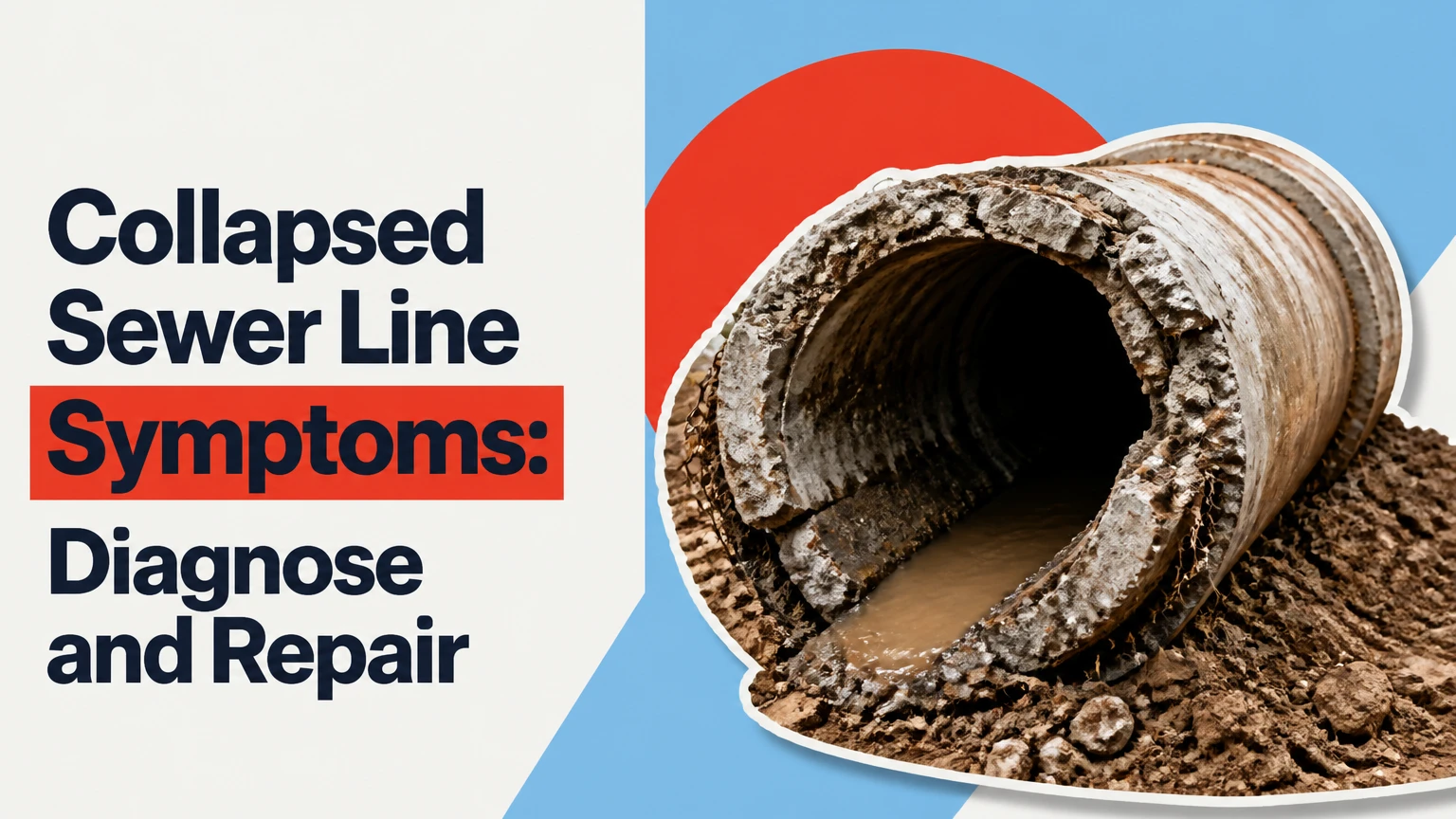
Collapsed sewer line symptoms usually include backups in multiple fixtures, recurring blockages after cleaning, gurgling drains, sewage odors, and unusual wet or sunken ground above the lateral. These signs indicate a possible structural failure, but only a CCTV inspection can distinguish a collapse from roots, a severe clog, a pipe belly, or a broken connection.
Key Facts at a Glance
A main sewer-line collapse commonly affects toilets, tubs, showers, and floor drains at the same time.
A camera inspection identifies the defect, while a sonde locator marks its position and approximate depth.
CIPP lining needs a substantially open, correctly aligned pipe; a fully crushed pipe usually requires excavation or another replacement method.
Typical residential repair costs range from about $3,000 to $20,000 or more, depending on depth, length, access, and restoration.
Stop using water when sewage rises through a lower fixture, because additional flow can move contamination into finished spaces.
A lush lawn patch, odor, or one slow drain can support a diagnosis, but none proves collapse by itself.
What Are Collapsed Sewer Line Symptoms?
The strongest collapsed sewer line symptoms are simultaneous backups at several fixtures, a blockage that quickly returns after professional clearing, and camera evidence of a crushed, fractured, displaced, or obstructed pipe. Outdoor clues include persistent sewage odor, unusually wet soil, a narrow strip of unusually green grass, or a depression along the lateral.
A main lateral carries wastewater from the building drain to a municipal sewer connection or private septic tank. When the lateral fails, wastewater cannot move normally by gravity. The result may be a complete backup, a slow leak into surrounding soil, or alternating drainage and backup as water finds temporary paths through broken sections.
Not every symptom has equal diagnostic value. Multi-fixture backup ranks higher than an odor because a dry plumbing trap can create odor without any underground failure. Likewise, a soggy patch may result from irrigation, groundwater, or a broken water service.
Which Symptoms Point to a Main-Line Problem?
A main-line problem becomes more likely when water use in one fixture produces movement in another fixture located downstream or at a lower elevation. For example, flushing an upstairs toilet that causes water to rise in a basement shower suggests a restriction in shared drainage, not a blocked toilet trap.
| Observation | More likely explanation | Urgency |
|---|---|---|
| One sink drains slowly for 2 hours | Local branch clog | Routine service |
| Two toilets back up together | Building drain restriction | Same-day assessment |
| Toilet flush raises basement shower water | Main lateral restriction | Stop water use |
| Backup returns 7-30 days after cabling | Roots, fracture, belly, or collapse | CCTV inspection |
| Sewage appears at a cleanout | Downstream restriction or failed lateral | Avoid contact |
A single clogged toilet can still be severe, but it does not normally affect unrelated fixtures. The shared-fixture pattern is the more useful homeowner observation.
How Does a Sewer Line Collapse?
A sewer line collapses when pipe deterioration, soil movement, root pressure, traffic loading, or loss of bedding support removes the pipe’s ability to resist external loads. A crack may first leak wastewater into the soil, while soil and gravel enter the pipe; the resulting void then allows the pipe crown or barrel to deform further.
Older clay tile lines can separate at joints. Cast-iron pipe can corrode from the inside and lose wall thickness. Orangeburg, a bitumen-fiber pipe used in some mid-century installations, can deform and flatten as its layers deteriorate.
The failure sequence often looks like this:
- A crack, open joint, root intrusion, or corrosion hole develops.
- Wastewater escapes and carries fine soil away.
- Soil enters through the defect during low-flow periods.
- A void forms beneath or around the pipe.
- Traffic, saturated soil, or overburden deforms the unsupported pipe.
- Broken material creates a restriction that catches paper and solids.
A collapse can be partial. A pipe with a small opening may drain for weeks before a heavy discharge or root mass creates a complete blockage.
What Causes a Sewer Lateral to Fail?
Common causes include aging pipe materials, tree roots, trench settlement, freeze-thaw movement, vehicle loads, poor original bedding, and incompatible repairs. Root intrusion usually enters through joints or cracks; roots do not normally penetrate an intact, properly joined modern plastic pipe.
Pipe age changes the likely defect. Clay lines often develop joint offsets and fractures, while cast iron more commonly presents corrosion, scale, pinholes, and structural thinning. A newer PVC line can still fail after excavation damage, settlement, improper installation, or heavy construction loads.
Is It a Clog or a Collapsed Sewer Line?
A clog often clears fully and remains clear, while a collapsed sewer line produces recurring backups, incomplete cable passage, visible deformation, or debris that returns after cleaning. The distinction cannot be made reliably from drainage speed alone, because a partial collapse and a dense root blockage can behave identically at first.
| Diagnostic clue | Ordinary blockage | Structural sewer failure |
|---|---|---|
| Affected fixtures | One branch or nearby group | Several fixtures throughout building |
| Snaking result | Flow restored for months or longer | Flow returns briefly or not at all |
| Cable travel | Reaches expected distance | Stops at repeatable location |
| Camera image | Grease, paper, or roots in open pipe | Crack, offset, void, crushed wall, or missing section |
| Outdoor evidence | Usually absent | Wet soil, odor, settlement, or sewage discharge |
Hydro-jetting can remove grease and roots, but it cannot rebuild a missing pipe wall or correct a settled section. A cleanout that drains after jetting does not prove the line is sound.
Why Do Clogs Return After Cleaning?
Recurring clogs indicate an unresolved restriction or defect, especially when the same location blocks again within 30-60 days. Roots, pipe scale, a belly that holds solids, and a partial collapse can all cause recurrence.
A useful service record includes the date of clearing, cable distance, water-jet pressure, camera images, defect location, and whether the technician reached the municipal connection. A contractor who recommends replacement without showing the defect location should provide a clearer inspection record before excavation begins.
What Should You Do During a Suspected Collapse?
Stop using toilets, showers, sinks, washing machines, and dishwashers until the drainage path is assessed. Keep children and pets away from sewage, avoid electrical equipment in wet areas, and call a licensed plumber or sewer contractor for an urgent inspection.
Do not pour chemical drain cleaner into a suspected main-line failure. Caustic products do not repair structural damage and can remain in standing wastewater, creating a chemical exposure risk for occupants and technicians.
If an exterior cleanout is accessible, a trained person may loosen the cap slowly with gloves, eye protection, and a container ready for discharge. Do not fully remove a pressurized cap or enter a cleanout. Cleanout location and water level can help a technician, but they do not precisely identify the failure.
Sewage contacting floors, walls, insulation, or porous materials requires prompt sanitation. The U.S. Centers for Disease Control and Prevention recommends protective gloves and boots during floodwater cleanup and advises avoiding contact with contaminated water when possible.
How Is a Collapsed Sewer Line Diagnosed?
A professional diagnosis normally combines fixture testing, cleanout assessment, CCTV inspection, electronic locating, and a review of pipe slope and material. The camera recording should show the defect, its distance from the access point, and the line’s condition upstream and downstream of the apparent failure.
The usual workflow is:
- Restrict water use. The technician confirms whether the backup is active and protects occupied areas.
- Check available access points. Cleanouts, basement drains, toilet openings, and exterior access points provide different views.
- Run a CCTV camera. A push camera or crawler travels through the lateral until it reaches an obstruction or defect.
- Record the defect. The report should identify roots, cracks, offsets, corrosion, standing water, deformation, and pipe material.
- Locate the position. A sonde transmitter and surface locator mark the route, distance, and approximate depth.
- Assess grade. The technician determines whether a belly or reverse slope contributes to repeated blockage.
- Recommend repair. The method should match the pipe profile, access, surface, ownership boundary, and structural condition.
A camera cannot always pass a completely crushed section. In that situation, the contractor may inspect from the opposite direction, use a locator, excavate a test pit, or expose the connection through a targeted opening.
What Does the Cleanout Water Level Tell You?
Standing wastewater in an exterior cleanout usually indicates a restriction between that cleanout and the street or septic tank, while a dry cleanout with an indoor backup may indicate a problem between the building and the cleanout. The result is a directional clue, not proof of collapse.
Cleanout configurations vary. A two-way cleanout may show different water levels on each side of the opening, and a cleanout located upstream of the failure can remain dry while a lower fixture backs up. A plumber should interpret the observation alongside the camera path.
Can a Collapsed Sewer Line Be Repaired Without Digging?
A partially damaged sewer line can sometimes be repaired with pipe bursting or CIPP lining, but a fully flattened, severely offset, inaccessible, or badly sagging line often requires open excavation. Trenchless repair reduces surface disturbance, yet it does not eliminate the need for cleaning, access pits, permits, reconnections, or restoration.
| Repair method | Minimum pipe condition | Typical access | Typical duration | Main limitation |
|---|---|---|---|---|
| Open-cut replacement | Any condition, including full collapse | Continuous trench | 2-5 business days | Lawn, concrete, and tree disturbance |
| Pipe bursting | Cable path through old line | Two pits, often 3-6 feet wide | 1-2 business days | Needs suitable alignment and surrounding clearance |
| CIPP lining | Round or nearly round host pipe | One or two access points | Usually under 24 hours | Cannot correct a flattened pipe or bad grade |
| Spot repair | Localized crack or joint defect | One excavation area | 1-2 days | Does not solve widespread deterioration |
When Is Open-Cut Replacement the Better Choice?
Open-cut replacement is preferable when the pipe has lost its route or slope, when several sections have failed, or when the line is fully crushed. Excavation allows the crew to remove damaged material, rebuild bedding, set the required fall, reconnect branches, and inspect surrounding utilities.
Open-cut work is also practical when a property owner plans other excavation, such as foundation drainage or water-service replacement. The combined project can reduce repeated restoration, although it may increase the immediate construction scope.
When Does Pipe Bursting Work?
Pipe bursting works when a pulling cable or rod can travel through the old alignment and the surrounding soil can accept the expanded replacement pipe. The bursting head fractures the old pipe while pulling HDPE into the created path.
Pipe bursting is often attractive beneath lawns, sidewalks, and driveways because it uses access pits rather than a continuous trench. It may be unsuitable near fragile utilities, shallow foundations, severe offsets, or locations where expansion could damage adjacent infrastructure.
Can CIPP Lining Fix a Fully Collapsed Pipe?
CIPP lining generally cannot fix a fully collapsed sewer pipe because the liner needs an open path and enough circular profile for installation and curing. CIPP can repair cracks, leaking joints, corrosion, and some deformation when cleaning equipment and the liner can pass through the host pipe.
CIPP also leaves the existing route and grade unchanged. If the original line contains a deep belly, the liner may create a smoother surface while wastewater still ponds at the low point. Lining repairs the wall, not the geometry.
How Much Does Sewer Line Repair Cost?
Typical residential sewer-line repair costs range from $3,000 to $20,000 or more, with open excavation often costing $50-$250 per linear foot, pipe bursting about $60-$200 per foot, and CIPP about $80-$250 per foot. Local labor, depth, street access, permits, and restoration can change the total substantially.
| Cost component | Typical range | Main price driver | Often included |
|---|---|---|---|
| CCTV inspection | $100-$500 | Access and report detail | Camera recording and diagnosis |
| Open-cut replacement | $3,000-$10,000 | Length, depth, surface | Pipe, trench, backfill |
| Pipe bursting | $5,000-$13,000 | Length and pit access | HDPE installation and pits |
| CIPP lining | $4,000-$20,000+ | Diameter, length, preparation | Resin liner and curing |
| Concrete or street restoration | $2,000-$5,000 | Surface area and jurisdiction | Saw cutting and patching |
| Permits and utility locating | $150-$600 | Municipality and project scope | Permit processing or marking |
These are typical planning ranges, not a bid. A 40-foot line under a lawn may cost less than a 15-foot line beneath a reinforced driveway because restoration and traffic control can dominate the estimate.
How Long Does Sewer Replacement Take?
Trenchless installation often takes one to two business days, while open-cut replacement commonly takes two to five business days before restoration. A complete project can last longer when permits, utility conflicts, contaminated soil, concrete curing, weather, or municipal inspections delay the work.
Ask whether the stated duration covers only pipe installation or also backfill, inspection, surface repair, and branch reconnection. A one-day liner installation does not mean the entire property is restored that same day.
Which Repair Method Fits Your Property?
The best repair method depends on structural condition first, then access, surface, pipe grade, and budget. Pipe bursting often fits a partially collapsed line under a lawn, CIPP suits an open and correctly graded pipe beneath hardscape, and excavation remains the dependable choice for a crushed or badly settled line.
| Property situation | Preferred starting option | Why it fits | Required confirmation |
|---|---|---|---|
| Partial collapse under grass | Pipe bursting | Limited surface restoration | Cable path and utility clearance |
| Cracks beneath driveway | CIPP lining | Avoids continuous concrete trench | Open profile and acceptable grade |
| Full collapse beneath patio | Open cut or targeted pits | Liner cannot pass crushed section | Excavation depth and access |
| Historic clay line with belly | Open-cut replacement | Restores slope and bedding | Grade survey or exposed pipe |
| Line near gas or water utilities | Spot repair or open cut | Controlled excavation reduces expansion risk | Utility marks and engineering review |
A contractor should explain why the rejected methods cannot work. “Trenchless” is not automatically better if the line has a reverse grade, inaccessible branch connections, or a structural void that needs soil correction.
What Problems Are Commonly Missed?
A sewer backup can involve more than one defect. Root removal may reveal a separated joint, and a collapse may coexist with a belly, corroded cast iron, or an unapproved branch connection.
The most frequently missed problems include:
- A sewer belly: A settled section holds water and solids, producing repeat blockages without a crushed pipe.
- An offset joint: One pipe section shifts out of alignment, leaving an edge that catches paper.
- A private lateral boundary: The homeowner’s responsibility may end at a municipal tap, but local ordinances control the exact point.
- A failed septic component: On private systems, a full tank, blocked outlet, or collapsed line to the tank can mimic a public sewer backup.
- A dry trap: Sewer odor may come from evaporation in an unused floor drain rather than a lateral leak.
- Stormwater cross-connection: Downspouts and footing drains can overload a sanitary line during rain where illegal connections exist.
Foundation cracks and sinkholes deserve prompt assessment, but they are not specific to sewer failure. Groundwater, poor compaction, retaining-wall movement, and leaking water mains can produce similar settlement.
What Mistakes Make Sewer Damage Worse?
Repeatedly clearing a structural defect, using chemical cleaners, and authorizing excavation without a camera record create avoidable cost and safety problems. A homeowner should request the inspection video, defect distance, surface location, pipe material, and recommended repair limits before approving replacement.
Mistake 1: Treating Every Backup as a Local Clog
A plunger may resolve a toilet obstruction, but it cannot address a backup that affects a shower and floor drain. Stop testing by repeatedly flushing when sewage is already rising.
Mistake 2: Accepting a Temporary Flow Restoration
A cable that restores drainage for three weeks may have opened a narrow channel through roots or debris. Ask whether the technician observed the pipe with a camera after clearing.
Mistake 3: Choosing Lining Without Checking Grade
A cured liner follows the host pipe’s existing geometry. A liner placed through a deep belly can leave the cause of recurring solids accumulation untouched.
Mistake 4: Ignoring Ownership Boundaries
The private lateral often runs from the building to a municipal tap, but cities differ on responsibility under sidewalks, streets, and easements. Contact the sewer utility before work reaches the public main.
Mistake 5: Omitting Service-Line Insurance
Standard homeowners policies commonly exclude gradual deterioration and maintenance, while optional service-line endorsements may cover excavation and replacement for qualifying causes. Review the policy before an emergency, because coverage, exclusions, waiting periods, and claim documentation vary.
What Should You Ask Before Hiring a Contractor?
Ask for a written diagnosis that connects the camera finding to the proposed repair. The quote should identify the affected linear footage, pipe diameter, material, depth, access method, restoration responsibility, permit costs, warranty, and municipal coordination.
Use this verification list:
- Can the contractor provide the complete CCTV recording?
- Where is the defect measured from, and how was it located above ground?
- Is the defect a clog, root intrusion, crack, offset, belly, partial collapse, or full collapse?
- Can the camera pass beyond the defect?
- Does the recommended method correct the pipe’s grade?
- Are branch connections included in the price?
- Who handles permits, inspection, backfill, concrete, asphalt, and landscaping?
- What happens if the crew finds a second failed section?
- Does the warranty cover infiltration, separation, and liner failure?
- Has the municipal utility confirmed the private-public boundary?
A low bid that excludes restoration or branch reconnection is not directly comparable with a complete replacement proposal.
How Can You Prevent Another Sewer Failure?
Preventive measures reduce risk but cannot reverse aging pipe. Keep grease, wipes, paper towels, and sanitary products out of drains, manage large trees near old clay or Orangeburg laterals, and obtain a camera inspection before buying an older property or adding a building extension.
Ask a plumber about a preventive inspection when a home has cast iron, clay, Orangeburg, repeated root cutting, or a history of backups. Annual jetting may control roots in some lines, but recurring service without structural assessment can postpone the necessary replacement while the pipe continues to deteriorate.
Do not plant large-rooted trees directly over a sewer route. Maintain cleanouts so the lateral can be inspected without removing fixtures, and keep records of every repair, camera run, and root-treatment visit.
Frequently Asked Questions
Can heavy rain cause a sewer line to collapse?
Heavy rain does not usually crush an intact sewer lateral, but saturated soil can reduce bedding support and increase external pressure around a weakened pipe. Rain can also expose an existing defect by increasing infiltration, overloading a combined system, or raising groundwater around a cracked line.
Will homeowners insurance pay for a collapsed sewer line?
Homeowners insurance often excludes wear, corrosion, roots, and gradual deterioration, while service-line coverage may cover certain sudden physical failures and associated excavation. Coverage depends on policy language, exclusions, deductible, cause of loss, and whether the failed section is privately owned.
Do tree roots mean the sewer pipe has collapsed?
Tree roots prove that moisture or an opening exists, not that the pipe has collapsed. Roots commonly enter cracked joints and can create a severe blockage while the pipe remains structurally round. CCTV imaging is needed to distinguish root intrusion from deformation or missing pipe.
Can I live in a house while the sewer line is repaired?
Many occupants can remain during a short exterior repair if the contractor provides temporary water-use restrictions and keeps contaminated areas isolated. Occupancy may be unsafe when sewage has entered living spaces, electrical systems, HVAC components, or porous building materials.
Is a sewer-line replacement tax deductible?
A routine residential sewer repair is generally a maintenance expense rather than an automatic federal tax deduction, but rules vary for rental property, business use, casualty losses, and capital improvements. Consult a qualified tax professional and retain invoices, permits, inspection records, and insurance documents.
The Bottom Line
The most persuasive collapsed sewer line symptoms are multi-fixture sewage backups, repeat blockages after clearing, and a CCTV image showing structural deformation or a missing pipe section. Stop using water, avoid chemical cleaners, and obtain a recorded camera inspection with electronic locating before approving excavation.
Choose open-cut replacement for a fully crushed or badly settled line. Choose pipe bursting when the alignment and surrounding utilities permit expansion. Choose CIPP only when the host pipe remains open and adequately graded.
Collapsed sewer line symptoms identify risk, not the final repair. The camera finding, pipe grade, property surface, ownership boundary, and restoration scope determine the defensible solution.